
Breaking Into Offline Retail: From Buyer Meetings to Your Proposal
Breaking into offline retail is a three stage process: you prepare with shelf research (planograms) and proof from your online sales, you win over the buyer with a proposal and a meeting, and then you protect your shelf spot with weekly performance tracking. Getting listed is the start, not the finish. Keeping the shelf is the harder part.
This is part 3 of our Channels and Business Models series. Catch up on part 1, our map of Korea's retail channels and part 2 on your own store vs. marketplaces.
In parts 1 and 2, we mapped Korea's retail channels and looked at how to balance your own store with marketplaces. Part 3 covers a channel many brands want to get into but find difficult: the practical process of getting into offline retail.
From specialty chains like Olive Young (Korea's best known health and beauty chain) to convenience stores, department stores and hypermarkets, offline is where customers touch and experience your product in person, and simply being on the shelf is social proof (see Marketing Strategy Basics part 1). But you can't get there with a few clicks the way you can online. Buyer meetings, proposals, fee negotiations, the competition for shelf space: there's a lot to know.
A quick note on terms: in Korea, the retail buyers who decide what goes on the shelf are called MDs (short for merchandisers). We'll call them buyers here.
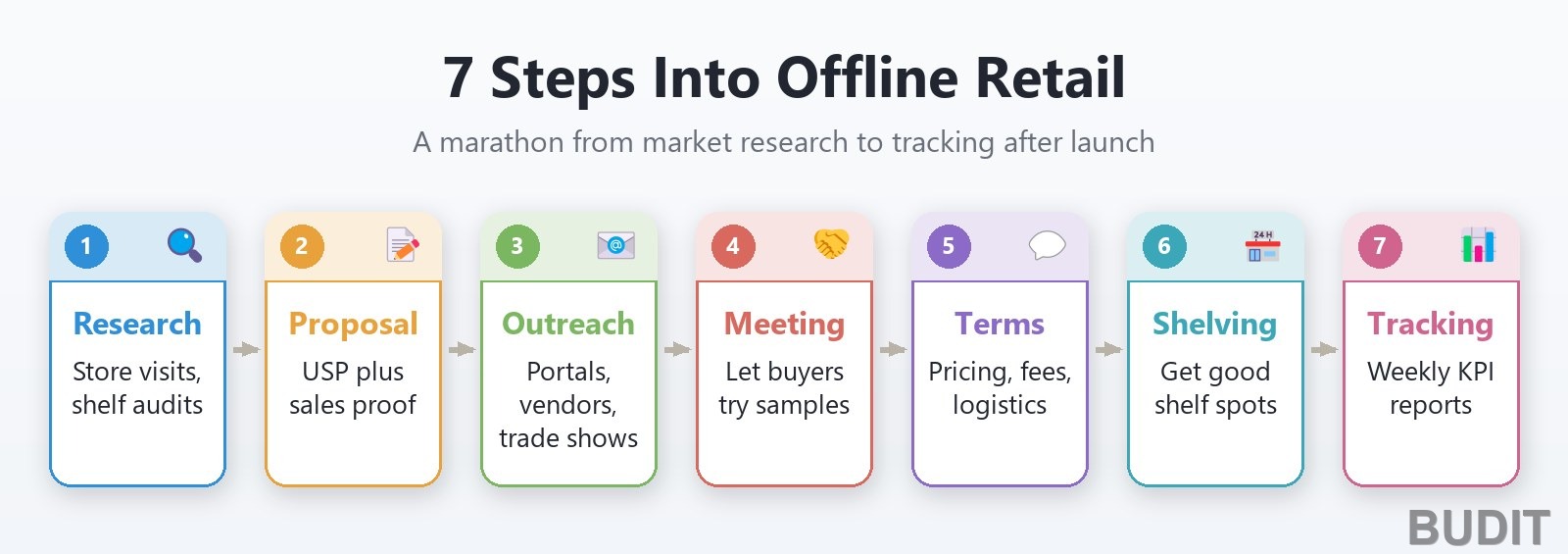
Offline retail takes time: a seven step process from market research to tracking after launch
1. Before You Pitch: What to Do Before Sending a Proposal
A mistake many brands make is sending a proposal right away. Before you write one, read the shelf and the market first.
Planogram research: reading the shelf
A planogram (POG) is a store's shelf layout. Whether you're aiming for Olive Young or convenience stores, visit real stores and see how your category's shelves are set up. Which brands take up how much space (their facings)? What price range are competitors in? Is there an empty spot, which is to say, an opening?
This is the offline version of the segmentation and positioning work from Marketing Strategy Basics part 1. Online, you analyze the competition through keywords. Offline, you look at the shelf.
Proof from online sales: the numbers that win buyers over
For a buyer, putting a new product on the shelf means pulling an existing one, and a bad call means lower sales. That's why data showing your product already sells online carries weight.
Monthly sales from your own store and Naver Smart Store (Naver's storefront service for sellers), social followers and engagement rates, review counts and ratings, search trend data: numbers like these show that your product is already getting traction. The first party data from your own store that we stressed in part 2 of this series comes into play here.
Quick tip: a checklist before you contact a buyer
- Visit several stores in your target channel in person and finish your planogram research.
- Pull together your online sales data from the last few months (with a monthly trend chart).
- Spell out how you differ from competing products on price, ingredients, and design.
- Summarize your customer reviews (the share of positive reviews and the words that come up most).
- Gather your social marketing results (influencer collaborations, content that performed well).
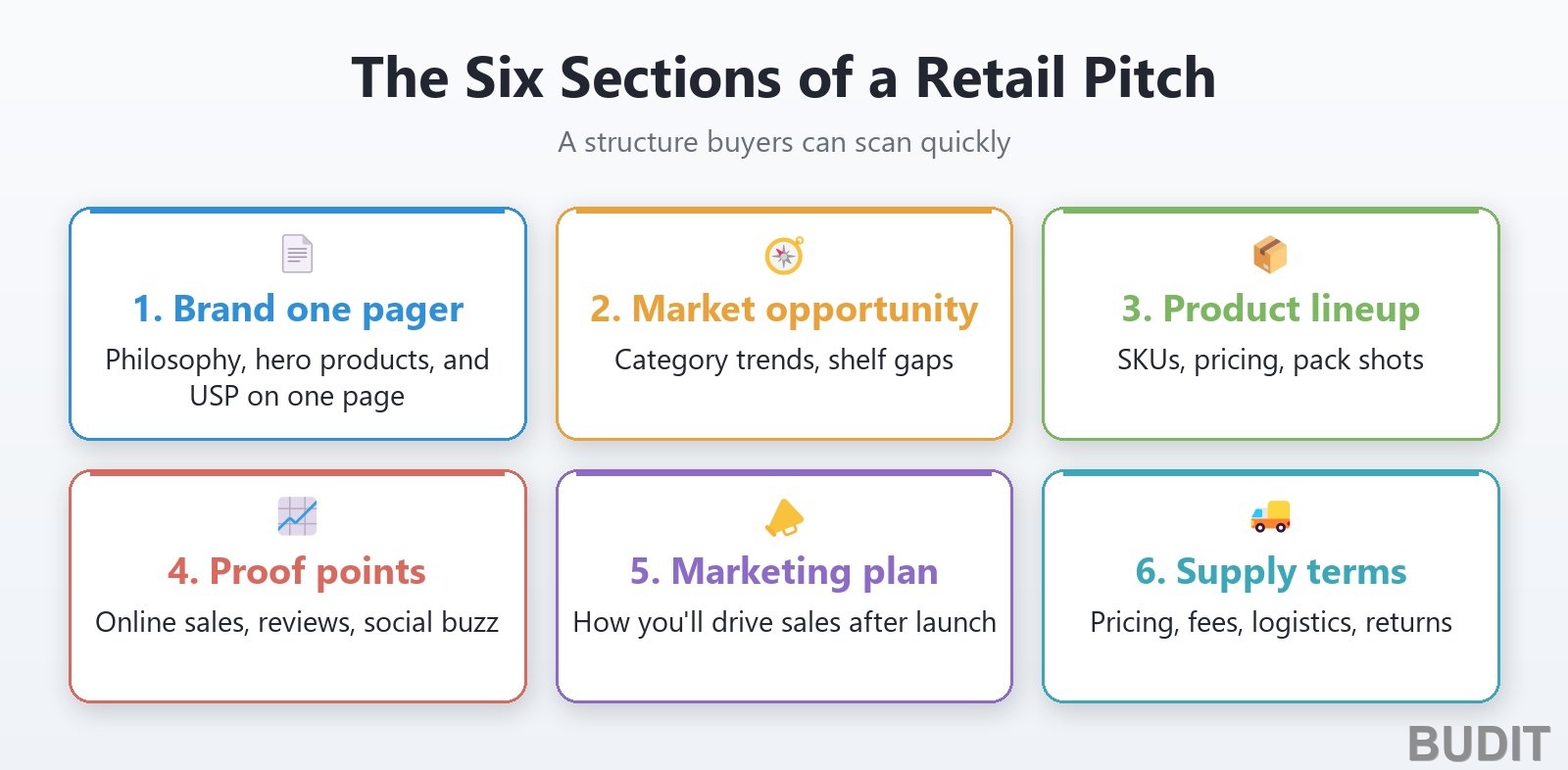
Build your retail proposal in six sections
2. The Proposal and the Buyer Meeting: Designing a First Impression
Your proposal is a first impression
Buyers receive a lot of proposals. The email subject line and the first page shape whether they read to the end, so put the essentials up front and make the proposal easy to scan.
Build your proposal around these six sections.
- A brand one pager: your brand philosophy, hero products, and USP on a single page. The USP from Marketing Strategy Basics part 1 becomes your headline here.
- Market analysis and opportunity: where your category is heading and the current gaps on the shelf (your opening), backed by data. This is where your planogram research from step one goes.
- Your product lineup: the SKUs you're proposing, price points, and packaging images. Take care with product photos so they show your brand's look and feel.
- Proof points: online sales, reviews, social buzz, anything that shows your product is already selling.
- A marketing plan: a concrete plan for driving sales after launch, such as influencer campaigns, social ads, and promotions in the store. It shows the buyer you'll keep working to sell once you're on the shelf.
- Supply terms: wholesale pricing, fee structure, logistics capacity, and return policy.
How to reach buyers
- Go direct. Check whether your target retailer's website has a channel for product listing inquiries. Olive Young's corporate site (corp.oliveyoung.com) has a product listing inquiry menu.
- Work with a vendor. In Korea, specialist distributors known as vendors can help you get listed. Their buyer networks help, but they take a margin. Early stage brands without retail experience can start with a vendor and move to direct trade later.
- Go to trade shows. Industry shows in areas like beauty and food are another place to meet buyers in person.
As you write your proposal, think from the buyer's side. Buyers welcome brands that will keep building sales with them after launch. Don't just say "our product is great." Show how you'll deliver results together in their channel.
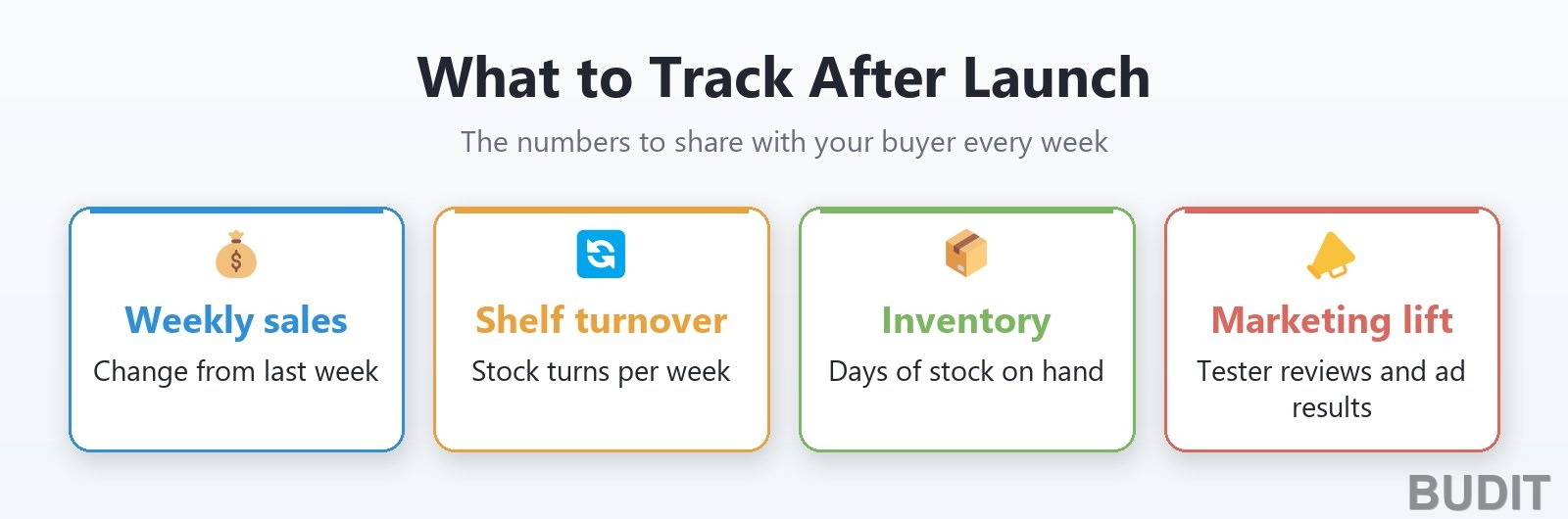
Getting listed is only the beginning. Tracking performance after launch is the key to keeping your shelf spot.
3. After Launch: Keeping the Shelf
A common misconception in offline retail is that once you're in, you're done. Getting listed is the start, and holding onto the shelf is harder. Products that don't perform have a hard time keeping their spot.
Managing sales performance
How a product sells in its first weeks can affect how visible it is later and what other opportunities come up. Prepare a marketing push for launch in advance, such as influencer reviews, product tester programs, and a first purchase offer.
Keeping buyers in the loop
Your conversations with the buyer should keep going after launch. Share a weekly summary of sales, inventory, and marketing results. When a buyer sees your brand as well managed, it's easier to talk about featured promotions, more SKUs, and better shelf placement.
The performance management built on KPIs from Marketing Strategy Basics part 5 applies offline just the same. The main metrics are weekly sales, shelf turnover (how fast your stock sells), average order value, and repeat purchase rate.
Connecting online and offline marketing
An offline listing works better when it moves together with your online marketing. "Available at Olive Young" adds credibility to your online marketing, and interest built online can bring people into stores.
Final Thoughts
Breaking into offline retail is a long process in three stages: prepare, pitch, and manage.
- Prepare: planogram research and proof from your online sales (everything you built up across the Marketing Strategy Basics series)
- Pitch: a proposal where your USP comes alive, and a partnership mindset with the buyer
- Manage: weekly KPI tracking and marketing that connects online and offline
Pick your target channel from the map in part 1, build up your online data through your own store in part 2, then use the process in part 3 to move offline. That's the flow of this series.
Starting with part 4, we look at marketing strategy by business model (B2C, B2B, and B2B2C). The same product needs different channels, messages, and funnels depending on who you're selling to.
Work with Budit
If you're getting ready for offline retail, get in touch with Budit.
Need search trend data for your proposal? You can check it with ViewVibe's Naver Trends tool (sign in required).
References
- CJ Olive Young corporate site, corp.oliveyoung.com (in Korean): product listing inquiries and partnership proposals
- This series: part 1, our map of Korea's retail channels · part 2, your own store vs. marketplaces
- The Marketing Strategy Basics series: part 1, STP and USP · part 2, performance marketing · part 3, conversion rate optimization · part 4, customer journey maps · part 5, GA4 and KPIs · part 6, growth hacking and AARRR