


Where Should You Sell? A Map of Korea's Retail Channels
A retail channel is where your product meets its customers. In Korea, channels split into online (general marketplaces, vertical platforms and your own store) and offline (department stores, hypermarkets, convenience stores and category killers). You pick among them based on your target customer, category norms, margin structure and brand positioning.
This is part 1 of our Channels and Business Models series, which looks at where and how to sell. We covered the marketing fundamentals earlier in our Marketing Strategy Basics series.
In Marketing Strategy Basics, we covered who to sell to (STP), how to get the word out (performance marketing) and how to convert (CRO). This series takes on the next question: where to sell.
Even with a great product and a solid marketing strategy, the wrong channel makes it hard to reach your target customers. Coupang's Rocket Delivery, Naver Smart Store's tie in with search, specialty chains like Olive Young: every channel plays by its own rules.
In this post we'll map Korea's retail channels, look at what each one is like, and cover how to choose the ones that fit your product.
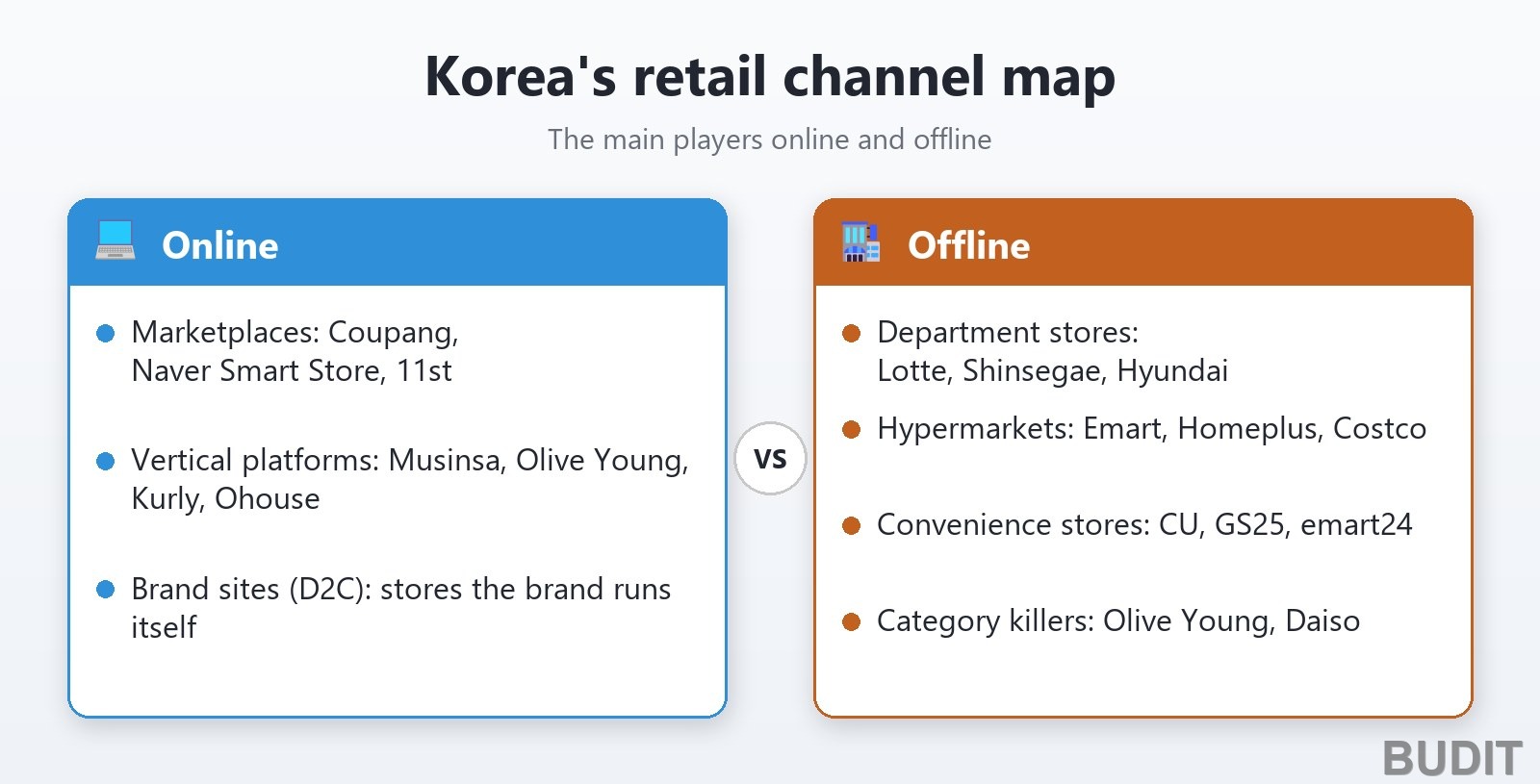
Korea's retail channels at a glance: the main players online and offline
1. Online Channels: From Search to Checkout
Online retail in Korea falls into three groups: general marketplaces, vertical platforms (specialty stores) and your own store (D2C).
General marketplaces: Coupang, Naver Smart Store and 11st
Coupang is one of Korea's leading ecommerce platforms, and its own logistics network, Rocket Delivery, is its biggest strength. According to Coupang's marketplace guide, sales commissions range from 4% to 10.9% depending on the category. Before you sign up, also check the payout schedule and any additional costs.
Naver Smart Store, the storefront service run by the Korean search portal Naver, has one big advantage: listings are tied into Naver Shopping search results. From June 2, 2025, Naver changed its fee structure for Smart Store sellers, dropping the traffic referral fee and charging a sales commission instead. Rates depend on how the sale came in and on your terms, so check the seller center for the current figures. Compared with your own store, you get less access to customer data and less control over how your page looks.
11st is another major Korean general marketplace.
Vertical platforms (specialty stores)
These platforms focus on a single category, which is where shoppers with a strong interest in that category gather.
- Fashion: Musinsa, Zigzag, W Concept and Ably
- Beauty: Olive Young's online store
- Food: Kurly and Oasis Market
- Home and interiors: Ohouse (Today's House)
The appeal of vertical platforms is that their shoppers are already interested in the category. Seen through the segmentation lens from part 1 of Marketing Strategy Basics, you're entering a market that has already been segmented, which makes targeting easier.
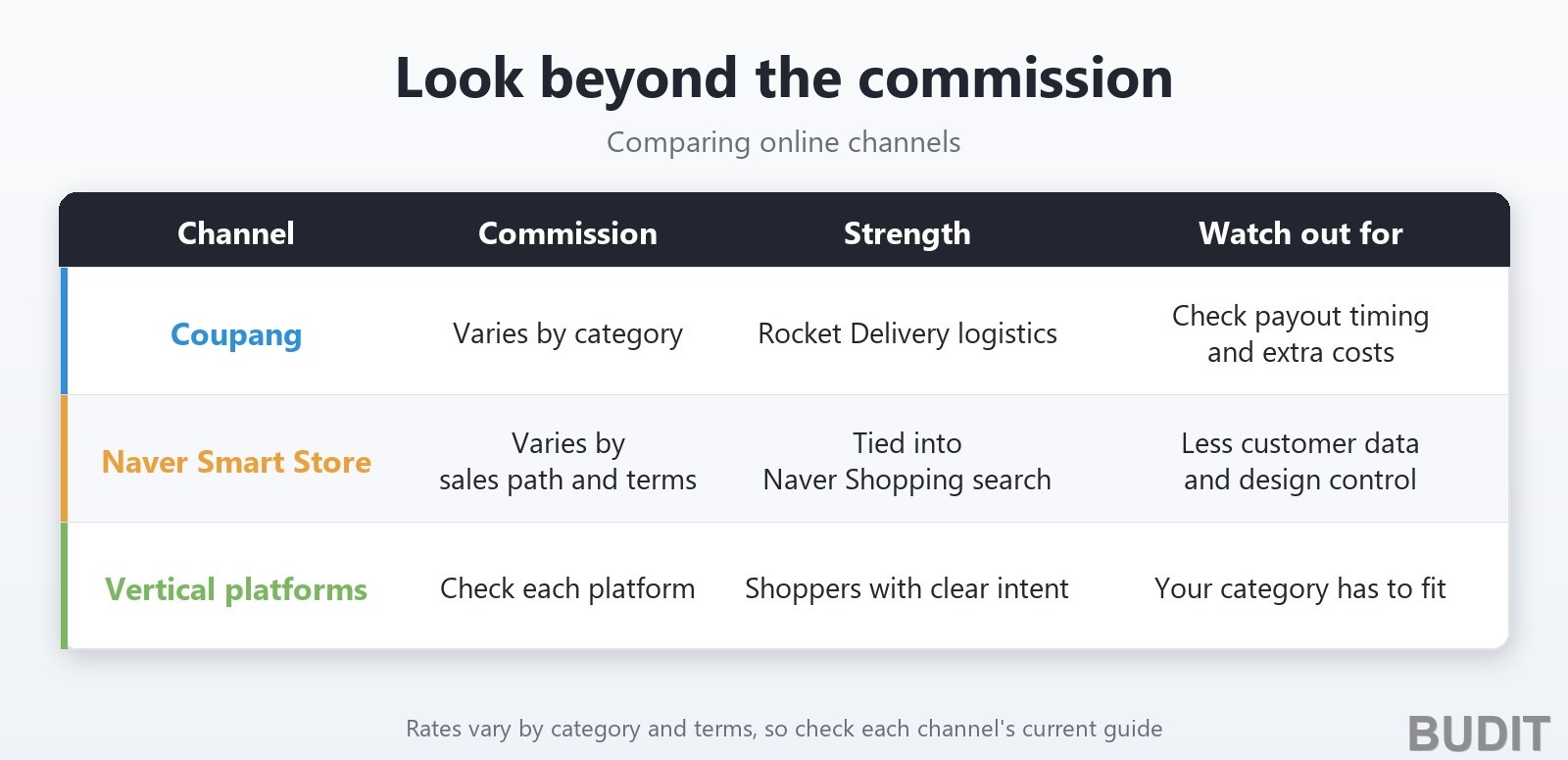
Don't just compare commissions. Look at payout timing, customer data and how products get surfaced.
2. Offline Channels: Where Customers Touch and Try
Online shopping has grown, but some shoppers still want to see a product in a store before they buy. In categories where trying or tasting matters, such as beauty, food and consumer electronics, offline touchpoints play a big role.
Department stores: the premium channel
Lotte, Shinsegae and Hyundai are the big three. You'll need to weigh the entry terms and fees carefully, but simply being carried by a department store builds brand credibility. It's the kind of social proof we talked about in part 1 of Marketing Strategy Basics. Department stores suit high end products and premium brands.
Hypermarkets: the everyday goods channel
Emart, Homeplus and Costco are the main players. Many of their customers buy in bulk, so you'll need competitive pricing and a reliable supply to get in. Fees vary by category and contract terms.
Convenience stores: everyday touchpoints
Convenience store chains like CU, GS25 and emart24 reach customers in almost every neighborhood. Small pack sizes, collaborations and limited editions are common plays, and in food and beverages, products made only for convenience stores can be a strong marketing tool.
Category killers: Olive Young and Daiso
Olive Young, Korea's best known health and beauty chain, is a key touchpoint in the shopper's exploration journey, since its stores are where people compare and try products (see part 4 of Marketing Strategy Basics). Daiso is a budget household goods chain that also sells beauty and food products.
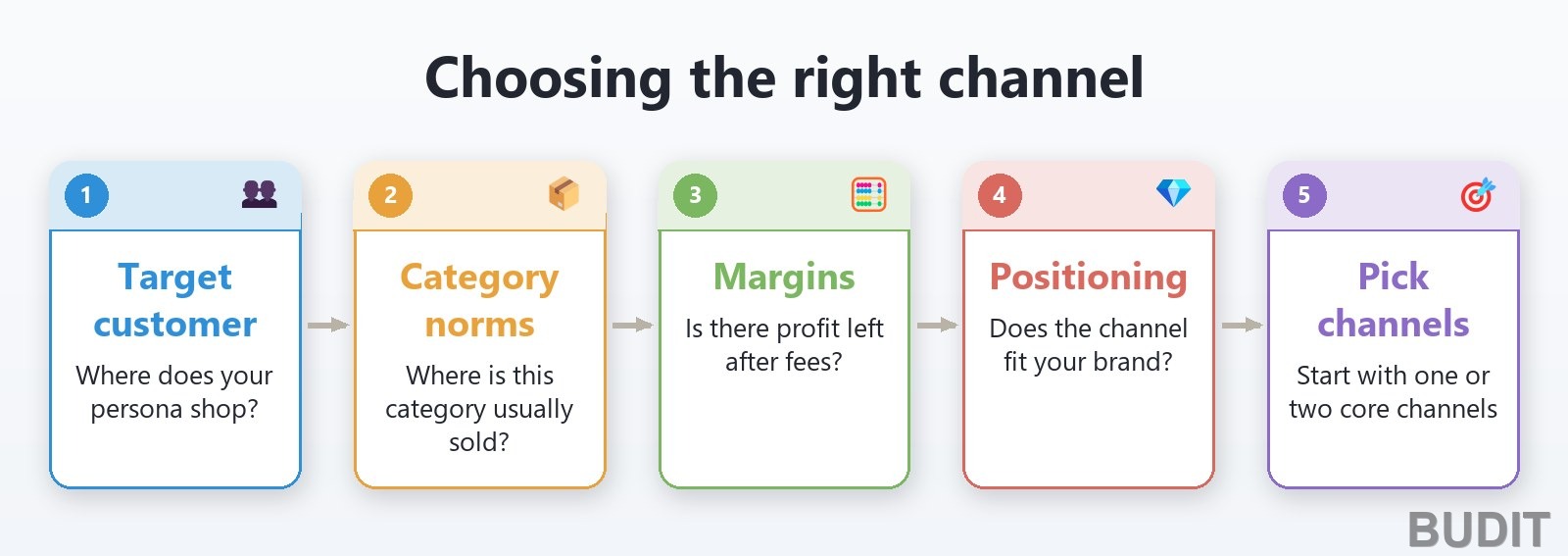
Which channel fits your product? A decision framework for choosing channels
3. Choosing Your Channels: How to Find the Right Fit
"Why not just sell on the biggest platform?" Plenty of early founders think this way. But the right channel depends on your product, your target customer, your margins and your brand strategy.
Four criteria for choosing a channel
- Where are your target customers? Figure out which channels the persona you defined in part 1 of Marketing Strategy Basics actually uses. If your persona mostly shops on specialty sites, start there. If they buy everyday essentials in one place, start with a general marketplace.
- What are the norms in your category? Fashion usually lives on vertical platforms, everyday essentials on general marketplaces, and premium food on specialty grocery sites or in department store food halls. Go against those norms and you risk clashing with what shoppers expect.
- Can your margins take it? A channel with high fees only works if your cost structure can absorb them. To avoid ending up with plenty of sales and nothing left over, run a profit and loss simulation that includes each channel's fees before you commit.
- Does it fit your brand positioning? This is where the positioning strategy from part 1 comes in. A premium brand in a discount store weakens its image, and a value brand sold only in department stores will struggle to reach its target customers.
Quick tip: how to approach your first channels.
- Don't try to get into every channel at once.
- Focus on one or two core channels, build results there, and then expand.
- When people and budget are limited, you're better off concentrating on your main channel.
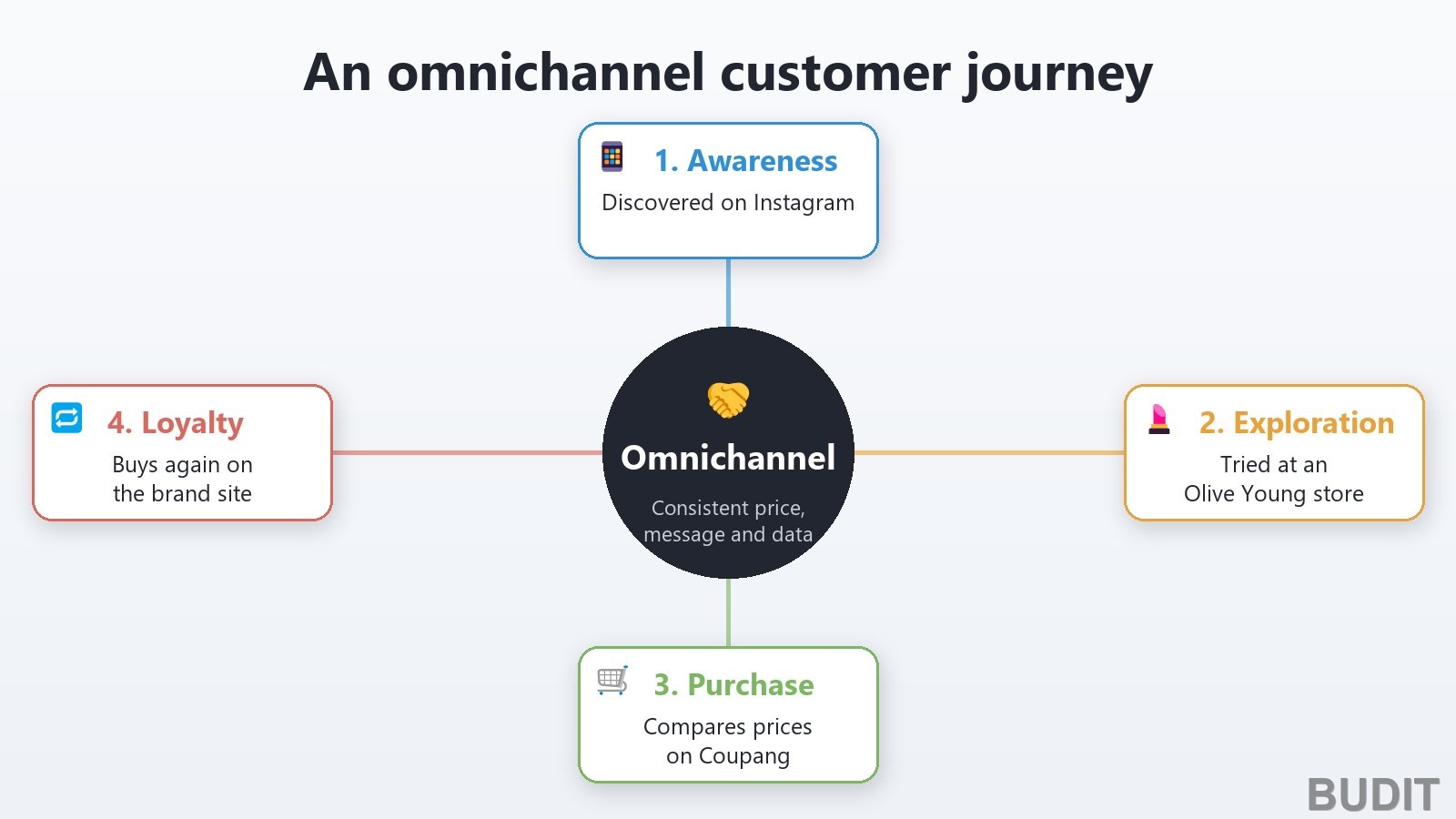
Omnichannel connects online and offline, so the customer experience flows across channel boundaries.
4. Omnichannel Strategy: Connecting Online and Offline
Retail is no longer just a choice between online and offline. A shopper might discover a product on Instagram, try it at Olive Young, compare prices on Coupang and reorder from the brand's own site. Omnichannel strategy is about turning that path into one consistent experience.
Three things to keep consistent
- Pricing: if prices vary widely from channel to channel, shoppers get confused and only buy wherever it's cheapest. Run promotions separately by channel, but keep your base pricing policy the same everywhere.
- Messaging: the USP from part 1 of Marketing Strategy Basics should come through the same way on every channel. Your Coupang product page, your shelf displays at Olive Young and your Instagram ads should share the same tone and core message.
- Data: track online performance by channel with GA4 and UTM tags from part 5 of Marketing Strategy Basics, and look at it alongside offline data (POS sales, surveys of store visitors and so on) to see the full customer journey.
Whatever the channel, you're ultimately providing a service to your customers. Channels are the means. The goal is the smooth customer journey we designed in part 4 of Marketing Strategy Basics.
Wrapping Up
Choosing retail channels isn't just a decision about where to list. It's an extension of your marketing strategy. Here's how it connects to the Marketing Strategy Basics series:
- STP from part 1 → choose channels where your target customers are
- Positioning from part 1 → choose channels that fit your brand image
- Performance marketing from part 2 → your ad strategy changes by channel
- The customer journey from part 4 → design the links between channels as an omnichannel experience
In part 2, we look at your own online store versus marketplaces, and the pros and cons of D2C and marketplace strategies.
Work with Budit
If you'd like to think through which channels and which channel mix suit your product, get in touch with Budit.
Want to see what competing products sell for first? ViewVibe's price scanner lets you compare competitor prices (sign in required).
References
- Coupang Marketplace, "Coupang Fees Explained" (in Korean): sales commissions of 4% to 10.9% by category
- Byline Network, "Why Naver Plus Store Is Changing Its Fee Structure" (March 4, 2025, in Korean): traffic referral fee dropped and a sales commission charged from June 2, 2025
- The full Marketing Strategy Basics series: part 1, part 2, part 3, part 4, part 5, part 6