
Win Both Sides of the Market: B2B2C Marketing Strategy
B2B2C (business to business to consumer) is a model where a company gives partner businesses (B) a platform, solution or infrastructure, and delivers value to end consumers (C) through those partners. The heart of it is marketing to a two sided market, keeping both customers, partners and consumers, happy at the same time.
This is part 6, the final installment of our Channels and Business Models series. Catch up on part 1 on Korea's retail channel map, part 2 on your own store versus marketplaces, part 3 on breaking into offline retail, part 4 on B2C marketing and part 5 on B2B marketing.
We covered B2C in part 4 and B2B in part 5. In the real world, though, plenty of businesses are a mix of both.
Baemin (Baedal Minjok), a Korean food delivery app, gives restaurants (B2B) a platform while offering delivery ordering to consumers (B2C). Kakao Gift, the gifting service inside the Korean messenger KakaoTalk, gives sellers a sales channel and gives users a way to send gifts. Toss, a Korean fintech app, works with financial institutions while offering financial services to individual users. That's B2B2C (business to business to consumer): reaching end consumers through business partners.
The difficulty with B2B2C is that you have to satisfy two different kinds of customers at once. In this post, we'll look at how to market in a two sided market like this.
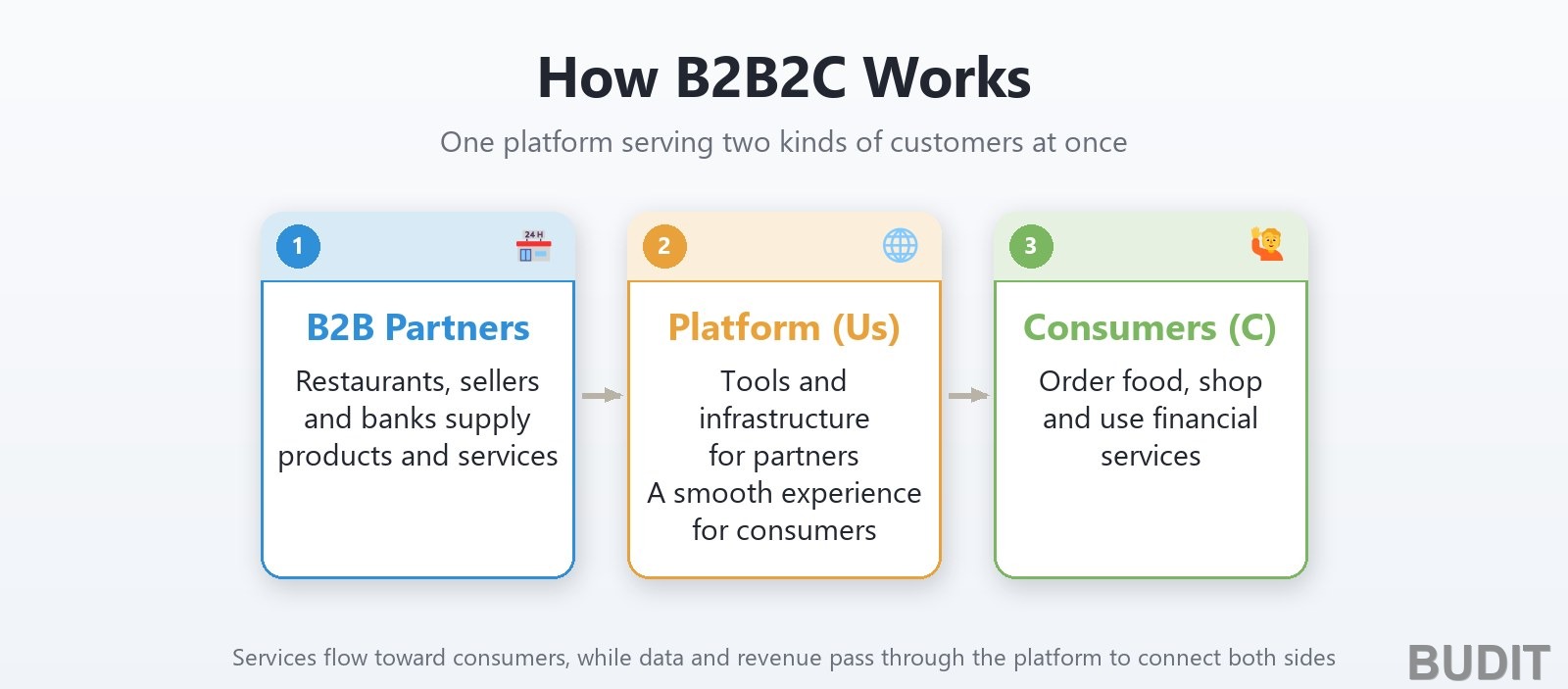
The B2B2C structure: a platform that connects two customers, partners and consumers, at the same time
1. Understanding B2B2C: The Logic of Two Sided Markets
What is B2B2C?
B2B2C is a business model in which a company provides a platform, solution or infrastructure to intermediary partners (B2B) and delivers value to end consumers (C) through those partners.
How it differs from pure B2B: In B2B, the deal is done once you sell to a business customer. In B2B2C, you also look after the experience of the end consumers who sit beyond that business customer.
How it differs from pure B2C: B2C sells directly to consumers. In B2B2C, you can't reach consumers without your partners in the middle.
Examples of B2B2C
- Baemin: it gives restaurants (B) tools to manage orders and gives consumers (C) a way to order delivery. The platform looks after satisfaction on both sides.
- Kakao Gift: it gives sellers (B) a sales channel and gives shoppers (C) a way to send gifts. KakaoTalk, the messenger itself, is the touchpoint with consumers.
- Amazon: Amazon says independent sellers account for more than 60% of sales in its store. It offers sellers a marketplace and consumers a single place to buy many kinds of products, which makes it a B2B2C structure.
- Fulfillment services: they provide sellers (B) with logistics infrastructure such as storage, packing and shipping, so the sellers' customers (C) get fast delivery. It's a B2B service, but consumers are the ones who feel the final value.
From the STP perspective in part 1 of our Marketing Strategy Basics series, B2B2C means segmenting twice. You define one set of segments for your partners and another for end consumers, then design a USP that works for both.
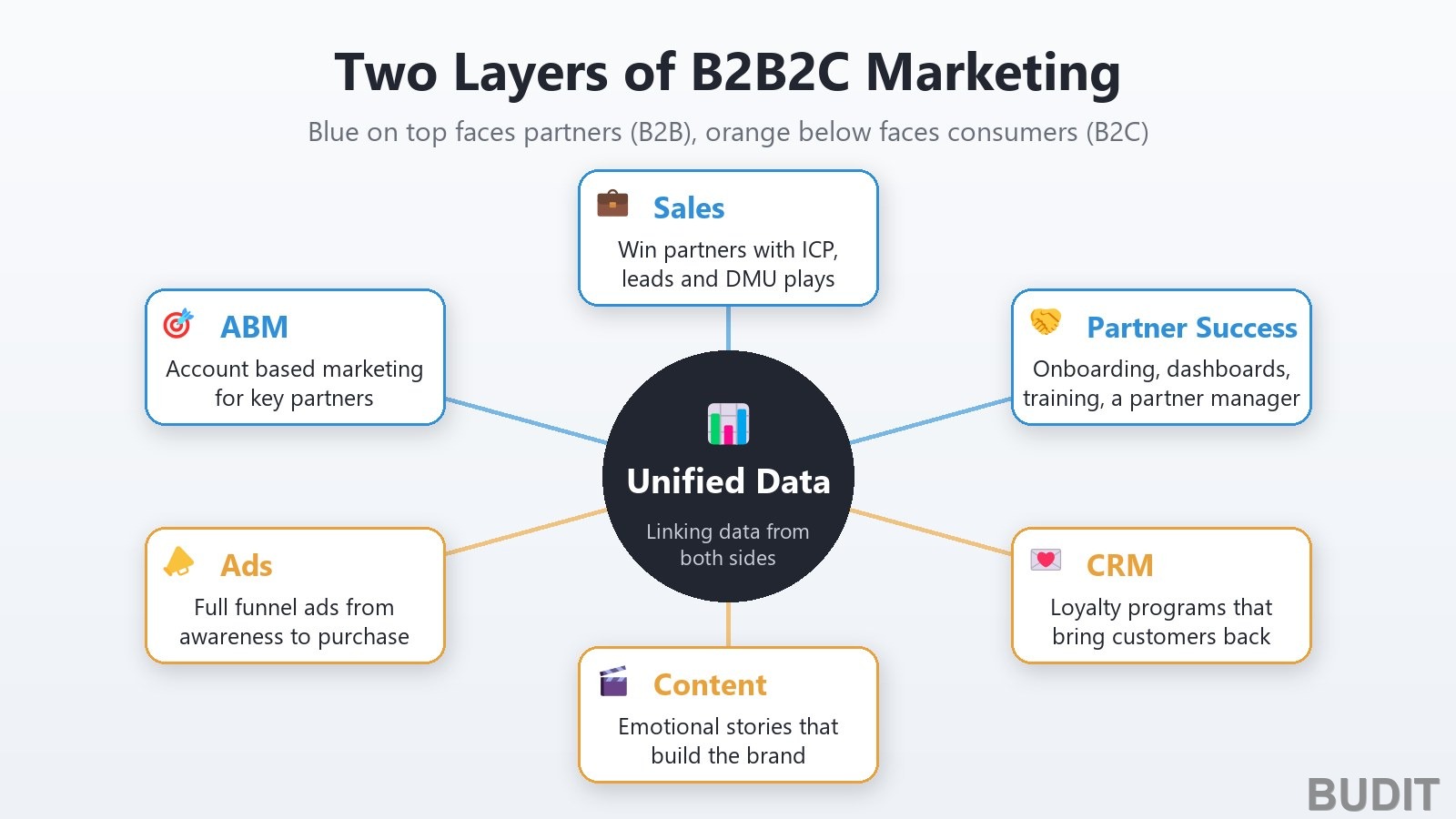
A multilayer strategy that runs B2B and B2C marketing side by side
2. Multilayer Marketing: Approach Partners and Consumers Separately
B2B2C marketing starts from one realization: a single message rarely wins over two different customers. Partners (B2B) and consumers (B2C) have different concerns, decision structures and preferred channels, so you need to run two marketing strategies in parallel.
The B2B layer: signing partners and helping them succeed
Signing partners follows the B2B playbook from part 5: defining your ICP, generating leads, winning over the DMU and building a sales pipeline.
B2B2C adds partner success on top. It isn't enough to get partners onto your platform. The platform grows when partners do well on it, so a partner's results are also the platform's results. For example, CJ Olive Young, which runs Korea's best known health and beauty chain, announced that 116 brands reached at least 10 billion won in annual sales at Olive Young in 2025. (We covered how to get into Olive Young in part 3.)
The main tactics:
- A partner onboarding program (guiding partners from sign up to their first results)
- A performance dashboard (so partners can see their own data)
- Partner education content (webinars, guides and shared success stories)
- A dedicated partner manager (or customer support contact)
The B2C layer: designing the end consumer experience
On the consumer side, you follow the B2C playbook from part 4: emotional appeal, a full funnel approach and systems that build loyal customers.
What matters especially in B2B2C is that consumers are your partners' customers and your platform's customers at the same time. Someone ordering on Baemin is a customer of their local fried chicken place and a customer of Baemin. Because of that dual relationship, the platform has to look after the entire consumer experience.
Quick tip: how to split your B2B2C marketing resources.
- Early on, put more resources into signing partners (B2B). Without partners, you have nothing to offer consumers.
- Once you have a reasonable number of partners, shift your weight toward consumer experience and brand building.
- Which side to grow first depends on your business, so decide together with the cold start strategies in the next section.
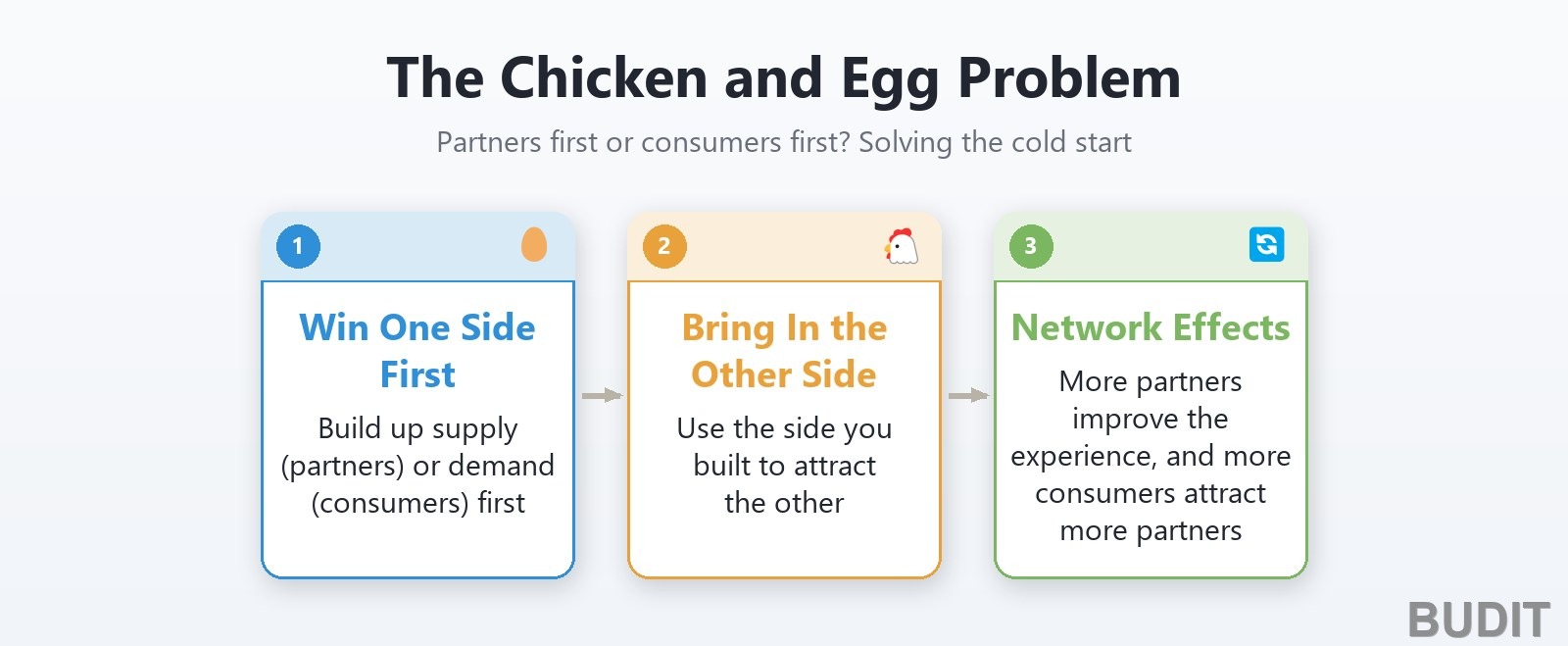
The old puzzle of two sided markets: the chicken or the egg, and the network effects that follow
3. The Core Challenge of Two Sided Markets: Build Network Effects
A major challenge in a B2B2C business is the chicken and egg problem. Without restaurants, consumers won't come. Without consumers, restaurants won't sign up. How you break that deadlock goes a long way toward deciding whether a B2B2C business works.
Cold start strategy: win one side first
A common approach is to build up one side first, then use it to attract the other.
- Supply (partners) first: a delivery app needs plenty of restaurants listed before consumers have a reason to use it.
- Demand (consumers) first: gather users with a feature they use often, and that user base becomes your pitch to partners.
- Either way, the side you build first has to give the other side a reason to join. It's the same principle as the growth loop from part 6 of Marketing Strategy Basics.
Network effects: the growth flywheel
Once you get past the chicken and egg problem, B2B2C's strength kicks in: network effects. The more partners you have, the better the consumer experience gets. The more consumers you have, the more partners want in. Once that virtuous cycle takes hold, it becomes a moat that competitors will struggle to cross.
These network effects connect to the difference between funnels and loops from part 6 of Marketing Strategy Basics. A B2B2C platform is a loop at its core.
The data cycle: connect data from both sides
A B2B2C platform's hidden asset is that it holds data from both sides of the market.
Share consumer data (which restaurants people like, what time they order) with partners as insights, and partner performance can improve. Feed partner data (which menu items are popular, what's in stock) into the consumer experience, and satisfaction can go up.
Wrapping Up
Over six parts, we've mapped out the full picture of sales channels and business models. To close, here's the whole Channels and Business Models series in a single table.
| Part | Key question | Key concepts |
|---|---|---|
| Part 1 | Where should we sell? | Korea's retail channel map (online and offline) |
| Part 2 | Someone else's land or our own? | Your own store vs. platforms (D2C strategy) |
| Part 3 | How do we get into offline retail? | Buyer meetings, listing proposals, shelf management |
| Part 4 | How do we win over consumers? | B2C: emotional appeal, full funnel, loyalty systems |
| Part 5 | How do we win over organizations? | B2B: lead gen, DMU, pipeline |
| Part 6 | How do we serve two customers at once? | B2B2C: two sided markets, network effects |
And this entire series stands on the foundation of our Marketing Strategy Basics series:
- STP from part 1 → choosing channels and defining target customers
- Performance marketing from part 2 → running marketing channel by channel
- CRO from part 3 → B2C conversion and the B2B pipeline
- AARRR from part 6 → the growth engine behind the whole series
Work with Budit
If you're working on B2B2C marketing that has to keep both partners and consumers happy, get in touch with Budit.
If your platform needs to sign up local shops as partners, you can start by seeing where potential partners are located with the District Map on ViewVibe.
References
- Amazon, announcement of its 2025 Small Business Empowerment Report on aboutamazon.com: selling partners, mostly independent businesses, account for more than 60% of sales in Amazon's store
- Hankook Ilbo, "Olive Young and K Beauty Growing Together: 116 Brands with 10 Billion Won in Sales" (January 4, 2026, in Korean): CJ Olive Young's announcement that 116 brands reached at least 10 billion won in annual sales in 2025
- Channels and Business Models series: part 1, part 2, part 3, part 4, part 5
- Marketing Strategy Basics series: part 1, part 2, part 3, part 4, part 5, part 6