


Designing Your Growth Engine: Growth Hacking and the AARRR Framework in Practice
Growth hacking is the practice of running experiments grounded in data, in quick succession, to build a sustainable growth engine. AARRR is a framework that splits the customer lifecycle into five stages (acquisition, activation, retention, referral and revenue) so you can see where growth is getting stuck.
This is part 6 of our Marketing Strategy Basics series, and the final installment. Catch up on part 1 on STP and USP, part 2 on performance marketing, part 3 on conversion rate optimization, part 4 on customer journey maps and part 5 on GA4 and KPIs.
"A growth hacker is a person whose true north is growth. Everything they do is scrutinized by its potential impact on scalable growth."
(Sean Ellis, "Find a Growth Hacker for Your Startup," 2010)
Over parts 1 to 5, we walked through the basic marketing loop: strategy, execution, conversion, integration and measurement. That leaves one last question: how do you make this loop spin faster?
Sean Ellis introduced the term growth hacker in a 2010 blog post. Growth hacking is often mistaken for viral buttons and cheap tricks, but at its core it's about building a sustainable growth engine through systematic experiments grounded in data and fast iteration.
The dashboard for that engine is the AARRR (pirate metrics) framework. In this final installment, we'll show how everything from parts 1 through 5 comes together into a single growth system.
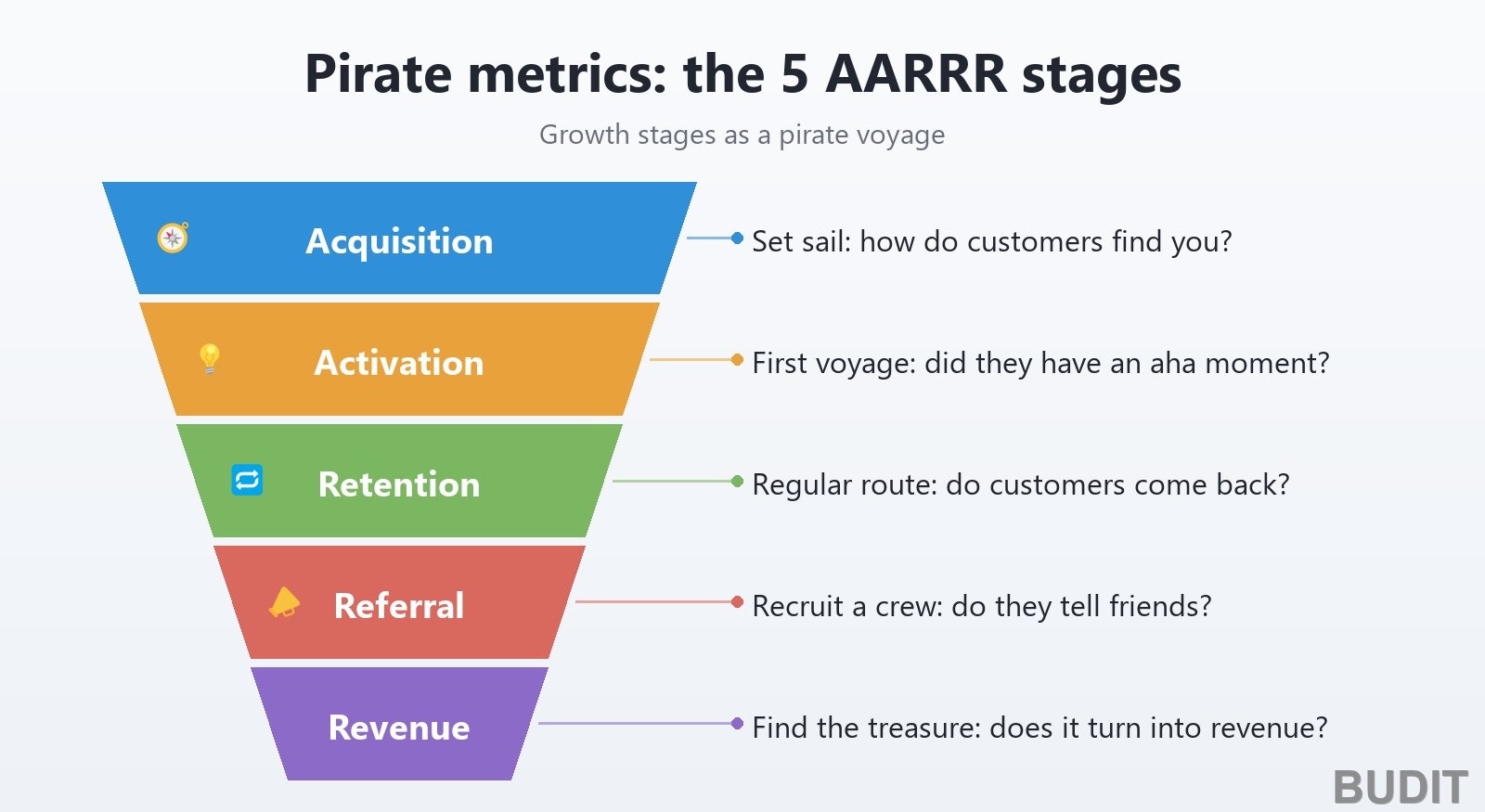
Pirate metrics: the five stages of the customer lifecycle
1. The AARRR Framework (Pirate Metrics): Finding Where Growth Gets Stuck
AARRR comes from Dave McClure's "Startup Metrics for Pirates." It breaks the customer lifecycle into five stages and tracks the key metrics for each one.
- Acquisition: How do customers find you? The performance marketing from part 2 drives this stage. Track traffic volume and customer acquisition cost (CAC) by channel.
- Activation: Did customers have their first "aha" moment? If someone lands on your site and leaves without doing anything, activation failed. The landing page optimization and CTAs from part 3 live here. Key metrics include signup rate, first purchase rate and use of core features.
- Retention: Do customers come back? The postpurchase experience and loyalty loop from the customer journey map in part 4 connect to this stage. Growing acquisition while retention is weak is like pouring water into a leaky bucket.
- Referral: Do customers recommend you? The social proof we mentioned in part 1 becomes a growth driver here. Referral programs, review requests and share features are the main plays at this stage.
- Revenue: Does all of this turn into actual sales? Among the KPIs from part 5, this is the ultimate goal metric. The ratio of customer lifetime value (LTV) to customer acquisition cost (CAC) is a common way to judge whether a business is healthy.
Quick tip: here's how to diagnose your funnel with AARRR.
- Measure the conversion rate from each stage to the next.
- Say you have 1,000 visitors, 200 activated users, 50 retained users, 10 referrers and 5 paying customers. The stage where you lose the most people is the bottleneck to focus on right now.
- You can track these numbers with the GA4 funnel exploration we covered in part 5.
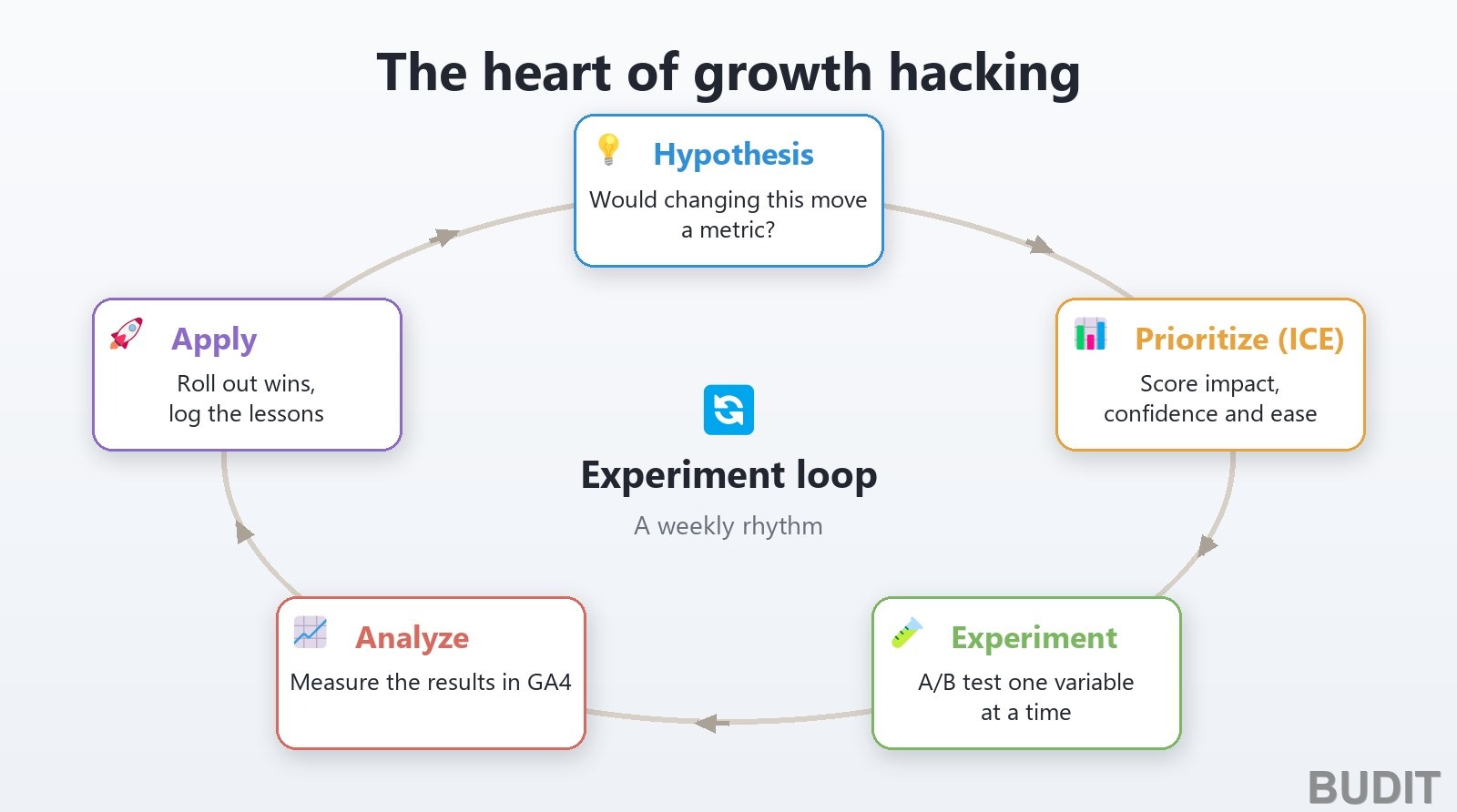
The core of growth hacking: a repeating loop of fast experiments and learning
2. The Experiment Process: Try Fast, Learn Fast
Once AARRR shows you the bottleneck, it's time to design experiments to fix it. Growth hacking values speed over a perfect plan: how quickly you can run small experiments, again and again.
The experiment process in four steps
-
Collect ideas. Gather ideas from the whole team along the lines of "What if we changed this? Would this metric go up?" A/B test ideas from part 3, journey map improvements from part 4 and anomalies you spotted in your GA4 data from part 5 are all good sources.
-
Prioritize with ICE scores. Score every idea on three criteria:
- Impact: how big a difference will it make if it works?
- Confidence: how much evidence do you have that it will work?
- Ease: how quickly and easily can you run the test?
Score each one out of 10, then start with the ideas that have the highest total or average.
-
Run the experiment. Follow the A/B testing principles from part 3: one variable at a time, a large enough sample and statistical significance.
-
Analyze and iterate. Measure the results in GA4 (part 5). If the test wins, roll it out. If it doesn't, write down what you learned and move on to the next experiment.
A steady rhythm helps. Hold a growth meeting every week to review last week's results, settle this week's experiments and keep the list of upcoming ideas up to date.
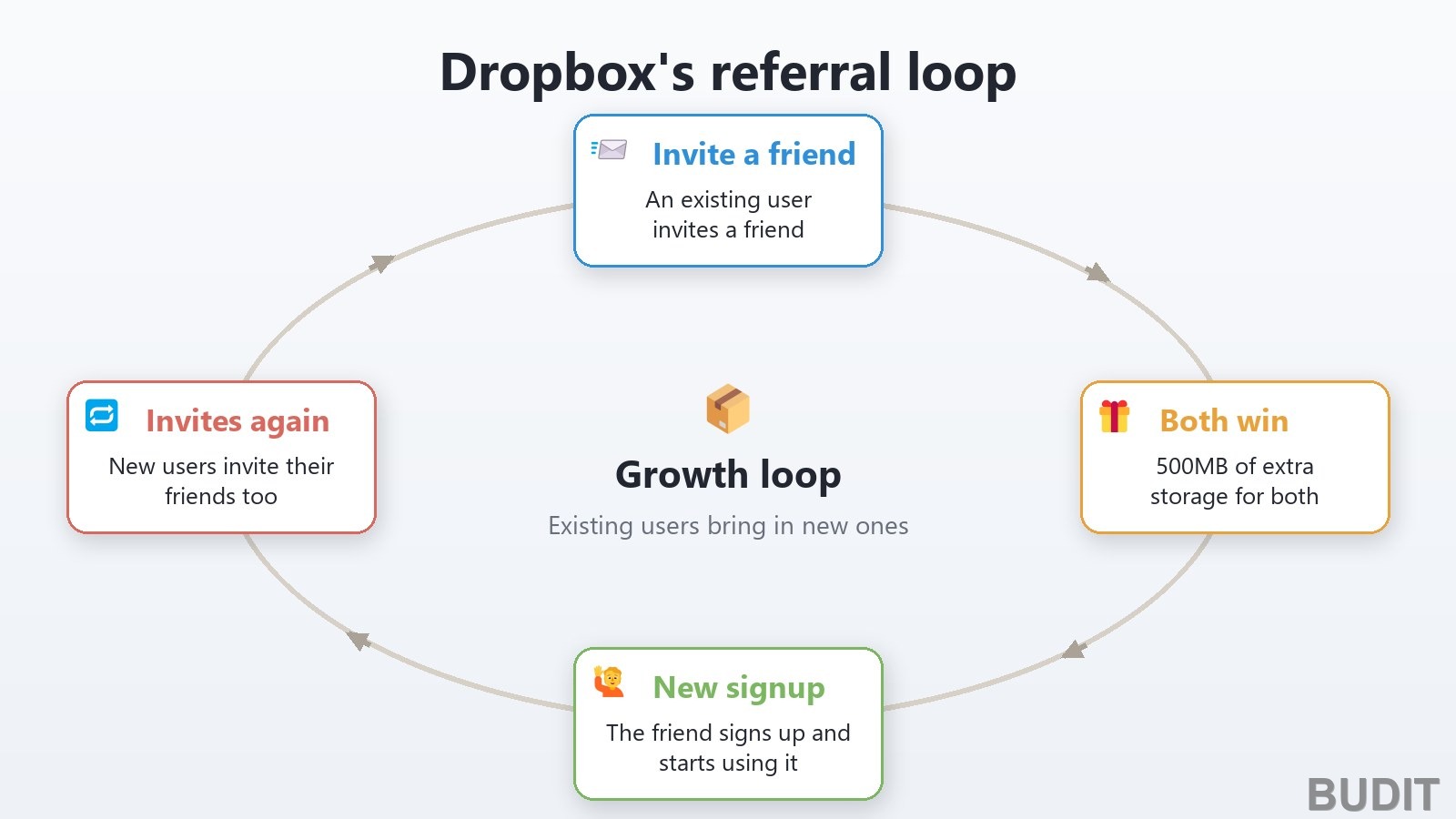
How the Dropbox referral program loops (a simplified view of the case)
3. Retention and Growth Loops: Plug the Leaky Bucket First
It's easy to equate growth with bringing in new customers. But before you push acquisition, check retention.
Sean Ellis uses a simple question to gauge product market fit. Ask your users, "How would you feel if you could no longer use this product?" and see whether at least 40% answer "very disappointed." If the share is under 40%, you likely haven't reached product market fit yet, and more acquisition will probably just mean more people leaving.
Referral gains strength only once retention is in place. And when referrals bring in new users who feed back into the first stage of AARRR, you have a growth loop.
Funnels versus loops
In a funnel, customers fall away as they move from top to bottom, so you have to keep pouring new customers in at the top. In other words, you keep paying for ads. A loop, on the other hand, is a system that reinforces itself: existing customers bring in new ones. When it works, you can keep growing while leaning less on ad spend.
Example: the Dropbox referral program
Dropbox gives extra storage both to the person who sends an invite and to the friend who signs up (currently 500MB per referral on Dropbox Basic). In a 2010 talk, cofounder Drew Houston said this referral program, with rewards on both sides, permanently increased signups by 60%. As new users invite their own friends, the loop keeps going.
Wrapping Up
Over six posts, we've built the backbone of marketing driven by data. To close, here's how it all fits together as one system:
| Part | Core idea | Where it fits in AARRR |
|---|---|---|
| Part 1: STP and USP | Who you serve and what value you offer | The strategic foundation for all of AARRR |
| Part 2: Performance marketing | Which channels and what budget | Acquisition |
| Part 3: Conversion rate optimization | Turning visitors into customers | Activation |
| Part 4: Customer journey maps | Designing the whole experience from the customer's side | A map of the full AARRR journey |
| Part 5: GA4 and KPIs | Measuring performance with data | The dashboard for every stage |
| Part 6: Growth hacking and AARRR (this post) | Running the growth engine through experiments | Retention, Referral, Revenue |
That completes one full lap. Our look at distribution channels continues in part 1 of the Channels and Business Models series.
Work with Budit
Not sure which AARRR stage is the weakest link in your business? Get in touch with Budit. We'll look at funnel diagnostics, experiment design and growth loops with you.
Need more experiment ideas? The competitor ad viewer in ViewVibe lets you browse the ads your competitors run, pulled from the Meta Ad Library (requires signing in and uses tokens).
References
- Sean Ellis and Morgan Brown, Hacking Growth (2017): the growth experiment process, ICE scores and the 40% product market fit test
- Sean Ellis, "Find a Growth Hacker for Your Startup" (July 26, 2010): the definition of a growth hacker, startup-marketing.com
- Dave McClure, "Startup Metrics for Pirates": the AARRR (pirate metrics) framework
- Drew Houston, "Dropbox Startup Lessons Learned" slides (April 2010): the referral program with rewards on both sides and the 60% increase in signups, slideshare.net
- Dropbox Help Center, referral rewards: 500MB per referral on Dropbox Basic, help.dropbox.com (accessed September 17, 2026)
- The full Marketing Strategy Basics series: part 1, part 2, part 3, part 4, part 5