Win the Heart, Open the Wallet: A B2C Marketing Playbook
B2C (business to consumer) marketing is marketing for companies that sell directly to individual consumers, and it works by tapping into people's emotions and immediate needs to drive quick buying decisions. It rests on three pillars: emotional appeal, a full funnel strategy, and a loyalty system.
This is part 4 of our Channels and Business Models series. Catch up on part 1, our map of Korea's retail channels, part 2 on your own store vs. marketplaces, and part 3 on breaking into offline retail.
Parts 1 through 3 of this series were about where to sell (channels). Starting with part 4, we change the lens to who you sell to and how (business models).
B2C is the model where a company sells its products directly to end consumers. Grocery orders on Coupang, a skincare run at Olive Young, a coffee at the café: all of these are B2C. (Coupang is a leading Korean ecommerce platform, and Olive Young is a Korean health and beauty chain.) In B2C marketing, what matters is tapping into people's emotions and immediate needs to drive quick buying decisions.
If B2B marketing is a long process of logically persuading several decision makers, B2C is closer to moving one person's heart. In this post, we'll cover the three pillars of B2C marketing: emotional appeal, a full funnel strategy, and a loyalty system.
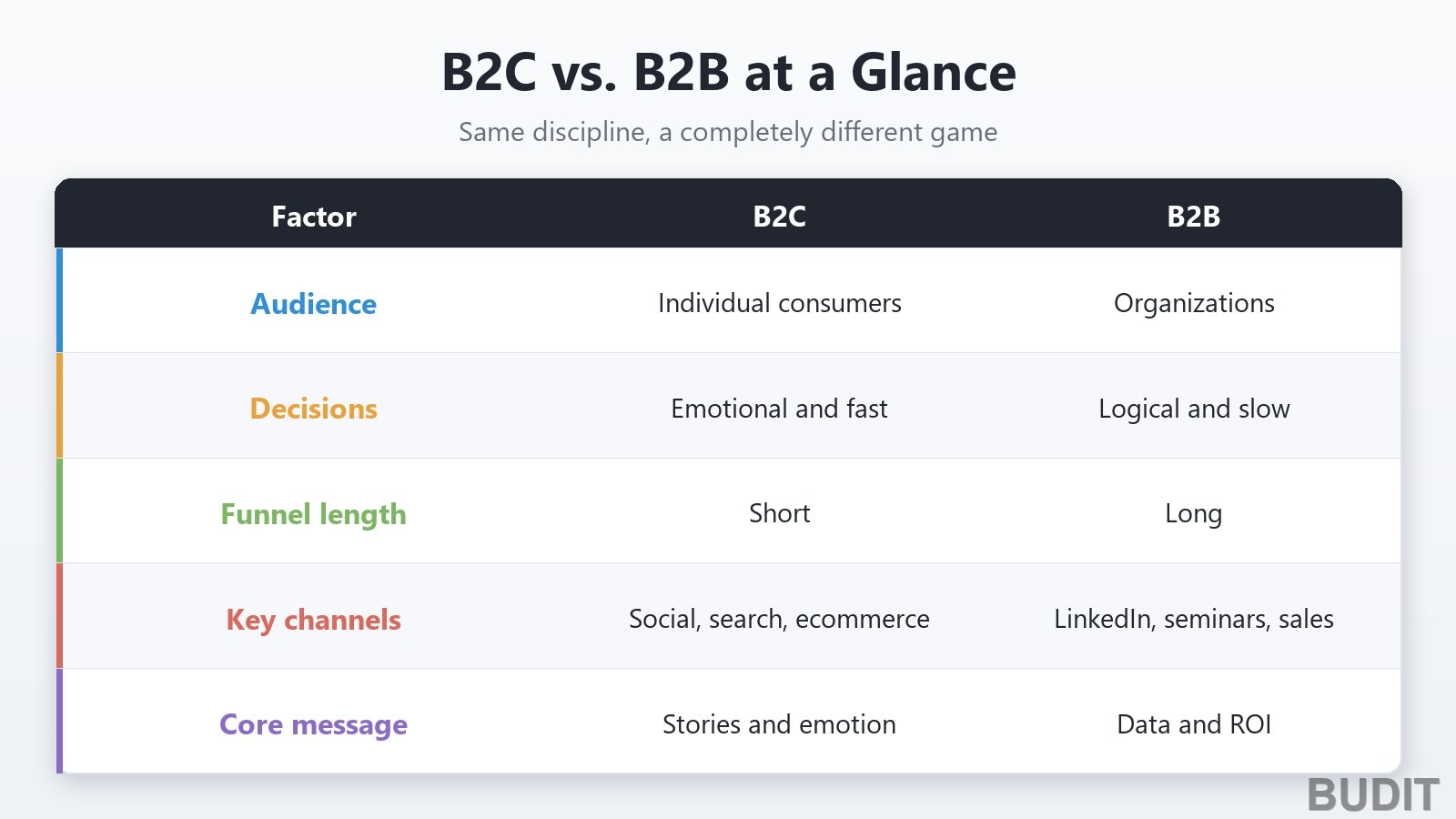
Same discipline, a different game: the key differences between B2C and B2B
1. Emotional Appeal: Feelings Move First
B2C shoppers often buy not because they need something, but because they want it. That means the USP we covered in Marketing Strategy Basics part 1 has to go beyond functional benefits and land as emotional value.
- Functional USP: "This sunscreen is SPF 50+."
- Emotional USP: "Shine all day, without a worry about the sun."
It's the same product, but the second message does more to make people want it. We looked at landing page headlines in Marketing Strategy Basics part 3, and in B2C that headline needs to connect with how customers feel.
Five emotional levers in B2C
- Belonging: copy like "Already chosen by customers like you." This is the emotional version of social proof (Marketing Strategy Basics part 1).
- Scarcity: copy like "Today only at this price." This is the scarcity principle Cialdini describes in Influence (see Marketing Strategy Basics part 3).
- Self expression: "A brand that says who I am." This appeals to the wish to show who you are through what you buy.
- Reassurance: "Free returns, guaranteed." This eases the worries that make people hesitate.
- Delight: unboxing moments, beautiful packaging, limited edition collaborations. The purchase itself becomes the experience.
Quick tip: a formula for emotional copy
- The formula: the customer's worry or desire + the emotional result your product delivers
- An example: "For everyone tired of fighting their skin, the moment looking in the mirror feels good again." (The function is skincare. The feeling is renewed confidence.)
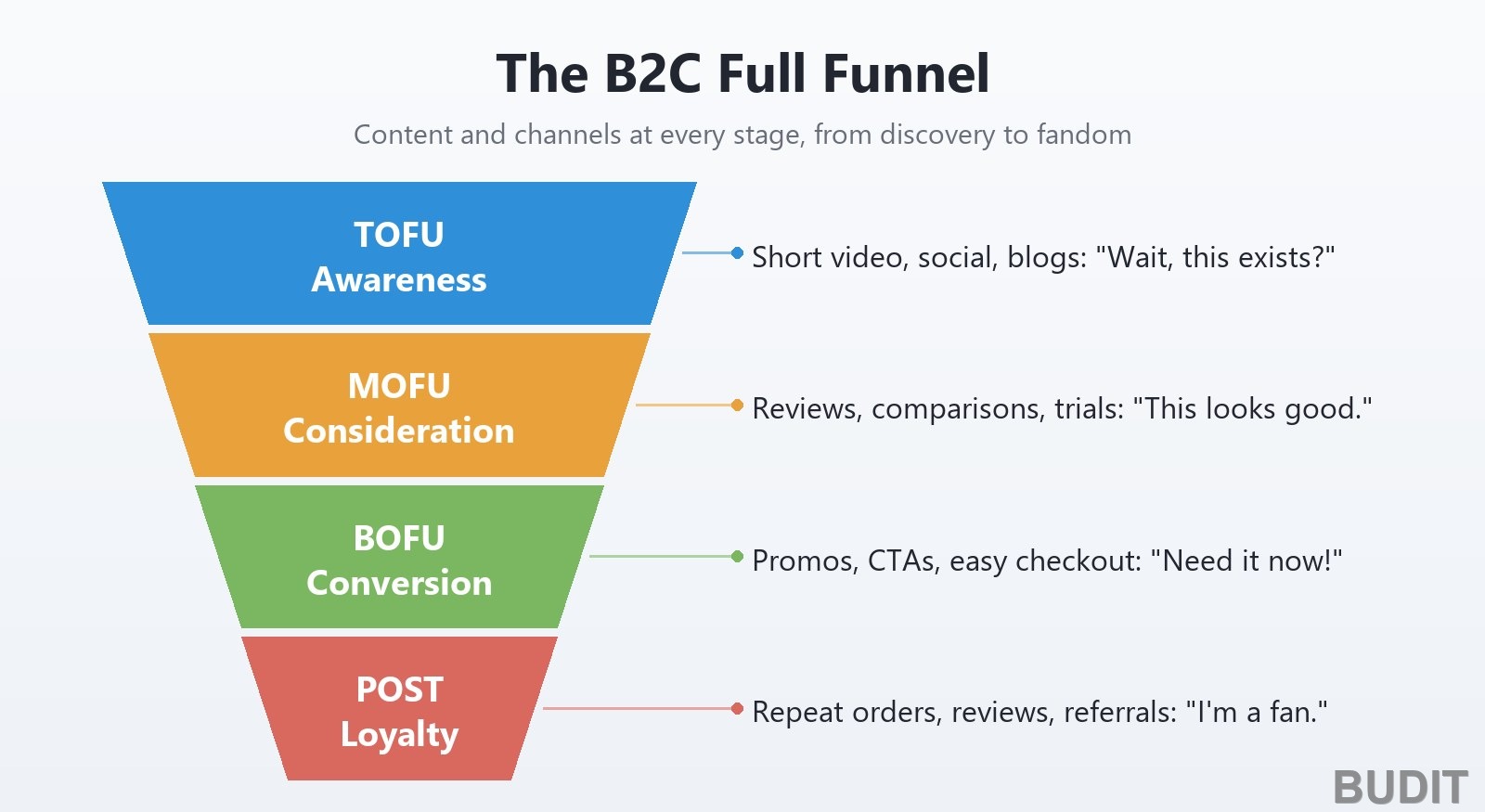
The B2C full funnel: content and channels for every stage, from discovery to fandom
2. The B2C Full Funnel: From Discovery to Fandom
In Marketing Strategy Basics part 4, we mapped the customer journey, and in part 3 we looked at the conversion funnel. In B2C, those come together as a full funnel strategy. It goes beyond getting people to buy: you design the entire journey of discovery, consideration, purchase, repeat purchase, and referral.
TOFU (top of funnel), awareness: "Wait, this exists?"
The goal is to get your brand in front of as many potential customers as possible. Rather than rushing to sell, create content that speaks to your audience's problems and interests.
Key channels: Instagram Reels, TikTok videos, YouTube Shorts, blogs, and social ads (see Marketing Strategy Basics part 2)
Content example: "3 reasons your skin feels tight after washing your face in the morning" (educational content that sparks interest)
MOFU (middle of funnel), consideration: "This looks pretty good."
Now that people know your brand, they start actively researching. Reviews, comparison content, and firsthand trial stories weigh heavily on the decision.
Key channels: Naver Blog reviews (Naver is a major Korean search portal), YouTube reviews, product detail pages, influencer collaborations, and search ads (see Marketing Strategy Basics part 2)
Content example: "Product A vs. Product B: an honest comparison after three weeks" (comparison content that builds confidence)
BOFU (bottom of funnel), conversion: "I need to buy this now!"
This stage takes shoppers who are about to buy all the way through checkout. It's where the CRO tactics from Marketing Strategy Basics part 3 come in.
Key tactics: discounts for a limited time, clear free shipping thresholds, abandoned cart reminders, and retargeting ads
Content example: "20% off your first order plus free shipping, until midnight tonight" (urgency plus a clear benefit)
Showing products that go well together right before checkout, an upsell and cross sell play, is another option at this stage.
POST, loyalty: "I'm a fan of this brand."
This is where Retention and Referral from the AARRR framework in Marketing Strategy Basics part 6 come in. The goal is to drive repeat purchases and get customers recommending your brand on their own.
Key tactics: thank you messages after purchase, reward points for reviews, membership tiers, and friend referral rewards
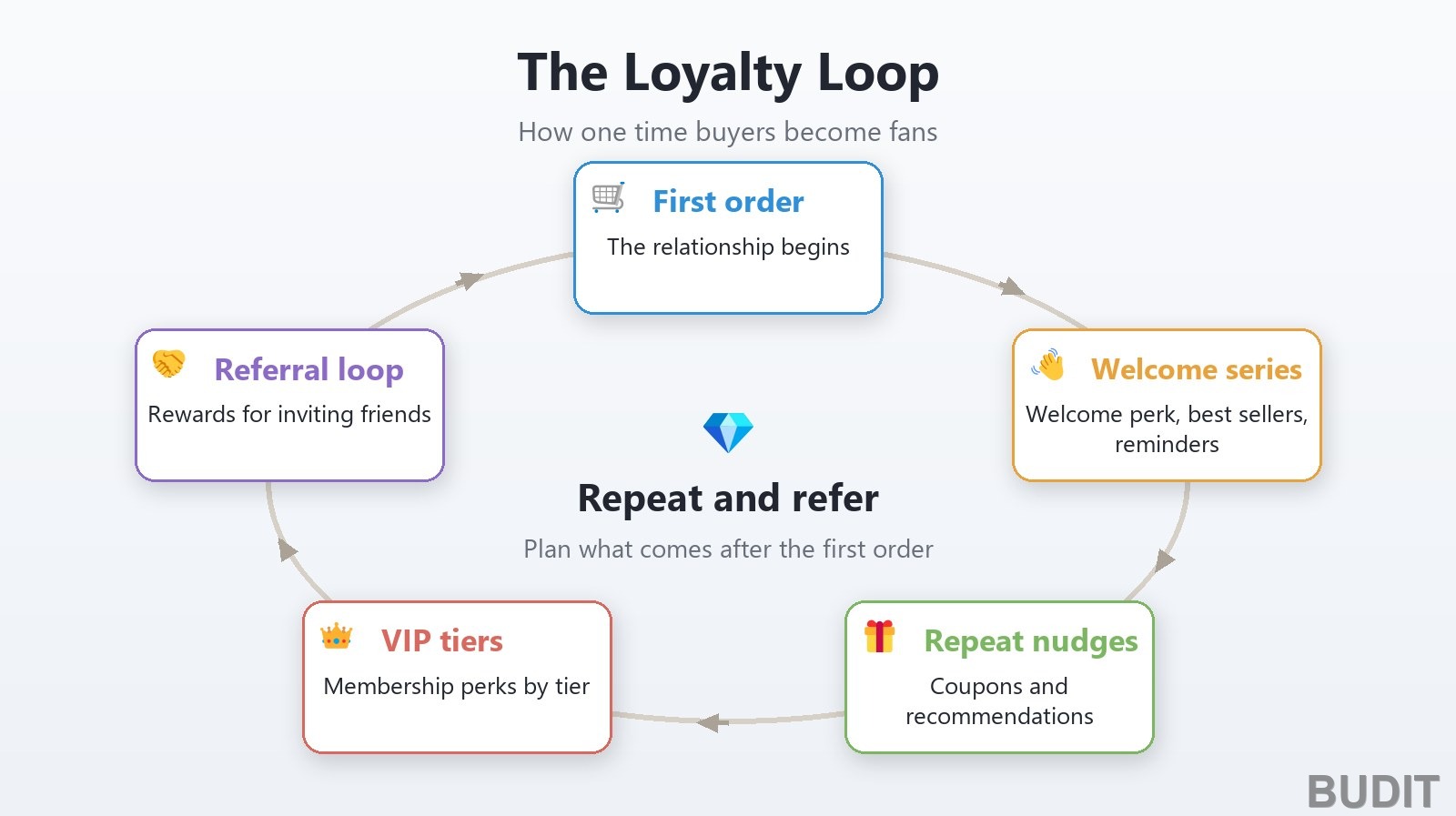
A loyalty system that turns one time buyers into fans
3. The Loyalty System: Planning What Comes After the First Purchase
In B2C, repeat purchases matter as much as the first one. Depending on the study and the industry, acquiring a new customer has been estimated to cost five to 25 times more than keeping an existing one (Harvard Business Review). As we discussed in Marketing Strategy Basics part 6, the rule "fix the leaky bucket first" matters especially in B2C.
Designing repeat purchases with CRM
- Welcome series: an automated sequence that leads new members to their first purchase in the days after they sign up. You might structure it as a welcome perk, then a look at your best sellers, then a cart reminder.
- Targeting by segment: sending every customer the same message tends to get weaker results. Segment customers by purchase history, favorite categories, last visit date, and so on (the segmentation from Marketing Strategy Basics part 1), and send each group a message that fits.
- Churn prevention: automatically send customers who haven't visited or bought in a while (your deep sleepers) a "we miss you" coupon or news about new products.
The virtuous cycle of reviews and UGC
In B2C, a valuable marketing asset is content your customers create (UGC, or user generated content). Reviews, Instagram posts, and unboxing videos build awareness among new customers at the TOFU stage, give shoppers confidence to buy at the MOFU stage, and deepen the loyalty of the people who created them at the POST stage.
This is the growth loop from Marketing Strategy Basics part 6 in action. Purchase, review, new customers arrive, purchase, review. Once that loop starts turning, you can depend less on ad spend.
Final Thoughts
If we had to sum up B2C marketing in one line, it would be this: win them with emotion, keep them with data.
- Open hearts with emotional appeal (TOFU).
- Guide people to purchase with a full funnel strategy (MOFU to BOFU).
- Turn buyers into fans with a loyalty system (POST and the loop).
Every tool from the Marketing Strategy Basics series comes into play here. You use STP to pick your target (part 1), performance marketing to bring in traffic (part 2), CRO to lift conversions (part 3), journey maps to design the whole experience (part 4), GA4 to measure it (part 5), and AARRR to keep the growth engine running (part 6).
In part 5, we look at B2B marketing strategy: persuading an organization with logic rather than an individual with emotion.
Work with Budit
If your B2C marketing brings people in but repeat purchases are the problem, get in touch with Budit.
Looking for influencers to partner with at the MOFU stage? You can find them with ViewVibe's Creator Explorer.
References
- Amy Gallo, "The Value of Keeping the Right Customers," Harvard Business Review (October 29, 2014): acquiring a new customer costs five to 25 times more than retaining one
- Robert Cialdini, Influence: The Psychology of Persuasion: the scarcity and social proof principles (linked to Marketing Strategy Basics part 3)
- This series: part 1, our map of Korea's retail channels · part 2, your own store vs. marketplaces · part 3, breaking into offline retail
- The Marketing Strategy Basics series: part 1, STP and USP · part 2, performance marketing · part 3, conversion rate optimization · part 4, customer journey maps · part 5, GA4 and KPIs · part 6, growth hacking and AARRR