


Is Half Your Ad Budget Wasted? A Guide to Performance Marketing Channels and Budget Allocation
Performance marketing measures the results of your advertising in numbers, then uses that data to keep improving your channels, budget and creative. The question isn't "how much did we spend?" but "how much came back for every dollar we put in?"
This is part 2 of our Marketing Strategy Basics series. If you missed it, start with part 1 on STP and USP.
There's an old line in advertising: half the money spent on ads is wasted, and the trouble is nobody knows which half. It has summed up a marketer's biggest headache for a long time. Today, measuring the results of each ad lets you see which half is working.
In part 1 we built a marketing backbone with STP and USP. This time we look at how to put that strategy to work in the market: performance marketing. We'll go through which channels to use, how much to give each one and how to measure the results.
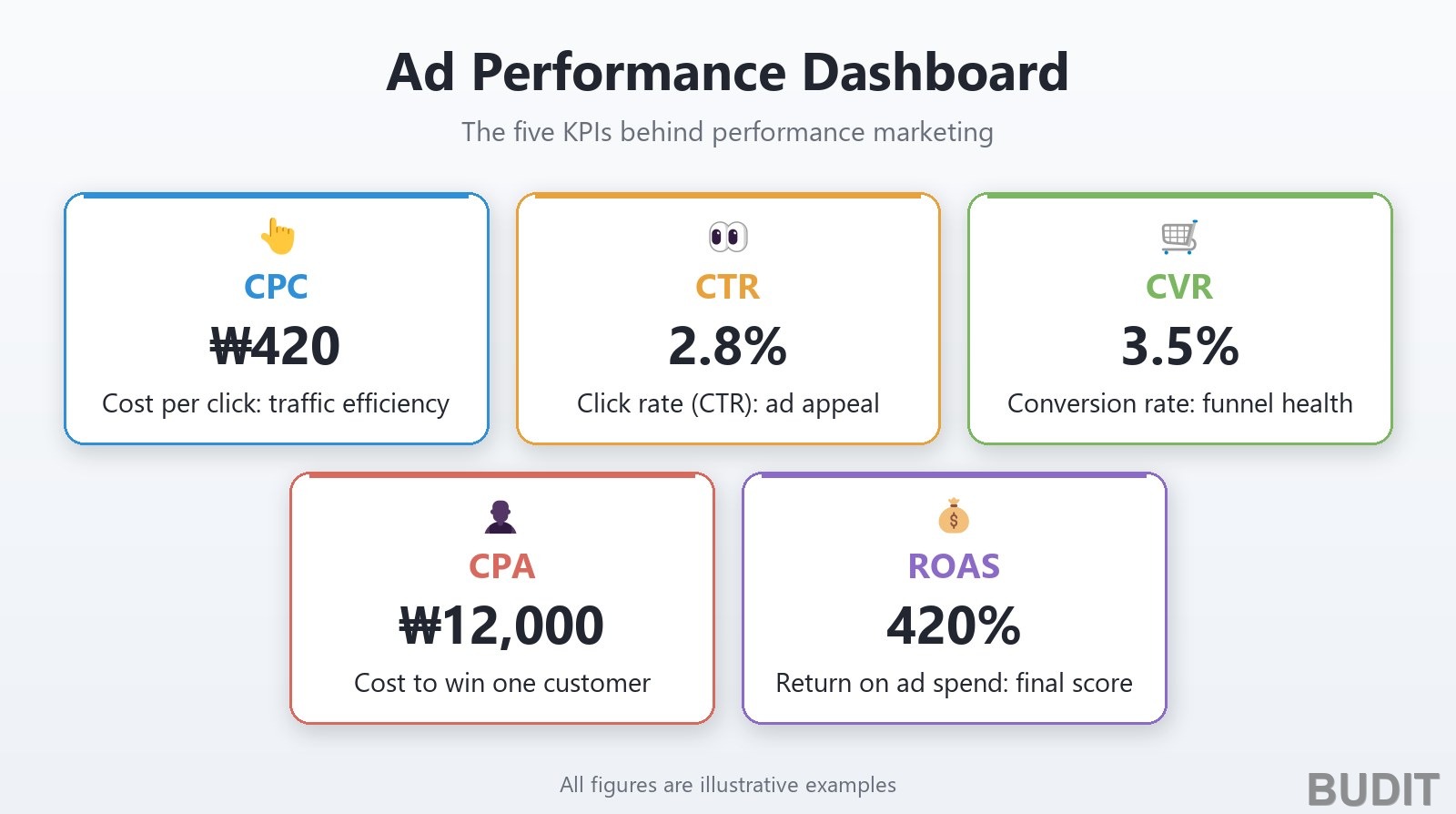
Every key ad metric on a single screen (figures are examples).
1. Performance Marketing: Measure It to Manage It
Performance marketing measures the outcomes of your ads in numbers and optimizes based on that data. Brand marketing usually aims for awareness and likability. Performance marketing goes after specific actions, like clicks, conversions and purchases, and measures each one.
In other words, it doesn't ask how much you spent. It asks how much came back for every dollar you spent. That's ROI, or return on investment.
"I do not regard advertising as entertainment or an art form, but as a medium of information. When I write an advertisement, I don't want you to tell me that you find it 'creative.' I want you to find it so interesting that you buy the product."
(David Ogilvy, Ogilvy on Advertising, 1983)
Quick tip: these are the five KPIs that matter most.
- CPC (cost per click): how efficiently you bring in traffic
- CTR (click through rate): how appealing your ad is
- CVR (conversion rate): how well your funnel is built
- CPA (cost per acquisition): what one new customer costs you
- ROAS (return on ad spend): the final scorecard
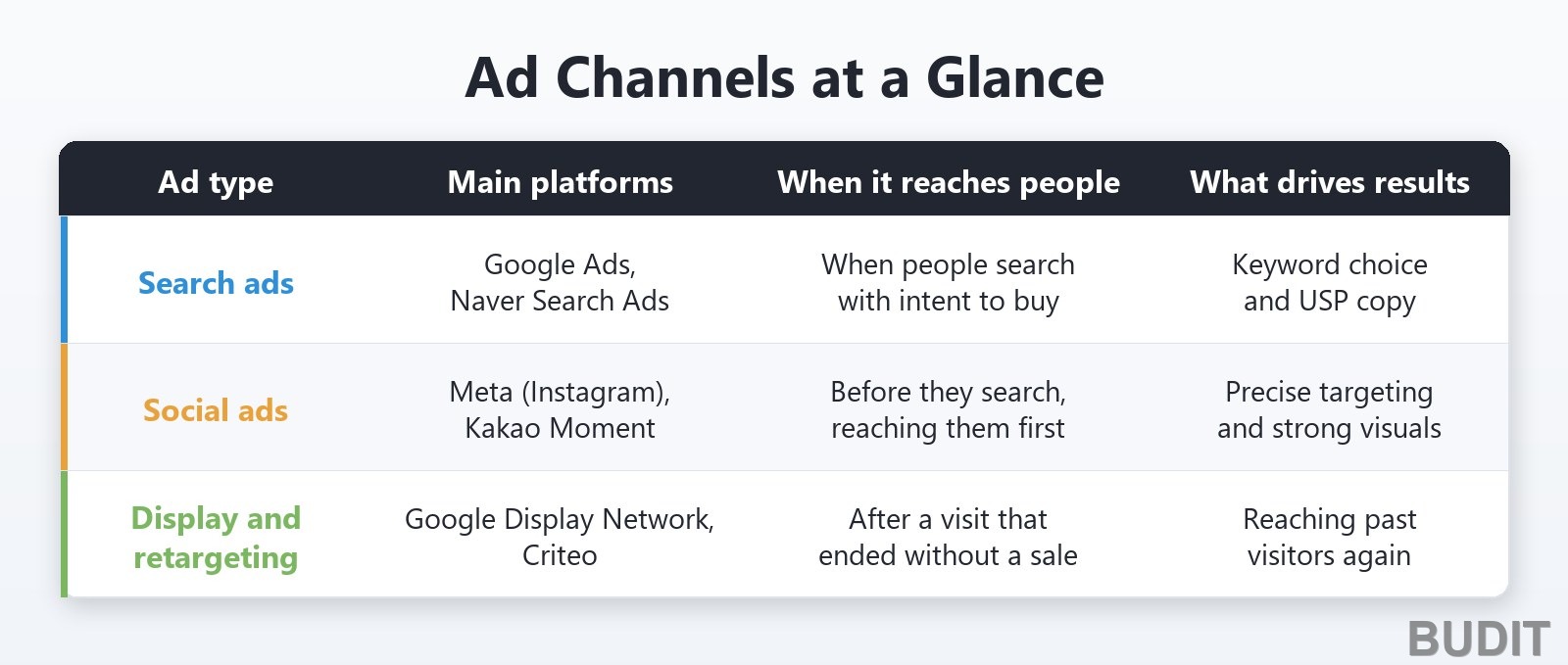
How the major channels compare. Google, Naver, Meta and Kakao ads each reach people at a different moment.
2. Media Channels: Each One Reaches People at a Different Moment
The first question in performance marketing is where your ads should run. Every channel has its own user behavior and ad formats, so the right mix depends on the STP strategy you set in part 1.
Search ads (Google Ads, Naver Search Ads)
Search ads on Google or Naver (Korea's largest search portal) catch people at the moment they search. Because you're reaching people who already intend to buy, conversion rates tend to be high, and keyword choice makes or breaks the campaign. The USP from part 1 becomes the heart of your ad copy.
Social ads (Meta and Instagram, Kakao Moment)
Social ads reach people before they ever search. Kakao Moment is the ad platform of Kakao, the company behind KakaoTalk, Korea's most widely used messaging app. These channels let you target precisely by interest, behavior and demographics, and your images and video have a big impact on results. This is where the segmentation and personas from part 1 come straight into play.
Display and retargeting (Google Display Network, Criteo)
This strategy brings back people who visited your site but left without buying. Retargeting shows your ads again to people who have already seen your product but didn't buy, and it's used to win back shoppers who were on the fence.
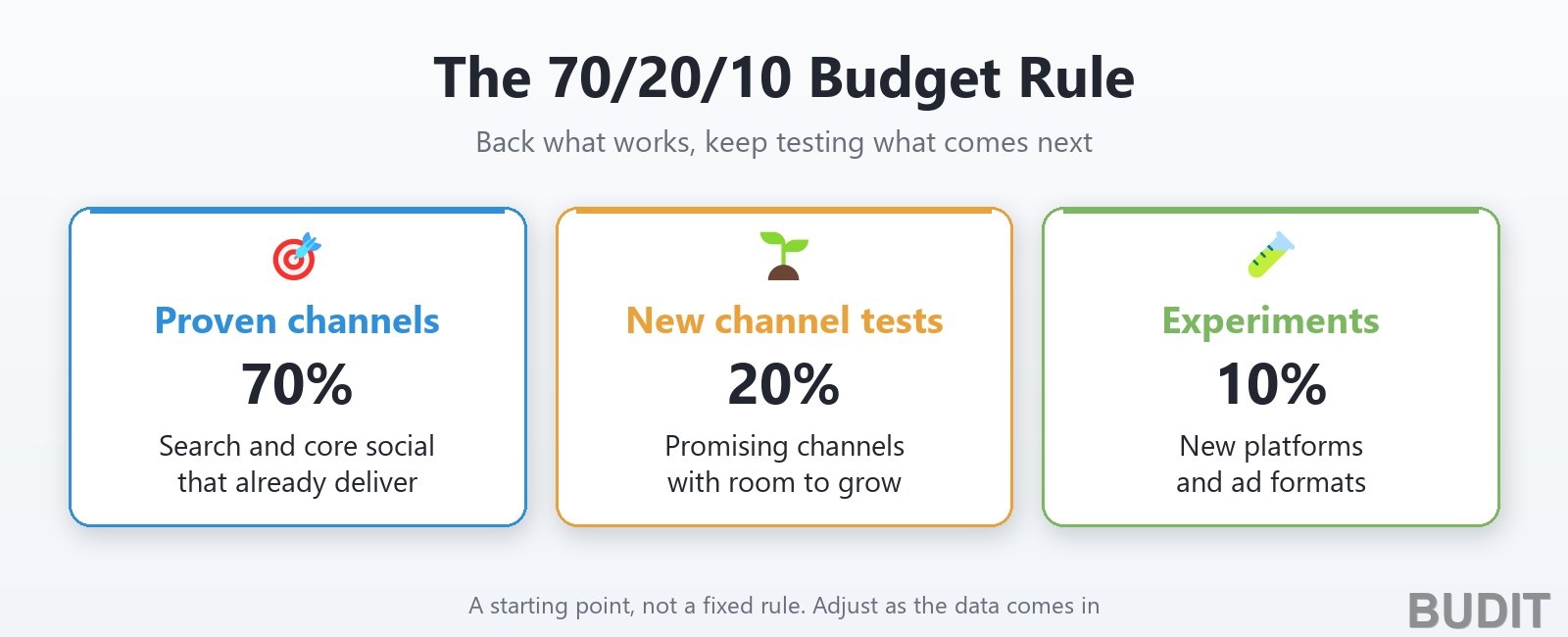
Splitting spend across channels with the 70/20/10 rule.
3. Budget Allocation: Where to Spend and How Much
How much to put into each channel is a question every marketer wrestles with. There's no single right answer, but there is a rule of thumb that makes a good starting point.
Quick tip: the 70/20/10 budget rule.
- 70% goes to core channels that have already proven themselves (search ads, your main social channels and so on)
- 20% goes to testing promising new channels
- 10% goes to experiments (new platforms, new ad formats and so on)
These ratios aren't fixed. Treat them as a starting point and adjust as the data comes in.
The key is to watch both the overall size of your budget and its efficiency (ROI). Chase efficiency alone and your reach shrinks. Chase scale alone and efficiency drops. Good budget allocation is about finding the balance between the two.
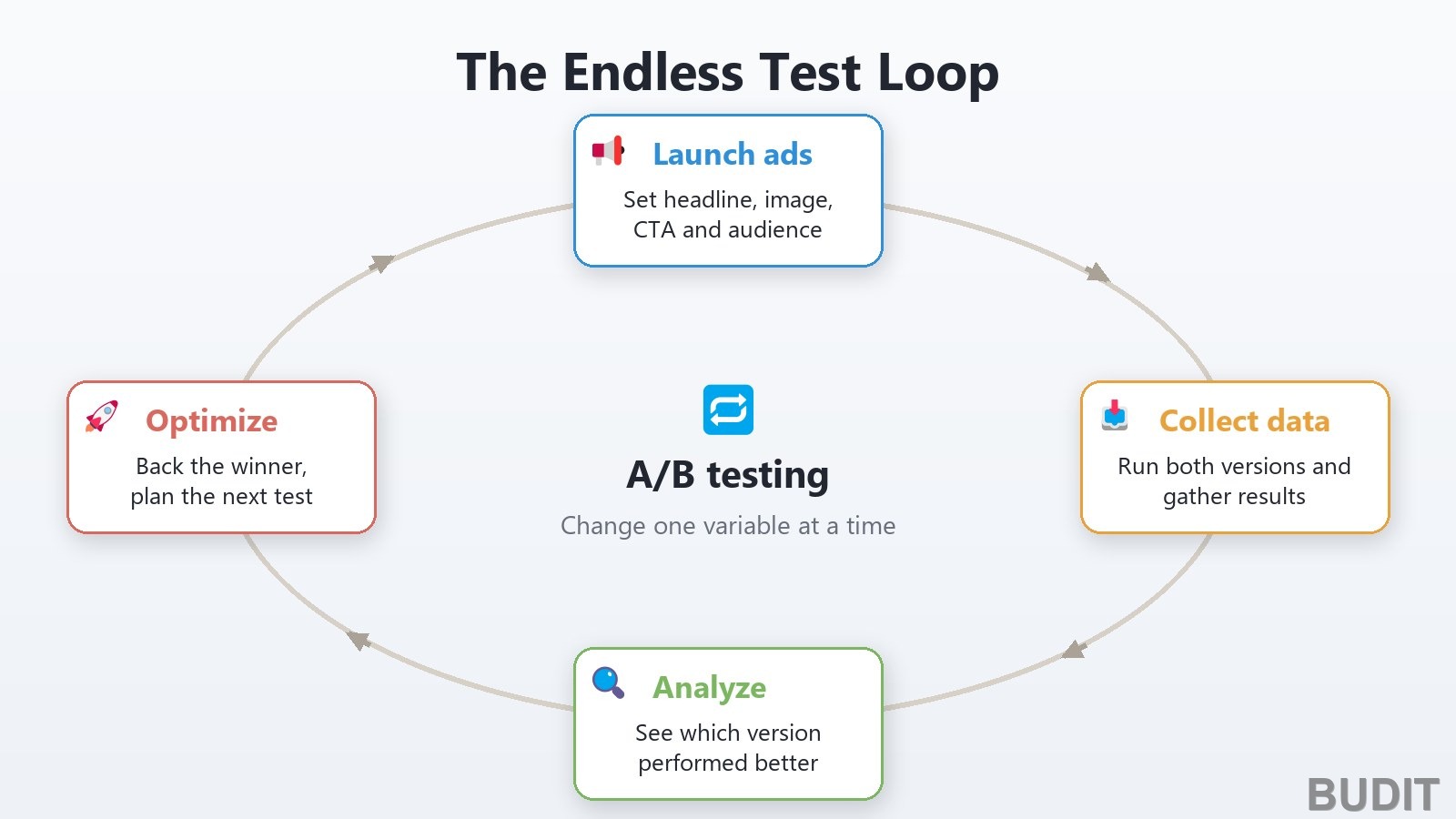
The test loop: launch, collect data, analyze, optimize, and repeat.
4. Test and Optimize: Let the Data Answer
Much of the value of performance marketing comes from optimizing after launch. No ad is perfect on day one. What matters is building a loop where you launch fast, read the data and keep improving.
An A/B test shows two versions of an ad at the same time to see which one performs better. You change only one variable at a time, whether that's the headline, the image, the CTA button text or the target audience.
Among your product's features, pick the selling point that matters most to customers, and test which message performs best. As we said in part 1, a story your competitors could tell just as easily isn't a USP.
Wrapping Up
Performance marketing runs on numbers, not gut feel. But to read those numbers correctly, you need the strategic foundation of STP and USP from part 1. Execution without strategy tends to waste budget, and strategy without execution never turns into results.
"Marketing is the generous act of helping someone solve a problem. Their problem."
(Seth Godin, This Is Marketing, 2018)
Work with Budit
Looking for a channel strategy that fits your brand? Get in touch with Budit, and we'll look at channel selection, budget planning and performance analysis with you.
Curious what messages your competitors are running? The competitor ad viewer in ViewVibe lets you browse ads from the Meta Ad Library (requires signing in and uses tokens).
References
- David Ogilvy, Ogilvy on Advertising (1983): quote on the purpose of advertising
- Seth Godin, This Is Marketing (2018): quote on what marketing is
- Part 1: Stop Marketing on Gut Feel: Building Your Marketing Backbone With STP and USP