
Turning Visitors Into Customers: A Practical Guide to Conversion Rate Optimization (CRO)
Conversion rate optimization (CRO) is the work of increasing the share of site visitors who take the action you want, such as buying or sending an inquiry. You use data to find where people drop out of your funnel, then fix and test one thing at a time.
This is part 3 of our Marketing Strategy Basics series. Catch up on part 1 on STP and USP and part 2 on performance marketing.
In part 2 we covered how performance marketing brings people to your site. But traffic alone doesn't create revenue. Say your site gets 10,000 visitors a month. At a 1% conversion rate, that's just 100 customers. Raise the rate to 2% and the same traffic gives you 200. Winning more customers from the same visitors, without adding to your ad budget, is what CRO is about.
In this post we'll walk through the three pillars of CRO: funnel design, landing page optimization and an improvement loop driven by data.
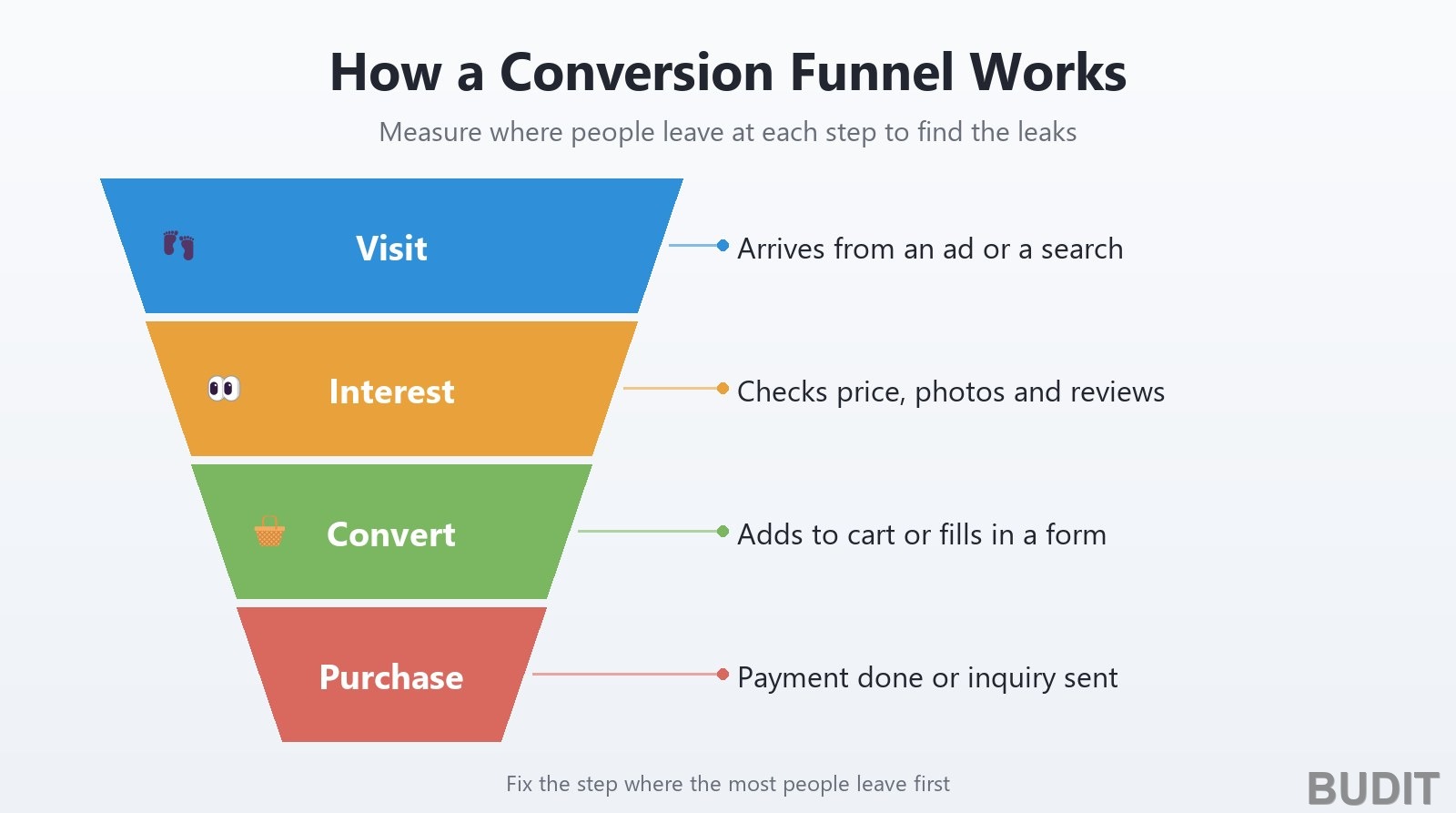
Find where customers slip away: how a conversion funnel is structured.
1. The Conversion Funnel: Finding the Leaks
A conversion funnel is the path a visitor takes, step by step, from landing on your site to the final purchase or inquiry. For an online store, a typical funnel runs from home page to product page to cart to checkout. For a B2B service, it might run from a blog post to a service overview to a filled in inquiry form.
What matters most is measuring how many people leave at every step. If 100 people reach a product page but only 10 add the item to their cart, something on that page isn't working. Maybe the pricing information is thin, the product photos fall flat, or there are no reviews to build trust. The data will tell you where the problem is.
"The consumer isn't a moron; she is your wife."
(David Ogilvy, Confessions of an Advertising Man, 1963)
Ogilvy's warning against underestimating consumers applies directly to CRO. Review every step of the funnel from the customer's point of view, the way they would actually read your pages.
Among the performance marketing KPIs from part 2, CVR (conversion rate) is the one that shows the health of this funnel. If your ads get plenty of clicks but CVR stays low, the problem isn't the ads. It's somewhere inside the funnel.
Quick tip: diagnose your funnel in three steps.
- Get the baseline: check how many people leave at each step in GA4.
- Find the bottleneck: look for the step where the most people leave.
- Form a hypothesis: write it down as "If we change this element at this step, the conversion rate will go up."
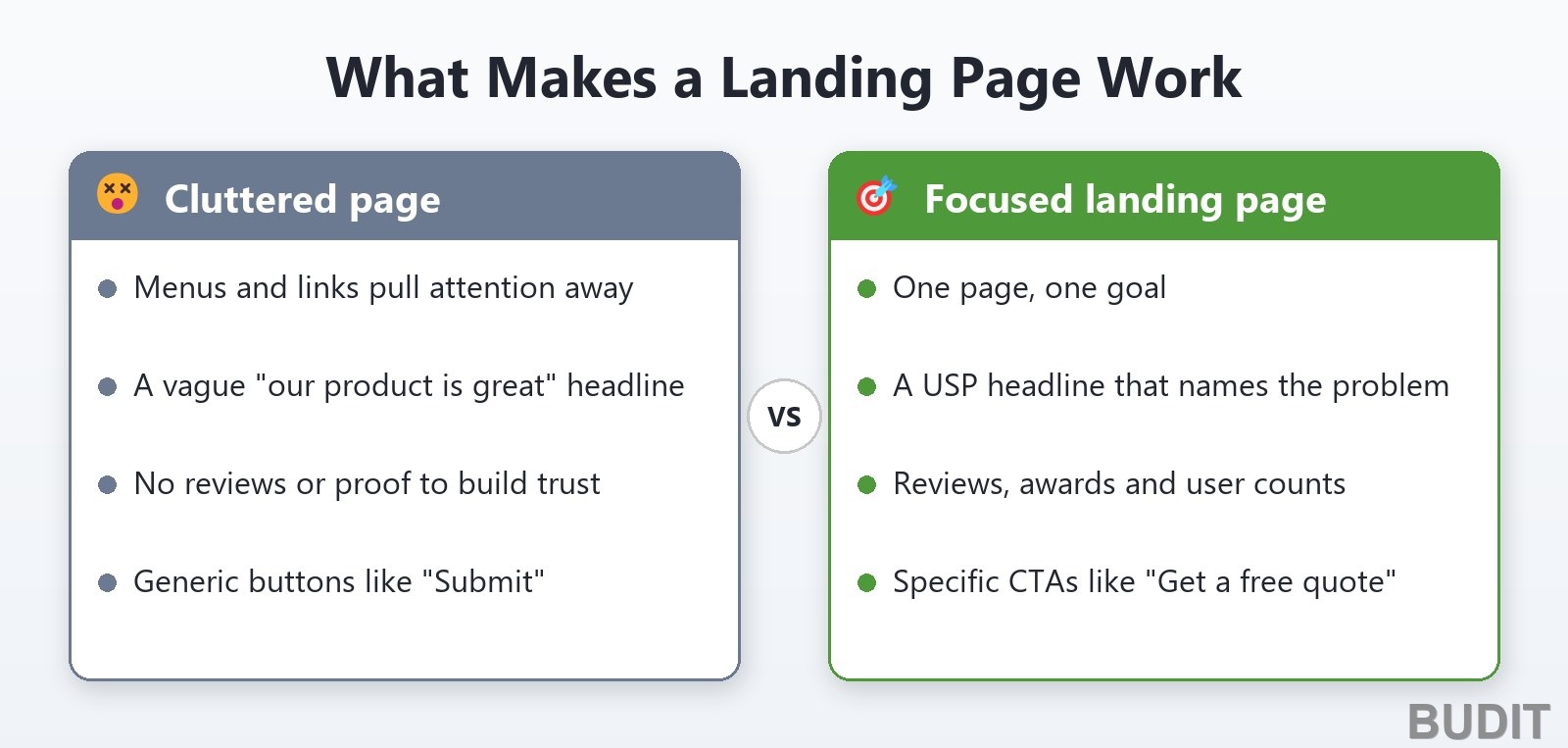
A landing page has one job: getting the visitor to take the next step.
2. Landing Page Optimization: Winning on First Impressions
A landing page is the first page people see after clicking your ad, and that first impression has a big influence on whether they convert.
The principles of a good landing page are simple.
- One page, one goal. When a page has lots of menus and links like a home page, attention scatters. A landing page should focus on driving a single action, whether that's a purchase, an inquiry or a download.
- Put the most work into the headline. The USP you defined in part 1 becomes your headline here. Instead of "our product is great," you need one sentence that speaks directly to the customer's problem.
- Use social proof. The social proof we mentioned at the end of part 1, such as customer reviews, awards and user counts, is what builds trust on a landing page.
- Make your CTA (call to action) clear and specific. "Get a free quote" tells people more than "Submit," and "Start your free trial (14 days)" says more than "Get started" about what happens when they click.
"On the average, five times as many people read the headline as read the body copy. When you have written your headline, you have spent eighty cents out of your dollar."
(David Ogilvy, Confessions of an Advertising Man, 1963)
Since the headline is what most people read, the same rule applies to landing pages. That's why the headline is usually the first thing worth testing.
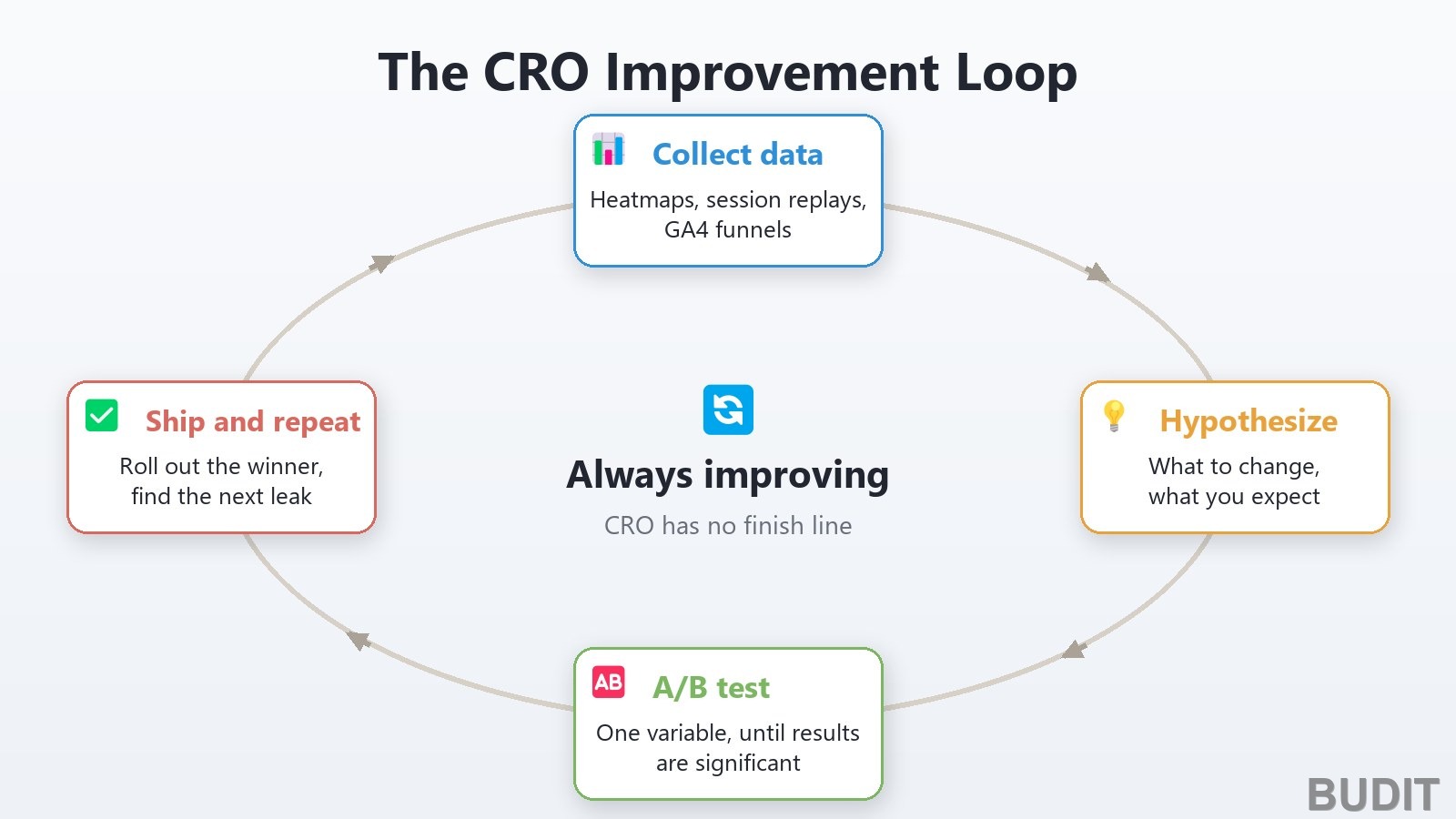
CRO never ends: an ongoing loop of improvement.
3. The Optimization Loop: One Change at a Time
At its core, CRO isn't about one big redesign. It's about small, steady improvements that add up. The main tool here is the A/B test, a concept we touched on in part 2 and now apply in more depth.
The four steps of the improvement loop
- Collect data. Use heatmaps, session replays and GA4 funnel reports to see where customers get stuck. Start from data, not gut feel.
- Form a hypothesis. Define the change and the expected result in concrete terms, for example: "If we add customer reviews to the product page, the share of visitors who add the item to their cart will rise by 15%."
- Run the A/B test. Change only one variable at a time, such as the headline, the image, the CTA button text or how the price is shown. Then gather enough traffic to reach a statistically significant result.
- Ship and repeat. Roll out the winning version, find the next bottleneck and run the same process again. CRO is never finished.
Here's a real example. Going, a service that sends cheap flight deals, tested two versions of its homepage CTA, "Sign up for free" and "Trial for free." After switching to "Trial for free," trial starts for its paid plans rose 104% month over month, according to Unbounce. A few words on a button can make a big difference.
Robert Cialdini's six principles of persuasion from Influence (reciprocity, consistency, social proof, liking, authority and scarcity) are also worth keeping in mind when you work on landing pages and funnels. Offering a free guide (reciprocity), showing a discount that ends soon (scarcity) and adding an expert endorsement (authority) are examples.
Wrapping Up
CRO isn't a flashy technique. It's the work of finding what frustrates your customers and removing it. If part 1's STP decided who to sell to and part 2's performance marketing brought those people in, part 3's CRO designs the moment they actually decide to buy.
Strategy (part 1), traffic (part 2) and conversion (part 3): together, these three posts lay out the basic flow of marketing driven by data.
Work with Budit
Not sure where in the funnel customers are dropping off? Get in touch with Budit. We'll look at funnel diagnosis, landing page improvements and A/B test design with you.
References
- David Ogilvy, Confessions of an Advertising Man (1963): quotes on consumers and headlines
- Robert Cialdini, Influence: The Psychology of Persuasion (1984): the six principles of persuasion
- Unbounce, "10 A/B testing examples and case studies to inspire your next test": the Going CTA test, unbounce.com/a-b-testing/examples (accessed September 17, 2026)
- Part 1: Stop Marketing on Gut Feel: Building Your Marketing Backbone With STP and USP
- Part 2: Is Half Your Ad Budget Wasted? A Guide to Performance Marketing Channels and Budget Allocation