

Sell to the Whole Organization, Not One Person: B2B Marketing Strategy
B2B marketing is marketing to organizations, where a group of people makes the buying decision together. The job is to find potential customers (leads), speak to each role in the decision making unit (DMU) in its own language, and guide a long sales process all the way to a signed contract.
This is part 5 of our Channels and Business Models series. Catch up on part 1 on Korea's retail channel map, part 2 on your own store versus marketplaces, part 3 on breaking into offline retail and part 4 on B2C marketing.
In part 4 we looked at B2C: emotional appeal, full funnel strategy and systems that build loyal customers. Part 5 calls for a very different approach. In B2B (business to business), the buyer isn't one person. It's an organization.
B2B purchases usually take a long time to decide, and several people weigh in on a single purchase. "This looks good, let's buy it" isn't the end of it. Someone on the team finds you, a manager reviews you, leadership signs off and procurement executes, and you have to clear each of those steps.
In this post we'll walk through three things that help you through that process: lead generation, winning over the DMU, and designing a sales pipeline.
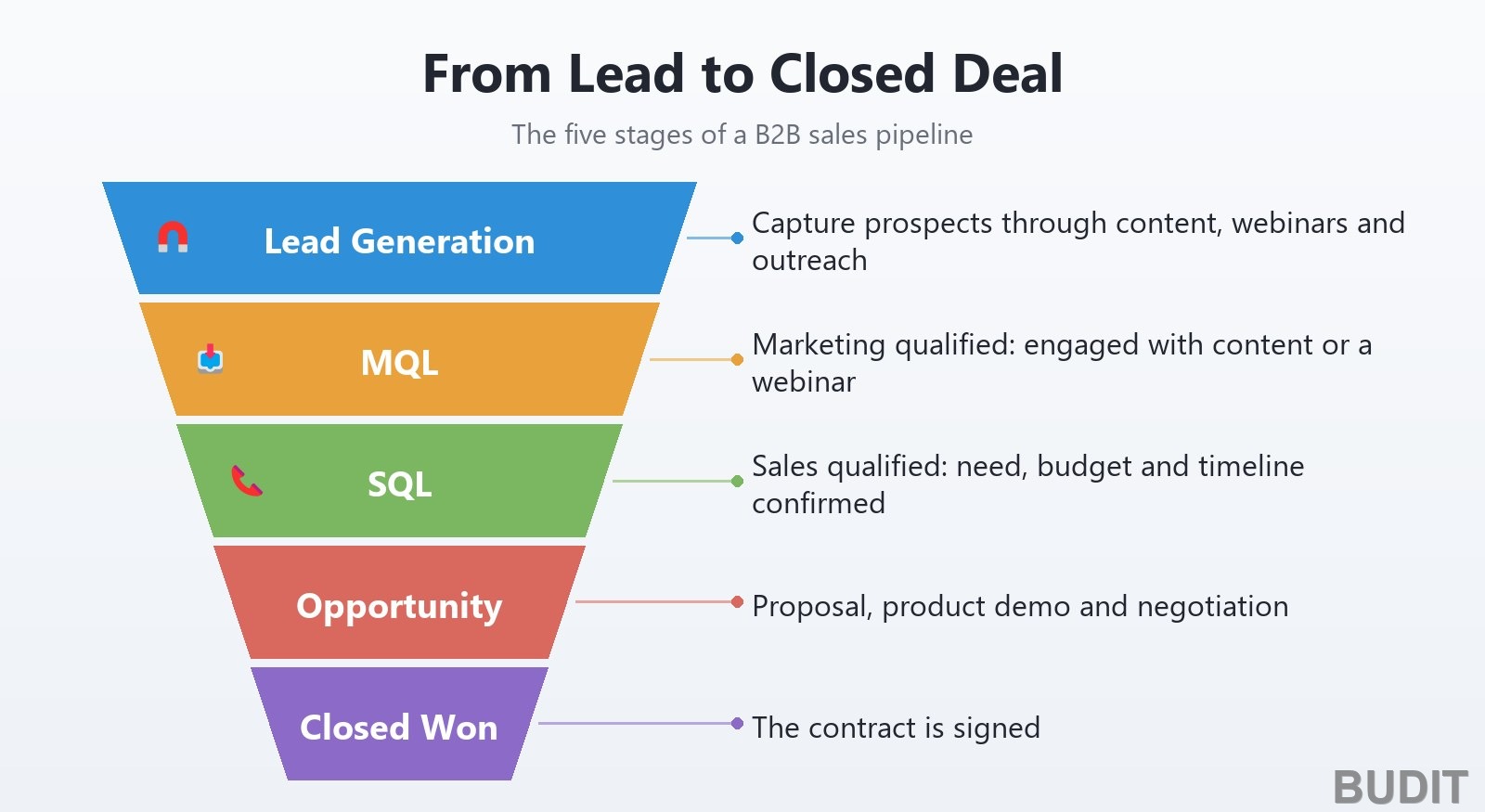
The B2B sales pipeline that turns a lead into a contract
1. Lead Generation: Finding Potential Customers
In B2B, marketing's first job is to create potential customers (leads) that the sales team can actually talk to. People rarely see an ad and pay on the spot the way they do in B2C. Instead, you collect a prospect's details (name, job title, company, email), and then sales reaches out.
Inbound leads: getting customers to come to you
Inbound is about giving prospects a reason to share their details on their own. The main tactics:
- Content marketing: create expert content that solves your customers' problems, such as blog posts, ebooks, reports and guides, and collect contact details when people download it.
- Webinars and seminars: bring interested prospects together in one place and build trust by talking directly with the people involved in the decision.
- SEO and a technical blog: bring in traffic on the problem keywords your prospects are searching for.
Outbound leads: reaching out first to spark interest
With outbound, marketers or salespeople approach prospects directly.
- LinkedIn outreach: you can pick decision makers by job function, company size and industry, which is why it's a widely used B2B channel.
- Cold email: plan your emails as a series that gradually builds interest.
- Trade shows and exhibitions: a chance to meet in person. As we covered in part 3, offline touchpoints help build trust.
Quick tip: Define your ICP (ideal customer profile) first.
- The persona from part 1 of our Marketing Strategy Basics series becomes your ICP in B2B.
- Skip broad labels like "women in their 30s" and get specific: "marketing leads at Series B or later SaaS companies with 50 or more employees."
- The clearer your ICP, the better your leads.
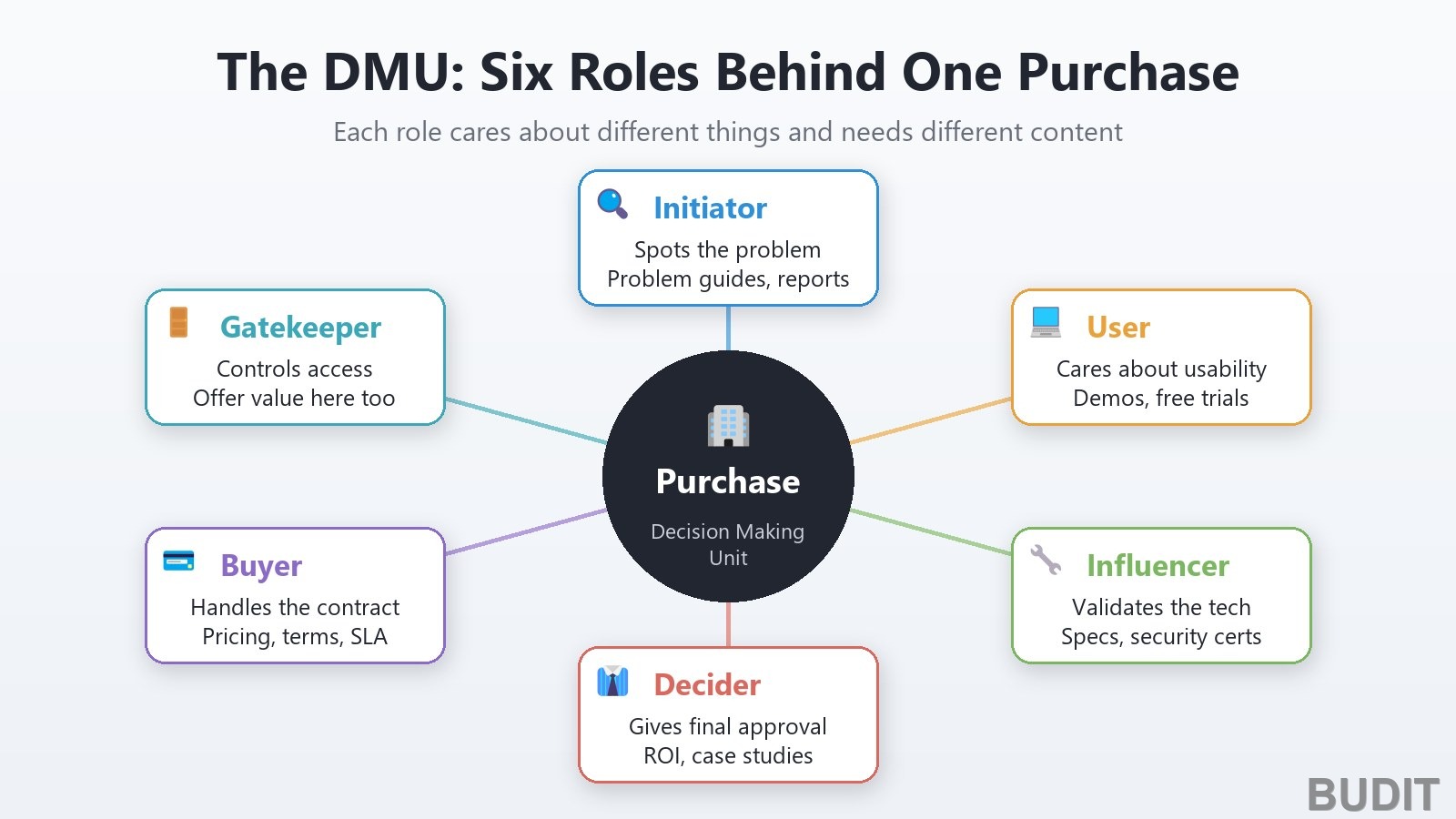
Who do you need to convince in B2B? The six roles of the decision making unit (DMU)
2. Winning Over the DMU: Persuade Each Role Differently
What sets B2B apart from B2C is the DMU (decision making unit). People in several different roles are involved in a single purchase, and each of them has different concerns and needs different information.
The six roles in a DMU
- Initiator: the person who first notices the problem and starts looking for a solution, usually someone on the working team. They need blog posts that define the problem and industry trend reports.
- User: the person who will actually use the product or service, with a strong interest in features and usability. They need demo videos, free trials and user guides.
- Influencer: the person who validates the technology or offers expert opinion, such as a CTO or an engineering lead. They need technical specs, API guides and security certification documents.
- Decider: the person who gives final approval, usually a senior executive. They need ROI analysis, competitor comparisons and customer case studies.
- Buyer: the person who handles the contract and payment, usually in purchasing or procurement. They need pricing proposals, contract terms and SLAs.
- Gatekeeper: the person who manages the flow of information, such as an assistant or an administrator. Either find a way to reach the decider directly, or make sure you offer the gatekeeper useful information too.
The key is to describe the same product in different languages. Tell the team on the ground how much work time it saves. Tell leadership about cost savings and ROI. Tell developers about the API and security certifications. Your USP from part 1 of Marketing Strategy Basics has to be translated for each role in the DMU.
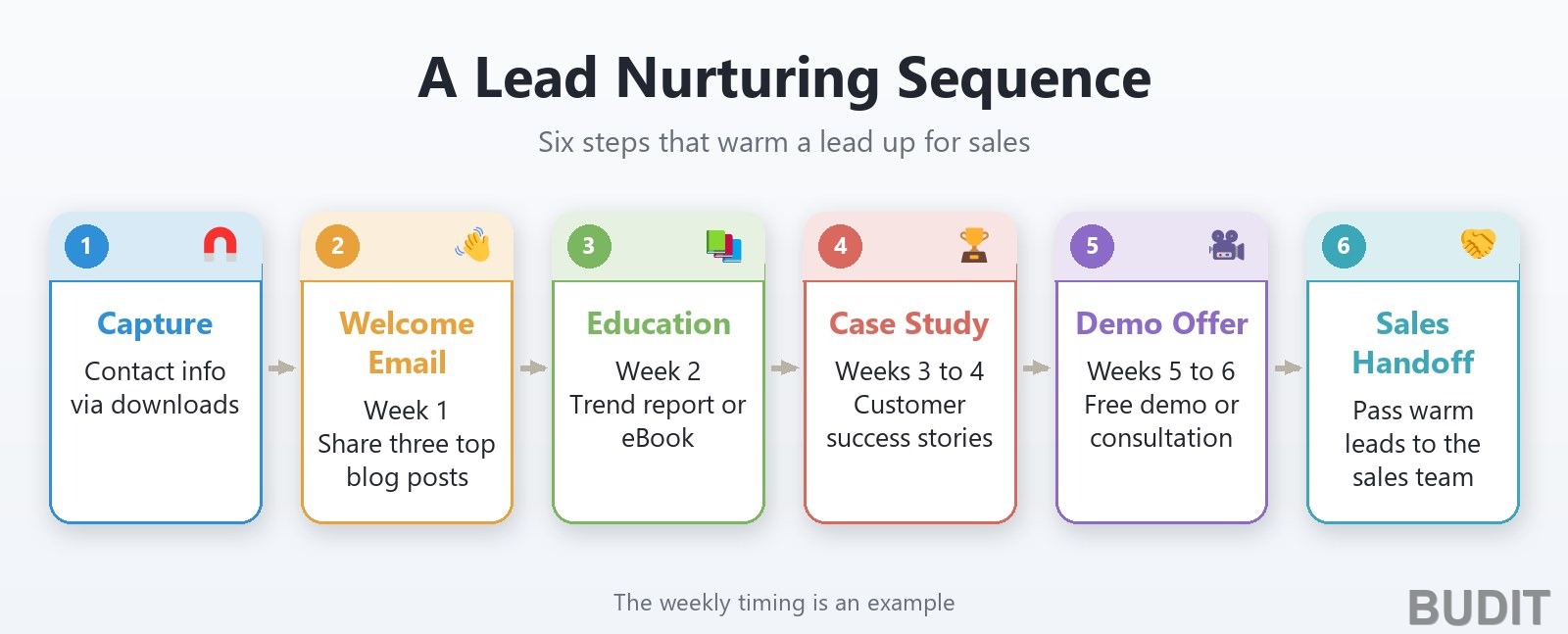
How leads become contracts: lead nurturing and the sales pipeline
3. The Sales Pipeline: A System That Turns Leads into Contracts
Capturing a lead isn't the finish line. In B2B, there's a stretch between a lead and a contract called lead nurturing. You keep in touch with your leads, build interest and trust over time, and hand them to sales once they're ready to buy.
Lead → MQL → SQL → contract
- Lead: a prospect who has shared their details. Purchase intent is still unclear.
- MQL (marketing qualified lead): a lead who has shown interest through marketing activity, such as downloading content or attending a webinar. This is the stage where marketing says, "This one has potential."
- SQL (sales qualified lead): a lead whose purchase intent, budget and timeline sales has confirmed in a direct conversation. This is the "this one can really buy" stage.
- Opportunity and closed won: a proposal, a product demo and contract negotiations lead to the final signed deal.
An example lead nurturing sequence
This is one example. Adjust the timing and content to fit your product and customers.
- Week 1: send a welcome email that points to three popular blog posts.
- Week 2: share an industry trend report or an ebook.
- Weeks 3 to 4: send a customer case study that shows concretely what problem a customer had and how they solved it.
- Weeks 5 to 6: offer a free demo or consultation, and hand the lead off to sales at this point.
Lead scoring: who to approach first
Not all leads are equal. Lead scoring ranks leads by assigning points to what they do (opening emails, requesting a demo, visiting the pricing page) and who they are (job title, company size, industry). Passing the highest scoring leads to sales first helps the sales team use its time better.
A concept often discussed alongside lead generation is demand generation. Instead of just piling up leads, you create the demand itself so customers come looking for you. Publishing expert content consistently to build trust, until customers feel "I want to talk to this company," is one example.
Wrapping Up
B2B marketing is less a game of emotion like B2C and more a game of trust. Deals aren't decided by a single ad. Trust built through consistent content and real expertise turns into contracts over time.
Here are the differences between part 4 (B2C) and part 5 (B2B) at a glance.
| Aspect | B2C (part 4) | B2B (part 5) |
|---|---|---|
| Buying decision | One person, emotional | Several people together (DMU), logical |
| Time to purchase | Usually short | Usually long |
| Core message | Story, emotion, experience | Data, ROI, trust |
| Core channels | Social media, search, commerce | LinkedIn, webinars, content |
| Key metrics | Conversion rate, repeat purchase rate, LTV | Lead volume, MQL to SQL conversion rate, pipeline value |
In part 6, we'll look at B2B2C marketing strategy, which blends B2C and B2B: how platform businesses serve both sides of a two sided market.
Work with Budit
If leads are piling up but not turning into contracts, get in touch with Budit.
Curious how competing solutions pitch themselves in their ads? Take a look first with Competitor Ad Analysis on ViewVibe (sign in and tokens required).