


Stop marketing on gut feel: building a winning marketing backbone (STP & USP strategy)
STP is the foundational marketing framework of Segmentation, Targeting, and Positioning within the customer's mind. USP (Unique Selling Point) is the strategy of defining the selling value that sets you apart from competitors.
Audience: early founders · junior marketers · new-business planners Reading time: about 8 minutes Series: Marketing Strategy Basics, Part 1 Images: 3 | Parts: 4 | Quotes: 5
[Introduction]
"The aim of marketing is to know and understand the customer so well that the product or service fits them and sells itself." — Drucker, P. (2001). The Essential Drucker. HarperBusiness.
When launching a new product or entering a new market, many companies fall for the illusion that "everyone needs our product!" But marketing with an unclear target is like scattering budget into thin air. As management pioneer Peter Drucker put it, true marketing should "make selling superfluous." To get there, you must start by deeply understanding the customer.
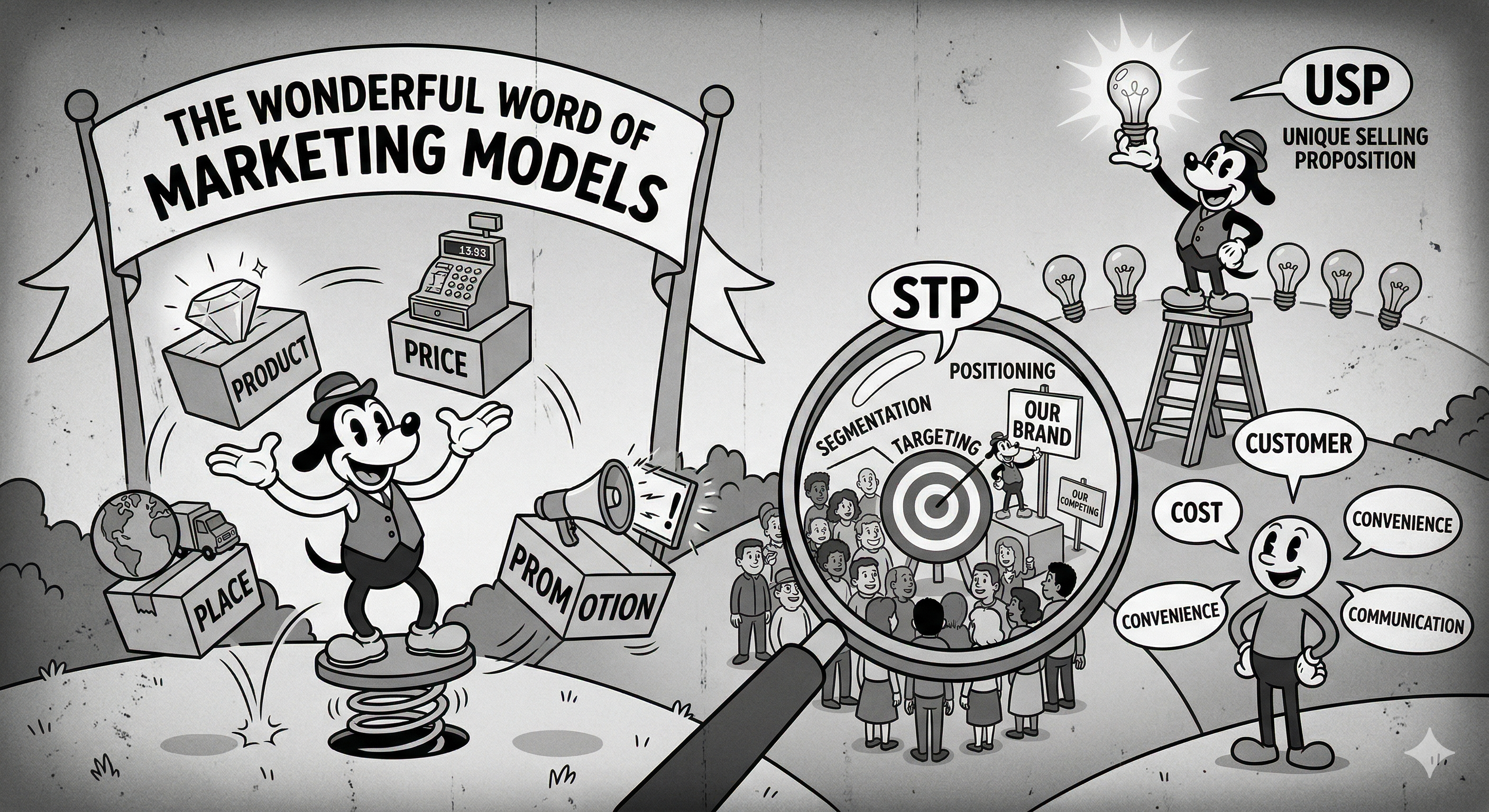
To enter a market successfully, you need a solid strategic backbone built on the traditional 4Ps (Product, Price, Place, Promotion) and the 4Cs (Customer, Cost, Convenience, Communication) that reinterpret them from the customer's point of view.
Today we'll cover STP and USP — the most basic and essential building blocks of data-driven marketing.
 Image description: an infographic showing the overall structure of the STP framework
Caption: the marketing backbone — Segmentation → Targeting → Positioning → USP
Image description: an infographic showing the overall structure of the STP framework
Caption: the marketing backbone — Segmentation → Targeting → Positioning → USP
Part 01. Segmentation: mapping where your customers are hiding
What is segmentation, and why divide the market?
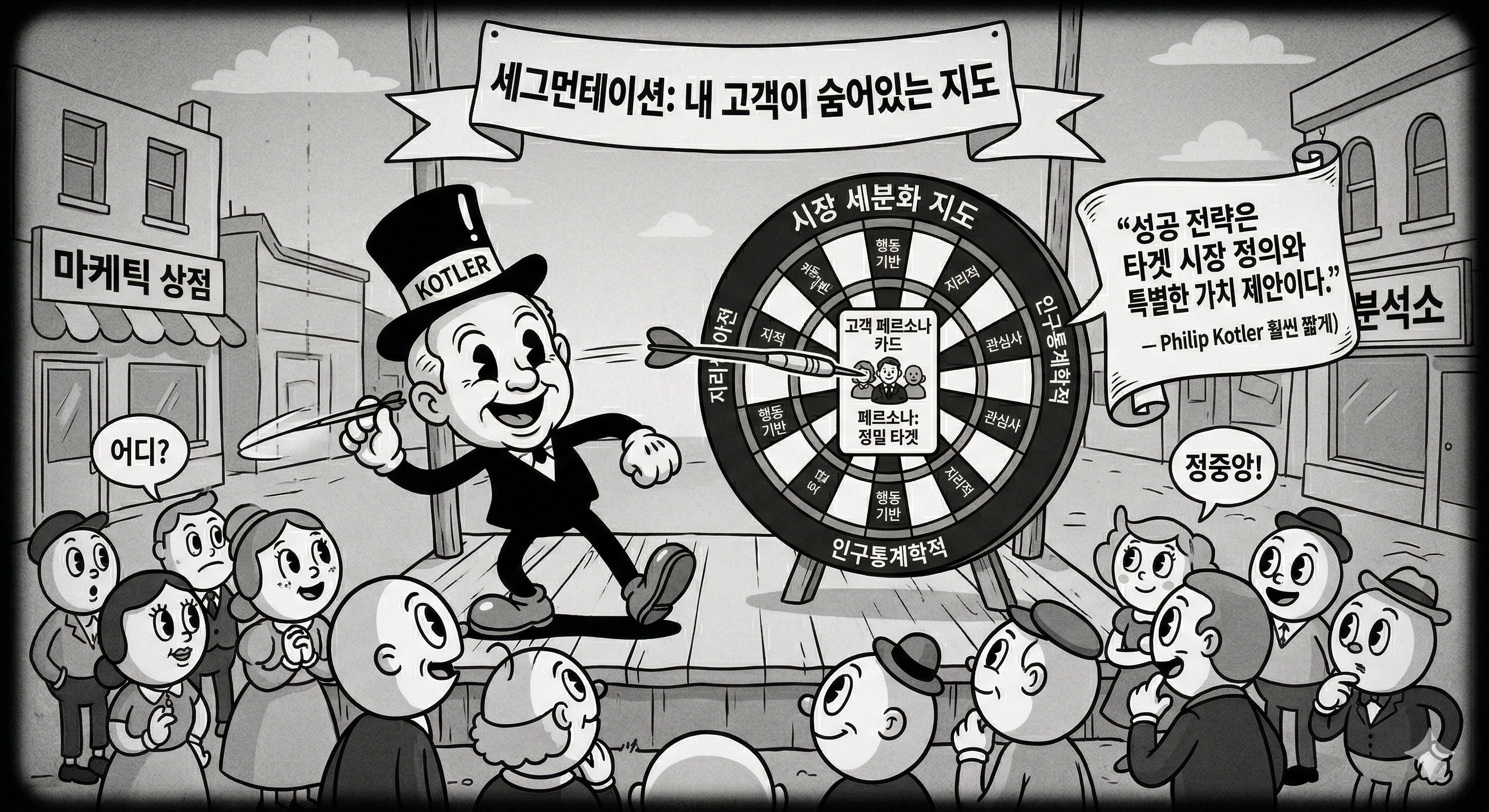
Segmentation is the work of dividing a large market into groups of customers who share similar traits — behavior, geography, demographics, and so on. Rather than sending the same message to everyone, it's the first step toward a tailored strategy for each group.
"There is only one winning strategy. It is to carefully define the target market and direct a superior offering to that target market." — Kotler, P. (2021). Marketing Management (16th ed.). Pearson.
As a company that works with data and technology, we go beyond one-dimensional labels like "women in their 20s," slicing the market finely based on customers' online behavior and interests.
💡 Kotler's 5 principles of segmentation
Effective segments must be Measurable, Substantial, Accessible, Differentiable, and Actionable. — Kotler, P. (2021). Marketing Management.
Part 02. Targeting & Customer Persona: choose and focus
What are targeting and personas, and how do you define your real customer?
Targeting means choosing, from the segmented market, the group you can satisfy best — and building a marketing strategy for that specific segment.
"No sane company tries to sell to everyone." — Kotler, P. (2021). Kotler On Marketing. Free Press.
The key here is defining a customer persona — a concrete, semi-fictional profile of your target customer, drawn from demographics, behavior patterns, and more. Only when you define a living, breathing persona — their daily routine, their worries, the media they consume — can you craft a razor-sharp marketing message.
"Don't try to make a product for everybody, because that is a product for nobody." — Godin, S. (2018). This Is Marketing. Portfolio.
💬 Wondering whether your brand's targeting is on point? Check for yourself how much your brand keywords are being searched right now. → [Go to trend search] → Quick inquiry via KakaoTalk
Part 03. Positioning: winning the battle for perception
What is positioning, and how do you claim a place in the customer's mind?
Positioning is the strategy of clearly surfacing what makes your brand different from similar products, so it takes hold in the customer's perception. When the right message meets effective media operations, strong positioning is achievable even through performance marketing.
"Positioning is not what you do to a product. It is what you do to the mind of the prospect." — Ries, A. & Trout, J. (1981). Positioning: The Battle for Your Mind. McGraw-Hill.
You must own the "single keyword" that comes to a target customer's mind first — "the affordable platform," "the fastest solution," and so on. As Al Ries and Jack Trout stressed, you should become the brand that finds an empty space in the customer's mind and fills it first.
💡 The key to successful positioning
"You must reduce the essence of your brand to a single thought or attribute." — Al Ries. To get inside the customer's head, focus on one simple, powerful keyword instead of a complex message.
Part 04. USP (Unique Selling Point): the fatal charm that opens wallets
What is a USP, and why does it decide the fate of performance marketing?
A USP (Unique Selling Point) is a value proposition — a strategy that highlights the differentiated strengths of a brand or product. The key is to find value only you can offer, not something competitors could say too.
"People do not buy goods and services. They buy relations, stories, and magic." — Godin, S. (2005). All Marketers Are Liars. Portfolio.
A USP goes beyond a mere concept and directly drives ad performance. It matters so much that whether your product has a fitting USP can decide the success or failure of performance marketing. Among a product's many features, we extract the point we most want to appeal to (the selling point) and relentlessly test to find the message that drives the highest performance in the market.
Completing your strategy with storytelling
Once STP and USP form the backbone of your strategy, you need a "story" to deliver that strategy to customers. Modern marketing isn't about listing product features — it's about creating a story customers can relate to.
Even a great USP is useless if you can't deliver it as a "story." Getting customers to spread your brand's story voluntarily — that is the true completion of marketing. Kotler, too, emphasized that "a satisfied customer is the best advertisement."
[Closing]
So far we've covered the concepts of STP and USP for a successful market entry. But knowing the theory and actually applying it to your business with data are two entirely different things.
"Marketing is a generous act of helping someone solve a problem. Their problem." — Godin, S. (2018). This Is Marketing. Portfolio.
To build up "social proof" that raises trust — customer reviews, best-seller records, and the like — meticulous early design is essential.
About the author
Budit Brand Team We combine data-driven performance marketing with brand strategy and have delivered many projects. Through the Marketing Strategy Basics series, we share practical know-how with early founders and junior marketers.
[CTA]
Not sure whether your brand's marketing direction is right? From precise, data-driven targeting to media operations that maximize conversion, Budit's marketing experts will help you diagnose your business.
▶ Request a free consultation via KakaoTalk ▶ Get a free marketing diagnosis for your brand ▶ Check your brand keyword trends yourself → [Trend search]
Marketing Strategy Basics series
✅ Part 1: STP & USP strategy — building a winning marketing backbone (this article) 👉 Part 2: Mastering performance marketing — channel traits and budget allocation [link] 👉 Part 3: Conversion Rate Optimization (CRO) — turning visitors into customers [link] 👉 Part 4: Customer journey map — an integrated content strategy [link] 👉 Part 5: GA4 and KPIs — measuring marketing performance with data [link] 👉 Part 6: Growth hacking & AARRR — designing your growth engine [link]
References
- Kotler, P. (2021). Marketing Management (16th ed.). Pearson. — STP strategy, 4P framework, 5 principles of segmentation
- Drucker, P. (2001). The Essential Drucker. HarperBusiness. — quotes on marketing and customer value
- Ries, A. & Trout, J. (1981). Positioning: The Battle for Your Mind. McGraw-Hill. — positioning concept and quote
- Godin, S. (2018). This Is Marketing. Portfolio. — targeting and storytelling philosophy
- Godin, S. (2005). All Marketers Are Liars. Portfolio. — the power of USP and story
- The 4P and 4C frameworks are based on general marketing theory.
[Marketing Strategy Basics] Stop marketing on gut feel: building a winning marketing backbone (STP & USP strategy) | Budit Brand Team
The Marketing Strategy Basics series is published irregularly online, capturing the knowledge and questions of marketers working with Budit.