Customers Don't Move in Straight Lines: Building Your Content Strategy With a Customer Journey Map
A customer journey map is a visual map of everything a customer experiences, from the moment they first hear about your brand through purchase, repeat purchase and referral. Once you've drawn it, you can put the right content and channels in front of customers at every stage.
This is part 4 of our Marketing Strategy Basics series. Catch up on part 1 on STP and USP, part 2 on performance marketing and part 3 on conversion rate optimization.
In part 3 we used CRO to find bottlenecks in the funnel and lift conversion rates. But a funnel focuses on what happens inside your own site. Real customers move through a much bigger world.
Someone might first spot your brand on Instagram, read a blog post a friend recommended, or only visit your site after looking up reviews on Naver, Korea's largest search portal.
In this post we'll look at how to map the entire customer journey and place the right content at each stage.
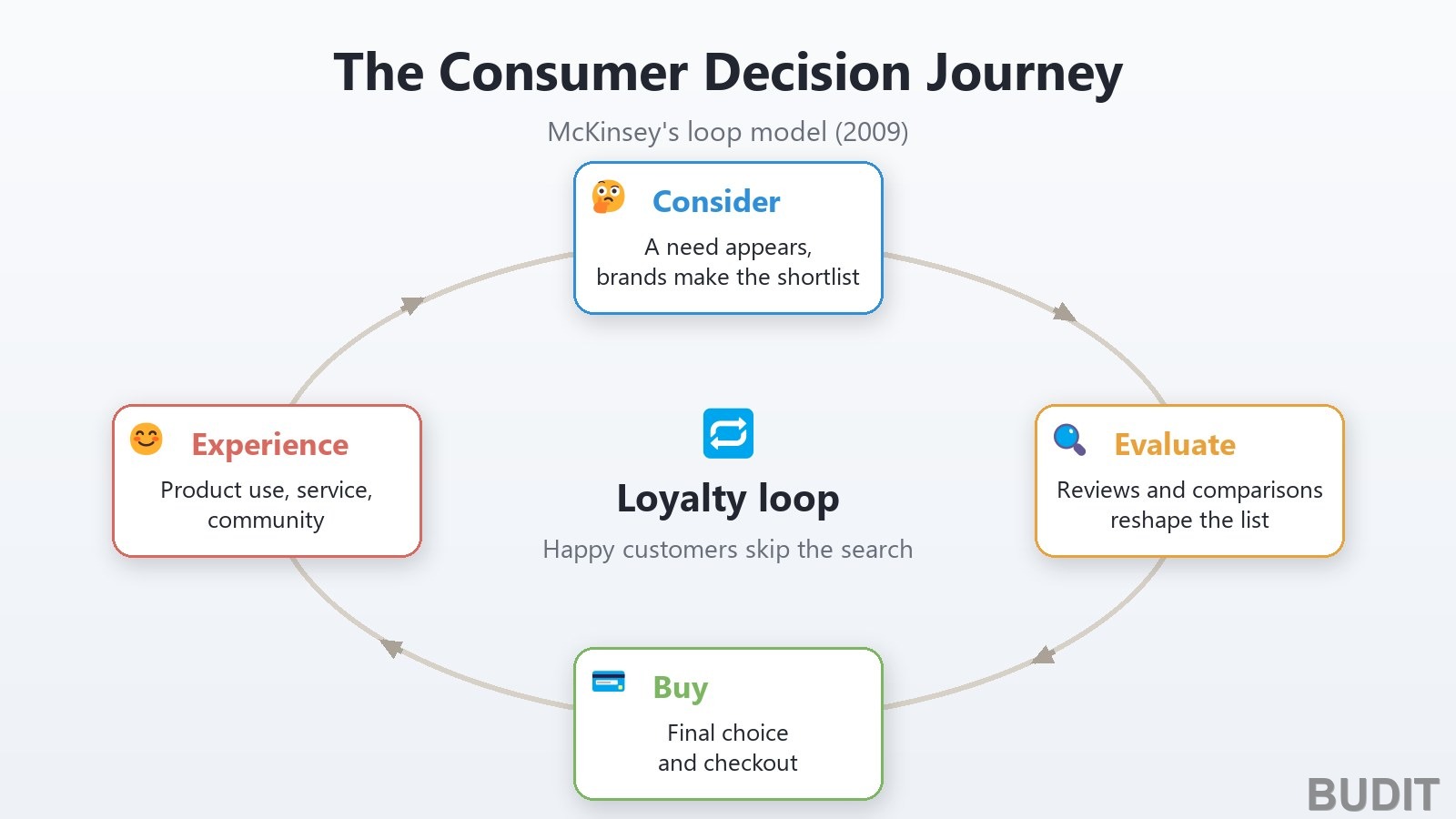
The customer journey is a loop, not a straight line. Adapted from McKinsey's consumer decision journey model.
1. The Customer Journey Map: Seeing the World Through Your Customer's Eyes
A customer journey map is a visual map of the full experience a customer has with your brand, from first awareness through purchase, repeat purchase and referral.
The traditional marketing funnel was a straight line from awareness to interest to purchase. In 2009, McKinsey studied the purchase decisions of almost 20,000 consumers across five industries and three continents and described the consumer decision journey, which works as a loop instead. It has four stages.
- Initial consideration: The customer feels a need and puts a handful of brands on the shortlist. This is where the positioning from part 1 does its work.
- Active evaluation: The customer looks up reviews, compares options and asks people around them. Along the way, brands that weren't on the list can get added, and brands that were can drop off.
- Closure: The final choice and payment. This is where the CRO from part 3 pays off.
- Postpurchase experience: Using the product, customer service and community. When this experience is good, it creates a loyalty loop: next time, the customer skips shopping around and goes straight back to the same brand.
The customer persona you set up in part 1 comes back here. Every persona travels a different path, so the journey of "Manager Kim, an office worker in his 30s" and that of "Dabin Lee, a freelancer in her 20s" will look like completely different maps.
Quick tip: build your customer journey map in five steps.
- Choose personas: pick one or two core personas you created in part 1.
- Define the stages: awareness, evaluation, purchase, experience, then loyalty and referral.
- List the touchpoints: every place the customer meets you at each stage (social media, search, reviews, stores, customer support and so on).
- Draw the emotion curve: how the customer feels at each stage (expectation, anxiety, satisfaction, frustration and so on).
- Mark the opportunities: wherever emotions dip, there's room to improve.
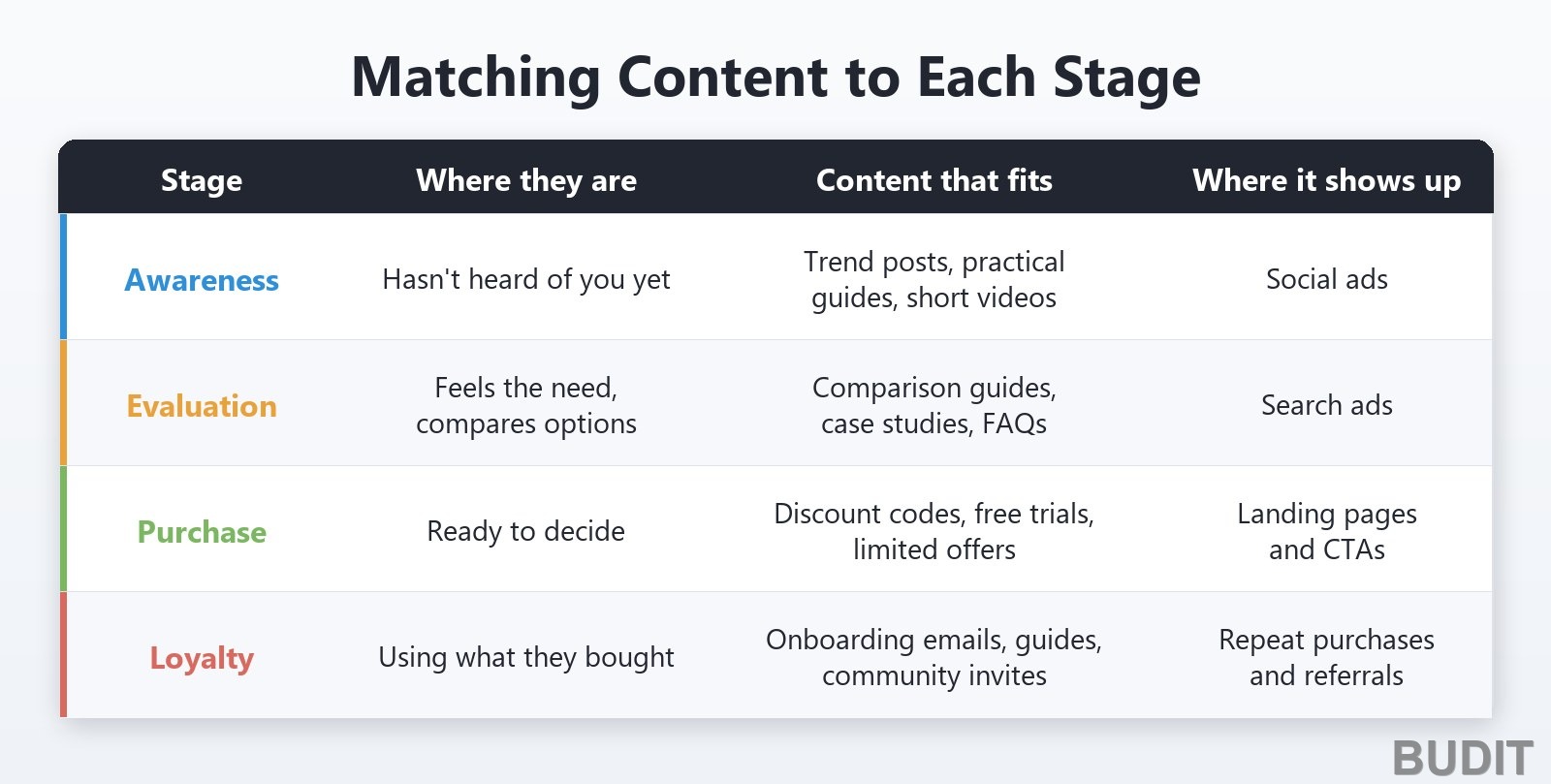
Meet customers where they are: mapping content to each stage of the journey.
2. Content for Each Journey Stage: Say Something Different at Every Step
Once your journey map is drawn, it's time to place the content customers need at each stage. Even for the same product, what customers want to know changes completely depending on where they are in the journey.
Awareness stage: The customer doesn't know your brand yet. Content that helps them recognize a problem fits here, such as industry trends, blog posts that solve common problems and short videos. The social ads we covered in part 2 are the typical channel for this stage.
Evaluation stage: The customer already feels the need and is actively comparing options. Detailed comparison guides, case studies and FAQs belong here. The search ads from part 2 target this stage.
Purchase stage: This is the moment the customer thinks, "This is the one." They need content that prompts action right away, like discount codes, free trials and offers that expire soon. The landing pages and CTAs from part 3 play this role.
Experience and loyalty stage: After the purchase, onboarding emails, user guides and community invitations are what count. Design this stage well and you get what McKinsey calls the loyalty loop, where customers come back and recommend you to others.
What matters is saying what the customer needs to hear at that moment, not what you want to say. Leading with price for someone in the awareness stage, or showing an industry trends article to someone about to buy, means telling a story that doesn't fit where they are.
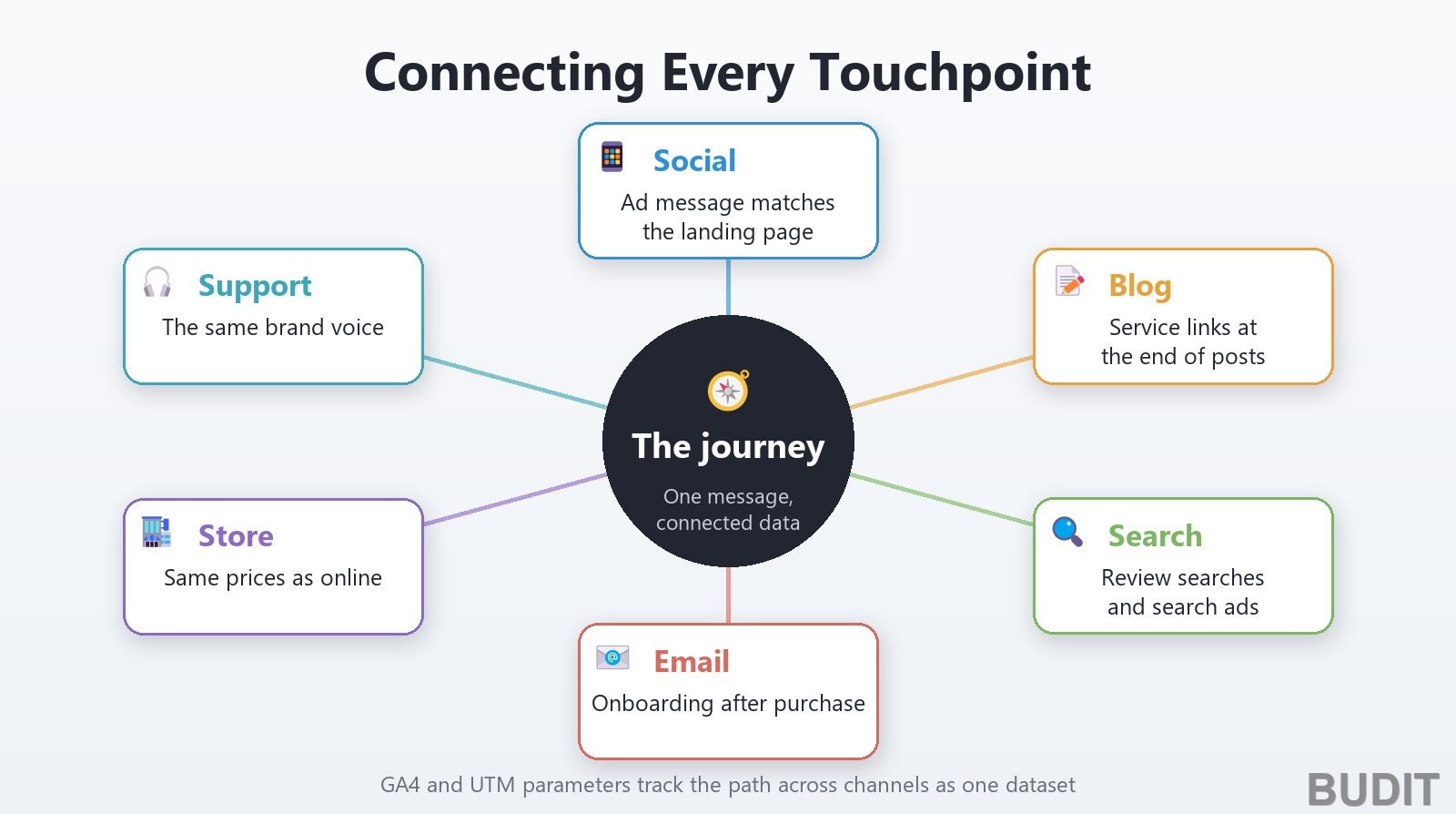
A seamless customer experience: an omnichannel strategy that connects every touchpoint.
3. Touchpoint Integration: Creating a Seamless Experience
With the journey mapped and content placed at each stage, the last step is connecting your touchpoints. When customers move across several channels, the experience easily breaks down if the message or the price differs from one channel to the next.
Say the message in your Instagram ad doesn't match the one on your landing page, or the price online differs from the price in your store. Customers get confused and leave.
To prevent that, keep three things in mind.
- Consistent messaging: The USP and positioning you defined in part 1 should come through in the same tone on every channel. Across ads, blog posts, emails and customer service, the core message of "we're the brand that does X" should never waver.
- Connected data: When a customer reads a blog post, clicks an ad and then sends an inquiry, that whole path should be tracked as one set of data. GA4 and UTM parameters, which we cover in part 5, handle this.
- Smooth handoffs between stages: Put related service links at the end of blog posts, customer reviews on product pages and an onboarding email after checkout. Each piece of content should act as a bridge to the next stage.
A customer journey map isn't just a diagram. It's a shared language for marketing, sales, customer service and product teams. Only when everyone agrees that "our customers feel this way and need this information at this stage" can the whole organization move in the same direction.
Wrapping Up
The customer journey map is the framework that ties together everything we've covered so far.
- STP and USP from part 1: where the journey starts (who you serve, and with what value)
- Performance marketing from part 2: choosing the right channel for each stage
- CRO from part 3: optimizing conversion at the purchase stage
- The customer journey map from part 4: bringing it all together from the customer's point of view
In part 5, we show how to measure the results of this journey by setting up GA4 and your key metrics (KPIs).
Work with Budit
Want to understand how customers discover your brand and where they drop off? Get in touch with Budit. We'll look at your customer journey and a content strategy for each stage with you.
To see what people in the evaluation stage are searching for on Naver, check search and shopping trends in Naver Trends on ViewVibe (requires signing in).
References
- David Court et al., "The consumer decision journey," McKinsey Quarterly (2009): the loop model of the consumer decision journey, based on the purchase decisions of almost 20,000 consumers, mckinsey.com
- Part 1: Stop Marketing on Gut Feel: Building Your Marketing Backbone With STP and USP
- Part 2: Is Half Your Ad Budget Wasted? A Guide to Performance Marketing Channels and Budget Allocation
- Part 3: Turning Visitors Into Customers: A Practical Guide to Conversion Rate Optimization (CRO)