
Rent a Platform or Build Your Own Store? Marketplaces, Your Own Store and D2C Strategy
D2C (direct to consumer) means selling straight to shoppers through your own online store instead of through Korean marketplaces like Coupang or Naver Shopping. Marketplaces lend you traffic, while your own store lets you own the customer relationship. For many brands, the realistic answer is a hybrid: start on marketplaces, then shift your weight to your own store.
This is part 2 of our Channels and Business Models series. Catch up on part 1, our map of Korea's retail channels.
In part 1, we mapped out Korea's retail channels. This time we take on a more fundamental question: should you sell on someone else's platform, or build a store of your own?
Marketplaces already have the crowds, so they're a good place to make sales quickly, but it's hard to control your customer data or your brand experience there. On the other hand, early stage brands that start with their own store often find that buying traffic costs so much their cash flow can't keep up.
The answer isn't one or the other. In this post, we'll look at the strengths and weaknesses of marketplaces and your own store, and how to design a hybrid strategy that fits your business.
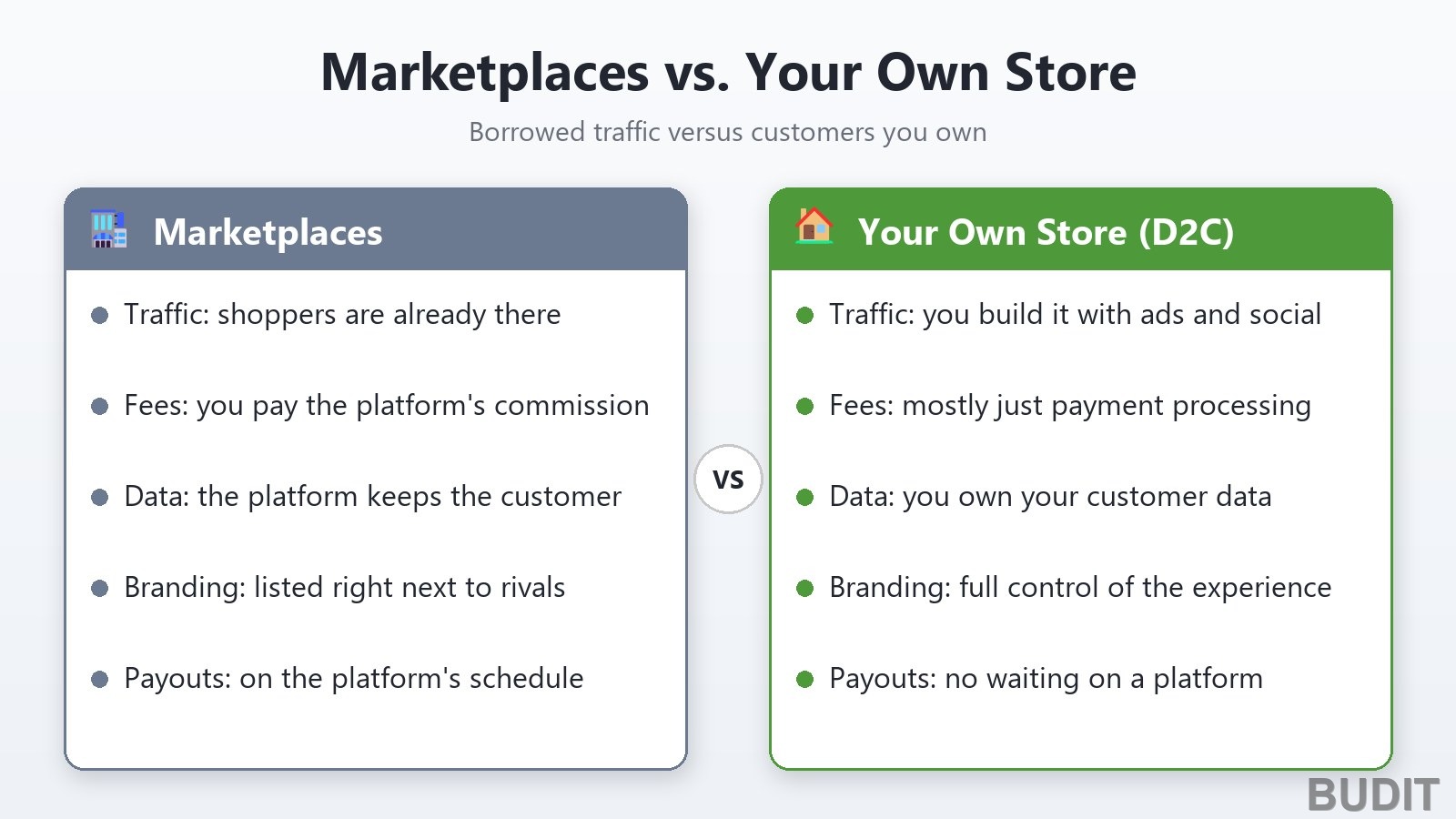
Borrowed traffic versus customers you own: the core difference between marketplaces and your own store
1. Platform vs. D2C: What's Different
Where marketplaces shine, and where they fall short
The upside is clear. On Coupang or Naver Shopping (Naver is a major Korean search portal), you're setting up a stall right where the crowd already is. Acquisition costs stay low early on, and sales can come quickly. Getting listed is also usually simpler than launching a store from scratch.
The downsides are just as clear. First, you don't own the customer data. It's hard to see who bought your product on Coupang, how they found it, or what they'll want next. The GA4 analysis we covered in Marketing Strategy Basics part 5 is hard to do properly inside a marketplace.
Second, you live by the platform's rules. Algorithm changes, fee hikes, late payouts: the seller absorbs those risks. In July 2024, the Korean marketplaces TMON and WeMakePrice failed to pay sellers on time, a stark example of how risky platform dependence can be.
Third, it's hard to control the brand experience. Your product sits right next to your competitors', and side by side price comparisons can easily pull you into a price war.
Where your own store shines, and where it falls short
The core advantage is ownership. Customer data, brand experience, pricing: you control all of it. Connect GA4 (from part 5 of Marketing Strategy Basics) to your store and you can track where customers come from, how they behave, and what they buy. Then you can use that to run personalized marketing like retargeting and automated email.
Instead of marketplace commissions, you mainly pay payment processing fees and the cost of your store platform, and you don't have to wait on a marketplace's payout schedule.
The catch is traffic. A brand new online store is a shop that just opened its doors. Nobody wanders in on their own, so you have to generate traffic yourself with the performance marketing we covered in Marketing Strategy Basics part 2. Upfront costs for the site, marketing, and logistics run higher than on a marketplace, and it takes time for sales to stabilize.
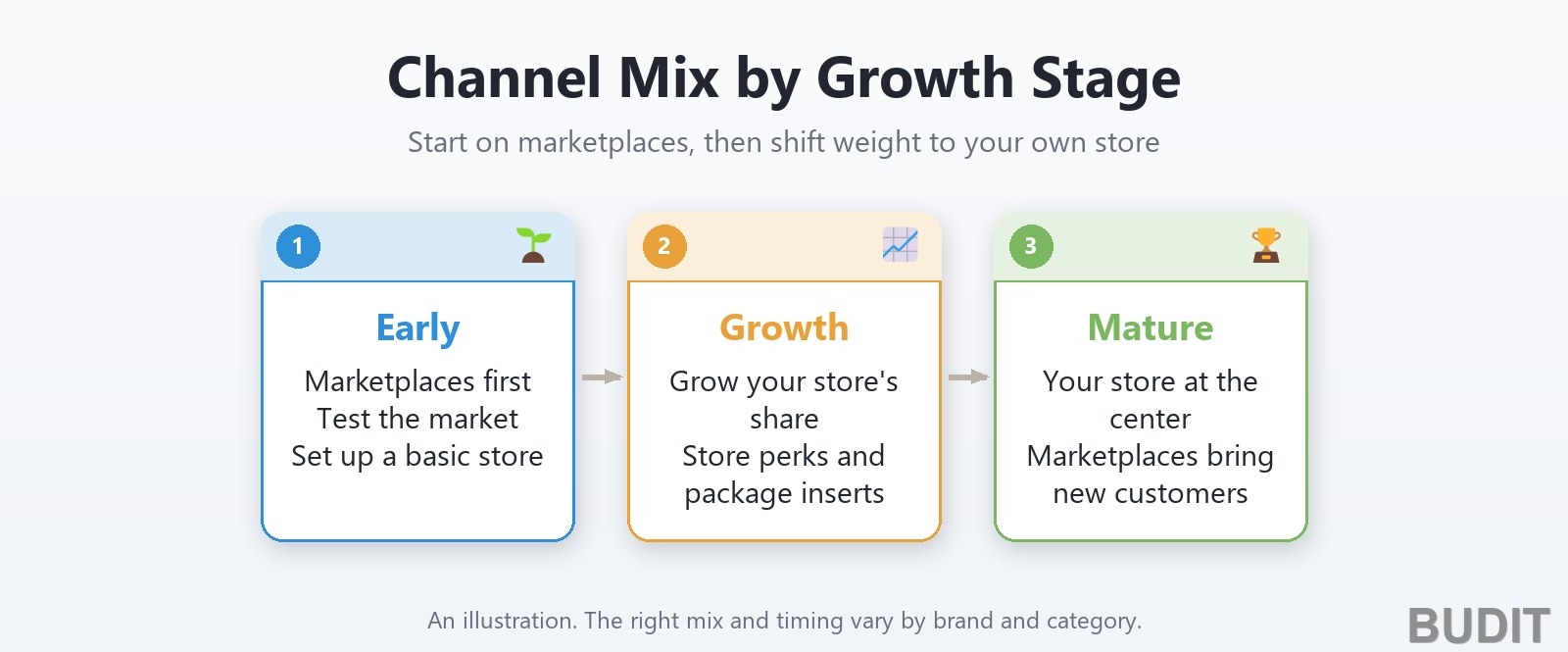
Adjust your channel mix as you grow. Start on marketplaces and shift your center of gravity to your own store.
2. The Hybrid Strategy: Start on Marketplaces, Grow Your Own Store
For many brands, the realistic answer is both. What really matters is the mix and the timing.
Adjusting your channel mix as you grow
The stages below are an illustration. The right mix and the right time to shift depend on your brand and category.
Early stage: marketplaces first
The priority is making sales quickly on platforms that already have traffic and seeing how the market responds. Meanwhile, set up a basic store (on Cafe24, a Korean store builder, or on Shopify) and use your brand's social accounts to start sending people there.
Growth stage: grow your own store's share
Start steering buyers of the products that proved popular on marketplaces to your own store. Store only perks (a first order discount, membership points) and an insert card in every package pointing to your store are common tactics.
Mature stage: your own store at the center
Your own store becomes the center of your revenue, and marketplaces become a channel for meeting new customers. The goal is a flow where shoppers discover you on a marketplace and come back to your store to buy again. This is where the growth loops from Marketing Strategy Basics part 6 come in.
Choosing a store builder
In Korea, tools you can use to build your own store include Cafe24, NHN Commerce (Godomall), MakeShop, imweb, and Shopify. They let you customize the design, connect payments, and handle basic customer management without developers. But the platform you pick matters less than the experience you'll give customers once they're in your store.
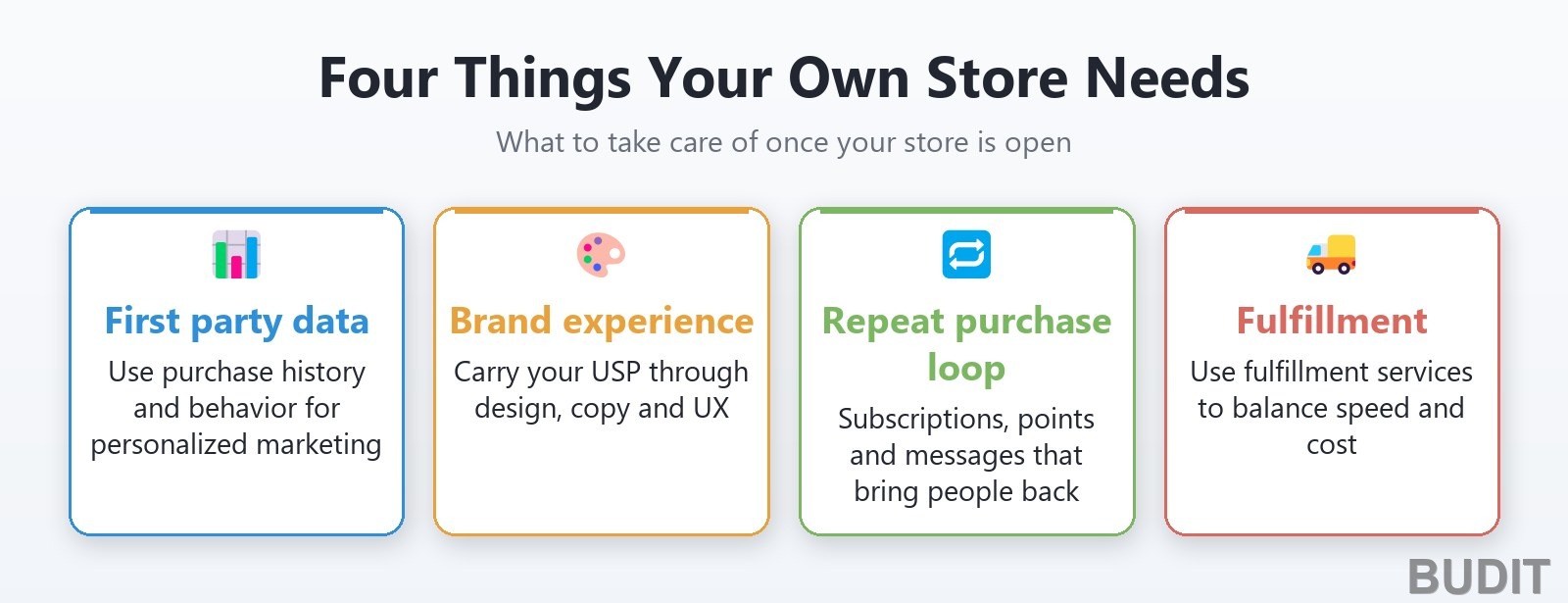
Four things to take care of once your own store is open
3. D2C Essentials: Growing Your Own Store
Opening a store doesn't make you a D2C brand. You need to take care of these four things as well.
- Put first party data to work. Owning your customer data is your store's biggest advantage. Collect first party data like purchase history, on site behavior, and email engagement, then build personalized marketing on top of it. This is where GA4 (part 5) and the retention strategies from part 6 are especially useful.
- Build a distinct brand experience. On a marketplace, every product shows up in the same page layout. On your own store, you can bring your brand's world to life. The USP and positioning from Marketing Strategy Basics part 1 should run through your store's design, copy, and user experience.
- Design a repeat purchase loop. In D2C, profit comes more from repeat orders than from the first one. Build in reasons to come back, such as subscriptions, reward points, and messages aimed at customers who haven't visited in a long time.
- Solve fulfillment. This is the most practical challenge for any online store. Shoppers used to fast delivery lose interest when shipping is slow. Use a fulfillment service that handles storage, packing and shipping to keep delivery quality high while keeping costs under control.
Quick tip: ways to bring marketplace customers to your own store
- Package inserts: tuck a card with a QR code for a first order discount on your store into every box.
- Social profile links: point the link in your Instagram and TikTok profiles to your store.
- Store exclusives: sell limited editions and bundles that shoppers can only get on your own store.
- Review rewards: give extra points for reviews written on your store.
Final Thoughts
Your own store versus marketplaces is a question of where you start, not where you end up. Consider starting on marketplaces, checking how the market responds, and then moving your center of gravity to your own store.
In part 3, we move offline: the process of getting into physical retail, from buyer meetings to writing your proposal.
Work with Budit
If you're weighing your channel strategy between marketplaces and your own store, get in touch with Budit.
You can compare what competing products sell for on marketplaces with ViewVibe's Price Scanner (sign in required).
References
- KB Think, "TMON and WeMakePrice Settlement Delays: Is Qoo10 Shaken?" (July 26, 2024, in Korean): the TMON and WeMakePrice seller payment delays
- Part 1 of this series: our map of Korea's retail channels
- The Marketing Strategy Basics series: part 1, STP and USP · part 2, performance marketing · part 3, conversion rate optimization · part 4, customer journey maps · part 5, GA4 and KPIs · part 6, growth hacking and AARRR