



How Many English Words a Day Is Right for a Child
『Ten words a day, so three hundred in a month.』 Almost everyone does this sum on the way home with a new vocabulary book. A month later, very few children still have three hundred words. The research counts differently. Whether a word stays depends less on 『how many you look at』 than on 『how many times, at what intervals, and in what way you meet it again』. Work the daily amount out that way and the number is smaller than you expect, and it lasts.
Video: the 『10 a day × 30 days』 sum turns into 『5 new + 15 review』, then the Day word table and the game screen (no sound)
At a glance
| Question | What the research says |
|---|---|
| How many times must a word be met | Words met about ten times in reading showed clear gains in meaning and spelling; one or two meetings left almost nothing |
| Cramming versus spreading out | For the same number of meetings, spreading them over days lasts longer. The more space between reviews, the larger the effect |
| Rereading versus recalling | Trying to recall a word from memory left far more in a test a week later than reading the list again |
| A benchmark for elementary children | About 5 new words a day plus 10 to 15 review words is what the count produces |
| How many words are needed | Most everyday English is covered by about 2,000 to 3,000 word families, and the elementary years are for securing the first thousand |
A word seen once does not stay
In a 2007 study Webb had learners meet the same new words in text once, three times, seven times or ten times, and measured meaning, spelling and use separately. Words met ten times showed clear gains on several measures; words met once showed almost none. Knowledge grew with every extra meeting, but there was no number of meetings at which a word was learned all at once. Vocabulary is less 『memorizing』 than 『meeting again』.
So the ten a day sum is wrong from its first line. Today's ten must be met again tomorrow, in three days and next week, which means that on any given day the words in front of a child should be mostly review words, not new ones.
Spread out meetings last longer
In 2006 Cepeda and colleagues pulled together 254 earlier studies of repeated study. For the same amount of study, spreading sessions across days left more in the test than packing them into one day, and the longer the gap until the test, the longer the gap between reviews should be. This is the 『spacing effect』.
Whether it holds for foreign language vocabulary was checked by Nakata in 2015. Learners studied words on a computer with review intervals that were either even or gradually expanding. Both beat massed study, and having gaps mattered more than the exact shape of the gaps. At home this means: a word seen today gets one review tomorrow, one in three days and one in a week. Those three are the word's 『review slots』.
Have them recall, not reread
In a 2008 study in Science, Karpicke and Roediger had people learn foreign words in two ways. One group reread the word list; the other took repeated tests, trying to recall the meanings with the answers covered. During study the two looked similar, but in a test a week later the recall group kept far more. Rereading gives the feeling of 『knowing』 while adding little to memory.
Instead of having a child reread the wordbook, cover the meaning and ask 『what was this one?』. The same minutes leave much more behind. Mistakes are fine. Looking at the answer after a miss is itself a form of retrieval.
Which words to choose
In a 2012 article Schmitt and Schmitt reviewed the frequency research and put the number of word families needed to cover most everyday English at about 2,000 to 3,000. Learning the most frequent words first means more sentences become readable for the same effort. What the elementary years secure is the first thousand or so of these: words that attach straight to a child's life, like home, school, body and food.
One more thing about choosing. Metcalfe and Kornell reported in 2005 that people learn most from items that are neither too easy nor too hard but 『almost there』. Between words a child already knows and words they have never seen, the half known words are the best material for a day's set.
What the count produces
Put the research into one child's week. Five new words a day. Yesterday's five again today, the five from three days ago again today, the five from a week ago again today. That gives about twenty words a day: five new and fifteen review. In a month that is a little over a hundred new words, but each met four or more times, spaced out, and recalled rather than reread.
| New words | Review words | Daily total | |
|---|---|---|---|
| Lower elementary | 3 to 5 | about 10 | about 15 |
| Upper elementary | 5 to 8 | about 15 | about 20 |
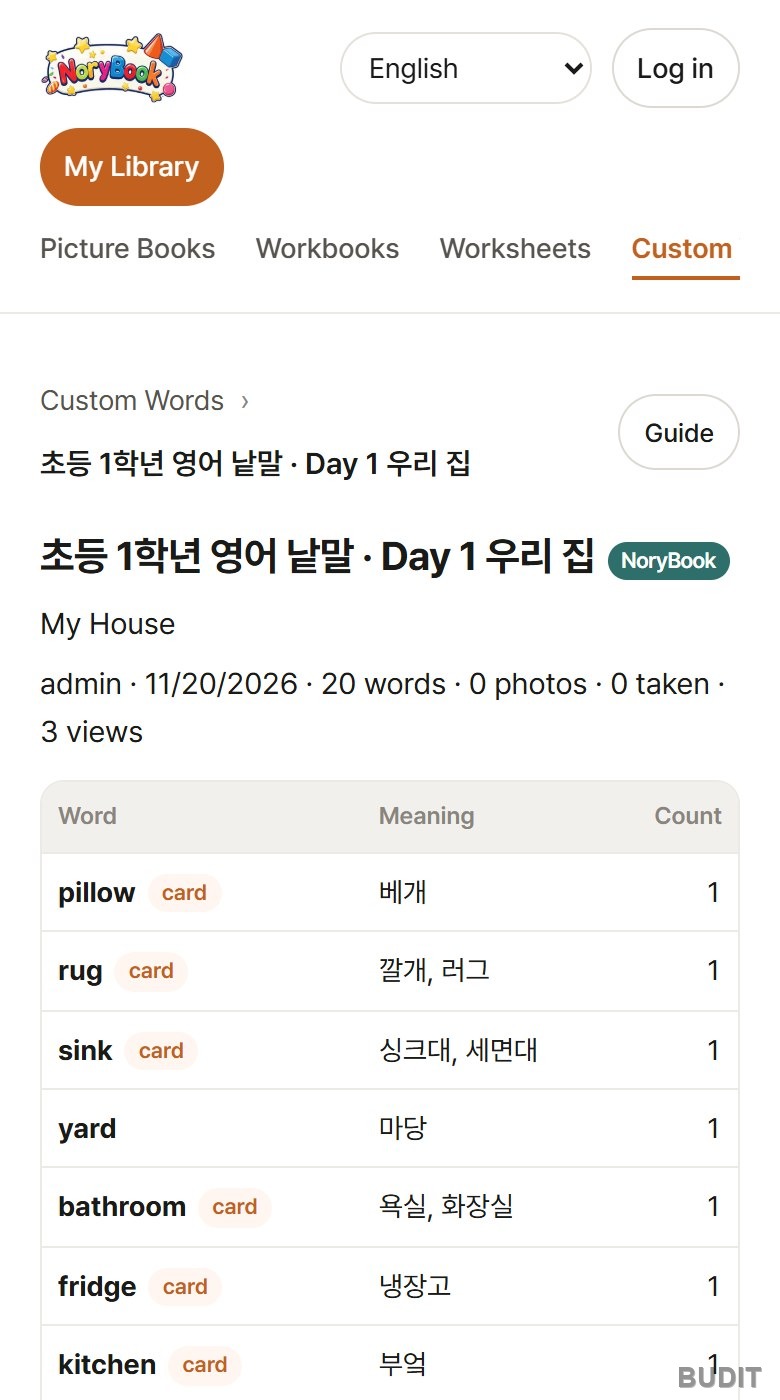
Photo: the 『Grade 1 English Words · Day 1 My House』 set in 『NoryBook』 shared wordbooks (as of November 23, 2026). One day's set is 20 words, starting with words that attach to a child's life, like things at home. See the shared wordbooks
These numbers do not come straight from a study; they come from fitting the repetition counts and intervals into a child's day. Children differ, and there are days when ten is easy and days when three is a struggle. What should not change is the ratio: more review than new.
Try this at home
- Keep new words to five a day. Words from the child's own life, and half known words, come first.
- Put reviews in three slots: tomorrow, in three days, in a week. Mark them on a calendar so nobody has to count.
- Review by asking, not by reading. Show the picture and ask 『what is it in English?』; show the English and ask 『what does it mean?』. After a miss, look at the answer and move on.
- Let games do the recalling. Matching pairs and dictation are retrieval practice the child does not notice.
- Once a month, mix everything and ask. The words that come out of a mixed pile are the ones that really stayed.
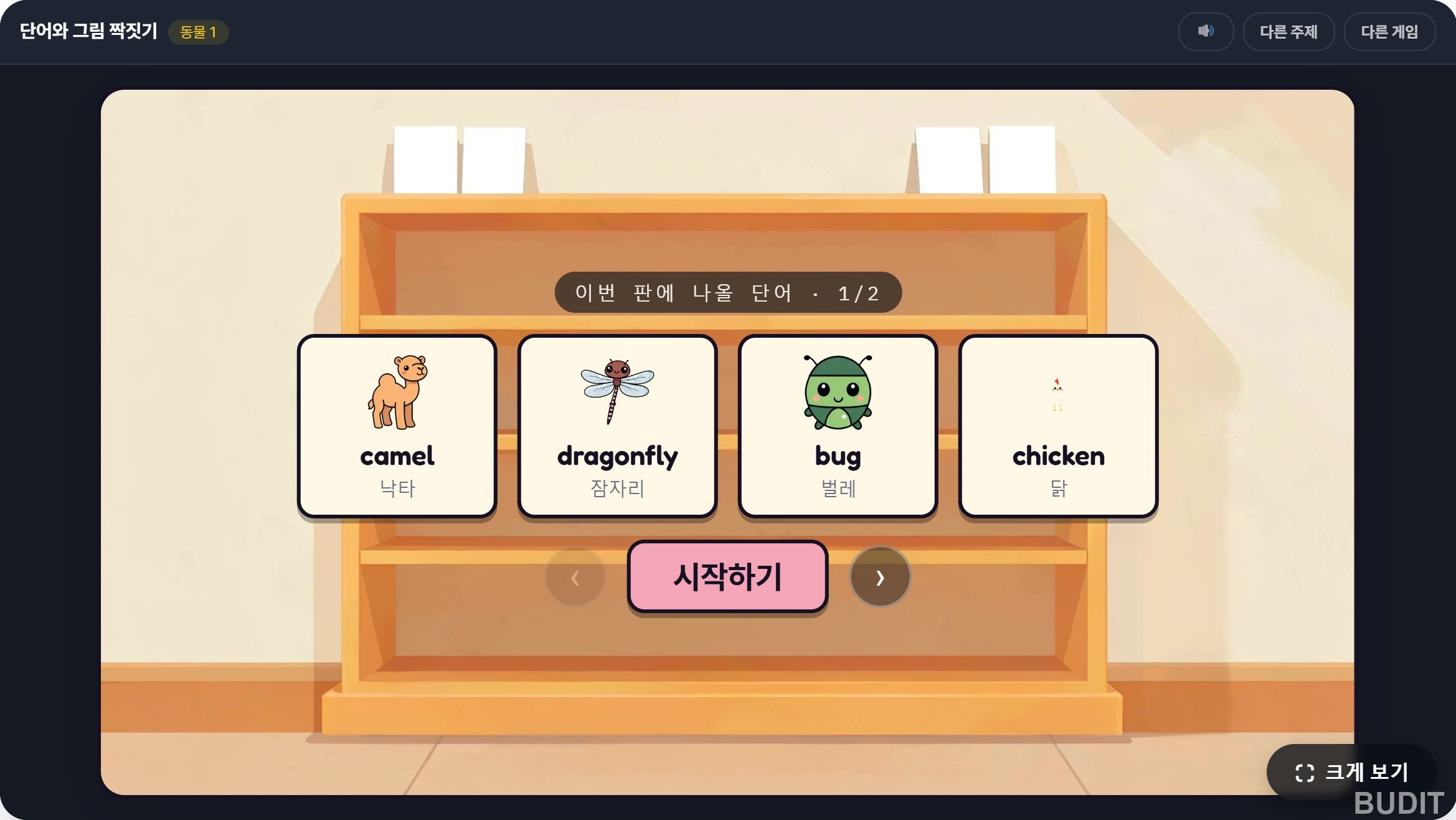
Photo: the word to picture matching game in 『NoryCard』 (sample photo mode, Korean interface). While choosing the picture for a word, the child recalls the meaning on their own. norycard.com
The research behind the two principles is covered in more detail in Why Game Review Helps Words Stick 『Retrieval Practice and Spacing』, and the period when words multiply is in Why Start Children's English with Everyday Words 『The Vocabulary Spurt』. The terms are in the glossary under spacing effect and retrieval practice.
Frequently asked questions
My child handles ten a day easily. Should I cut back? No need to cut. Just add the slots where those ten come back tomorrow, in three days and in a week. As new words grow, reviews grow with them, and the daily total soon passes thirty. If that becomes a strain, cut the new words, not the reviews.
My child hates getting things wrong. Do we really have to do recall? The benefit of recall comes from the effort of trying, not from being right. Look at the answer straight after a miss. Use a format where mistakes cost little, like games or cards, and children usually ask to play first.
If the app sets the intervals, do parents need to do anything? The app can handle the intervals. The parent's job is to be 『the one who asks』. Children keep going longer when there is someone to hear the word they pulled out and react to it.
How Budit continues this
The three steps in the picture at the top are how 『NoryBook』 uses this count as it is.
- 『Twenty words per Day』: NoryBook shared wordbooks carry elementary English words for grades 1 to 6 in Day 1 to 10 sets of 20 words. Twenty a day is sized to the 『new plus review』 total above.
- 『Book word cards come in sets of about twenty too』: the word cards in NoryBook picture books are split into sessions of 17 to 25 words, so one session a day is the same size as the count above. Turn through them with the meaning covered.
- 『Again as a game』: the same wordbook runs matching pairs and dictation games, so the child does retrieval practice without noticing.
How to build a wordbook is in Turn a Photo of Your Home into English Word Cards 『NoryBook Custom Cards』, and the games are in Reviewing with Word Cards and Games 『NoryBook Review Features and NoryCard Games』.
Related reading: Why Game Review Helps Words Stick 『Retrieval Practice and Spacing』, Learning Feeling Words with My Own Face 『Emotion and Memory』, Why Start Children's English with Everyday Words 『The Vocabulary Spurt』
References
- Webb, S. (2007). The effects of repetition on vocabulary knowledge. Applied Linguistics. Source
- Cepeda, N. J., Pashler, H., Vul, E., Wixted, J. T. and Rohrer, D. (2006). Distributed practice in verbal recall tasks: A review and quantitative synthesis. Psychological Bulletin. Source
- Nakata, T. (2015). Effects of expanding and equal spacing on second language vocabulary learning: Does gradually increasing spacing increase vocabulary learning? Studies in Second Language Acquisition. Source
- Karpicke, J. D. and Roediger, H. L. (2008). The critical importance of retrieval for learning. Science. Source
- Schmitt, N. and Schmitt, D. (2012). A reassessment of frequency and vocabulary size in L2 vocabulary teaching. Language Teaching. Source
- Metcalfe, J. and Kornell, N. (2005). A region of proximal learning model of study time allocation. Journal of Memory and Language. Source
This article covers general developmental and educational information; every child develops at a different pace. For specific concerns, consult a pediatrician or a developmental specialist.