

Learning Feeling Words with My Own Face
Think of a childhood memory that is still vivid. Chances are it was a moment of great joy, surprise or sadness. Experiences that stir strong feelings tend to stay with us.
Emotion helps memories stick
The amygdala, a brain region involved in emotional responses, is closely connected to the hippocampus, which helps form memories. When something stirs strong emotion, the amygdala influences how the hippocampus and related areas store the memory, so the experience tends to be remembered better (McGaugh, 2004).
When 『me』 meets 『emotion』
As we saw in our earlier post on the 『self reference effect』, Why Children Learn Better as the Hero, people remember information about themselves better. Meeting 『Happy』 through their own beaming face and 『Sad』 through their own glum face lets a child link a word to both themselves and a feeling.
The power to put feelings into words
Knowing words for feelings matters in its own right. A study that followed 72 children from low income families found that those who were better at recognizing and naming facial expressions at age five scored higher on measures of social behavior and school skills at age nine (Izard et al., 2001).
Ideas to try at home
- Make 『a happy face』 and 『a sad face』 together in front of a mirror and say the feeling words aloud.
- At the end of the day, ask 『How did you feel today?』 and let your child pick an emotion card.
- When teaching a new word, connect it to a happy moment your child actually had.
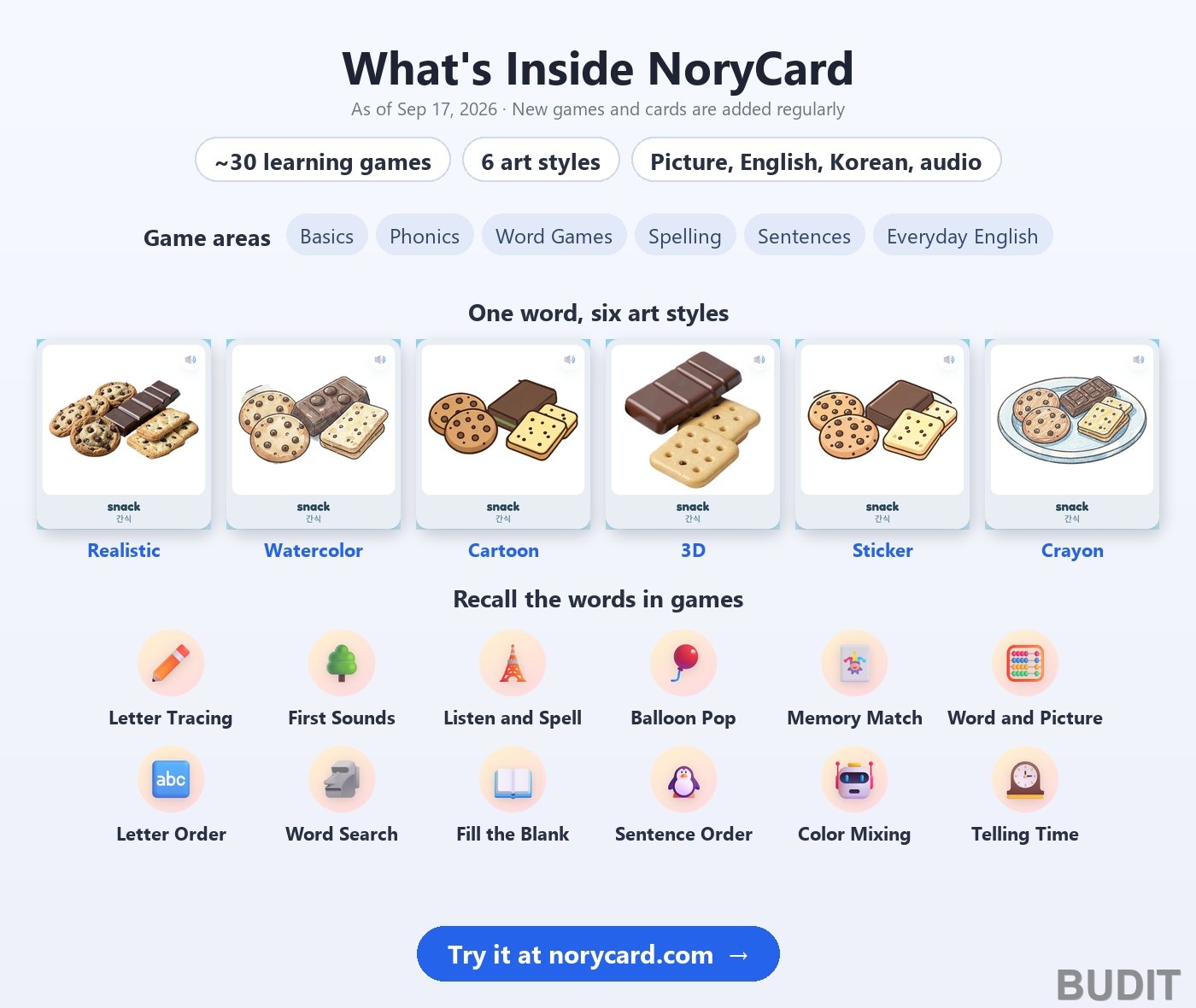
Photo: what's inside 『NoryCard』 by Budit (as of Sep 17, 2026). Around 30 learning games cover basics, phonics, words, spelling, sentences and everyday English, and every word card comes in six art styles. See all NoryCard games
Worth watching
Video: EBS Knowledge 『Is Memory Inborn?』 (official YouTube channel, Korean). A clip from Part 3 of the 2009 EBS Docuprime series 『The Secret of Memory』, with tips for improving memory.
How this continues in Budit
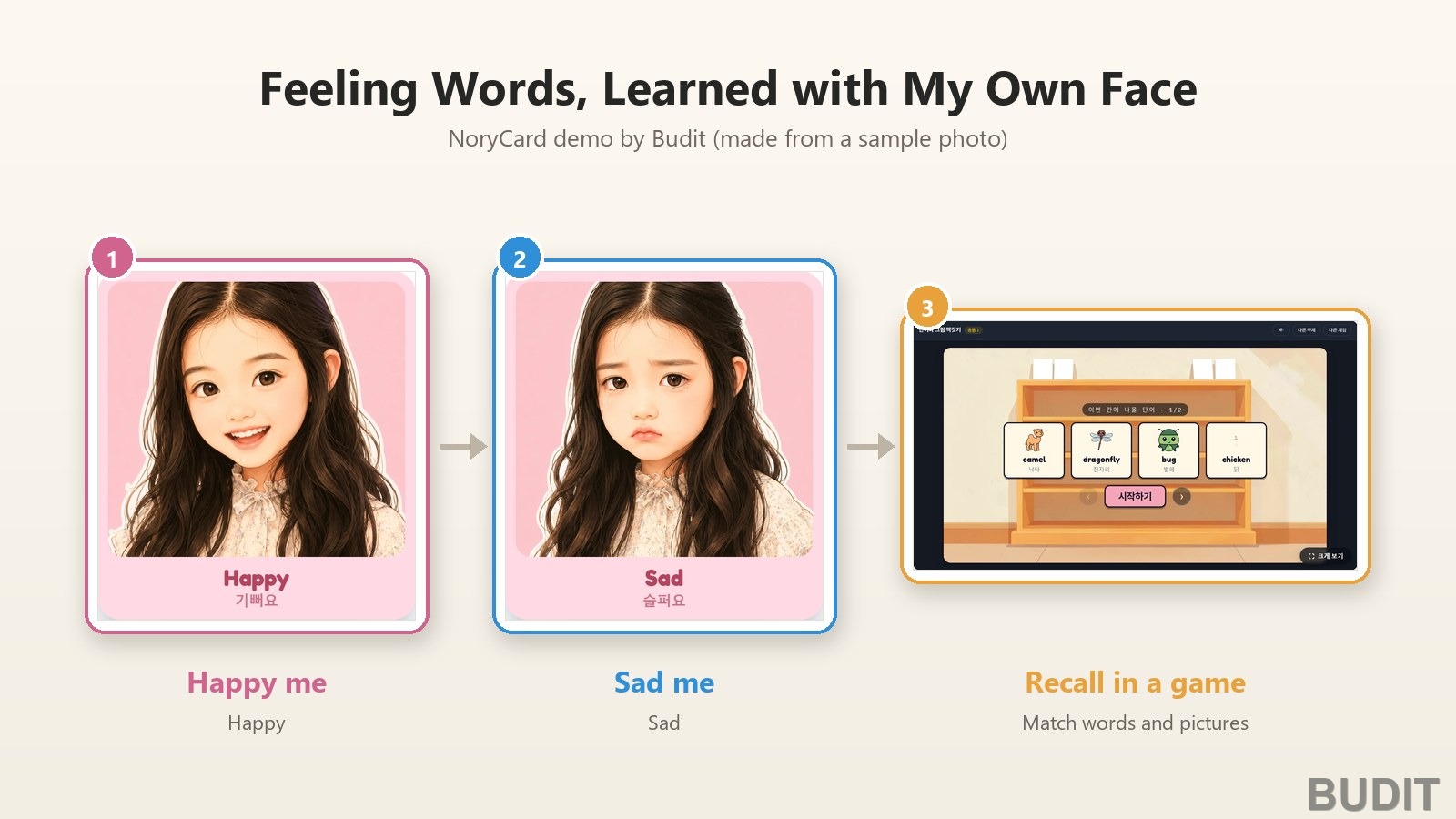
The 『NoryCard』 demo shows feeling cards and action cards made from a single sample photo, and the learning games let children practice English words. The image at the top shows real screens made from a sample photo.
- 『Happy me』: in the NoryCard demo, the child in the sample photo stars in a 『Happy』 card.
- 『Sad me』: flip to the next card and the same child appears in 『Sad』.
- 『Recall in a game』: short games such as 『단어와 그림 짝짓기』 (word and picture matching) in the NoryCard games help bring words back to mind.
References
- McGaugh, J. L. (2004). The amygdala modulates the consolidation of memories of emotionally arousing experiences. View on Google Scholar
- Izard, C. et al. (2001). Emotion knowledge as a predictor of social behavior and academic competence in children at risk. View on Google Scholar
This article shares general information about child development and education. Every child grows at their own pace. For specific concerns, please talk with a pediatrician or a child development specialist.