


A Two Sentence Thought Journal
Ask a child who just finished a book 『how was it?』 and many days the answer is 『fun』. It is not that there are no thoughts. They just have not been put into words yet. The moment a child writes, even briefly, thinking gets sorted, and what they know and don't know comes into view. It does not need to be a long book report. Two sentences are enough.
At a glance
| Question | What the research says |
|---|---|
| Does writing really help learning | School writing to learn programs raised achievement by a small but steady amount |
| Which writing worked best | Writing that asked students to reflect on what they understood and what confused them worked better |
| Does it help reading too | Writing about a text that was read improved understanding of that text |
| Does it work in other subjects | Adding writing in science, social studies and math increased learning |
Writing makes learning stay
Bangert-Drowns and colleagues reviewed 48 studies of writing to learn in schools. Lessons that added writing raised achievement by a small but steady amount, and the effect was larger when the writing asked 『what do I understand, and what still confuses me?』 (Bangert-Drowns et al., 2004). A question that makes a child look back at their thinking matters more than writing a lot.
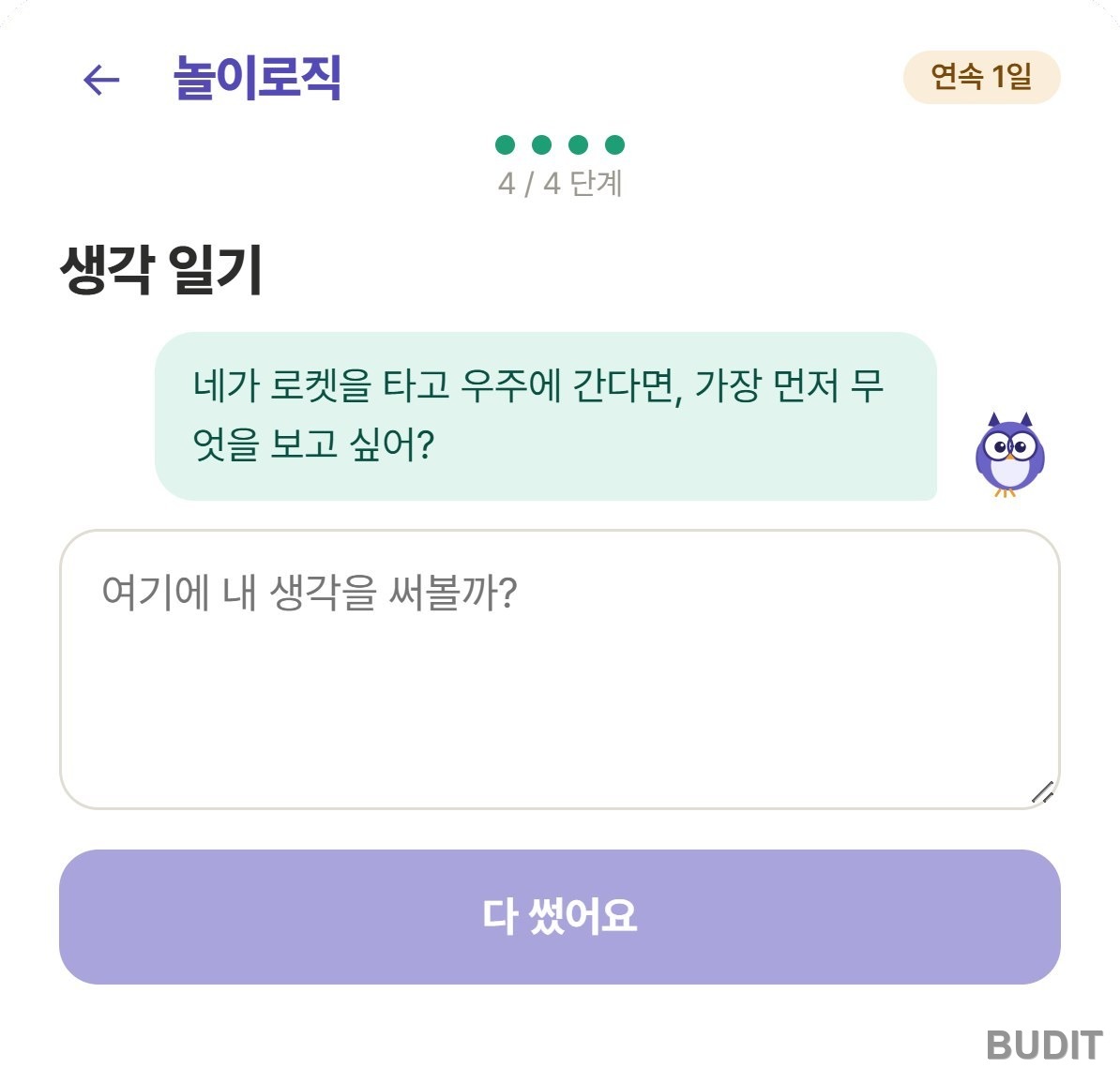
Photo: the thought journal in the 『NoryLogic』 story 『How do rockets get to space?』 (as of Nov 5, 2026; NoryLogic is currently in Korean). The child writes an answer to one question linked to the story. Visit NoryLogic
Writing about a text improves reading it
Graham and Hebert analyzed studies in which students wrote about texts they had read. Summarizing the text, answering questions about it or adding their own thoughts improved understanding of that text (Graham and Hebert, 2011). To write, a child has to recall the text, pick out what matters and put it in their own words.
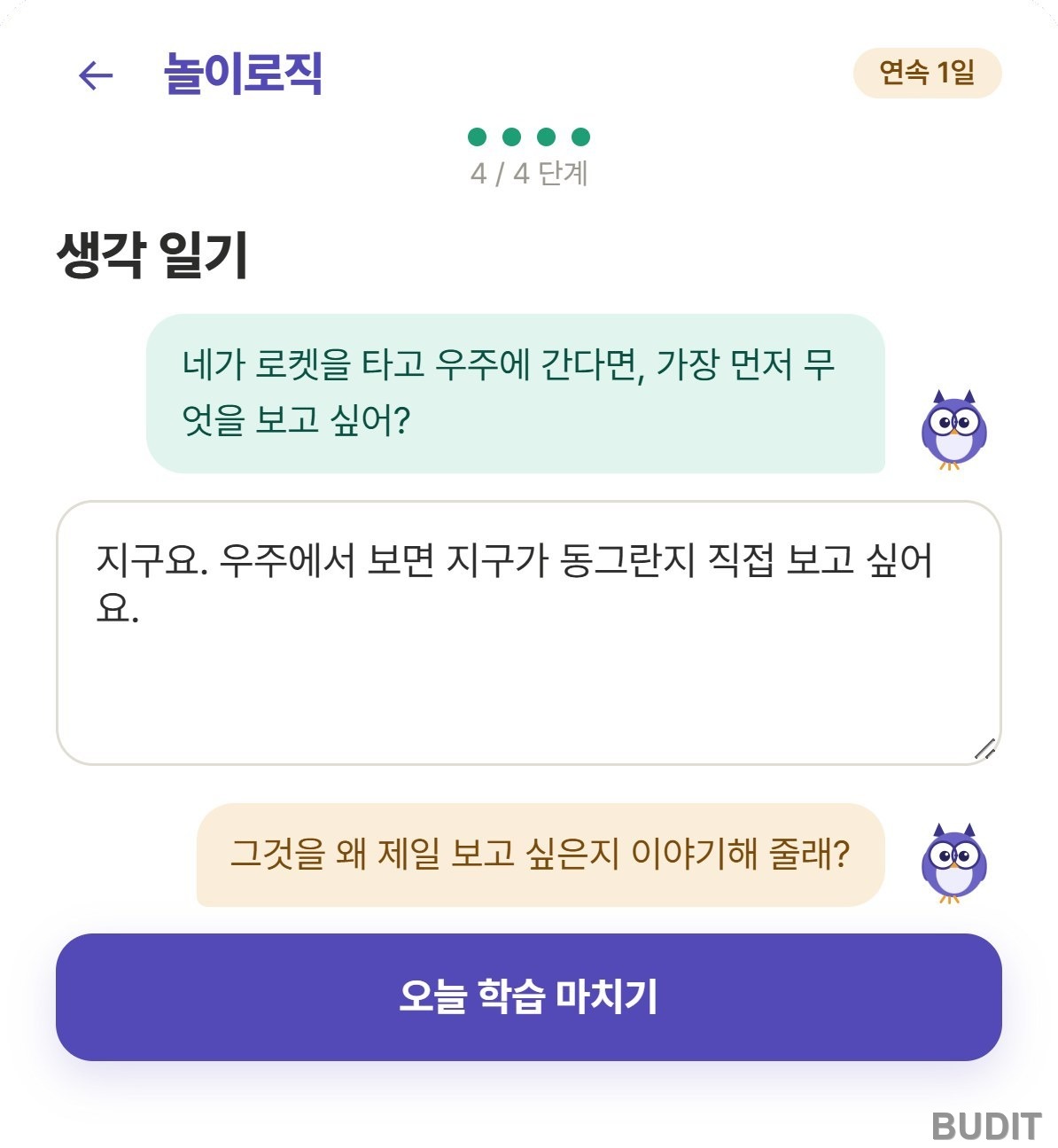
Photo: the follow up question after writing (as of Nov 5, 2026, with a sample answer typed in). Adding 『why?』 to the first sentence naturally makes two. Visit NoryLogic
Writing grows learning in other subjects too
Graham, Kiuhara and MacKay analyzed 56 studies that added writing to science, social studies and math lessons. Lessons that added writing to explain what was learned or to note thoughts increased learning in that subject, with a similar pattern from primary to high school (Graham et al., 2020). Writing is not only for language lessons.
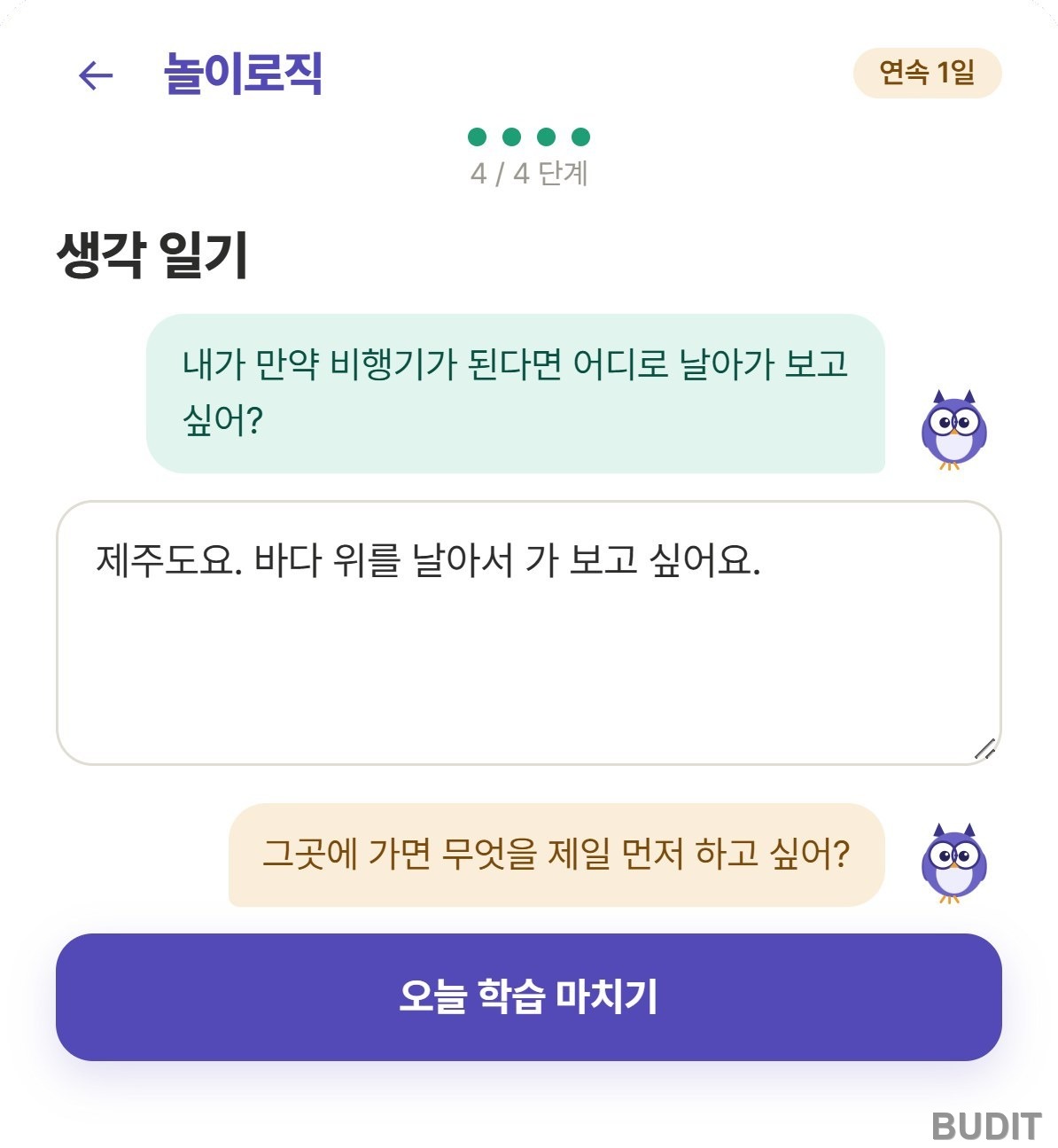
Photo: the thought journal in the 『NoryLogic』 story 『How do planes fly?』 (as of Nov 5, 2026, with a sample answer typed in). A science story ends with a question that links to the child's own experience and imagination. Visit NoryLogic
What to do at home
- Set it at two sentences. The first says 『what I think』, the second 『because』. Short is what makes it daily.
- Give one question. 『What surprised you most?』 is easier to write about than 『how was it?』.
- Don't correct spelling. During writing, let the child focus on thinking, and look at spelling another time.
- Let them write what confused them. 『I still don't get this part』 is a great entry. Knowing what you don't know is where the next lesson begins.
- Read the entries together. Reading them again a week later lets the child see their own thinking grow.
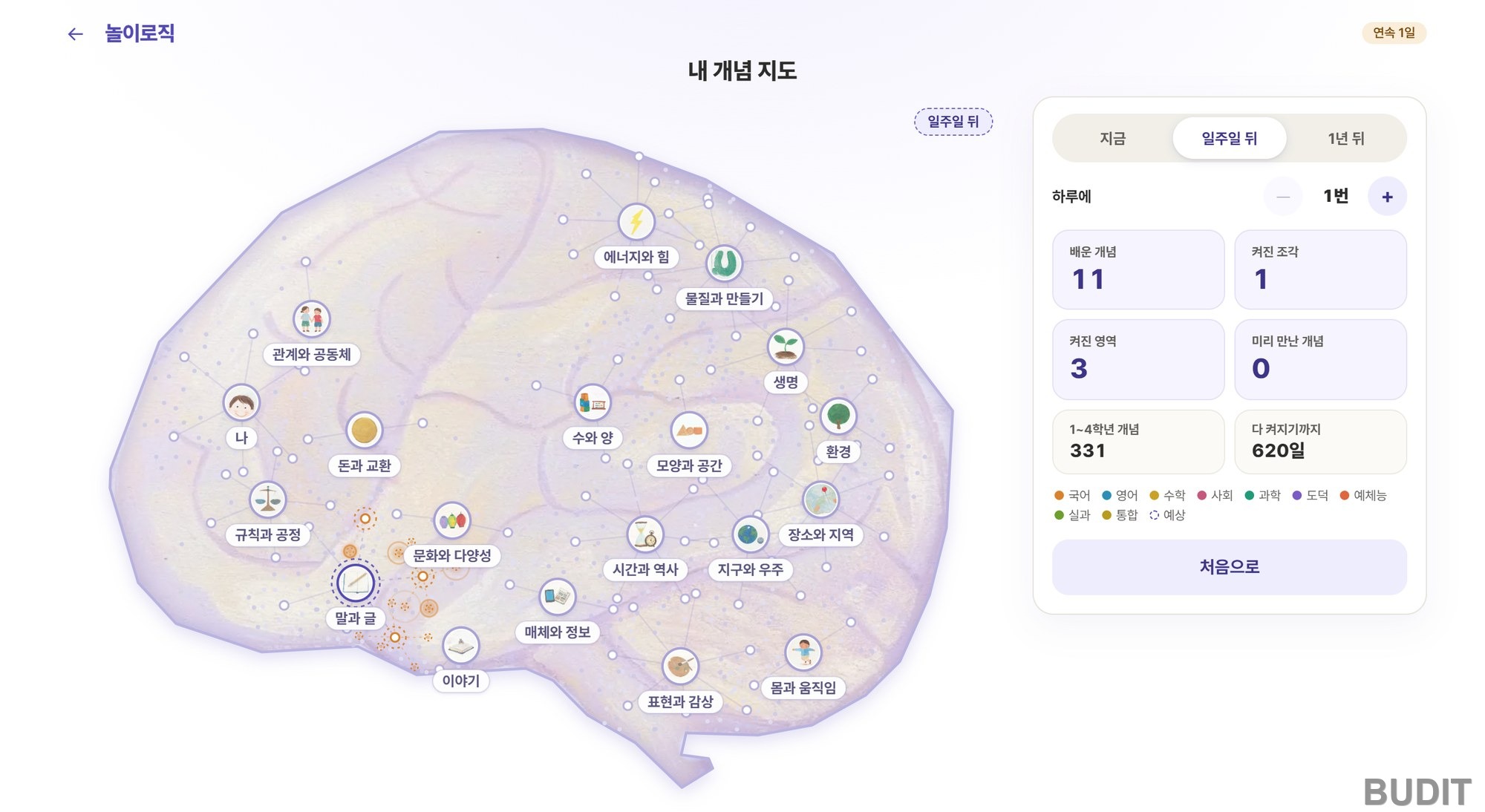
Photo: the 『NoryLogic』 concept map (as of Nov 5, 2026). Stories finished through the thought journal are kept as a record, and the linked curriculum concepts light up on the map. See the concept map
Questions people ask
My child can't write well yet. Talking works too. If the child says it and a parent writes it down, the thinking still comes out. Then gradually let the child write a word or two themselves.
They write the same thing every day. Change the question. Questions tied to the story, such as 『what if…?』 or 『what would you do?』, rarely get the same answer.
Don't they need to write long pieces to improve? In the research, the bigger effects came from writing that made students look back at what they understood and what confused them. Short, frequent writing in their own words comes first.
How this continues in Budit
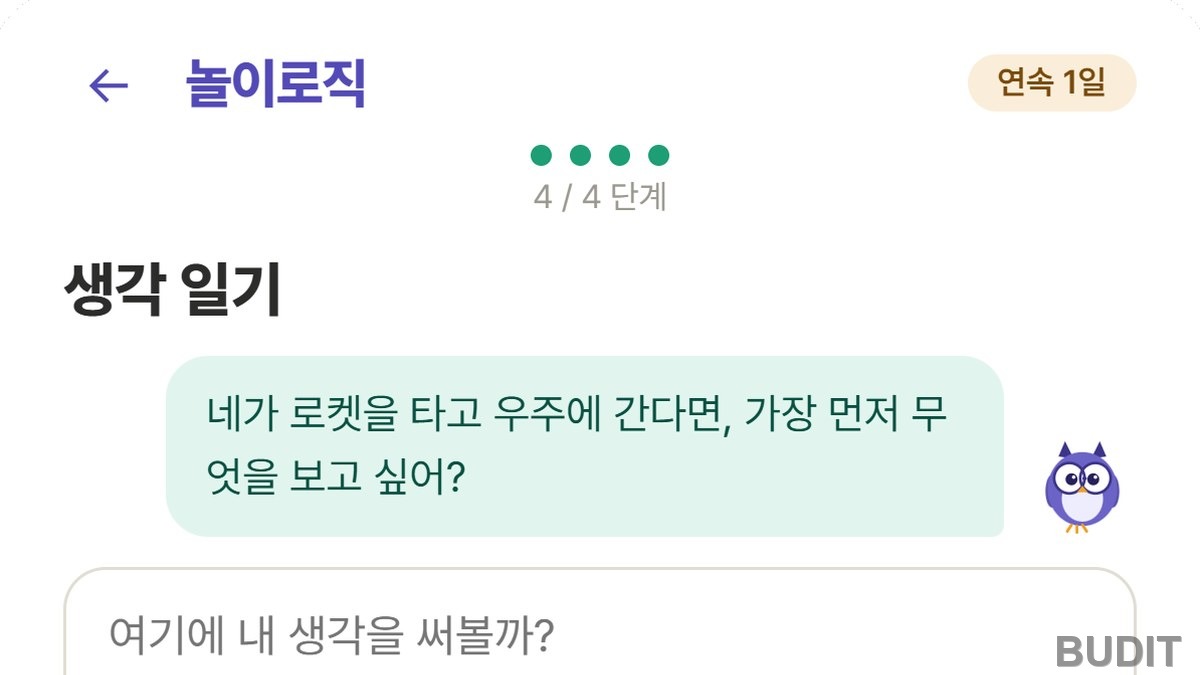
The three steps in the image at the top are the order of the 『NoryLogic』 thought journal.
- 『Get one question』: a NoryLogic session ends with one question linked to the story.
- 『Write two sentences』: after writing, one more follow up question draws out the second sentence. Going past two sentences earns a bigger star.
- 『Keep the record』: tapping 『Finish today's learning』 keeps the child's sentences in the account as a record, word for word.
If you are new, start with Getting Started with NoryLogic to see the order of one session.
Related reading: The Power of 『Why Do You Think So?』 『Explaining It Yourself Deepens Learning』, What Happens in the Brain When You Write by Hand 『Handwriting and Learning』, Children Who Trust AI Answers As Is 『Automation Bias and the Habit of Thinking First』
References
- Bangert-Drowns, R. L., Hurley, M. M. and Wilkinson, B. (2004). The effects of school based writing to learn interventions on academic achievement: A meta analysis. Review of Educational Research. View the paper
- Graham, S. and Hebert, M. (2011). Writing to read: A meta analysis of the impact of writing and writing instruction on reading. Harvard Educational Review. View the paper
- Graham, S., Kiuhara, S. A. and MacKay, M. (2020). The effects of writing on learning in science, social studies, and mathematics: A meta analysis. Review of Educational Research. View the paper
This article shares general information about development and education. Every child grows at their own pace. For specific concerns, please consult a pediatrician or a development specialist.