Children Who Trust AI Answers As Is
When homework gets hard, a child asks an AI. The answer arrives in seconds, in smooth sentences. The problem is not asking. It is believing the answer as is, without weighing it. Researchers call this 『automation bias』. What a child needs is less to stay away from AI than a habit of thinking first and giving reasons before taking the answer.
At a glance
| Question | What the research says |
|---|---|
| What is this called | The tendency to accept a machine's judgment without checking it enough is 『automation bias』 |
| Does trust reduce thinking | The more people trusted AI, the less critical thinking they reported |
| What is left after handing off writing | Most people who wrote with ChatGPT could not correctly quote the essay they had just written |
| If scores go up, is it fine | Essays written with AI scored higher, but knowledge gained did not increase |
| What about children | The younger the group, the greater the reliance on AI and the lower the critical thinking scores |
What researchers call it
『Automation bias』 is a term long studied where people work with automated systems, such as flying and medicine. Parasuraman and Manzey described how people follow an automated system's judgment without checking it enough, and found the tendency in experts as well as beginners (Parasuraman and Manzey, 2010). Generative AI is that automated system, now in our pocket.
There are related terms. Handing thinking to a tool is called 『cognitive offloading』, and no longer checking your own understanding because a tool does it for you is called 『metacognitive laziness』. Recently 『cognitive debt』 has also been used, for the way handing off thinking builds up like a debt.
The more we trust, the less we check
Lee and colleagues asked 319 people who use generative AI at work about real times they had used it. The more they trusted the AI, the less critical thinking they reported, while those more confident in their own skills checked more (Lee et al., 2025). Adults, too, check less the more they trust.
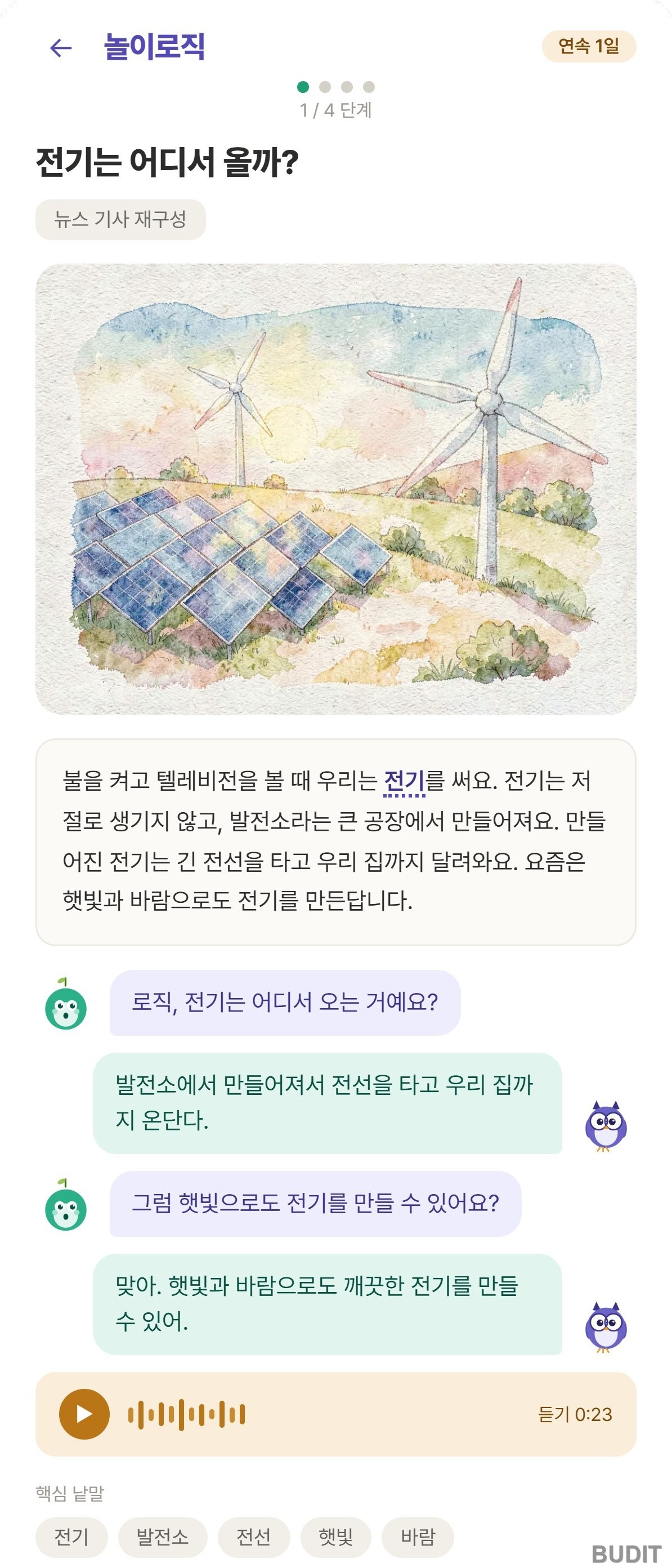
Photo: the reading screen of the 『NoryLogic』 story 『Where does electricity come from?』 (as of Nov 5, 2026; NoryLogic is currently in Korean). Text that starts from the news is labeled as a retelling of a news article, and tapping an underlined word shows its meaning at a child's level. A short dialogue between two characters follows. Visit NoryLogic
Writing we hand off does not stay with us
Kosmyna and colleagues at the MIT Media Lab had 54 people write essays over four months while measuring their brain activity. In the first session, 15 of the 18 people in the ChatGPT group could not correctly quote a single sentence from the essay they had just written, and their brain connectivity was the weakest of the three groups (Kosmyna et al., 2025). The study has not yet been peer reviewed and is small, but it shows that writing we hand off does not become our own.
An experiment by Fan and colleagues found something similar. University students helped by ChatGPT got higher essay scores, but their ability to apply what they learned to new problems was no different from the other groups. The researchers called this 『metacognitive laziness』, since the tool did the checking so the students stopped reflecting (Fan et al., 2025).
The younger, the more reliance
Gerlich surveyed 666 people and interviewed 50. The more often people used AI, the lower their critical thinking scores, and the habit of handing thinking to the tool sat in between. The gap was clearest in the youngest group, aged 17 to 25 (Gerlich, 2025). It is a one time correlation, so it cannot show cause, but it is a sign to take care during the years when thinking habits form.
In Korea, the share of people who had used generative AI rose to 44.5% in 2025 from 33.3% a year earlier (Ministry of Science and ICT, 2025 Survey on Internet Usage), and seven in ten middle and high school students said they had used it (National Youth Policy Institute, 2024). We cannot stop children from meeting AI. We can help them learn the order of thinking before they meet it.
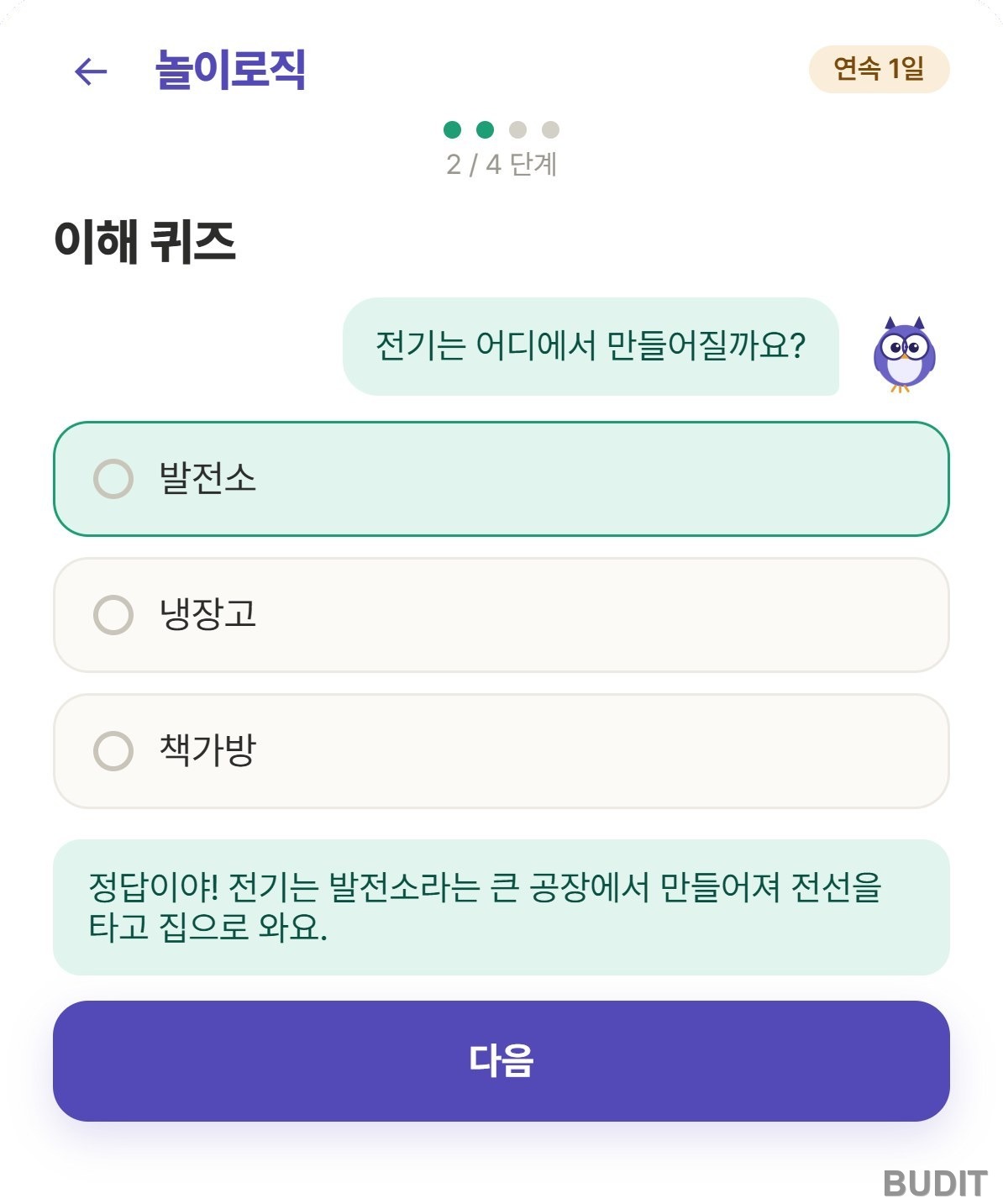
Photo: the 『NoryLogic』 comprehension quiz (as of Nov 5, 2026). After choosing an answer to 『Where is electricity made?』, an explanation follows right away. Visit NoryLogic
Ask for reasons, not just answers
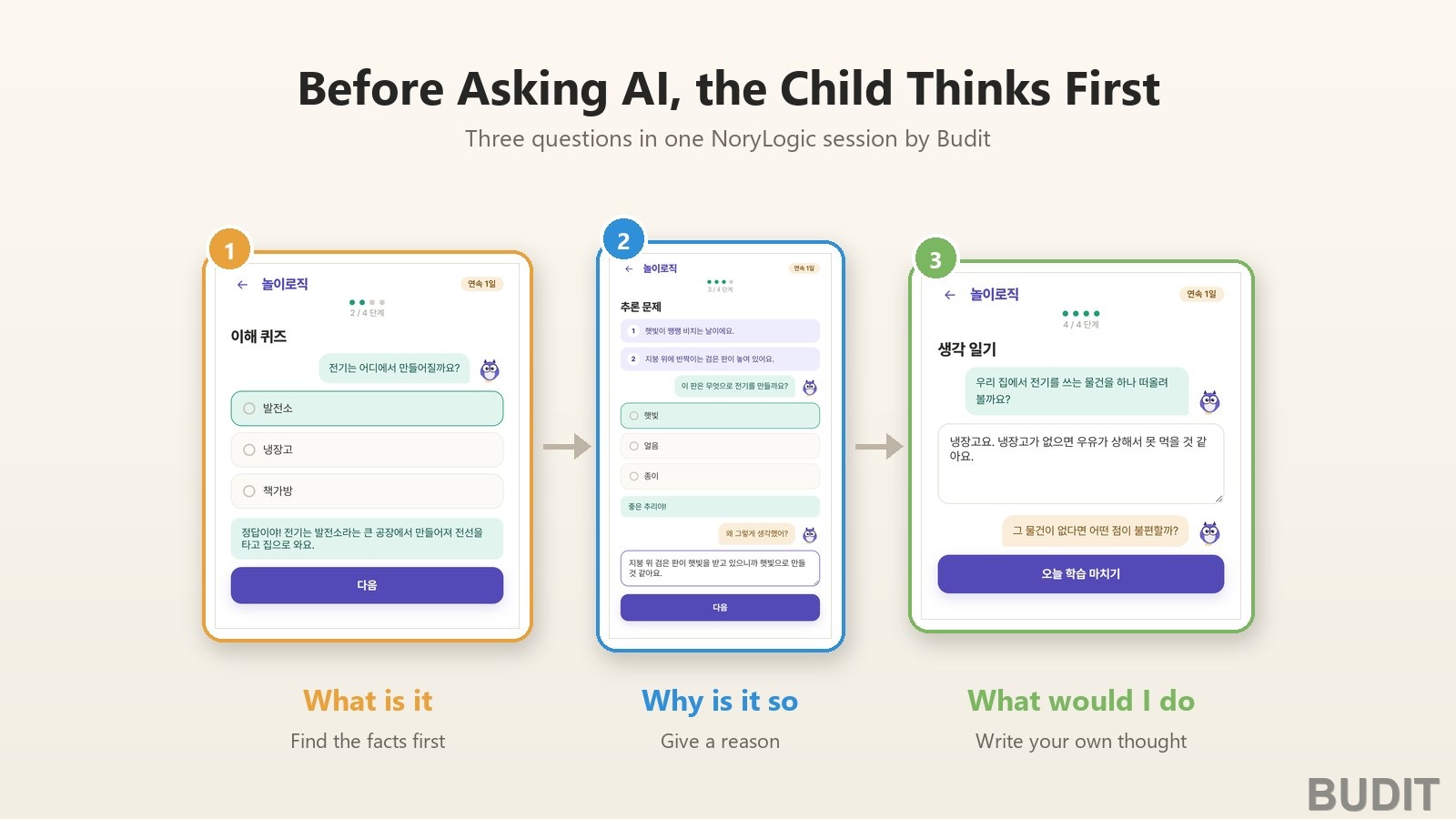
The way to reduce automation bias is to think for yourself before getting an answer, and to weigh the reasons after. For a child, that becomes three questions.
- What is it: find the facts first. Check what the text actually says.
- Why is it so: after choosing an answer, give a reason for 『why do you think so?』.
- What would I do: write your own thought in two sentences, and keep what you wrote as a record.
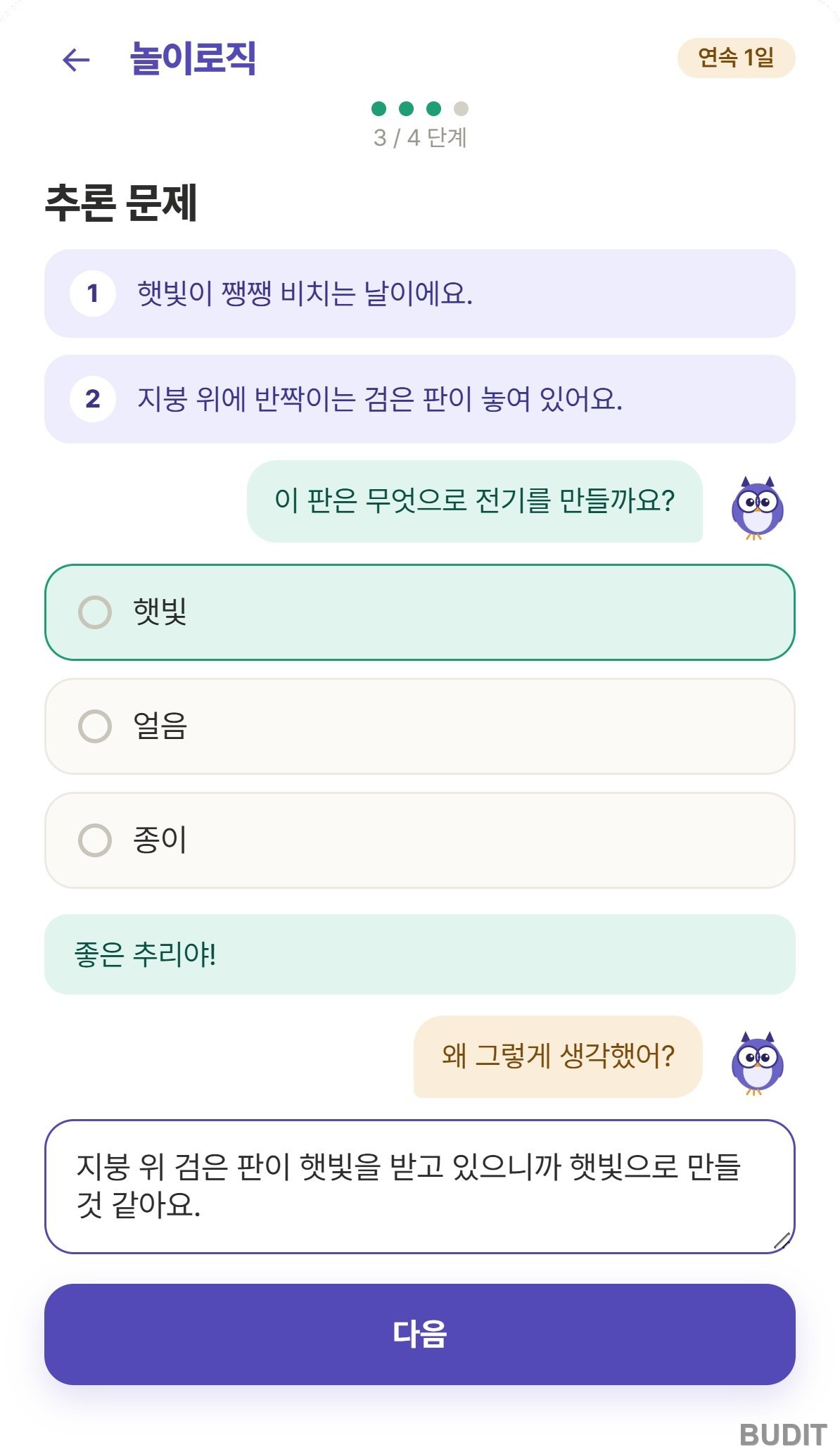
Photo: the 『NoryLogic』 reasoning question (as of Nov 5, 2026, with a sample answer typed in). After looking at two clues and choosing an answer, the child is asked 『why do you think so?』 and writes the reason. Visit NoryLogic
What to do at home
- Ask before asking the AI. Start with 『what do you think?』, then look it up together.
- When an answer comes, ask 『how can we know?』. Check once more somewhere else, such as a book, a dictionary or an article.
- Look for numbers and names with no source. The smoother the sentence, the harder a mistake is to see.
- Leave thoughts in writing. Even two sentences the child wrote themselves stay in memory.
- Let the child see you check. 『The AI says this, let me see if it's right』 is the best model there is.
- Look at the record together. Once a week, look back at what the child read and how they thought about it.
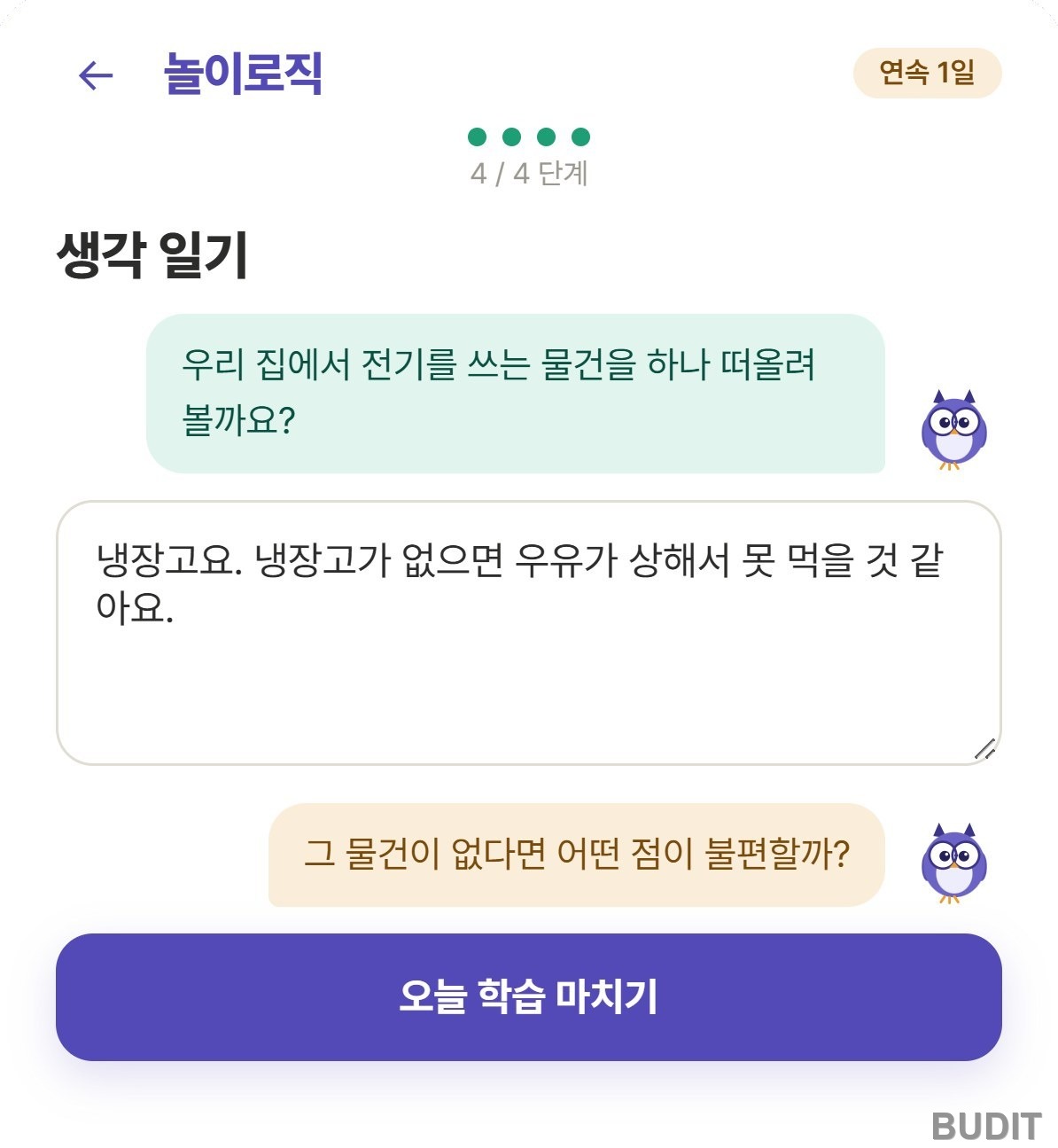
Photo: the 『NoryLogic』 thought journal (as of Nov 5, 2026, with a sample answer typed in). After writing, a follow up question such as 『what would be hard without it?』 comes next. What the child writes becomes the record. Visit NoryLogic
Questions people ask
Should children not use AI at all? Changing the order is more realistic than banning it. Think for yourself first, and treat the AI's answer as something to check.
Are automation bias and cognitive debt the same thing? Automation bias is the tendency to follow a machine's judgment without checking. Cognitive debt refers to the result, the ability to think for yourself getting less use the more you hand thinking to a tool. One is closer to a habit, the other to the mark the habit leaves.
Won't homework done with AI raise grades? Grades may go up. In the research, though, knowledge did not grow as much as scores did. Look less at the finished work than at whether the child's own thinking is in it.
At what age should this practice start? It works from the early grades of primary school, when children read and start to ask 『why?』. At first, reading together with a parent and giving reasons out loud is enough.
How this continues in Budit
The three steps in the image at the top are the order of one 『NoryLogic』 session.
- 『What is it』: NoryLogic rewrites news and curriculum concepts at a child's level and checks the facts first with a comprehension quiz.
- 『Why is it so』: the child reasons from clues, then gives a reason for 『why do you think so?』. The machine does not hand over the answer. The child gives the reasons.
- 『What would I do』: finishing the thought journal keeps a record, and the concept map shows what the child met and what stayed, as curriculum concepts.
AI writes the first draft of each NoryLogic story, but it does not go out as is. Each claim is checked against source articles, and only stories a person has approved for copyright, safety, facts, style and structure reach a child's screen.
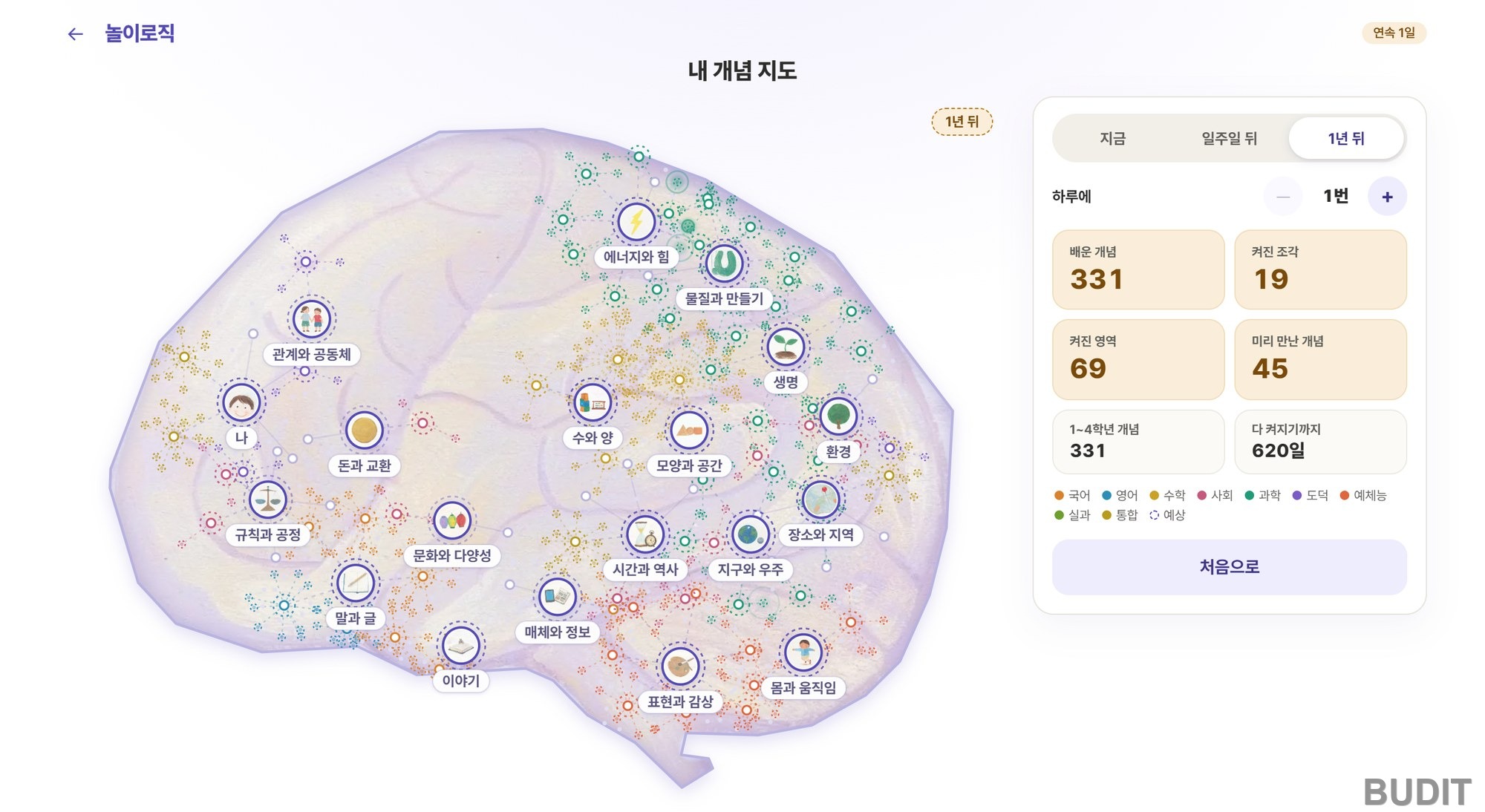
Photo: the 『NoryLogic』 concept map previewing 『one year ahead』 (as of Nov 5, 2026, projected at one story a day). Primary curriculum concepts linked to the stories a child finishes light up on the map, showing how far today's thinking can reach. See the concept map
Related reading: Growing Scientific Curiosity 『How to Answer a Child's Why』, Why Deep Reading Matters in the Age of Short Form 『The Reading Brain Is Not Inborn』, Screen Time, Alone or Together 『The Same Screen Turns on Who Is Sitting Beside the Child』
References
- Parasuraman, R. and Manzey, D. H. (2010). Complacency and bias in human use of automation: An attentional integration. Human Factors. View the paper
- Lee, H. P. et al. (2025). The impact of generative AI on critical thinking: Self reported reductions in cognitive effort and confidence effects from a survey of knowledge workers. CHI 2025. View the paper
- Kosmyna, N. et al. (2025). Your brain on ChatGPT: Accumulation of cognitive debt when using an AI assistant for essay writing task. arXiv preprint. View the paper
- Fan, Y. et al. (2025). Beware of metacognitive laziness: Effects of generative artificial intelligence on learning motivation, processes, and performance. British Journal of Educational Technology. View the paper
- Gerlich, M. (2025). AI tools in society: Impacts on cognitive offloading and the future of critical thinking. Societies. View the paper
This article shares general information about development and education. Every child grows at their own pace. For specific concerns, please consult a pediatrician or a development specialist.