



What is cognitive debt
『Cognitive debt』 is a term that spread widely in 2025. Just as borrowing money is easy now but has to be repaid with interest later, handing thinking to a tool is easy now but costs that much ability later. For a child who is still building the power to think, the debt is heavier than for an adult. Here is what the term means, what the research says, and how to keep the debt from piling up.
At a glance
| Question | Answer |
|---|---|
| What is cognitive debt | The loss repaid later in ability, in exchange for the ease of handing thinking to a tool now |
| Where the term comes from | An expression used by MIT researchers in 2025 while measuring the brain activity of people writing with AI |
| What was observed | The group writing with AI showed the weakest brain connectivity and could barely recall a sentence from the essay they had just written |
| What was known before | When we believe we can look something up, we remember where to find it instead of the content |
| For a child | The power to think is still growing, so whatever is handed over does not grow |
What the term means
What spread the term 『cognitive debt』 was a report from MIT Media Lab researchers in June 2025. Kosmyna and colleagues split 54 adults into three groups and had them write essays. One group used ChatGPT, one used only search, and one used no tool at all. Measuring brain activity while they wrote, the group with no tool showed the widest and strongest brain connectivity, and the AI group the weakest. Asked right afterward to quote one sentence from their own essay, most of the AI group could not, and their sense of ownership of the essay was the lowest. Four months later, when the groups switched tools, those who moved from AI to no tool still showed lower brain activity. The researchers called this accumulated loss 『cognitive debt』 (Kosmyna et al., 2025). It is a preliminary study, not yet peer reviewed and with a small sample, so conclusions need care. But it is clear why the term spread. It gave a name to something many people were already feeling.
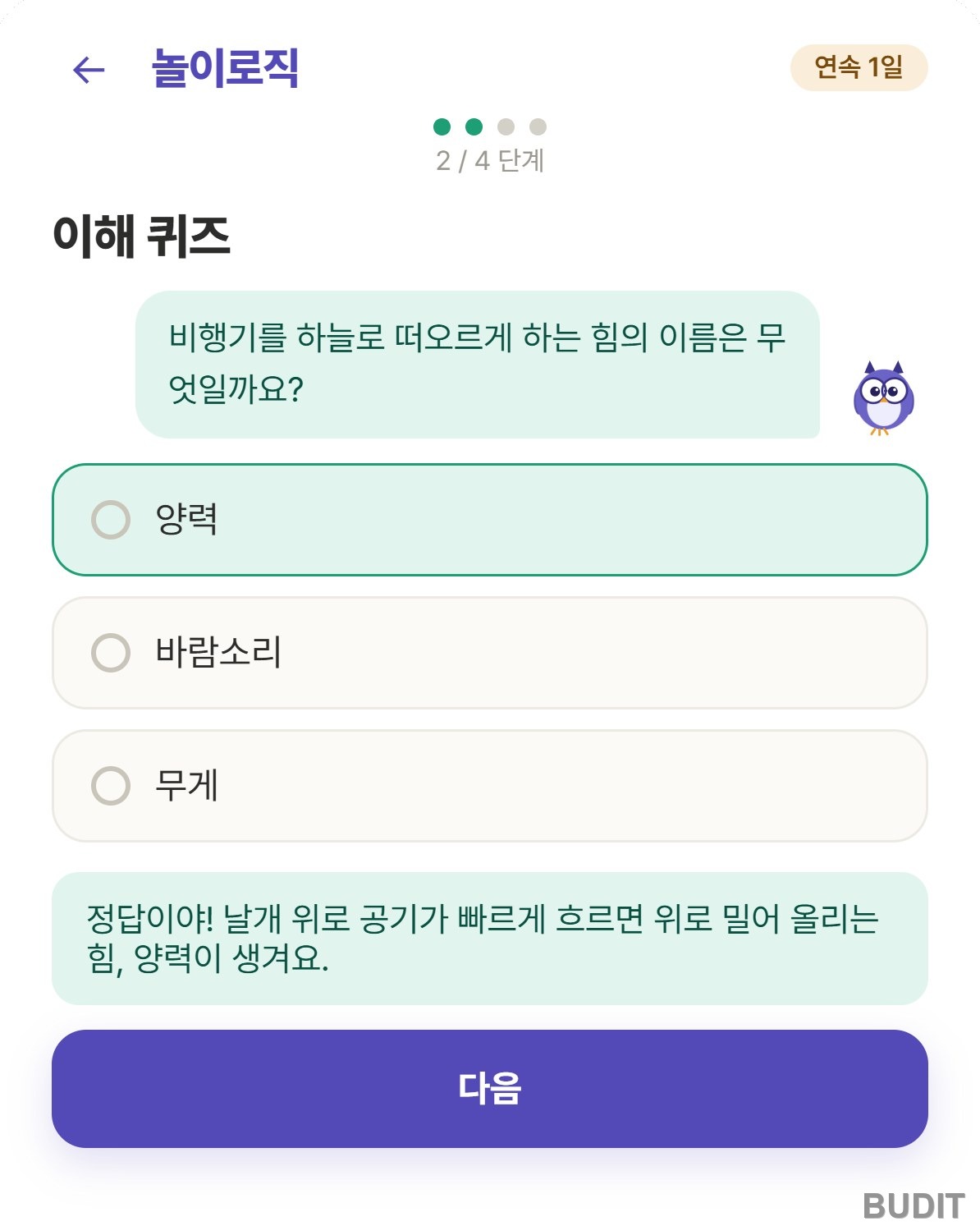
Photo: the comprehension quiz for the 『NoryLogic』 story 『How does an airplane fly?』 (as of Nov 5, 2026; NoryLogic is currently in Korean). Closing the text and recalling is a small piece of thinking done without taking on debt. Visit NoryLogic
It was known before AI
This phenomenon was studied before AI. Sparrow and colleagues showed that when people believe information can be looked up later, they remember where to find it instead of the content (Sparrow et al., 2011). Risko and Gilbert called handing thinking to tools outside the body 『cognitive offloading』 and summarized that the more we offload, the more our own ability to do that work may shrink (Risko and Gilbert, 2016). Gerlich surveyed 666 people and reported that heavier use of AI tools went with lower critical thinking scores, that the link between them was exactly this offloading, and that dependence was higher among younger people (Gerlich, 2025). Cognitive debt is not a new phenomenon. Offloading became far easier with AI, so the debt piles up faster.
For a child the debt is heavier
An adult hands a tool an ability they have already built. A child hands over an ability still being built. The two are different. An adult who uses a calculator gets a little rusty at arithmetic, but a child who uses only a calculator before learning arithmetic never develops it. Reading and recalling, giving reasons and writing in your own words are powers made during the elementary years. Handing this work to AI does not make it easier. It leaves it empty. As the post on automation bias showed, children also accept AI answers as given more easily than adults do.
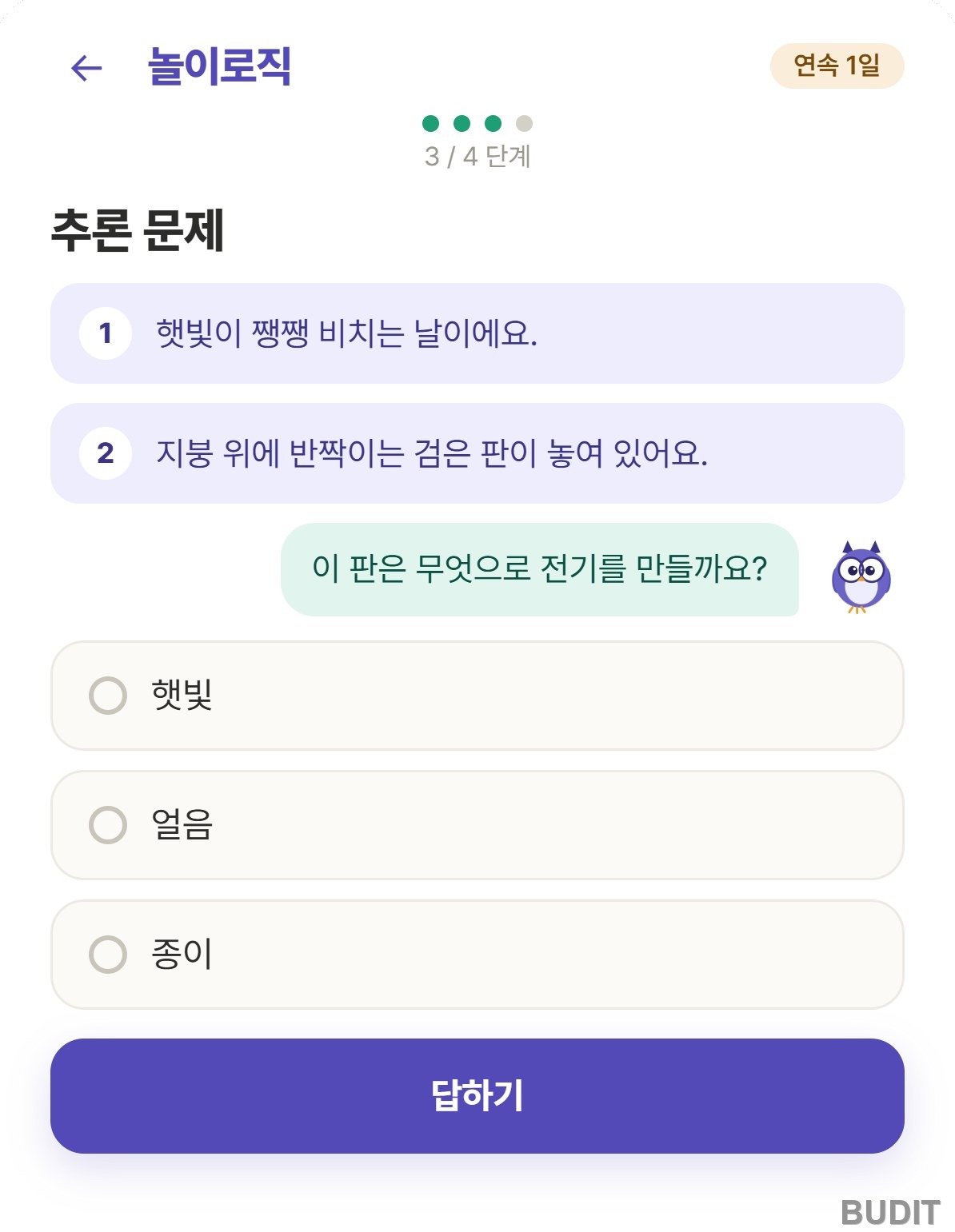
Photo: the reasoning question for the 『NoryLogic』 story 『Where does electricity come from?』 (as of Nov 5, 2026). Clues only, no answer. That empty space is where the child's thinking goes.
Keeping the debt from piling up
| Uses that pile up debt | Uses that do not |
|---|---|
| Letting AI do the first thinking | Thinking alone first, then comparing |
| Receiving the answer and copying it | Getting one hint and solving it yourself |
| Having a text summarized so you skip reading it | Reading, then asking only about unknown words |
| Handing in AI writing as your own | Writing your own, then asking what to improve |
The rule is order. When the child's thinking comes first and AI comes after, it is help, not debt. When AI comes first and the child after, it is debt.
Try this at home
- Make 『your thinking first』 a house rule. Before asking anything, the child says their own thinking, even one sentence.
- Recall what was read. Whether a book or an AI answer, ask 『just one thing you remember』 afterward. If they cannot recall it, it is not theirs yet.
- Ask for the reason. 『Why do you think so?』 is the shortest question that stops offloading.
- Protect the place for their own words. Journals, responses and thought writing are done without AI. Even with mistakes, that writing is the child's.
- Show them. Let the child see you receive an AI answer, say 『is that really so?』, and look it up in another source.
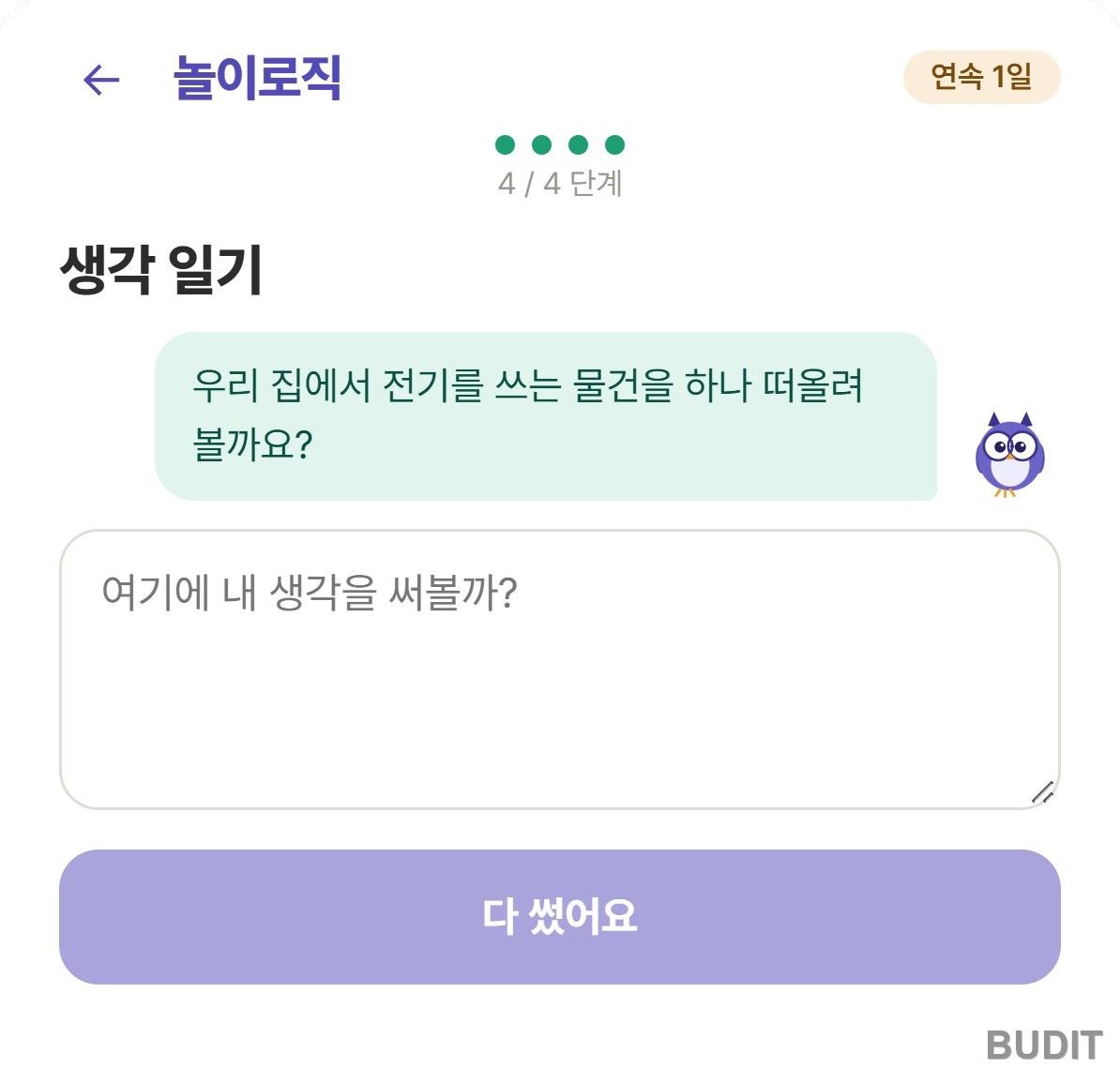
Photo: the thought journal for the same story (as of Nov 5, 2026). The blank is filled by the child. There is no feature that writes it for them.
Frequently asked questions
Should my child not use AI at all? No. The debt comes not from using AI but from handing over the thinking. Keep the order, think first and use it after, and AI becomes help.
Can cognitive debt be reversed? In the study above, people who moved from AI to no tool did not recover from a single switch. But that study was on adults with a small sample. A child is still growing, so giving back a little room for their own thinking every day is enough.
Are calculators and dictionaries cognitive debt too? A tool used after learning is not debt. A calculator after learning arithmetic, or a dictionary after learning to read, does not replace an ability but extends it. Having the tool stand in before learning is the debt.
How this continues at Budit
The three steps in the picture at the top are how 『NoryLogic』 puts the child's thinking first.
- 『Recall first』: the comprehension quiz on NoryLogic shows the explanation only after the child chooses.
- 『The child gives the reason』: the reasoning question gives clues only, and the child answers 『why do you think so?』.
- 『The child fills the blank』: the thought journal has no feature that writes for the child. Finished sessions pile up on my concept map, as an asset rather than a debt.
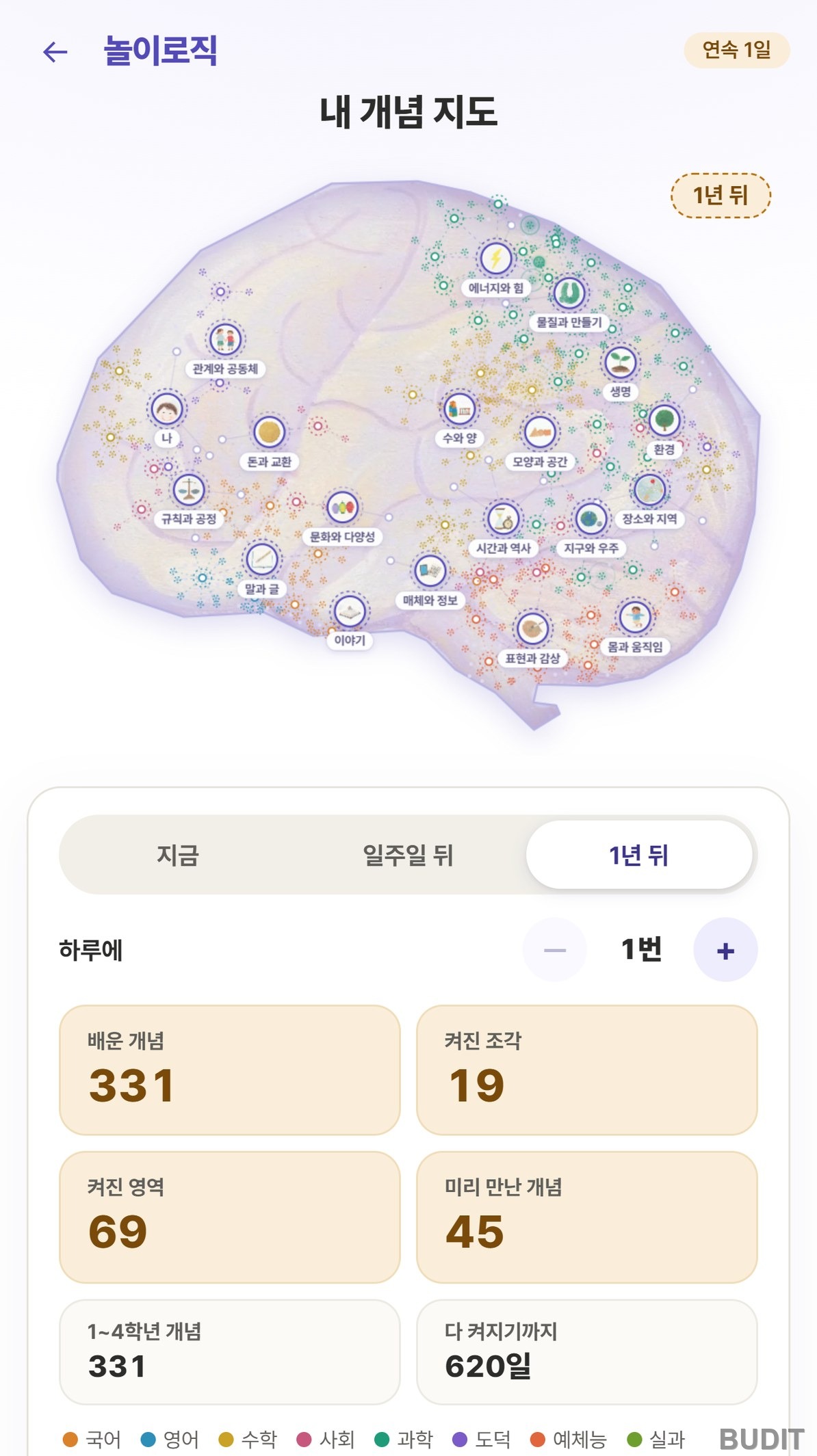
Photo: 『NoryLogic』 my concept map (as of Nov 5, 2026, the one year preview at one session a day). When days of thinking for yourself pile up, the map widens like this.
If you are new, start with Getting Started with NoryLogic to see the order of one session.
Related reading: Can My Child Do Homework with ChatGPT 『What to Hand Over and What Not To』, Children Who Trust AI Answers As Is 『Automation Bias and the Habit of Thinking First』, What Is Metacognition 『A Child's Power to Know Their Own Thinking』
References
- Kosmyna, N., Hauptmann, E., Yuan, Y. T., Situ, J., Liao, X. H., Beresnitzky, A. V., Braunstein, I. and Maes, P. (2025). Your brain on ChatGPT: Accumulation of cognitive debt when using an AI assistant for essay writing task. arXiv preprint. Read the paper
- Sparrow, B., Liu, J. and Wegner, D. M. (2011). Google effects on memory: Cognitive consequences of having information at our fingertips. Science. Read the paper
- Risko, E. F. and Gilbert, S. J. (2016). Cognitive offloading. Trends in Cognitive Sciences. Read the paper
- Gerlich, M. (2025). AI tools in society: Impacts on cognitive offloading and the future of critical thinking. Societies. Read the paper
This post covers general developmental and educational information, and every child develops at their own pace. For specific concerns, please consult a pediatrician or a developmental specialist.