



What is metacognition
『Metacognition』 is one of the words that comes up most often in writing about elementary education these days. The meaning fits in one line. Knowing what I know and what I do not know, and adjusting how I study to match. It sounds difficult, but if a child can say 『I know this one, I am not sure about that one』, it has already begun.
At a glance
| Question | Answer |
|---|---|
| What is metacognition | The ability to look at your own thinking (knowing what you know and do not know) and adjust your studying to match |
| Who named it | The psychologist Flavell, in 1979 |
| Why it matters | It explains differences in learning outcomes apart from intelligence scores |
| From what age | Around age five children start noticing 『I am not sure』, and it grows a lot during elementary school |
| Can it be taught | Yes, and the effect was especially large for elementary students |
Knowing your own thinking
In a 1979 paper the psychologist Flavell defined 『metacognition』 as knowledge about your own cognition, together with the activity of monitoring and regulating it. Knowing that you memorize some things well and others poorly, noticing while reading that 『I did not understand what I just read』, and deciding to read it again all belong here (Flavell, 1979). The name is hard, but what it does is simple. You take one look inside your own head.
A power different from intelligence
Many studies ask how much metacognition has to do with school learning. Veenman and colleagues, reviewing the research so far, wrote that metacognitive skills explained about 17 percent of the variation in learning outcomes on their own, apart from what overlaps with intelligence scores, and that this was larger than the share explained by intelligence alone (about 10 percent) (Veenman et al., 2006). The research is closer to 『a child who can look at their own studying does well』 than to 『a bright child does well』.

Photo: the comprehension quiz for the 『NoryLogic』 story 『Where does electricity come from?』 (as of Nov 5, 2026; NoryLogic is currently in Korean). The explanation appears right after the child chooses, so they check for themselves whether they had it right. Visit NoryLogic
From what age does it appear
When do children start knowing that they do not know? Lyons and Ghetti had three to five year olds look at pictures and choose answers, and let them skip answers they were unsure about. With age, children increasingly noticed which answers were likely wrong and skipped them (Lyons and Ghetti, 2011). Metacognition does not appear overnight. It sprouts in early childhood and keeps growing through elementary school and into adolescence (Kuhn, 2000). That makes the elementary years a good time to grow it.
It grows when taught
Dignath and Büttner gathered studies that taught students how to plan and check their own studying, and measured the effect. For elementary students the effect size was 0.61, larger than medium for educational research. The effect was especially large for programs that taught metacognitive strategies and also explained why those strategies help (Dignath and Büttner, 2008). Metacognition is not an inborn trait but a skill that is taught and practiced.

Photo: the reasoning question for the same story (as of Nov 5, 2026, with an example answer filled in). After choosing, the child answers 『why do you think so?』 and puts the basis for their thinking into words.
Try this at home
The easiest way to grow metacognition is a question that gets the child to put their own thinking into words. Four are enough.
- Before: 『Do you think this will be easy or hard?』 They estimate their own state in advance.
- During: 『How far do you understand so far?』 They mark the line between what they know and do not know.
- After answering: 『Why do you think so?』 Their thinking becomes visible while they give the reason.
- At the end: 『Was it the same as you first thought, or different?』 They compare the estimate with the result.
A wrong answer is the opportunity. Instead of 『that is wrong』, ask 『where did it get confusing?』 and the child looks back at their thinking rather than at the answer.

Photo: the thought journal for the same story (as of Nov 5, 2026, with an example answer filled in). One follow up question comes after what the child wrote.
Frequently asked questions
What does a child with strong metacognition look like? They say they do not know when they do not know. Before solving a problem they say 『this is like the one I did before』, and when they get it wrong they try to find where. A child with weak metacognition often feels they know it all while actually getting it wrong.
Can tutoring or workbooks build it? Solving many problems does not by itself build metacognition. There needs to be time afterward to say 『why was that right, why was that wrong』. Any material works if you add that time.
Is it good for parents to explain a lot? The longer the explanation, the less room the child has to bring out their own thinking. Keep explanations short and ask one question at a time.
How this continues at Budit
The three steps in the picture at the top are where a child looks at their own thinking within one 『NoryLogic』 session.
- 『See if you were right』: NoryLogic shows the explanation as soon as the child chooses an answer in the comprehension quiz. They check on the spot whether they had it right.
- 『Say the reason』: in the reasoning question, after choosing, the child writes an answer to 『why do you think so?』. It is where they put the basis for their thinking into words.
- 『See what you know』: the concepts from finished sessions light up on my concept map, so the child sees at a glance what they have learned and what remains.
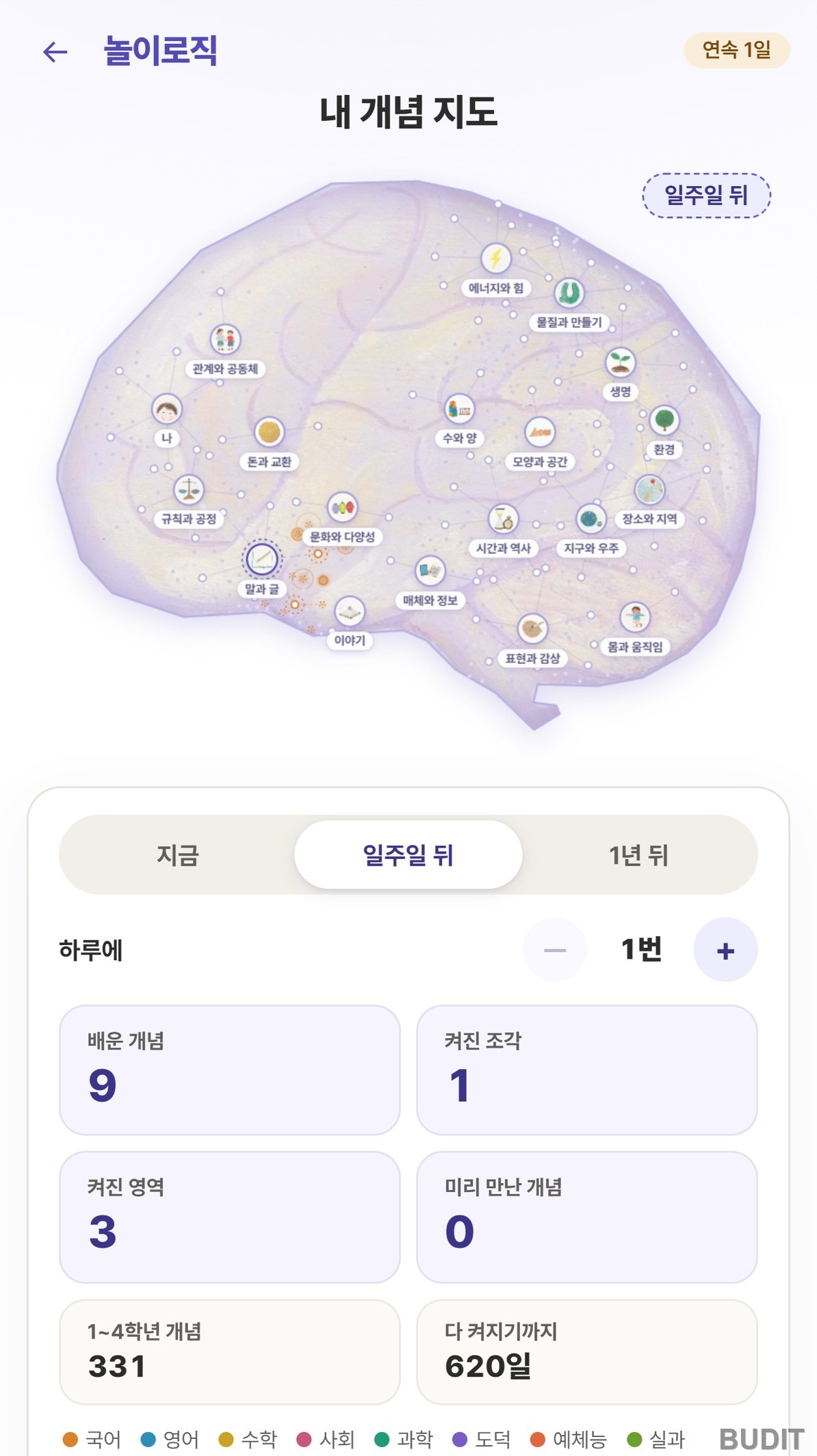
Photo: 『NoryLogic』 my concept map (as of Nov 5, 2026, the one week preview at one session a day). Concepts learned and concepts still ahead show as numbers and on the map.
If you are new, start with Getting Started with NoryLogic to see the order of one session.
Related reading: The Power of 『Why Do You Think So?』 『Explaining It Yourself Deepens Learning』, Read, Answer, Explain, Write 『There Is a Reason for This Order』, Praising the Process 『You Kept Trying Beats You're So Smart』
References
- Flavell, J. H. (1979). Metacognition and cognitive monitoring: A new area of cognitive developmental inquiry. American Psychologist. Read the paper
- Veenman, M. V. J., Van Hout-Wolters, B. H. A. M. and Afflerbach, P. (2006). Metacognition and learning: Conceptual and methodological considerations. Metacognition and Learning. Read the paper
- Lyons, K. E. and Ghetti, S. (2011). The development of uncertainty monitoring in early childhood. Child Development. Read the paper
- Kuhn, D. (2000). Metacognitive development. Current Directions in Psychological Science. Read the paper
- Dignath, C. and Büttner, G. (2008). Components of fostering self regulated learning among students: A meta analysis on intervention studies at primary and secondary school level. Metacognition and Learning. Read the paper
This post covers general developmental and educational information, and every child develops at their own pace. For specific concerns, please consult a pediatrician or a developmental specialist.