


What Happens in the Brain When You Write by Hand
Typing is faster and neater, so why ask a child to write by hand? Several studies find that the brain does something different when writing by hand than when typing.
The reading network in five year olds
Five year olds who could not yet read learned letters by writing them by hand, typing them, or tracing their outlines, and were then scanned. When they looked at the letters afterwards, the brain regions involved in reading became active together only for the letters they had written by hand (James and Engelhardt, 2012). Same letters, same time spent, different outcome by method.
EEG in twelve year olds and adults
In Norway, twelve children aged twelve and twelve university students had their EEG recorded while writing by hand and while typing. Theta synchronization in parietal and central regions, a pattern tied to memory formation, appeared while writing by hand and while drawing, but not while typing (Askvik, Van der Weel and Van der Meer, 2020).
The same group later recorded 36 university students with a 256 channel EEG system. Writing by hand with a digital pen produced widespread connectivity across parietal and central regions, and typing did not (Van der Weel and Van der Meer, 2024).
Why this happens
Two things overlap.
- Producing it yourself: we remember what we generate better than what we only read. This is called the 『generation effect』 (Slamecka and Graf, 1978). Looking at a finished letter and drawing one yourself, however clumsily, are different acts.
- How much the hand contributes: typing is the same motion for every letter, while handwriting moves in a different direction, length and order for each one. That movement is bound to what the eye sees, adding more hooks for memory.
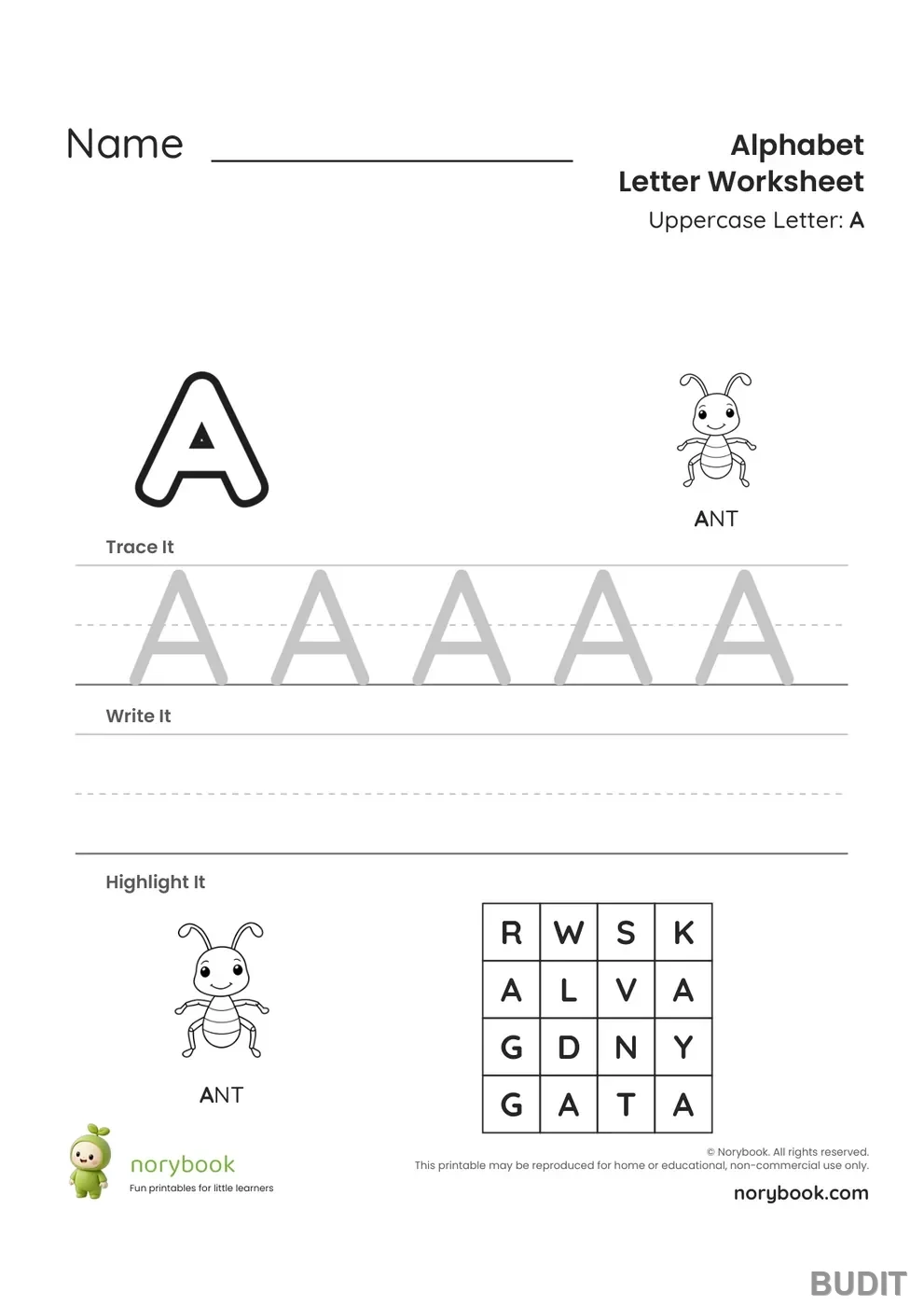
Photo: a page from the uppercase and lowercase worksheet in 『NoryBook』. Below the grey letters to trace there is an empty line with no help at all. The studies above are why that empty line is always there.
A video worth watching
Video: EBS Docuprime, 『What happened to children after four weeks of handwriting』 (official EBS Collection Science channel, in Korean). It follows children who copied text by hand for four weeks.
What you can do at home or in class
- Short and often: one or two pages a day is enough. Spreading practice over several days beats doing it all at once.
- Leave the blank line: tracing alone moves the hand but skips the part where the child produces the letter. Keep the last line empty.
- Do not correct the shape: wobbly letters are fine. A letter a child produced sticks better than a neat one they copied.
- Alternate with the screen: meet the sound and meaning on screen first, then write that word on paper. The order is in Why Paper Worksheets in a Digital Age.
How this continues in NoryBook
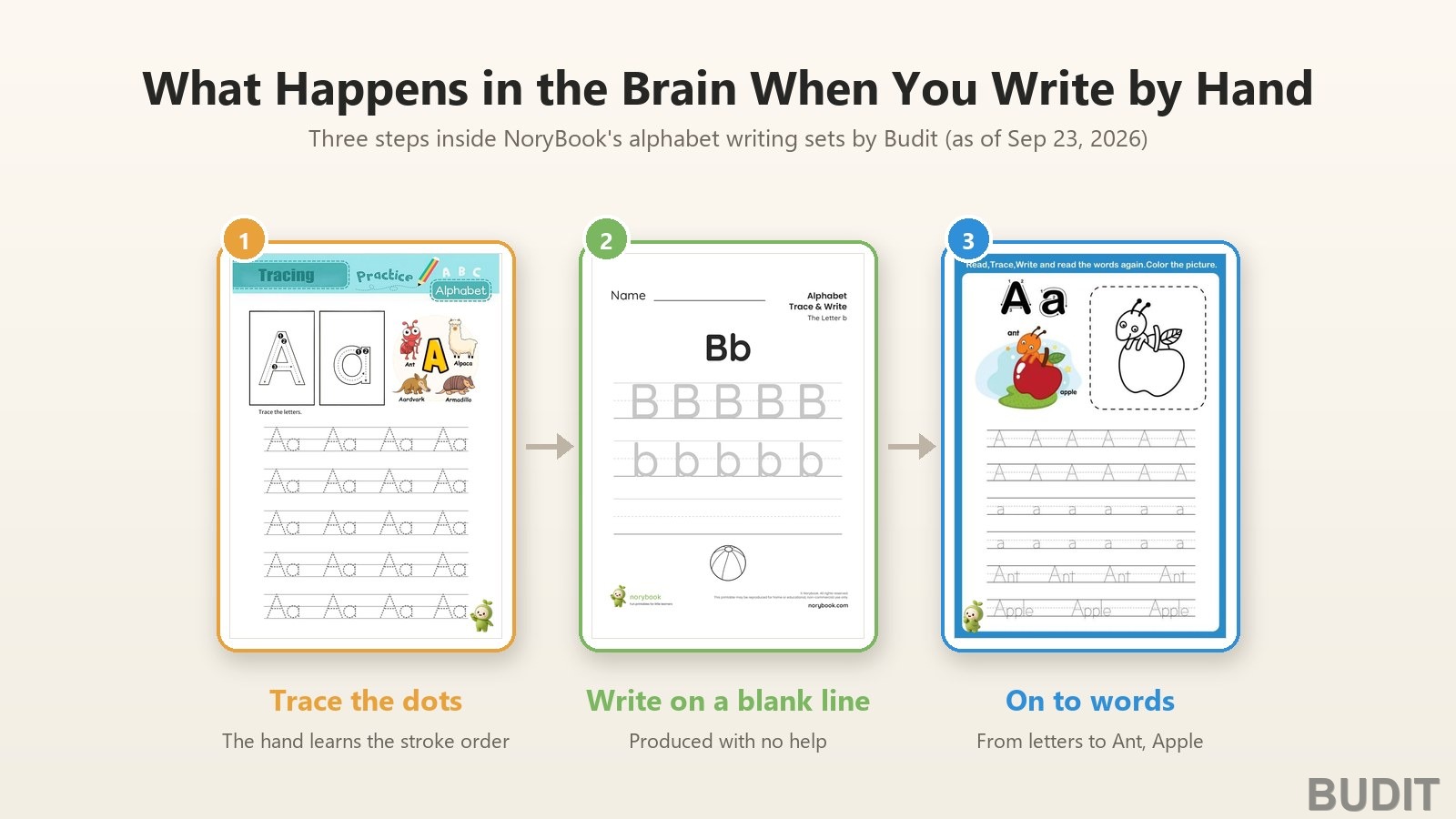
The 19 alphabet writing sets in 『NoryBook』 move through four steps: line tracing, dotted letters, writing on blank lines, and words. Support is removed a little at each step, and the last box is always one the child fills in alone. Page counts and the full order are in Why Alphabet Tracing Sheets Come in This Order.
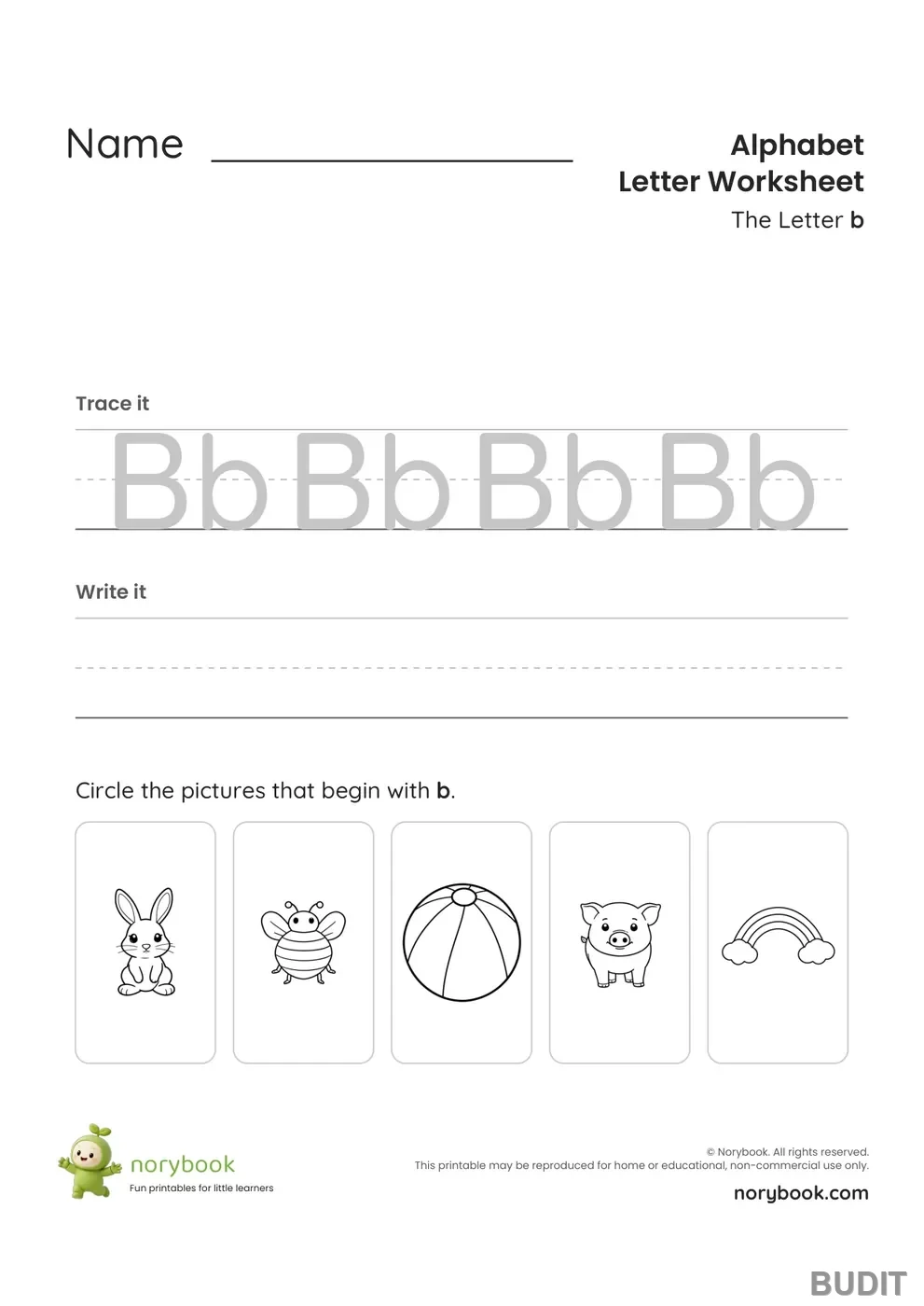
Photo: a page from the tracing combo worksheet. After writing, the child picks a picture that starts with that letter's sound, tying the movement of the hand to the sound.
See the alphabet writing materials
References
- James, K. H. and Engelhardt, L. (2012). The effects of handwriting experience on functional brain development in pre-literate children. See on Google Scholar
- Askvik, E. O., Van der Weel, F. R. and Van der Meer, A. L. H. (2020). The importance of cursive handwriting over typewriting for learning in the classroom. Frontiers in Psychology, 11, 1810. See on Google Scholar
- Van der Weel, F. R. and Van der Meer, A. L. H. (2024). Handwriting but not typewriting leads to widespread brain connectivity. Frontiers in Psychology, 14, 1219945. See on Google Scholar
- Slamecka, N. J. and Graf, P. (1978). The generation effect: Delineation of a phenomenon. See on Google Scholar
This article covers general development and education information, and every child develops at a different pace. For specific concerns, please consult a pediatrician or a developmental specialist.