


Screen Time, Alone or Together
Many parents ask how many minutes of screen time a day is safe. The research points more often to method than to minutes. The same video leaves little behind when a child watches alone, and turns into learning when an adult beside them asks and answers. A screen picture book like NoryBook is no exception.
At a glance
| Question | What the research says |
|---|---|
| From what age are screens all right | Avoid them before 18 months except video calls; from 2 to 5, under an hour a day of good content, watched together |
| Do children learn from video | Until about two and a half, a child learns far more from a person in front of them than from the same content on a screen |
| Does it change with someone beside them | Three year olds whose parents paused and asked questions learned more words and understood more than those who watched alone |
| What happens with a lot of screen time | More screen time at two and three went with lower developmental screening scores at three and five |
| So | Short, together, then off the screen |
The pediatric line covers time and method
In its 2016 guidance the American Academy of Pediatrics said to avoid screens before 18 months apart from video calls, and that if screens are introduced at 18 to 24 months, parents should choose high quality content and watch with the child rather than leave them alone. From 2 to 5 the line is under an hour a day of good content, watched together (American Academy of Pediatrics, 2016). The time limit is easy to remember, but half of the guidance is in the word 『together』.
Young children learn less from video
Even when the same person says the same thing, a child under about two and a half learns far less from a screen than from the person in front of them. Researchers named this the 『video deficit』 and found it largest between one and two years of age (Anderson and Pempek, 2005). A person on a screen does not adjust to the child's reactions. The experiment in which only infants spoken to by a live person kept their ability to tell foreign sounds apart is in our earlier article Does Background English Work.
An adult who asks changes the result
In one experiment, three year olds watched the same story video over four weeks. One group's parents learned to pause the video and ask 『what is this?』 and 『why did that happen?』 and expand the child's answers; the other group simply watched together. The children in the questioning group came out ahead in vocabulary and story comprehension (Strouse et al., 2013). The dialogic reading used with picture books works on a screen as well.
There is a result in the other direction too. When three year olds and their parents read an electronic book full of sounds and effects, there was less talk about the story and more talk about behavior, such as 『don't press that』, than with a paper book, and story comprehension was lower (Parish-Morris et al., 2013). A screen can help conversation or push it out. What decides is the words of the person beside the child, not the screen.
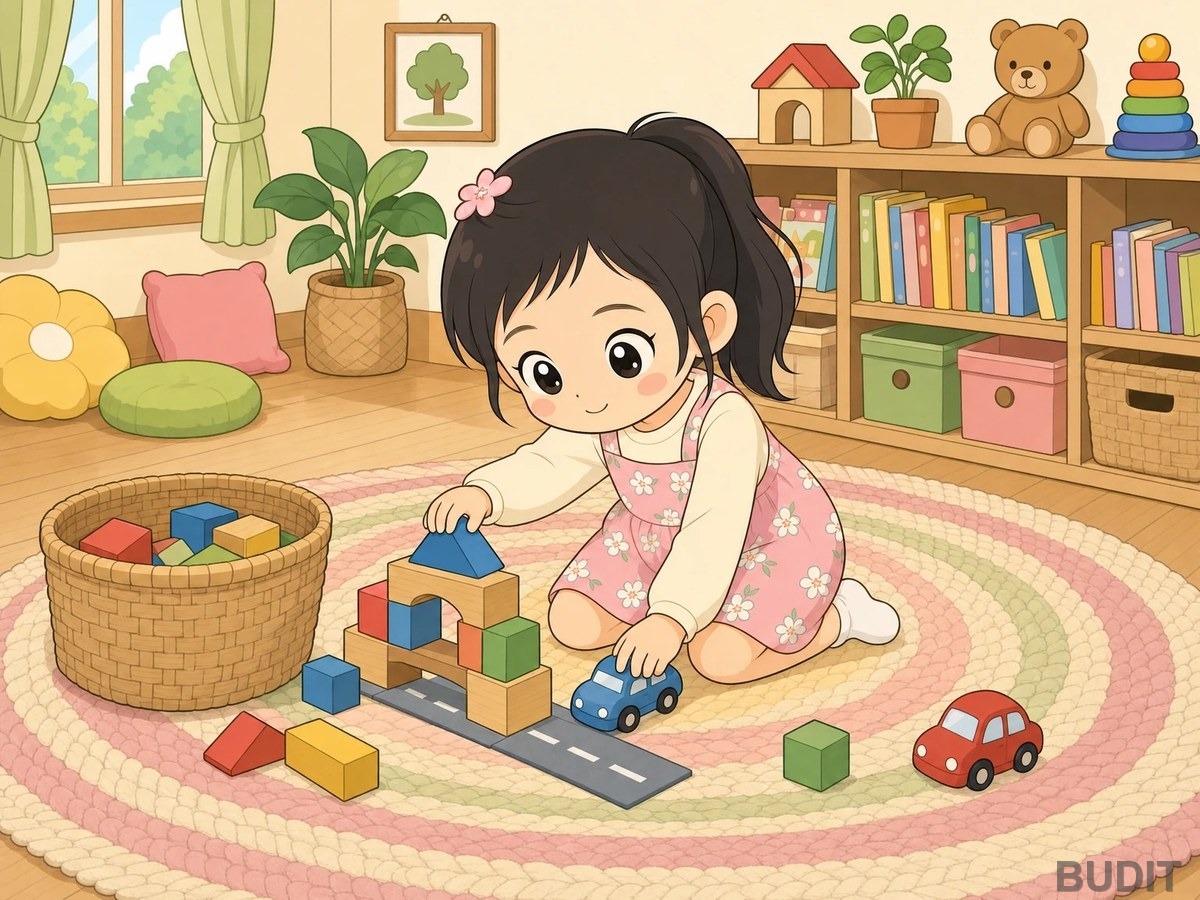
Photo: a scene from the 『NoryBook』 picture book 『My Day』 (as of Oct 21, 2026). Looking at the same screen, the parent is the one who asks 『what is this?』. Open the book
The study that followed children as screen time grew
A Canadian study that followed 2,441 children found that more screen time at ages two and three went with lower developmental screening scores at three and five. The reverse, slower development leading to more screen time, was not what the data showed (Madigan et al., 2019). The averages were about 17 hours a week at two and 25 at three, which is two to three hours a day. The real question is not zero screens but 『how long, and how』.
If it is a screen picture book
NoryBook picture books are screens too, so two things were kept in the design. Each page holds one or two sentences, and the next page comes only when ▶ is pressed, so the book does not run on like a video even when a child is left with it. Tapping an object in the picture brings up a word card and stops. That stop is where the parent steps in.
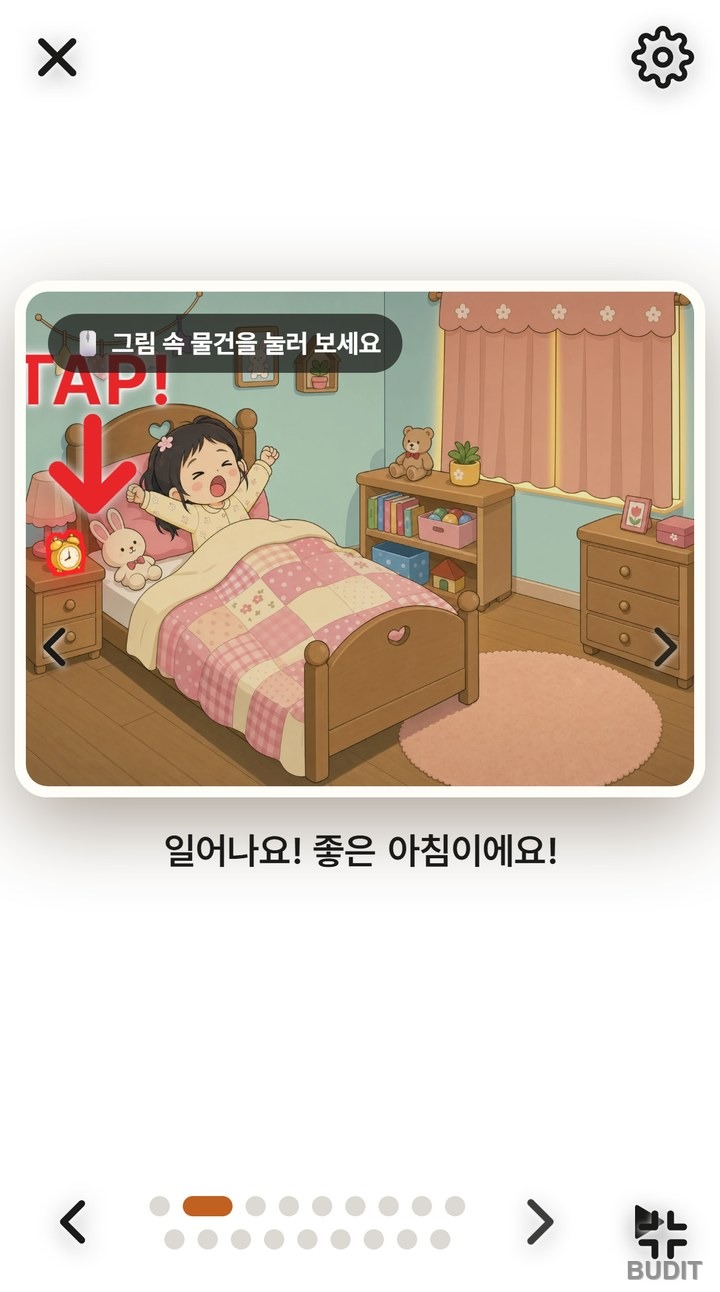
Photo: the first page of 『My Day』 (as of Oct 21, 2026, Korean interface shown). Pages do not turn on their own, and tapping an object brings up a card and stops. Ask one question at every stop.
What to do at home
- Before 18 months, use a voice instead of a screen. When apart, a video call is better, and when even that is hard, a book read in a recorded voice is an option. See A Book Read in Mom's or Dad's Voice.
- From 2 to 5, stay under an hour a day, split into 10 to 15 minute sessions. One NoryBook picture book is about that length.
- When watching together, stop three times. At the start, 『what do you think will happen?』; in the middle, 『what is this?』; at the end, 『what did you like best?』. The questions can be in your own language.
- When a child watches alone, keep it short, choose something that does not advance on its own, and turn the volume down. In NoryBook the gear at the top right sets the volume.
- When it ends, carry it off the screen. Coloring or writing the same word on paper leaves what was seen on the screen in the hand.
- Do not leave a screen on in the background. The study in which a television left on reduced parent and child conversation is in Does Background English Work.
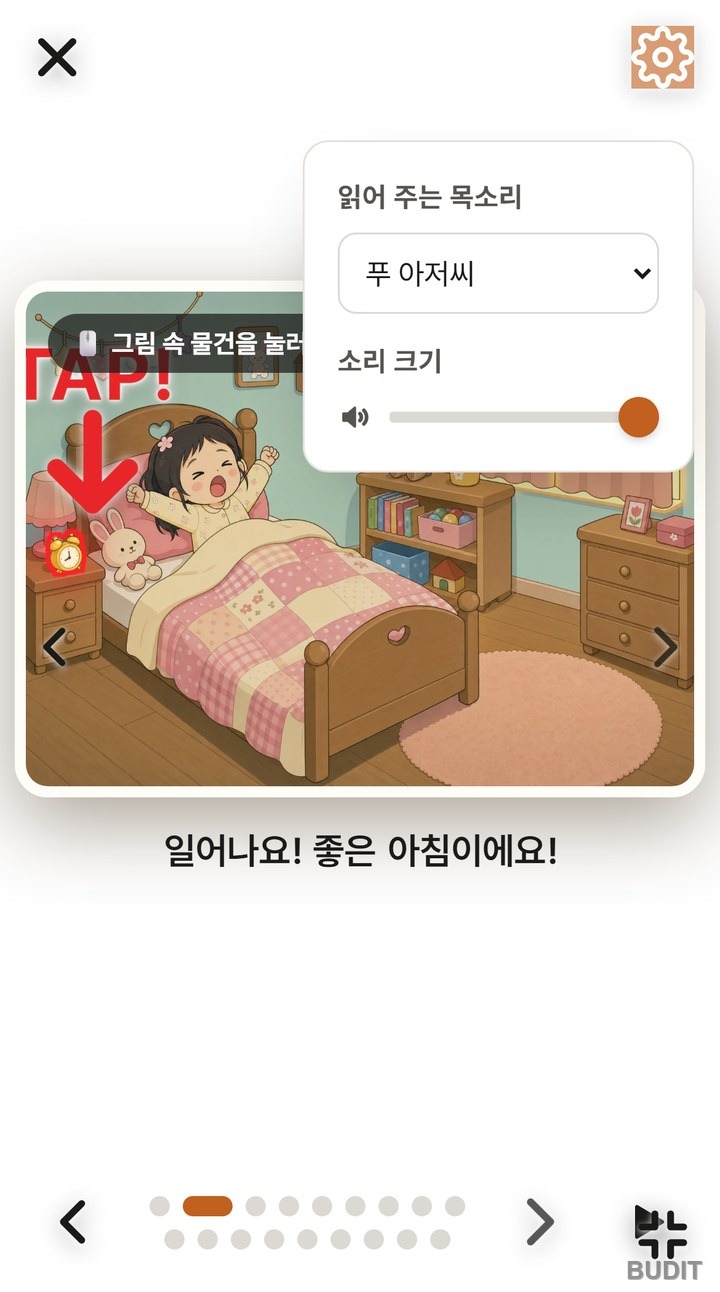
Photo: the 『My Day』 settings panel (as of Oct 21, 2026, Korean interface shown). When a child watches alone, lower the volume and leave only the reading voice.
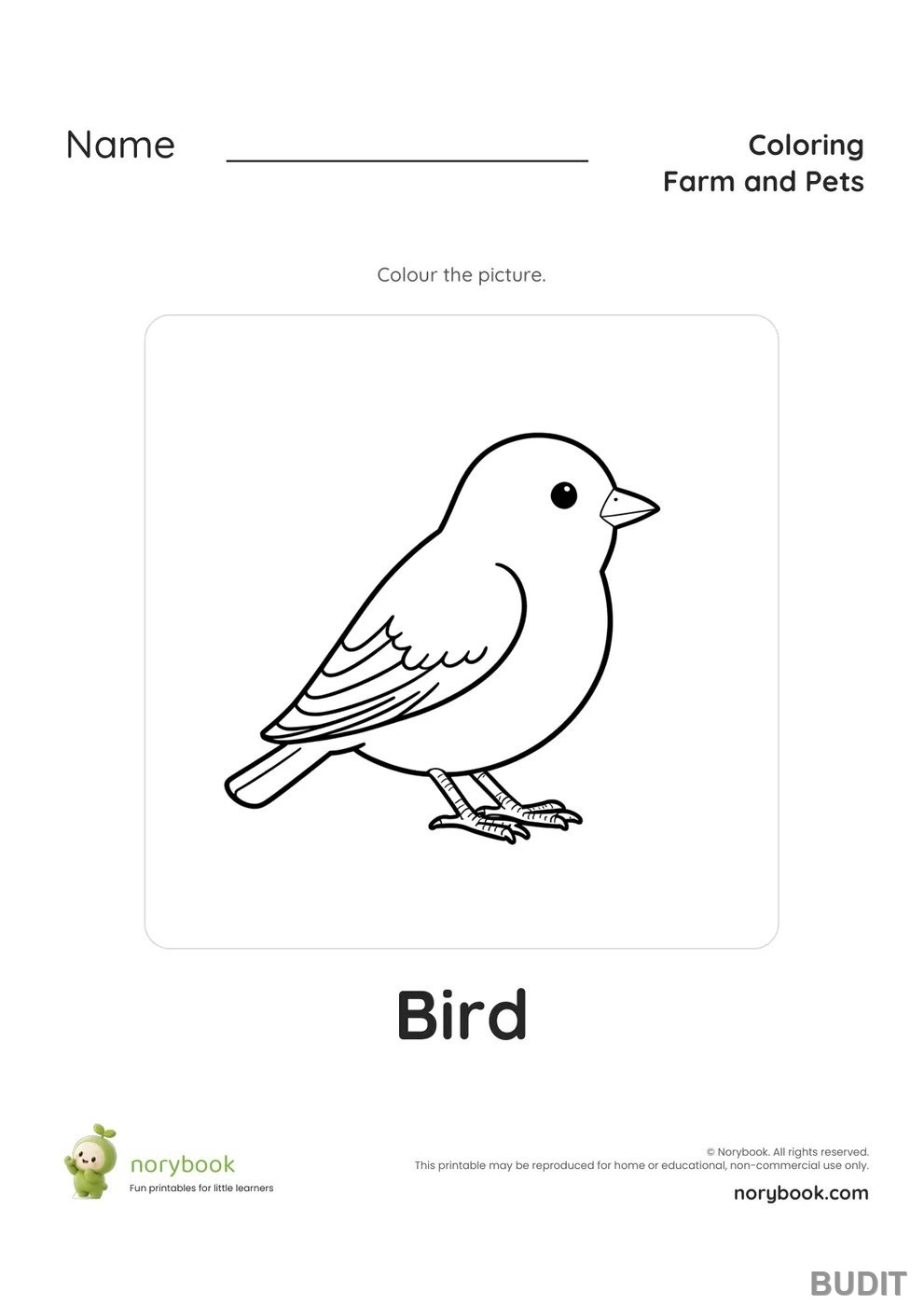
Photo: a page from the 『NoryBook』 『Farm Animals Coloring』 worksheet (as of Oct 21, 2026). One sheet of paper to finish what was seen on the screen. Open the material
Questions people ask
Isn't educational video fine? Even with good content, a child under two and a half who watches alone keeps little of it. Choosing good content and watching together are two different jobs, and both are needed.
Why are video calls the exception? Because when the child reacts, the other person answers at once. The study in which two year olds learned new words from live video calls but not from recorded video is in A Gift of Voice for Busy Parents.
Does watching with a sibling count as watching together? Children watching with each other is closer to watching alone. Watching together needs someone who pauses and asks. That said, an older child explaining to a younger one is good practice for the older child.
Should we cut screens out entirely? The guidance is about time and method, not cutting out. Watching together within an hour a day and carrying it off the screen is more realistic than fighting over a ban.
How this continues in Budit
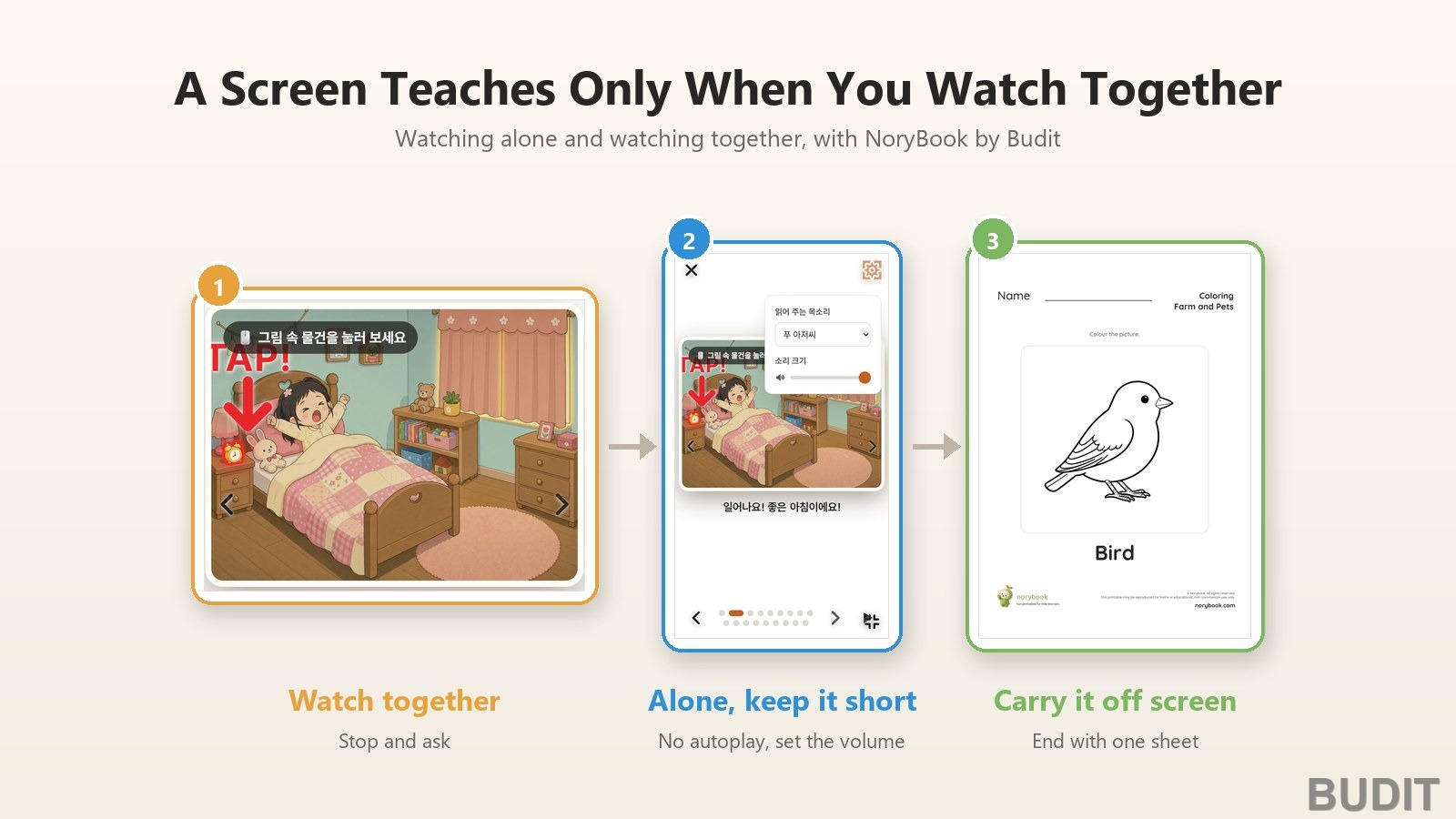
The three steps in the image at the top are the order for using a screen.
- 『Watch together』: read My Day side by side, and stop to ask every time an object is tapped. How tapping works is in Tap the Picture, Collect the Word Cards.
- 『Alone, keep it short』: one book that does not advance on its own, with the volume turned down in settings.
- 『Carry it off screen』: after the last page, finish with one sheet of paper such as Farm Animals Coloring.
Related reading: Does Background English Work, The Science of a Bedtime Reading Routine 『Emotional Security and Sleep』, Learning Words by Pointing at Pictures 『Interactive Book Reading』
References
- Council on Communications and Media, American Academy of Pediatrics (2016). Media and young minds. Pediatrics. View the paper
- Anderson, D. R. and Pempek, T. A. (2005). Television and very young children. American Behavioral Scientist. View the paper
- Strouse, G. A., O'Doherty, K. and Troseth, G. L. (2013). Effective coviewing: Preschoolers' learning from video after a dialogic questioning intervention. Developmental Psychology. View the paper
- Parish-Morris, J., Mahajan, N., Hirsh-Pasek, K., Golinkoff, R. M. and Collins, M. F. (2013). Once upon a time: Parent-child dialogue and storybook reading in the electronic era. Mind, Brain, and Education. View the paper
- Madigan, S., Browne, D., Racine, N., Mori, C. and Tough, S. (2019). Association between screen time and children's performance on a developmental screening test. JAMA Pediatrics. View the paper
This article shares general information about development and education. Every child grows at their own pace. For specific concerns, please consult a pediatrician or a development specialist.