
Play Is Learning
『All my child does is play.』 Yet there is learning inside that play, and a little guidance from an adult makes it easier for play to turn into learning.
Play comes in many forms
Rather than sorting activities into 『play or study』, researchers suggest seeing play as a range, from free play that the child leads to direct instruction that an adult leads (Zosh et al., 2018). The table below sums up four points along that range.
| Form | Who leads | Example |
|---|---|---|
| Free play | The child | Building with blocks, pretend play |
| Guided play | The child leads, while an adult sets things up and asks questions | 『Shall we collect only the red blocks?』 |
| Games with rules | The child, within set rules | Memory match, board games |
| Direct instruction | The adult | Listening to explanations, dictation |
The power of guided play
In 『guided play』, the child stays in charge while an adult sets up the activity around something to learn and nudges the child's thinking with questions (Weisberg et al., 2016). In an experiment where 70 children aged 4 and 5 learned the defining features of shapes, those taught through guided play understood the shapes better than those who only heard explanations or played freely, and the difference was still there a week later (Fisher et al., 2013). A meta analysis also found that guided play worked better than direct instruction in some areas, such as early math and knowledge of shapes, while in several other areas there was no clear difference (Skene et al., 2022).
Four things that help children learn
After looking at educational apps, researchers in the science of learning summed up four things that activities where children learn well have in common (Hirsh-Pasek et al., 2015).
- 『Active』: children think and take part instead of just watching.
- 『Engaged』: few distractions pull their attention away, so they can focus.
- 『Meaningful』: the activity connects to the child's life and to what they already know.
- 『Social』: children talk with parents and friends.
Why writing by hand helps children remember is covered in our earlier article Why Paper Worksheets in a Digital Age.
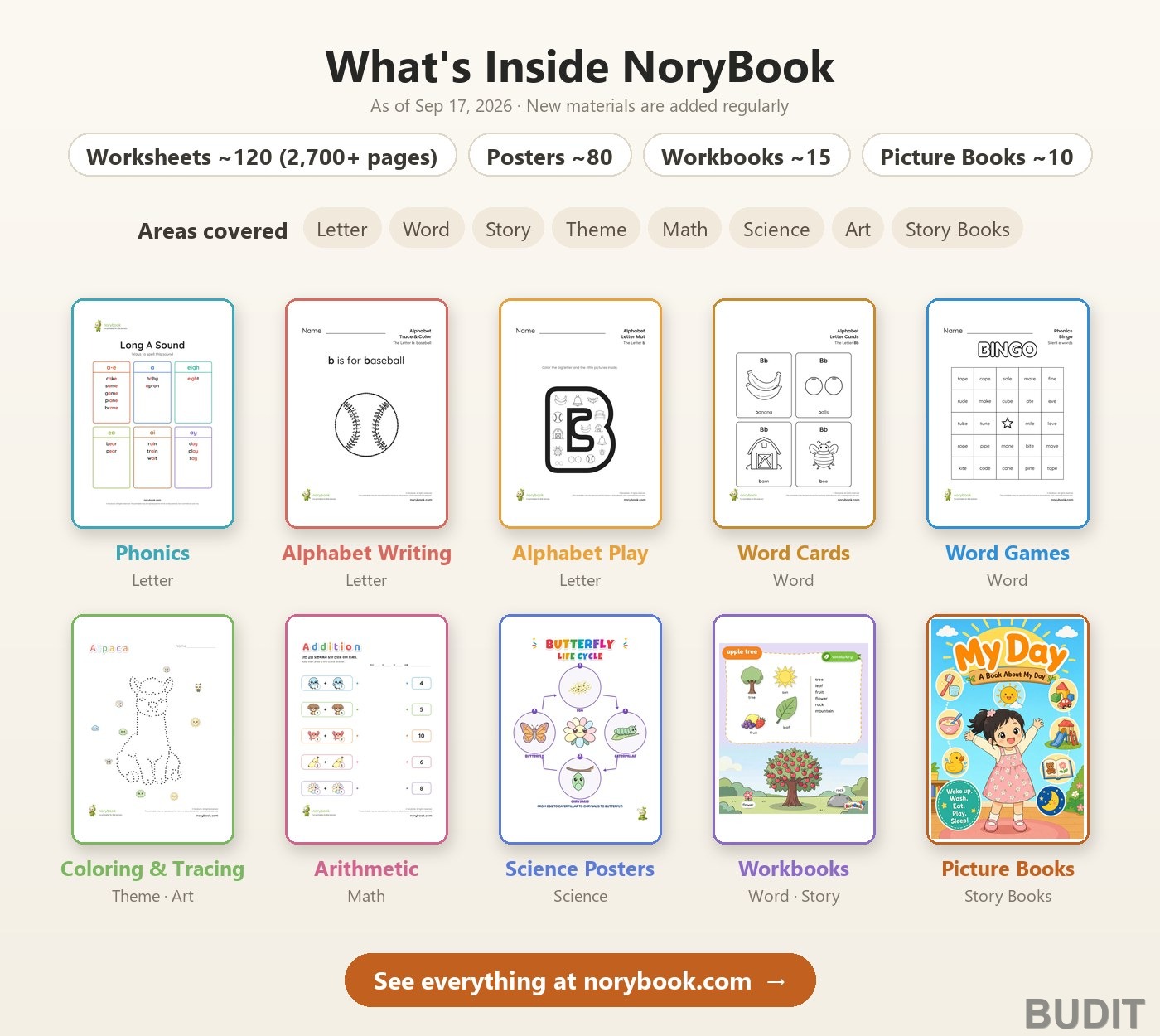
Photo: the 『NoryBook』 collection by Budit (as of Sep 17, 2026). Around 120 worksheets plus posters, workbooks and picture books cover letters, words, stories, themes, math, science and art, and new materials keep coming. See everything at norybook.com
Worth watching
Video: EBS New Year special 『The Power of Play』, part 1, edited cut (official YouTube channel, Korean). Through the story of a child who started academics very early and had little time to play, it looks at why play matters in early childhood.
How this continues in Budit
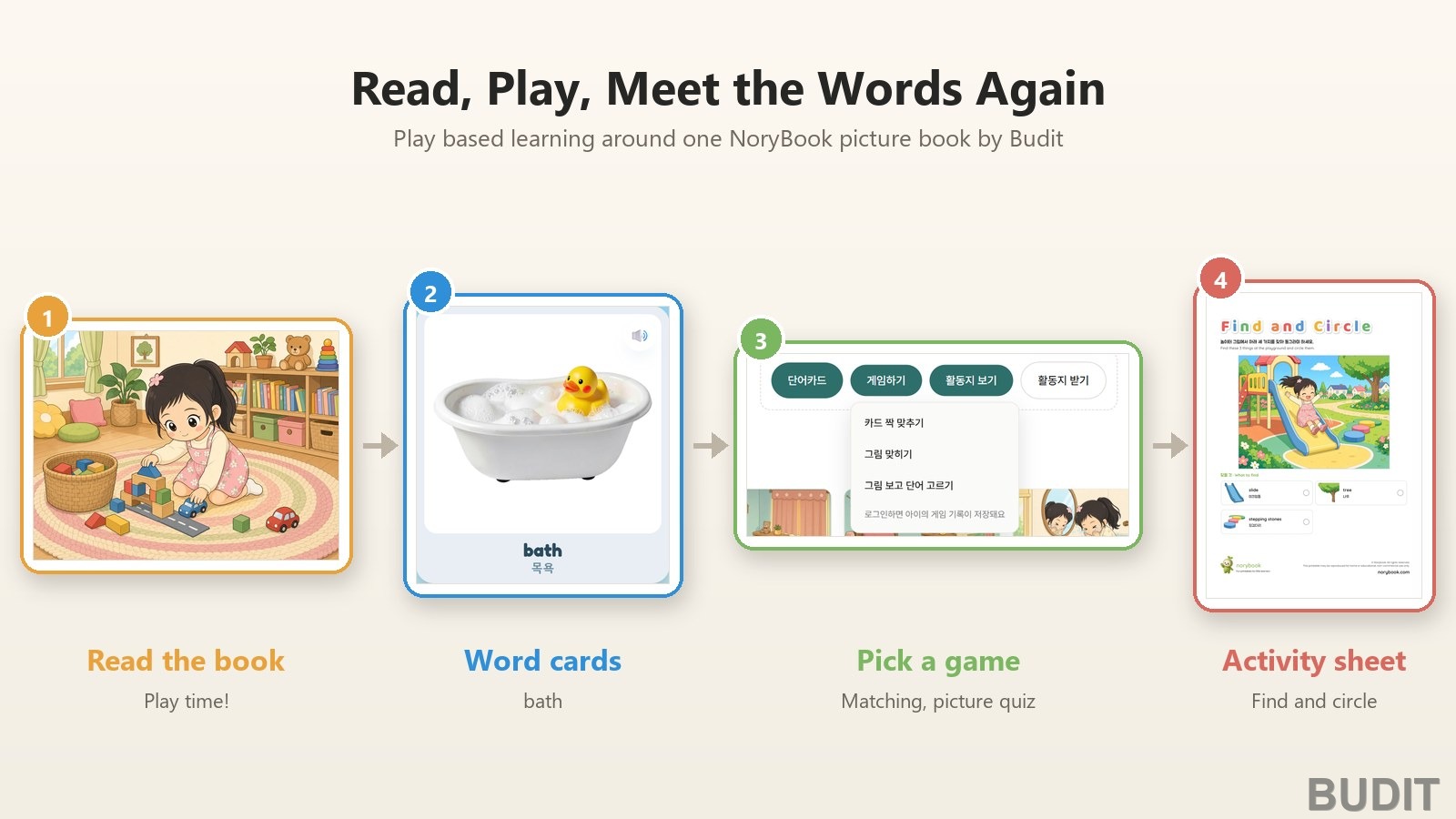
A 『NoryBook』 picture book does not stop at reading. It leads on to word cards, games and activity sheets. The four steps in the image at the top are real screens and materials from 『My Day』.
- 『Read the book』: in the reader, point together at the blocks and cars in the 『Play time!』 scene.
- 『Word cards』: the 『단어카드』 (word cards) button on the book page shows the words from the book with a picture, audio and meaning.
- 『Pick a game』: the 『게임하기』 (play games) button lets you choose memory match, a picture guessing game, or a game where you pick the word that goes with a picture.
- 『Activity sheet』: finish with a paper activity from 『활동지 보기』 (view activity sheets), where your child finds things in a picture and circles them.
Along the way, rather than giving the answer right away, guide your child with questions such as 『Where is it?』 or 『What was this called in English?』
References
- Zosh, J. M. et al. (2018). Accessing the inaccessible: Redefining play as a spectrum. View on Google Scholar
- Weisberg, D. S. et al. (2016). Guided play: Principles and practices. View on Google Scholar
- Fisher, K. R. et al. (2013). Taking shape: Supporting preschoolers' acquisition of geometric knowledge through guided play. View on Google Scholar
- Skene, K. et al. (2022). Can guidance during play enhance children's learning and development in educational contexts? A systematic review and meta-analysis. View on Google Scholar
- Hirsh-Pasek, K. et al. (2015). Putting education in "educational" apps: Lessons from the science of learning. View on Google Scholar
This article shares general information about development and education. Every child grows at their own pace. For specific concerns, please consult a pediatrician or a development specialist.