


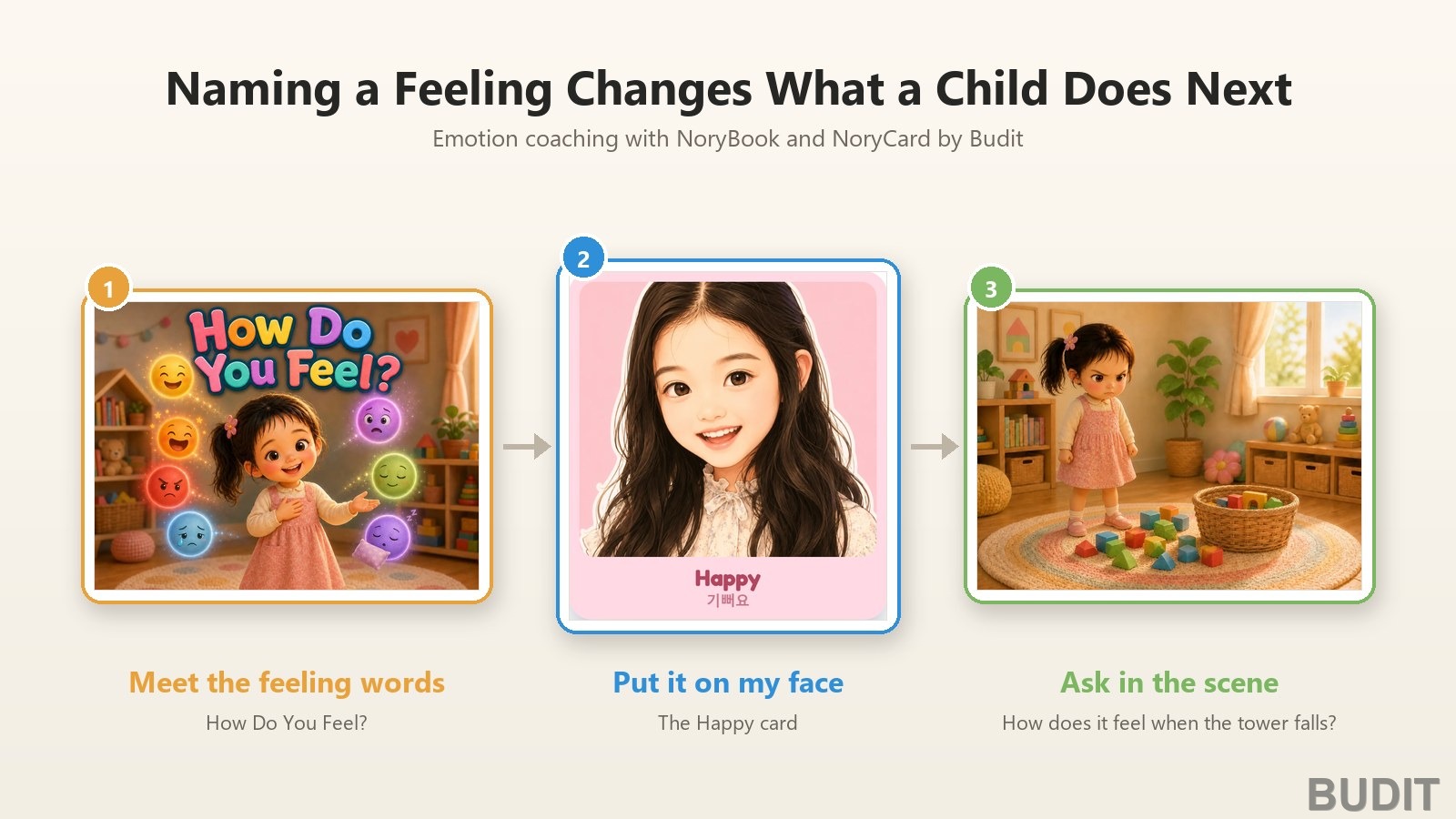
Emotion Coaching and Feeling Words
Some days 『stop it』 does nothing for a child lying on the floor, and 『the tower fell and you're upset』 does. That is not luck. Naming a child's feeling is, before it is a calming trick, a lesson in which the child learns the words for handling their own mind. The principle is the same whether the words are Korean or English.
At a glance
| Question | What the research says |
|---|---|
| What is emotion coaching | Five steps: notice the child's feeling, listen, name it, and only then set a limit |
| Why does naming calm a child | Brain imaging showed the emotional response dropping when a feeling was put into words |
| Why do feeling words matter | Children who heard more talk about feelings at home at three read others' feelings better at six |
| Has it been tested | In a trial that taught parents emotion coaching, children's problem behavior fell and emotion understanding rose |
| So | Say the feeling first, grow the words, then state the rule |
The five steps of emotion coaching
Gottman and colleagues sorted families by how parents treated children's feelings and followed the children. Children of parents who treated anger and sadness as moments to teach and work through together came out ahead in emotion regulation, peer relationships and school, and the approach was named 『emotion coaching』 (Gottman et al., 1996). The five steps:
- Notice the child's feeling. Small feelings are easier to catch than big ones.
- See the feeling as a chance to get closer and to teach.
- Listen, and accept that the feeling makes sense.
- Name the feeling: 『you're upset』, 『that was scary』.
- Then set a limit and think together about what to do.
The order is the point. Going from step 3 to step 5 without naming leaves the child with a rule and the feeling untouched.
A named feeling gets smaller
In a brain imaging experiment, people looked at angry faces and in one condition chose a feeling word such as 『angry』, while in another they chose the person's gender. When the feeling was put into words, activity in the amygdala, which processes emotion, dropped, and the frontal areas that handle language became more active (Lieberman et al., 2007). The researchers called it 『affect labeling』. Behind the way 『you're upset』 settles a child is this mechanism.
Feeling words are learned at home
One study recorded three year olds talking with their families at home and met them again three years later. Children from homes where feelings were talked about more at three were better at six at reading other people's emotions (Dunn et al., 1991). The ability to recognize emotions in turn predicted later social skills and adjustment to school (Denham et al., 2003). Feeling words grow at the dinner table more than from a workbook.
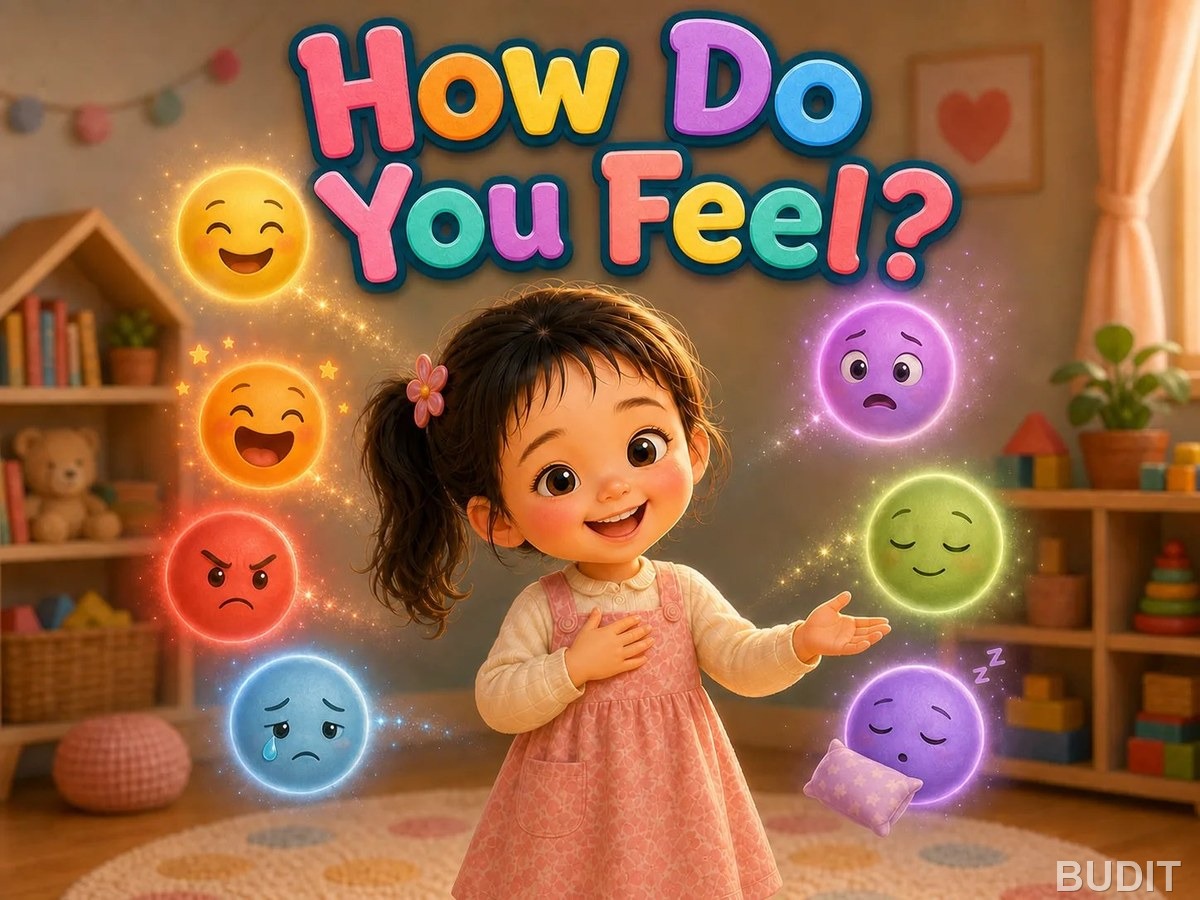
Photo: the cover of the 『NoryBook』 picture book 『How Do You Feel?』 (as of Oct 23, 2026). A book that meets feeling words such as happy and excited through a child's day, with the first five pages open as a preview. See the book
When parents learn it, children change
Emotion coaching is learned, not inborn. In a randomized trial, parents of four and five year olds took six sessions on emotion coaching. Trained parents dismissed their children's feelings less and coached more, and their children's emotion understanding rose while problem behavior fell (Havighurst et al., 2010). What parents needed was not long training but knowing the order.
Growing feeling words with books and cards
The easiest place to grow feeling words is a scene in a picture book. On the page where the hero's block tower is about to fall, ask 『how does she feel right now?』, and when the child answers, add one English word: 『upset, sad』. When a child sees an emotion card with their own face on it, the word stops being about someone else. Why things related to the self are remembered better is in our earlier article Feeling Words on My Own Face.
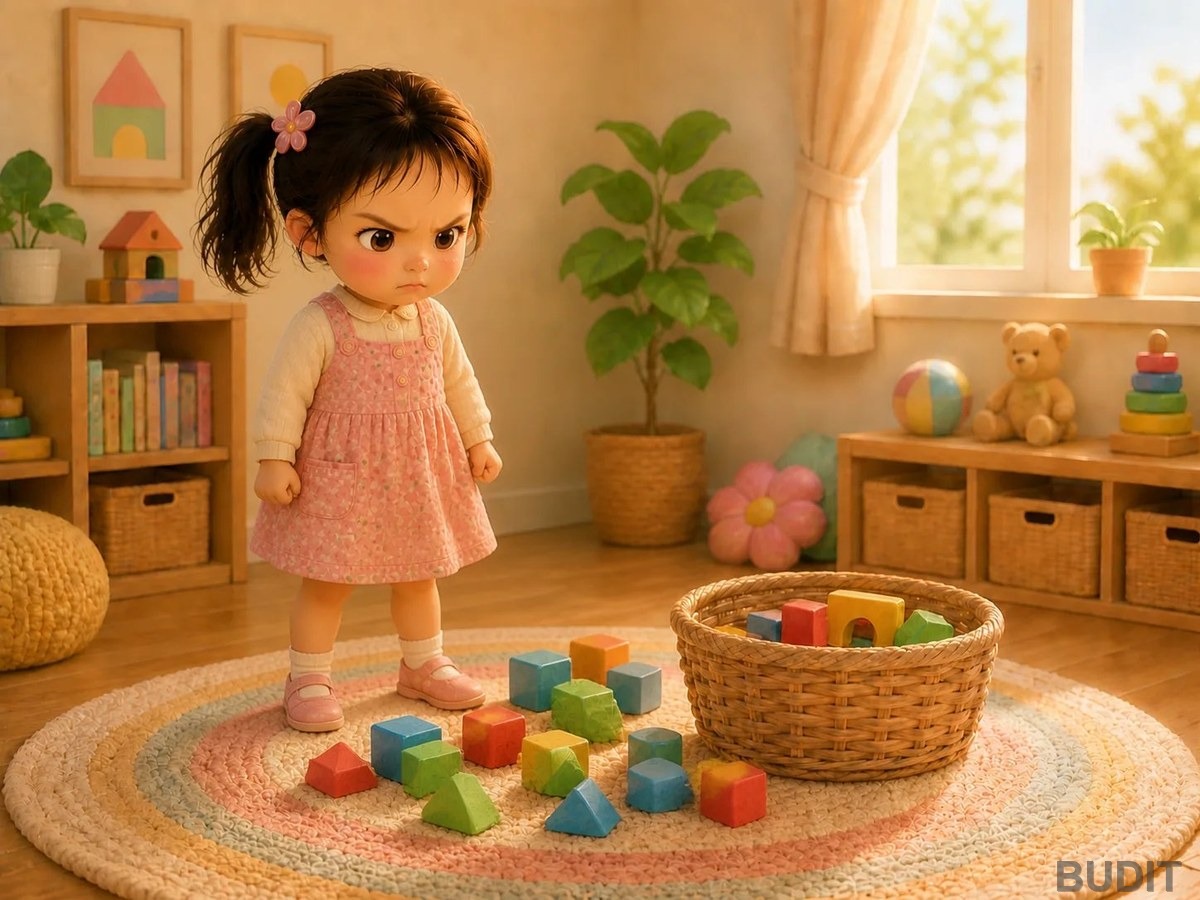
Photo: the 『Up, up! A tall block tower.』 scene from 『How Do You Feel?』 (as of Oct 23, 2026). A good page to ask 『how will it feel if the tower falls?』.
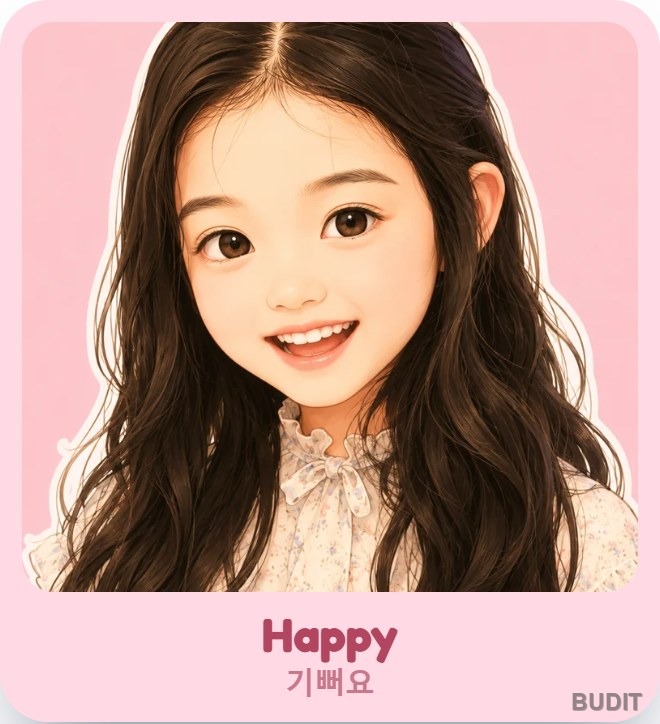
Photo: the 『Happy』 card from the 『NoryCard』 demo (as of Oct 23, 2026, sample photo, Korean interface shown). Made from the child's own photo, the child becomes the main character of the feeling word. Try it
What to do at home
- Say the feeling before the rule. 『You're angry』 before 『no throwing』. Switching the order is enough for the next sentence to be heard.
- Start with four feeling words: happy, sad, angry, scared. Once the child uses them, add excited, tired and surprised.
- Name your own feelings too. 『Mom is a little tired right now.』 Children learn feeling words by watching adults use them.
- Ask in picture book scenes. 『How does she feel?』 『Have you ever felt like that?』 One scene a day is enough.
- Make faces in a mirror or a photo. 『What does a sad face look like?』 Making emotion cards from the child's own face turns that game into cards.
- Talk after the big feeling has passed. While the crying is at its peak, only name it; once it settles, think together about 『what happened back there』.
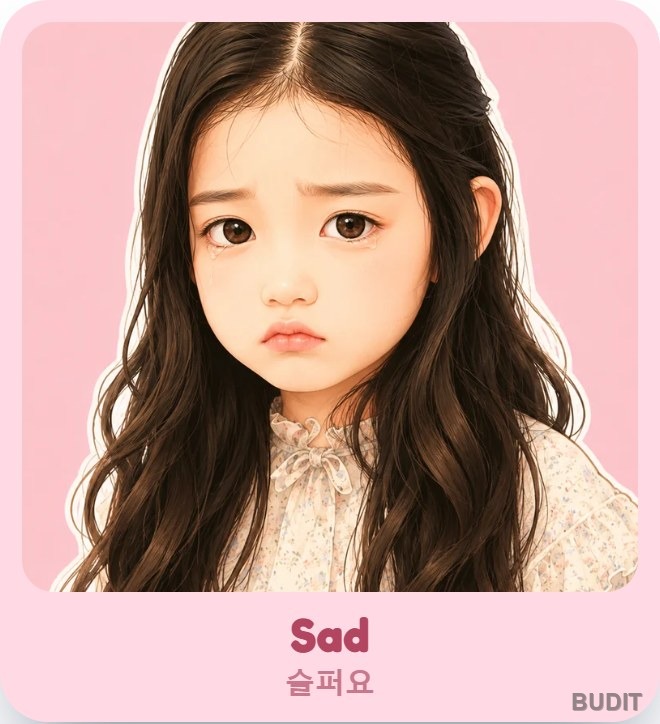
Photo: the 『Sad』 card from the 『NoryCard』 demo (as of Oct 23, 2026, sample photo). Swipe and the same child's next feeling follows.
Questions people ask
Won't accepting feelings spoil the child? Accepting a feeling and allowing a behavior are different things. The last of the five steps is setting a limit. 『It's fine to be angry. Throwing is still not allowed』 is emotion coaching.
From what age should I use English feeling words? Once the child starts naming feelings in their own language, add one English word at a time. It attaches a sound to a feeling the child already understands, so there is nothing separate to teach.
My child refuses to name feelings The parent can name them instead. 『You're upset』 does not demand an answer. Words build up from listening alone.
What about sibling fights? Name both children's feelings. 『You're angry, and your brother was scared.』 Who was right comes after that.
How this continues in Budit
The three steps in the image at the top are the order for growing feeling words.
- 『Meet the feeling words』: How Do You Feel? meets a feeling word in each scene of a child's day.
- 『Put it on my face』: the NoryCard demo shows emotion cards made from a child's photo. You can try it first with the sample photo.
- 『Ask in the scene』: while reading, ask 『how does she feel right now?』 and add one English word to the child's answer.
Related reading: Feeling Words on My Own Face 『Emotion and Memory』, When a Child Refuses English 『Let Them Choose Instead of Pushing』, My Face in the Picture Book 『Self Concept and Personalized Books』
References
- Gottman, J. M., Katz, L. F. and Hooven, C. (1996). Parental meta-emotion philosophy and the emotional life of families: Theoretical models and preliminary data. Journal of Family Psychology. View the paper
- Lieberman, M. D. et al. (2007). Putting feelings into words: Affect labeling disrupts amygdala activity in response to affective stimuli. Psychological Science. View the paper
- Dunn, J., Brown, J. and Beardsall, L. (1991). Family talk about feeling states and children's later understanding of others' emotions. Developmental Psychology. View the paper
- Denham, S. A. et al. (2003). Preschool emotional competence: Pathway to social competence? Child Development. View the paper
- Havighurst, S. S., Wilson, K. R., Harley, A. E., Prior, M. R. and Kehoe, C. (2010). Tuning in to Kids: Improving emotion socialization practices in parents of preschool children. Journal of Child Psychology and Psychiatry. View the paper
This article shares general information about development and education. Every child grows at their own pace. For specific concerns, please consult a pediatrician or a development specialist.