



When to Start Talking About Money with Children
It is easy to put money talk off until 『when they are older』. Yet research says thinking and habits about money settle in earlier than we think. Children are already learning about money at the checkout, on pocket money day and from news about rising prices. Carrying that learning into conversations with parents becomes the root of financial literacy.
At a glance
| Question | What the research says |
|---|---|
| Does childhood money talk last | People who talked about money with their parents as children understood finance better as adults |
| Does financial education work | Across 76 experiments, financial education changed both knowledge and real behavior |
| What lays the foundation | Self control, family conversations and hands on experience form the base of money habits |
| What to do at home | Start with money you can see, then widen to exchange, saving and choice |
Money talk in childhood stays
Grohmann and colleagues surveyed young adults and compared their childhood with their current financial understanding. Those who had talked about money with their parents at home and watched them manage it scored higher on financial understanding as adults, and education at school helped too (Grohmann et al., 2015). Money is not a topic to hide, but one to talk about together.
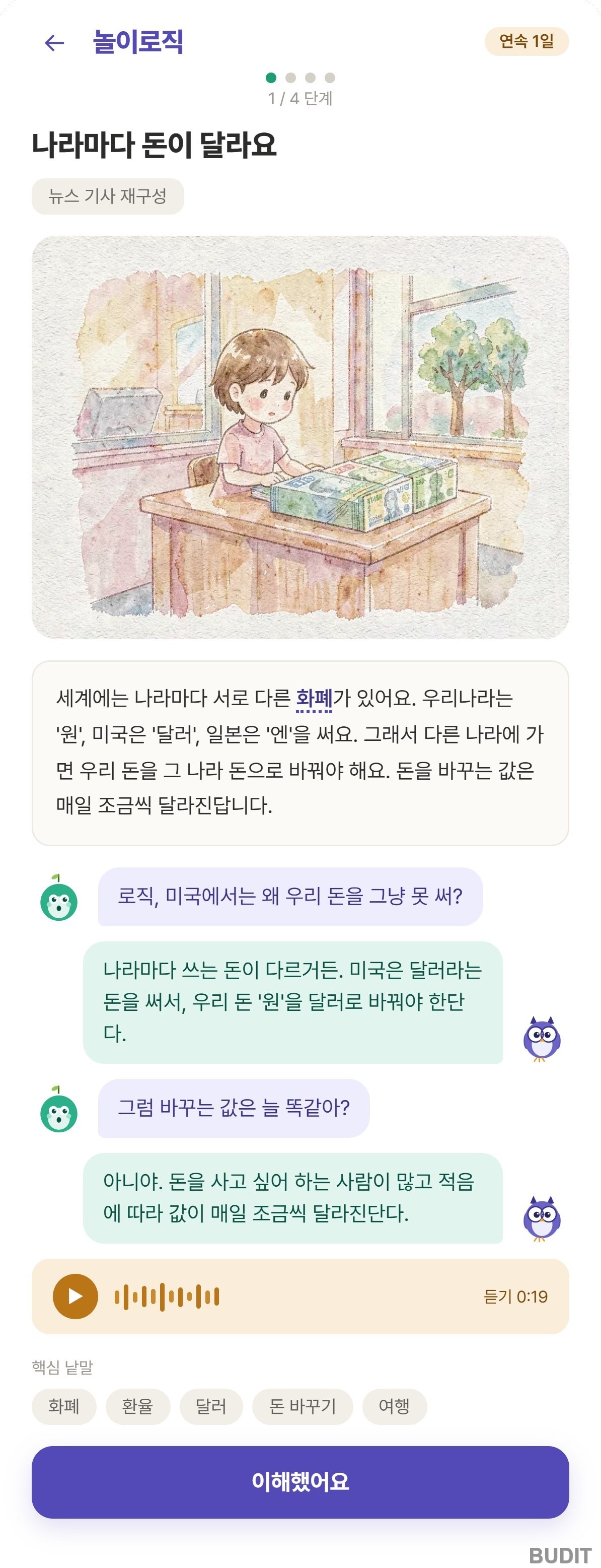
Photo: the 『NoryLogic』 story 『Every country has its own money』 (as of Nov 5, 2026; NoryLogic is currently in Korean). A story that starts from the news, explaining different currencies and the price of exchanging money at a child's level. Visit NoryLogic
Financial education changes knowledge and behavior
Kaiser and colleagues analyzed 76 studies that tested financial education in experiments. People who received financial education not only knew more but also improved real behaviors such as saving and budgeting. The size of the effect was similar to that of other education programs, such as math or reading (Kaiser et al., 2022). Finance, too, is a subject children learn when it is taught.
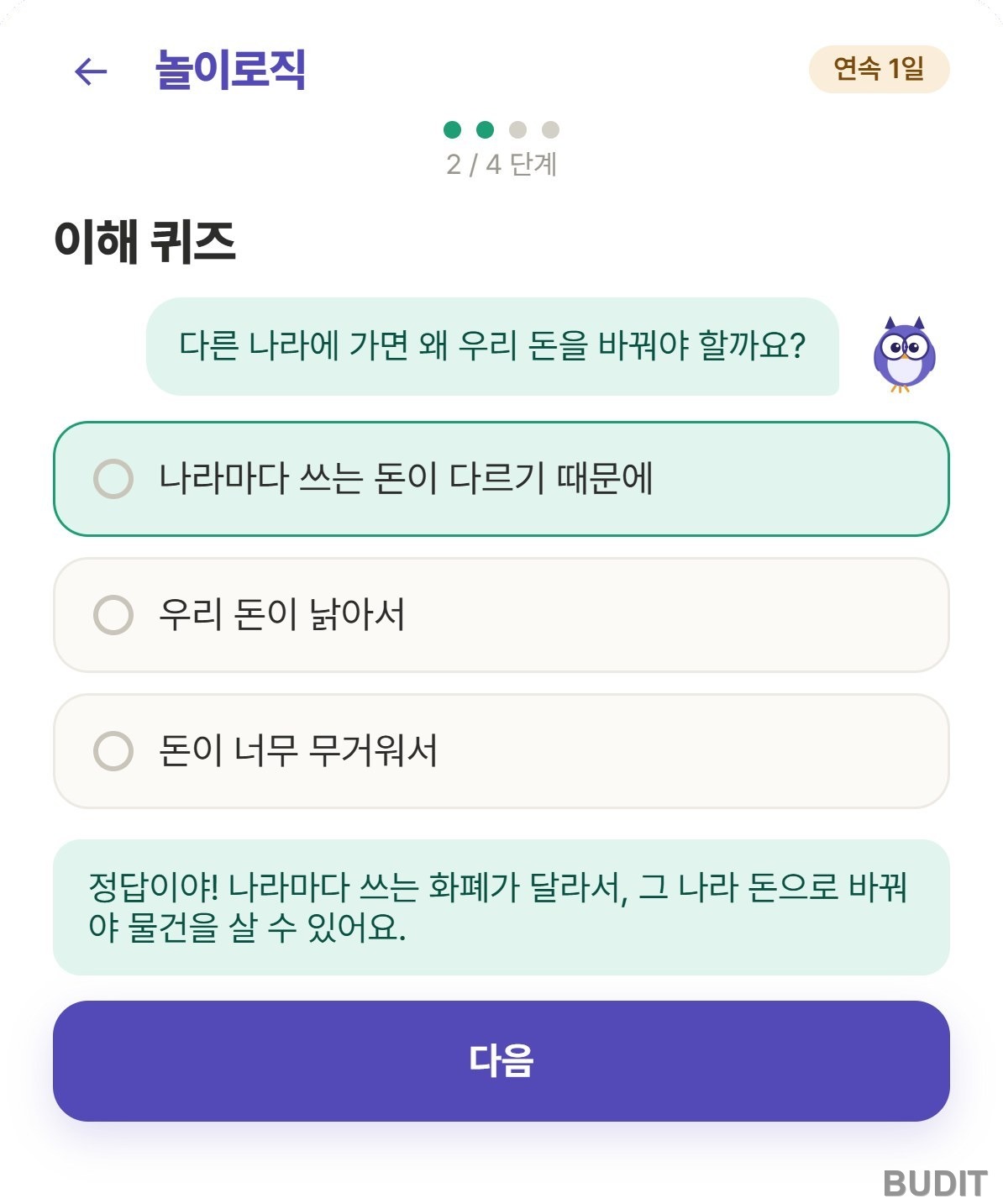
Photo: the comprehension quiz in the same story (as of Nov 5, 2026). Visit NoryLogic
Three foundations of money habits
Drever and colleagues described how money habits develop from childhood through youth. They named three foundations: self control to wait instead of buying now, attitudes toward money learned through family conversations, and the experience of actually spending and saving. In the early years, they argued, these three grow before any arithmetic (Drever et al., 2015).
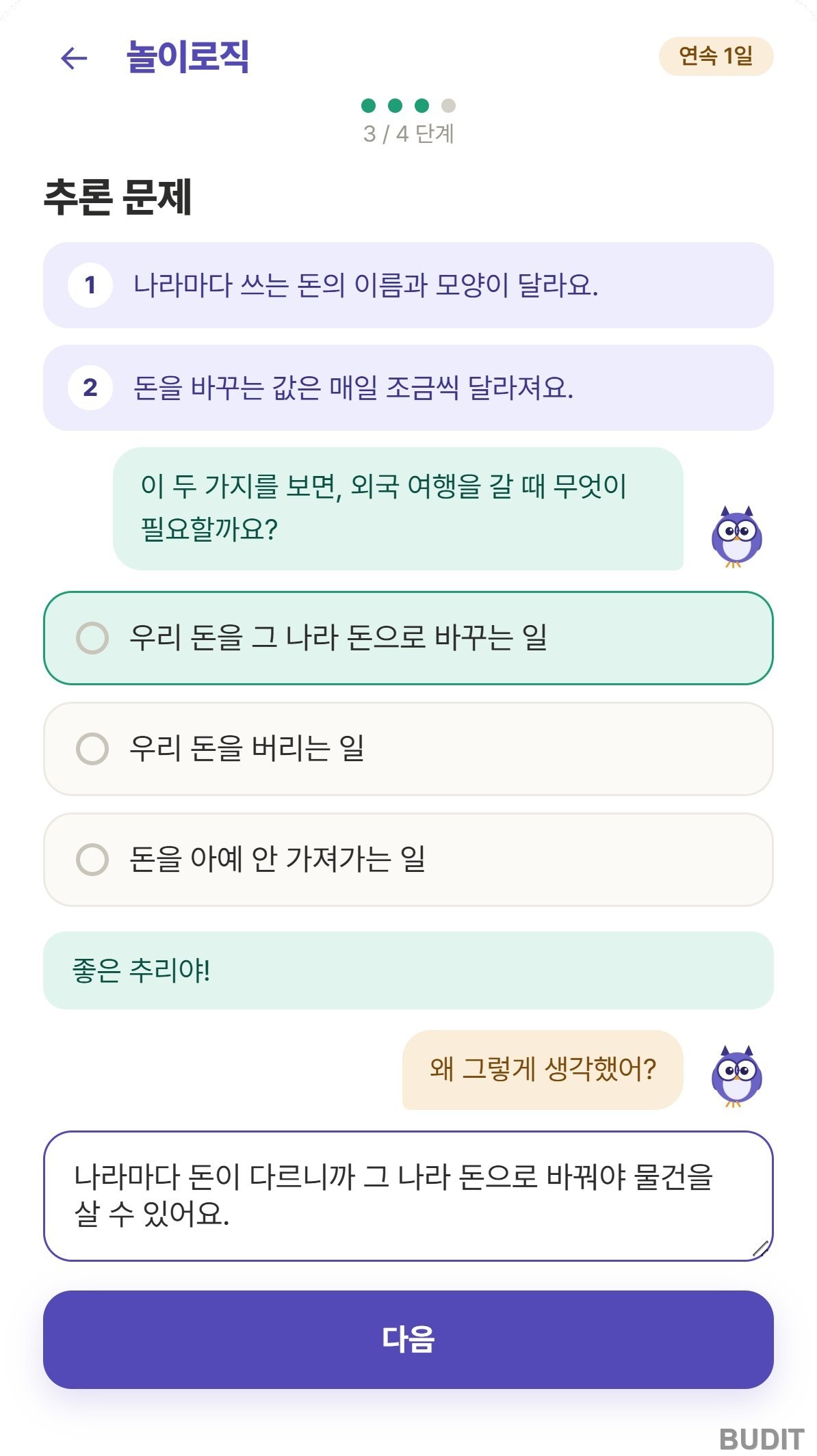
Photo: the reasoning question in the same story (as of Nov 5, 2026, with a sample answer typed in). The child reasons from clues about what a trip abroad needs, and writes the reason. Visit NoryLogic
What to do at home
- Start with money you can see. Count coins and notes together, and talk about what they are made of and who makes them.
- Shop together. Choosing within a set amount, 『if we buy this, we can't buy that』, teaches the idea of choice.
- Give them the experience of waiting. A piggy bank to save up for something over a few weeks is practice in self control.
- Turn economic news into a child's words. Change 『fuel prices went up』 into 『why do prices go up?』, and it becomes an economic idea.
- Say your own choices out loud. 『We'll eat out less this month to save for a trip』 shows an attitude toward money.

Photo: the 『NoryLogic』 money and economy category (as of Nov 5, 2026). Everyday economic ideas, such as choosing just one, interest and how goods reach the shop, can be read one after another. See money and economy stories
Questions people ask
At what age should pocket money start? Rather than a set age, a good time is when the child can count and tell 『more』 from 『less』. Start with small amounts at short intervals, and count what is left together.
Won't talking about money make them obsessed with it? Hiding money only makes them more curious. Talk together about money as a tool for exchanging what we need, and about the choices that come with spending it.
Isn't economic news too hard? Articles as they are, yes. Turn exchange rates into 『the price of swapping money because each country's is different』 and interest into 『the price of lending money』, and even early primary children understand.
How this continues in Budit
The three steps in the image at the top are the order for continuing money talk with 『NoryLogic』.
- 『Read the economy in the news』: NoryLogic rewrites economic news, such as exchange rates, prices and interest, as stories at a child's level.
- 『Check the concept』: a comprehension quiz and a reasoning question check ideas such as currency, exchange and choice.
- 『Keep reading one subject』: read similar stories in the money and economy category, and connect them to daily life in the thought journal.
If you are new, start with Getting Started with NoryLogic to see the order of one session.
Related reading: Background Knowledge Changes Reading Comprehension 『We Read What We Already Know』, Number Sense in Everyday Life 『Counting What Is in Front of You Beats Drills』, A Two Sentence Thought Journal 『Writing Sorts Out Thinking』
References
- Grohmann, A., Kouwenberg, R. and Menkhoff, L. (2015). Childhood roots of financial literacy. Journal of Economic Psychology. View the paper
- Kaiser, T., Lusardi, A., Menkhoff, L. and Urban, C. (2022). Financial education affects financial knowledge and downstream behaviors. Journal of Financial Economics. View the paper
- Drever, A. I. et al. (2015). Foundations of financial well being: Insights into the role of executive function, financial socialization, and experience based learning in childhood and youth. Journal of Consumer Affairs. View the paper
This article shares general information about development and education. Every child grows at their own pace. For specific concerns, please consult a pediatrician or a development specialist.