



Study habits for the early grades
『Do I really need to set study habits in first grade?』 Yes, but not the kind of studying you may be picturing. What the early grades need is not the stamina to sit at a desk for a long time but the experience of finishing something short at a set time in a set place. The research says that what separates achievement at this age is not the amount of study but the power to regulate oneself, and that this power grows from deciding 『when and where』.
At a glance
| Question | Answer |
|---|---|
| How much should the early grades do | In elementary school there was almost no link between homework amount and achievement. Daily matters more than length |
| What separates achievement | Self discipline (waiting, putting off, planning) explained grades better than IQ scores |
| How habits form | The same situation (time, place, the action before) becomes a cue and the habit hardens |
| The single most effective thing | Deciding 『when, where, what』 in one sentence. Follow through rose a lot |
| How many days | 66 on average, and missing one day was fine |
It is not about quantity
Cooper and colleagues gathered homework research from 1987 to 2003 and looked at the link between homework and achievement. For middle and high school students the link was clear, but for elementary students there was almost none (Cooper et al., 2006). This does not mean homework is useless in the early grades. It means that what homework does at this age is not raise achievement but plant the habit of 『finishing what has to be done at a set time』. So there is no reason to increase the amount. Short and daily is enough.

Photo: the 『NoryLogic』 first setup screen (as of Nov 5, 2026; NoryLogic is currently in Korean). One story a day is the default, and turning on the daily reminder gives a cue at the set time. Visit NoryLogic
What separates achievement is self regulation
Duckworth and Seligman measured eighth graders' self discipline (the power to hold back what you want to do and do what has to be done first) together with their IQ scores, and then looked at their grades at the end of the year. Self discipline explained grades better than IQ, and it also explained behaviors such as time spent on homework and absences better (Duckworth and Seligman, 2005). This power does not appear suddenly in middle school. It grows in the early grades, through the daily experience of 『I want to play, but ten minutes first』.
Habits harden through cues
Wood and Neal summarized that habits run not on willpower but on cues from the situation. When the same time, the same place and the same preceding action repeat, the situation itself calls up the behavior (Wood and Neal, 2007). If 『go study』 has to be said every time, it is not yet a habit. Dinner, clear the table, ten minutes right there. When that order repeats, clearing the table becomes the cue.

Photo: the 『NoryLogic』 home screen (as of Nov 5, 2026). One mission for today is already set when the app opens, so there is no 『what should I do』 to decide.
One sentence: 『when and where』
There is one single most effective thing for building a habit. Gollwitzer and Sheeran gathered 94 studies and showed that people who set their goal as one sentence, 『when and where I will do what』, followed through far more than people who only set the goal. The effect size was 0.65, and it was similar across health, study and work (Gollwitzer and Sheeran, 2006). 『Let's study hard』 is a goal. 『After dinner, at the table, one NoryLogic story』 is an implementation intention. Write that sentence on paper with your child and stick it on the table.
How many days does it take? Lally and colleagues reported that when people repeated a new behavior daily, it took an average of 66 days to feel automatic, ranging from 18 to 254 days depending on the person, and that missing a single day had no large effect (Lally et al., 2010). Give it two months, and one missed day does not mean starting over.
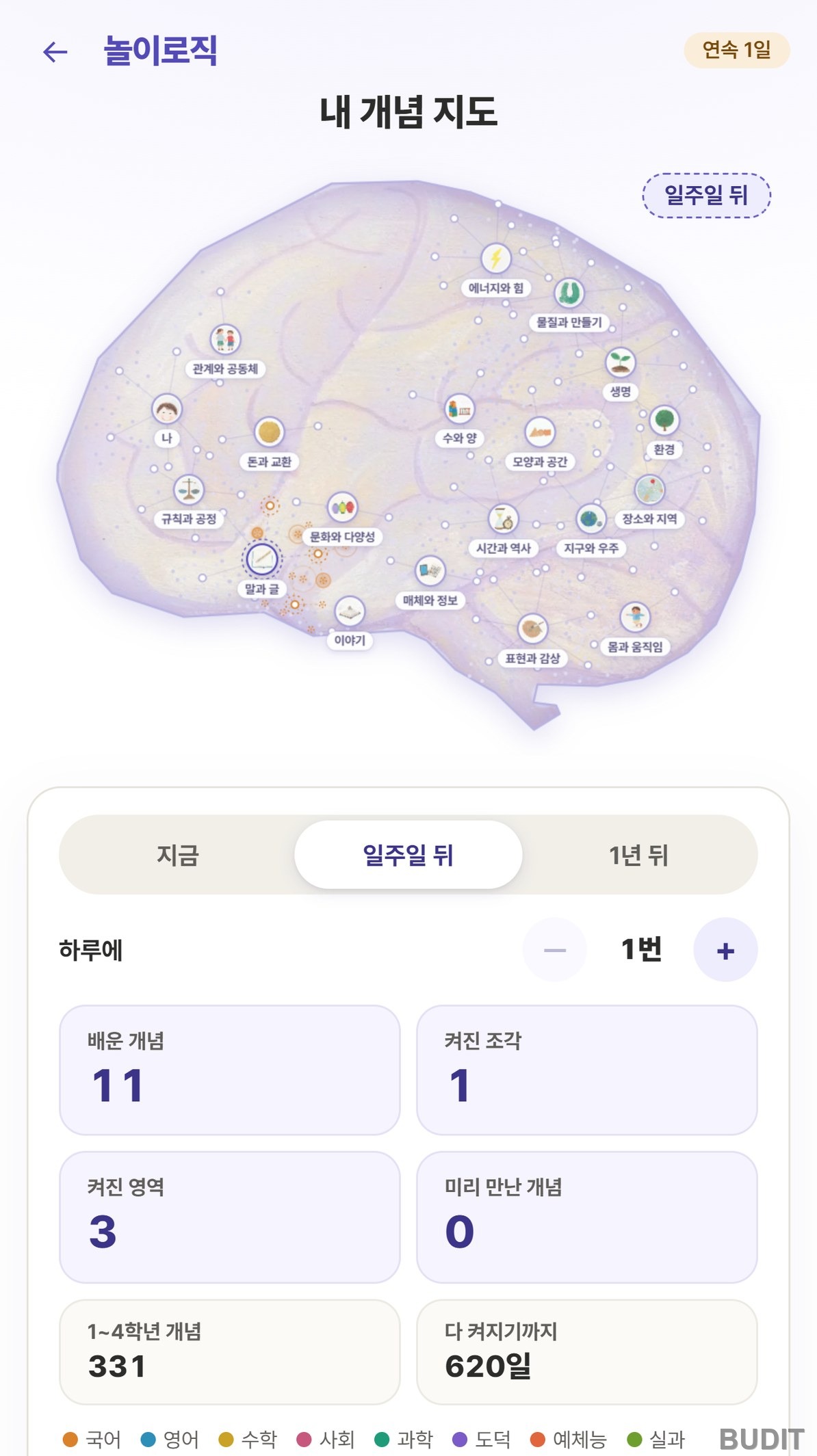
Photo: 『NoryLogic』 my concept map (as of Nov 5, 2026, the one week preview at one session a day). After just one week, what has lit up is visible.
Try this at home
- Start with ten minutes. Ten minutes for grades 1 and 2, fifteen for grade 3 is enough. Even if the child wants to keep going, stopping is better for the next day.
- Write 『when, where, what』 in one sentence together with the child. Include the preceding action, like 『after dinner, at the table, one story』.
- Keep the same place. Change the place and the cue disappears.
- Mark it when finished. One circle on the calendar, or one lit concept in the app. A visible record calls up the next day.
- Let a missed day go. 『You skipped yesterday, so double today』 breaks the habit. Ten minutes today is enough.
- Praise the finishing in words. Praise the process, not the result, like 『you did it at the set time again today』.
Frequently asked questions
My child struggles to sit even ten minutes. Five minutes is fine to start. The key is not the length but the experience of 『I started at the set time and finished』. When five minutes gets easy after a couple of weeks, go to ten.
Does it have to be workbooks? Anything works. Reading one story and saying one thing about it, or one short text and one question, is enough. If the child gets to choose, it lasts longer.
Weekends too? Doing it briefly at the same time is better for the habit. But on days with family plans, skipping is fine. Missing one day had no large effect.
How this continues at Budit
The three steps in the picture at the top are how 『NoryLogic』 fits early grade habits.
- 『A cue at the set time』: NoryLogic lets you turn on a daily reminder in the first setup, and one mission for today is set when the app opens.
- 『One story in ten minutes』: reading, comprehension quiz, reasoning and thought journal make one session, done in about ten minutes.
- 『A visible record』: concepts from finished stories light up on my concept map, and the streak shows on the home screen.

Photo: the 『NoryLogic』 wide home screen (as of Nov 5, 2026). On a tablet or computer, today's mission shows over a constellation background.
If you are new, start with Getting Started with NoryLogic to see the order of one session.
Related reading: How One Story a Day Adds Up 『Short, Same Time, Every Day』, Praising the Process 『You Kept Trying Beats You're So Smart』, Screen Time, Alone or Together 『The Same Screen Turns on Who Is Sitting Beside the Child』
References
- Cooper, H., Robinson, J. C. and Patall, E. A. (2006). Does homework improve academic achievement? A synthesis of research, 1987 to 2003. Review of Educational Research. Read the paper
- Duckworth, A. L. and Seligman, M. E. P. (2005). Self discipline outdoes IQ in predicting academic performance of adolescents. Psychological Science. Read the paper
- Wood, W. and Neal, D. T. (2007). A new look at habits and the habit goal interface. Psychological Review. Read the paper
- Gollwitzer, P. M. and Sheeran, P. (2006). Implementation intentions and goal achievement: A meta analysis of effects and processes. Advances in Experimental Social Psychology. Read the paper
- Lally, P., van Jaarsveld, C. H. M., Potts, H. W. W. and Wardle, J. (2010). How are habits formed: Modelling habit formation in the real world. European Journal of Social Psychology. Read the paper
This post covers general developmental and educational information, and every child develops at their own pace. For specific concerns, please consult a pediatrician or a developmental specialist.