


Number Sense in Everyday Life
Some days a child who rattles off one to ten without a pause is asked for 『just three candies』 and comes back with a fistful. That is not strange. Saying number names in order and knowing that 『the last number you said is how many there are』 are different abilities, and what joins them is less counting drill than counting the things in front of you together, out loud.
At a glance
| Question | What the research says |
|---|---|
| Why does number sense matter | Number skills at school entry predicted later math achievement, better even than reading skills did |
| Does reciting numbers mean knowing them | Children learn number names first and took close to a year to grasp that the last number is the total |
| What makes the difference at home | The amount of number talk differed by tens of times between homes, and children who heard more knew quantities better |
| What kind of number talk helps | Counting and naming the number of objects that are right there had the larger effect |
| Can play do it | Children who played a board game with squares numbered 1 to 10 four times improved in number sense |
Number sense is the first button of school learning
Duncan and colleagues analyzed six longitudinal datasets from the United States, Canada and the United Kingdom together. Of the skills children had at school entry, math skills predicted later achievement best, followed by reading and attention (Duncan et al., 2007). Number sense is not speed at calculation. It is the feel for estimating and comparing amounts and for linking numbers to quantities, and it is already growing before school starts.
Counting by rote and counting with understanding
Wynn gave two and three year olds toys and asked them to 『give me two』 or 『give me three』. Many children who could recite number names fluently handed over exactly one correctly but gave a fistful for anything more, and it took close to a year for them to grasp that the last number counted is the total (Wynn, 1990). So reciting 『one, two, three』 well is not yet knowing numbers. That is why one more question after counting, 『so how many?』, matters.
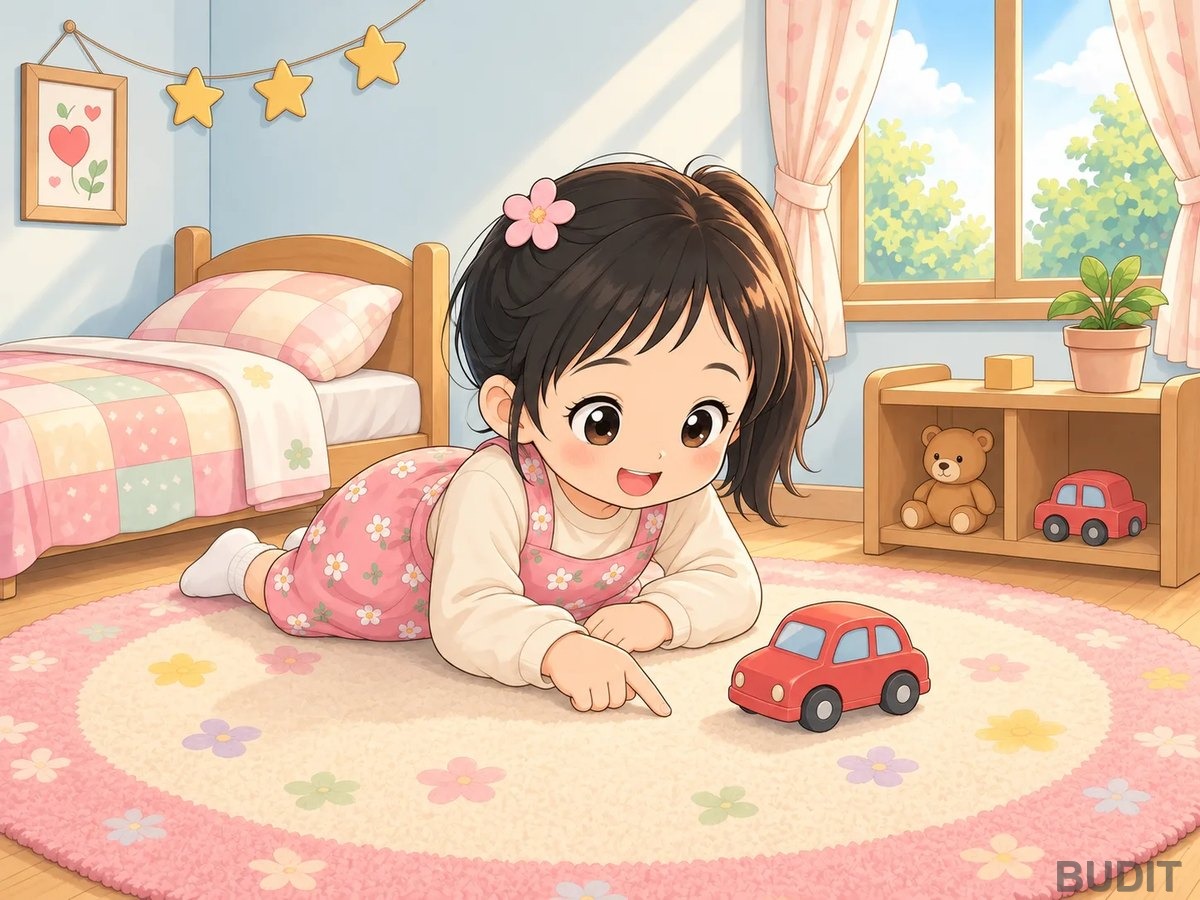
Photo: the 『How many wheels? One, two, three, four!』 scene from the 『NoryBook』 picture book 『How Many?』 (as of Oct 26, 2026). Point at each one with a finger, then sum it up as 『four』 at the end. See the book
Number talk differs by tens of times between homes
Levine and colleagues recorded what children heard at home from 14 to 30 months. The amount of number talk parents used differed by tens of times between homes, and children who heard more of it did better at 46 months on a task asking how many (Levine et al., 2010). A second look at the same data found that among number talk, counting or labeling sets of objects that were present, especially larger sets from four to ten, best predicted later understanding (Gunderson and Levine, 2011). 『Apples, one, two, three, three apples』 does more than reciting numbers to a child.
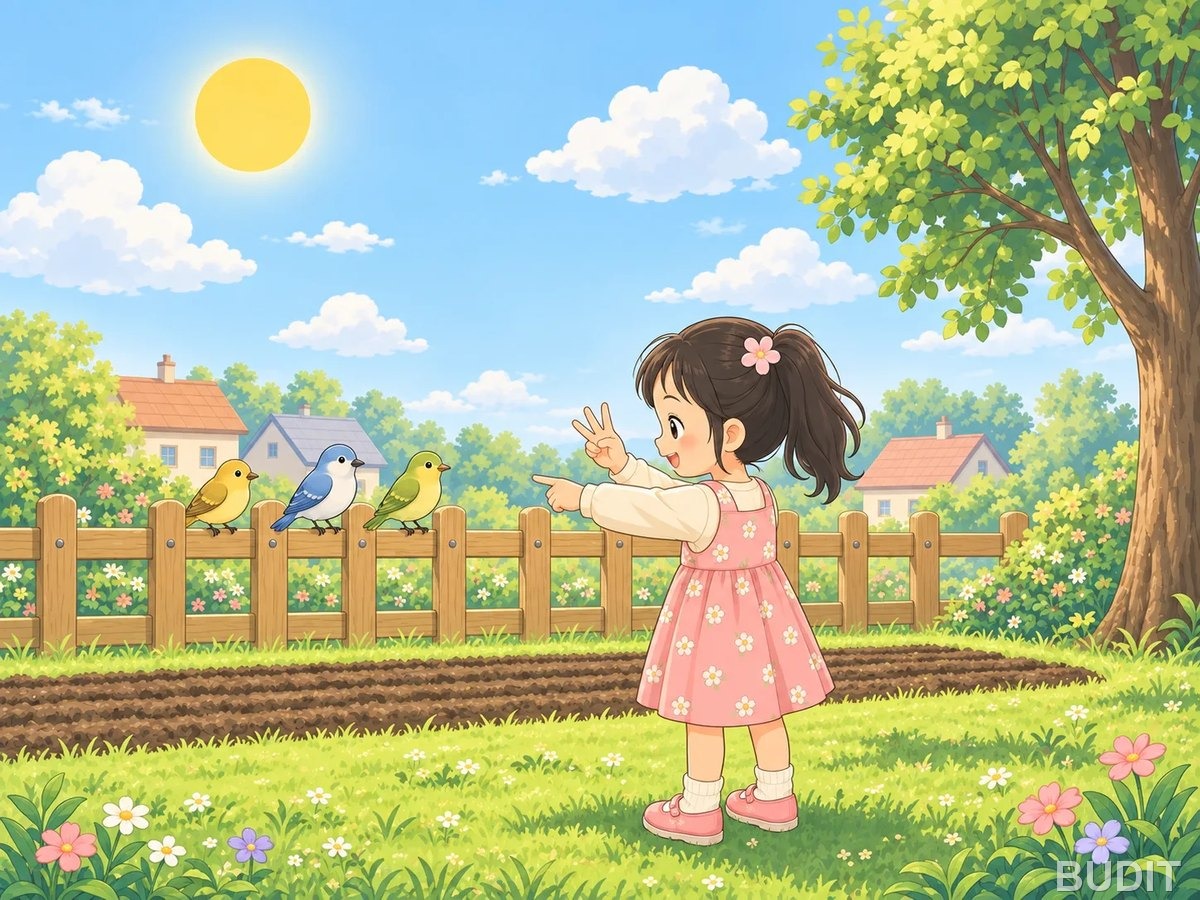
Photo: the 『How many birds? One, two, three!』 scene from 『How Many?』 (as of Oct 26, 2026). Tap each bird in the picture as you count. The first five pages of this book are open as a preview.
Four rounds of a board game make a difference
Siegler and Ramani built a game in which children spin a spinner and move a token along a single row of squares numbered 1 to 10. Preschoolers from low income families played four sessions of 15 to 20 minutes, and their magnitude comparison, number line estimation, counting and numeral identification all improved, while children who played the same board with colors instead of numbers did not improve as much (Siegler and Ramani, 2008). The key was saying 『five, six』 out loud with each move. The feel that bigger numbers lie farther along gets into the body.
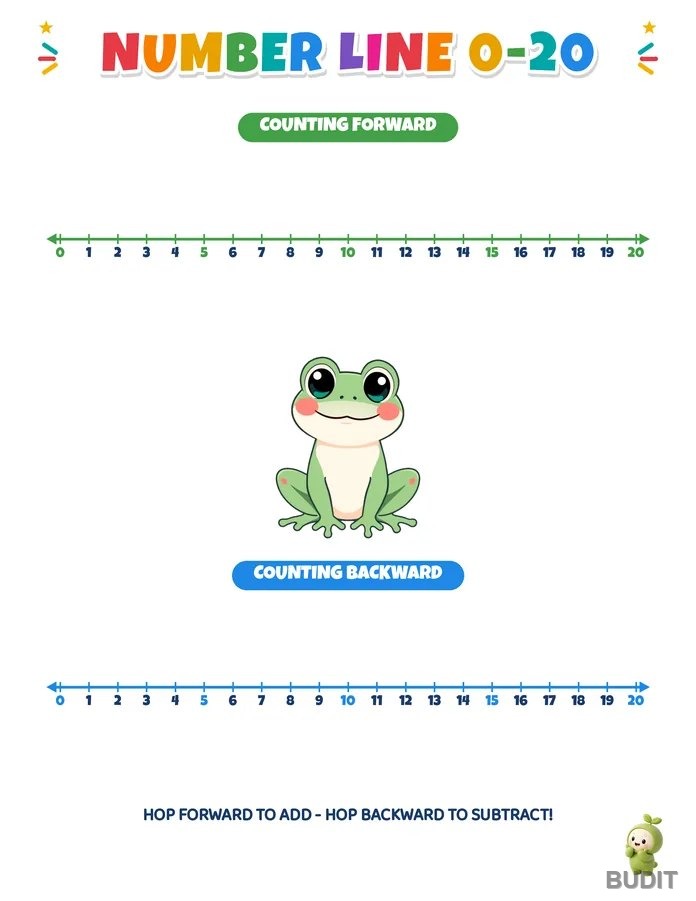
Photo: the 『NoryBook』 『Number Line』 sheet (0 to 20, as of Oct 26, 2026). Hop the frog forward to add and backward to subtract. Print it and use a single game piece as a token, and it becomes a board game. Get the sheet
Counting again on paper
Counting done in daily life lasts longer when it is brought out once more on paper. Counting pictures and writing the number in a box links 『counting』 to 『the shape of the numeral』. Keep the order, though. Objects first, then paper.
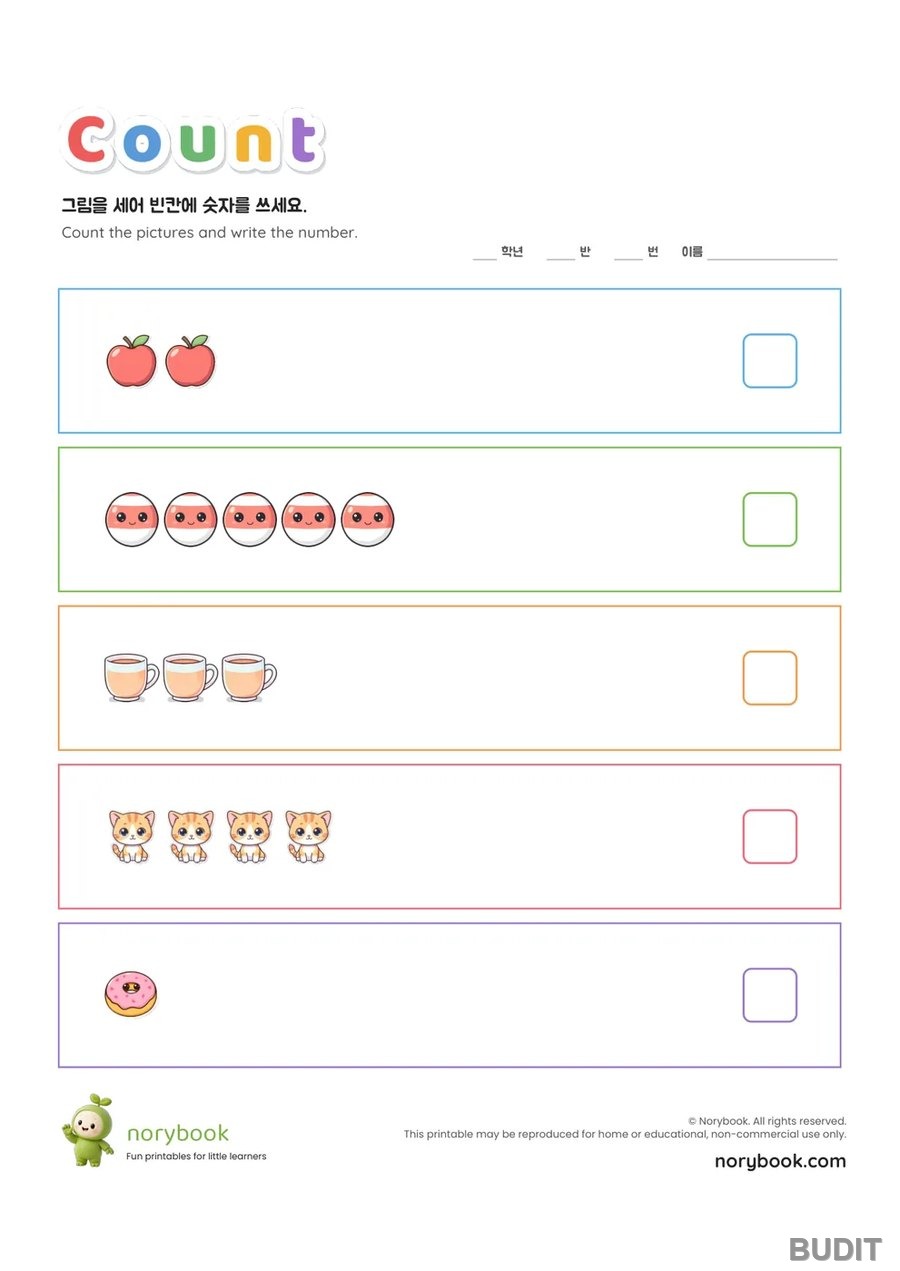
Photo: a page of the 『NoryBook』 『Count Workbook』 (as of Oct 26, 2026, Korean title shown). Count the pictures and write the number in the box. It goes on to circling as many as the number, choosing the side with more, counting 11 to 20 with ten frames and filling in missing numbers, with an answer page included. Get the workbook
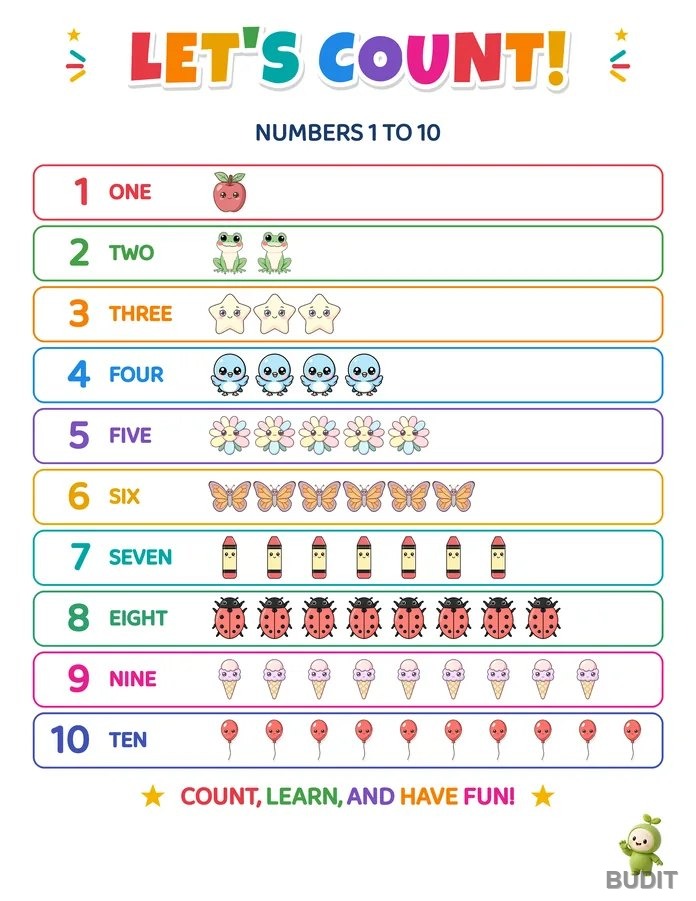
Photo: the 『Let's Count』 sheet, numbers 1 to 10 (as of Oct 26, 2026). Each row has the numeral, the English number name and that many pictures, so it works well on a wall for counting in passing. Get the sheet
What to do at home
- Sum it up after counting. After 『one, two, three』, always add 『three of them』. The principle that the last number is the total is learned from that one phrase.
- Count what is in front of you. Stairs, shoes, plates, orange segments, whatever is in sight now. Having the child touch each one with a finger cuts down on skipping or counting twice.
- Go past five. Up to three can be seen at a glance, but four to ten have to be counted. That range is also where the research found the larger effect.
- Ask 『more or less?』. Split snacks onto two plates and let the child pick which has more. Estimating without counting is number sense too.
- Play a board game. On a board where the numbers run in a single row, say the number of each square out loud as the token moves.
- Attach English number names to numbers the child already knows. Adding 『three』 in English when the child already knows there are three leaves nothing new to teach.
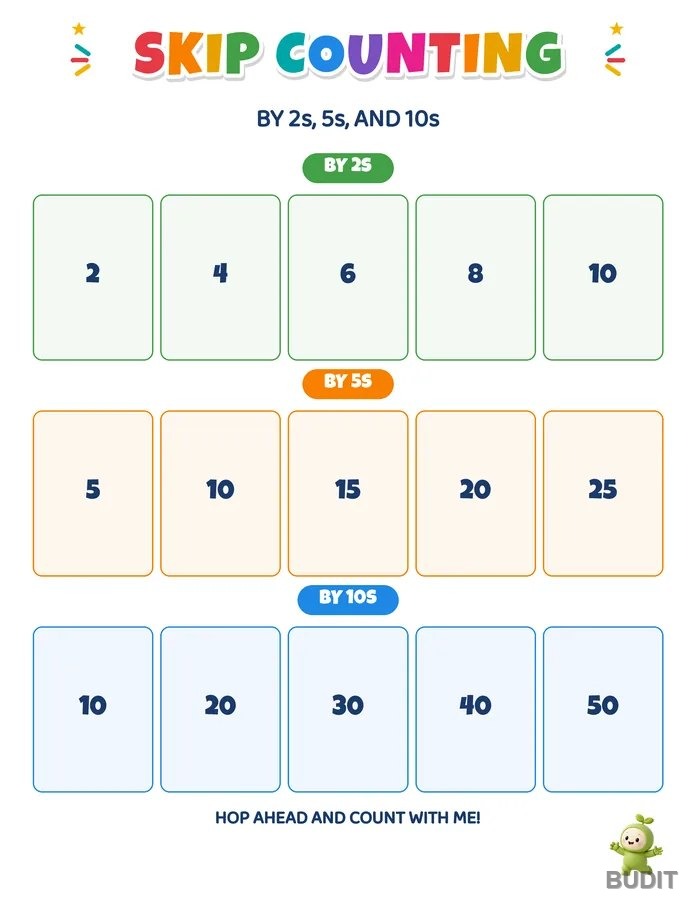
Photo: the 『Skip Counting』 sheet (as of Oct 26, 2026). The next step for a child at ease counting to ten: counting by 2s, 5s and 10s. Get the sheet
Questions people ask
Can't we start with arithmetic worksheets? Learning operation signs before counting and quantity are linked leaves a child memorizing rules without picturing amounts. Counting and comparing with objects come first, paper after.
Won't counting on fingers become a habit? Fingers make numbers visible. Touching each item helps a child count without skipping, and with practice children naturally use their hands less.
My child counts backward or skips numbers That is common at the rote stage. Rather than correcting it, count again together while pointing.
From what age should we start? You can say 『one, two』 to a child from around the first birthday. The differences in number talk in the research showed up from 14 months. The right time is less a set age than the moment you notice things to count during the day.
How this continues in Budit
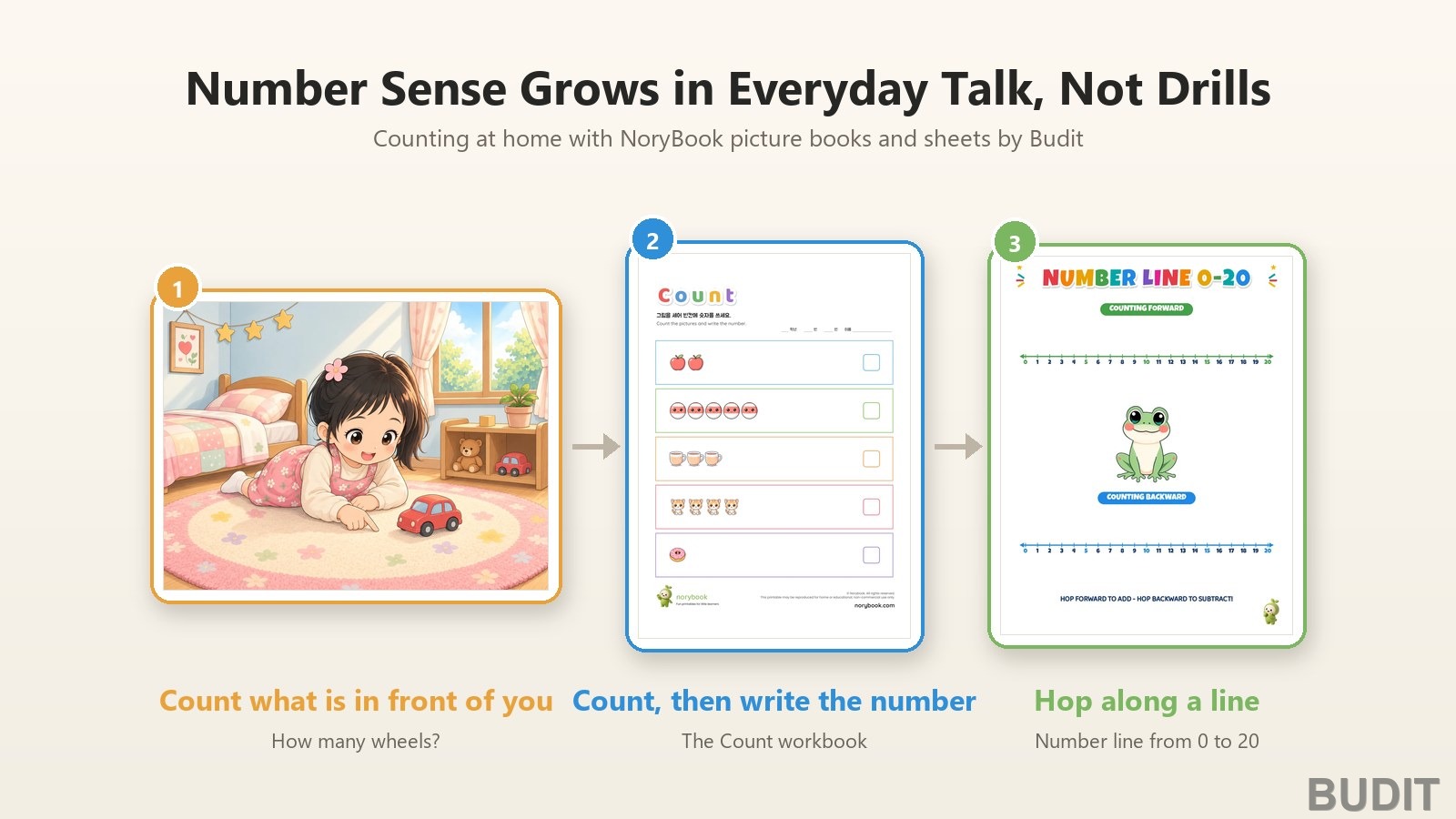
The three steps in the image at the top are the order for number play at home.
- 『Count what is in front of you』: How Many? offers one thing to count per scene, one sun, two eyes, three birds, four wheels. The first five pages can be read as a preview.
- 『Count, then write the number』: the Count Workbook and Let's Count download from NoryBook without a login, ready to print.
- 『Hop along a line』: print the Number Line and play a board game with a single token, then move on to Skip Counting.
Visit NoryBook · Open How Many?
Related reading: Play Is Learning 『Play Based Learning』, Why Paper Worksheets in a Digital Age 『The Generation Effect』, Why Game Review Helps Words Stick 『Retrieval Practice and Spacing』
References
- Duncan, G. J. et al. (2007). School readiness and later achievement. Developmental Psychology. View the paper
- Wynn, K. (1990). Children's understanding of counting. Cognition. View the paper
- Levine, S. C., Suriyakham, L. W., Rowe, M. L., Huttenlocher, J. and Gunderson, E. A. (2010). What counts in the development of young children's number knowledge? Developmental Psychology. View the paper
- Gunderson, E. A. and Levine, S. C. (2011). Some types of parent number talk count more than others: Relations between parents' input and children's cardinal number knowledge. Developmental Science. View the paper
- Siegler, R. S. and Ramani, G. B. (2008). Playing linear numerical board games promotes low income children's numerical development. Developmental Science. View the paper
This article shares general information about development and education. Every child grows at their own pace. For specific concerns, please consult a pediatrician or a development specialist.