



What children need in the age of AI
『If AI does everything, what should my child learn?』 It is the question parents ask most these days. The answer is simpler than it seems. Producing answers is now something AI does faster, so what is left for a child is the power to make questions, to check whether an answer holds, to explain in their own words, and to see things through. All of these can be grown from elementary school.
At a glance
| Ability | Why it matters | At home |
|---|---|---|
| Making questions | Students in a classroom ask about 0.1 questions per hour | Ask 『what are you curious about?』 first |
| Checking the answer | Students who took AI answers as given scored lower on the exam | 『How do you know that is right?』 |
| Explaining in your own words | Jobs that need social skills are growing | 『Can you explain it to me?』 |
| Seeing it through | The jobs hardest to automate are the ones that take judgment and persistence | Short, every day, at the same time |
Answers are no longer scarce
Frey and Osborne estimated how likely each of 702 US occupations was to be replaced by computers. The more a job followed a fixed procedure, the more replaceable it was, and about 47 percent of all jobs fell into the high risk group (Frey and Osborne, 2017). Looking at the other side, Deming analyzed the US labor market from 1980 to 2012 and found that the share of jobs requiring a lot of social skill grew by nearly 12 percentage points, and that wages rose fastest in jobs demanding both social skills and math skills (Deming, 2017). The value of producing answers quickly is falling, and the value of judging and explaining together with other people is rising.
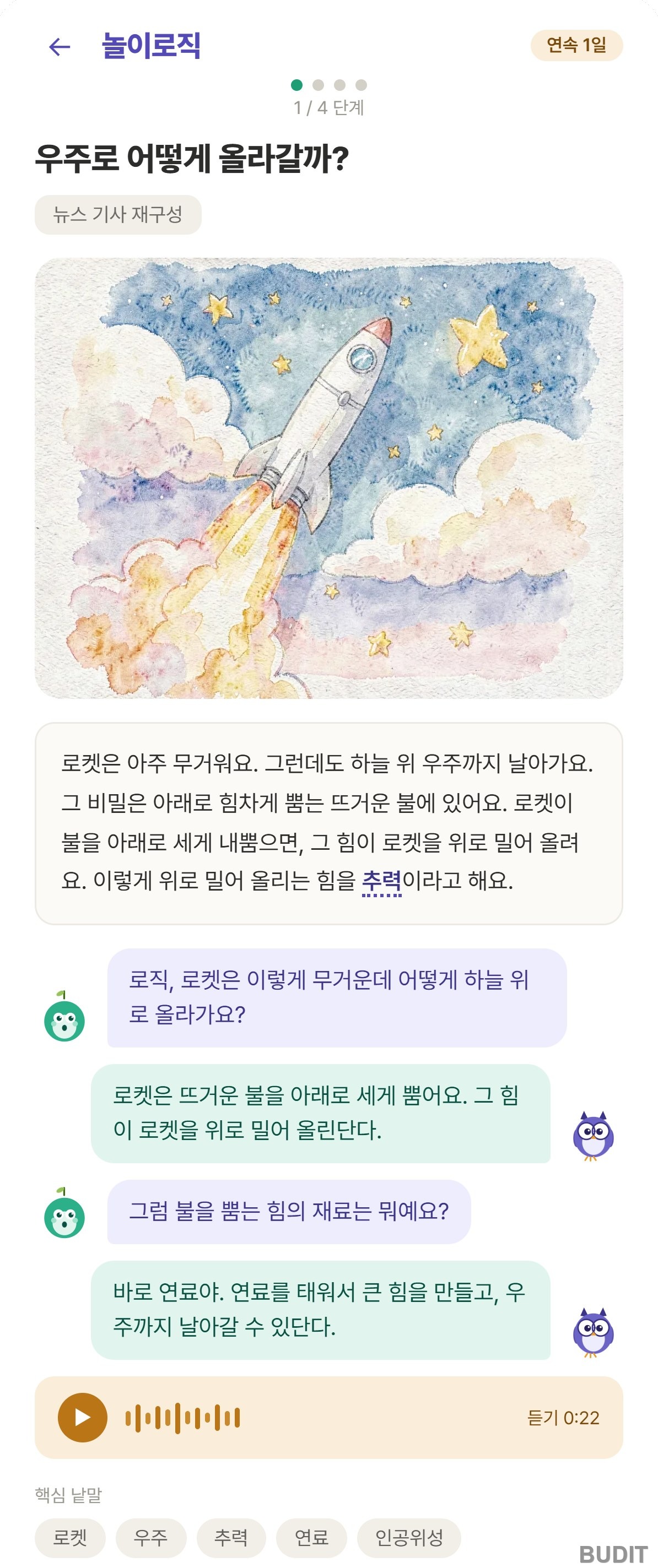
Photo: the reading screen for the 『NoryLogic』 story 『How do we go up into space?』 (as of Nov 5, 2026; NoryLogic is currently in Korean). A story that started as news is rewritten at a child's level, and the conversation between Hogi and Logic keeps the questions going. Visit NoryLogic
Children hardly ask questions
The power to make questions does not grow on its own. Graesser and Person counted the questions students asked in classrooms and in one to one tutoring. In a classroom, one student asked an average of 0.11 questions per hour. In one to one tutoring it was 26.5 per hour, more than 200 times as many (Graesser and Person, 1994). Children do not stay quiet because they are not curious. They stay quiet because there is no room to ask. Make room, and they ask.
Hand over the answer and the learning is lost
What happens when the answer is handed to AI? Bastani and colleagues had about a thousand high school students in Türkiye use AI during math practice. Students who used an AI that gave the answer directly scored 48 percent higher on the practice problems, but on an exam taken without AI they scored 17 percent lower than students who had not used AI at all. Students who used an AI built to give only hints instead of answers scored 127 percent higher in practice and lost nothing on the exam (Bastani et al., 2025). AI is not the problem. Using it to receive answers and using it to support thinking are different things. What to grow in a child is the habit of checking whether an AI answer holds and explaining again, in their own words, any answer they receive in their own words.
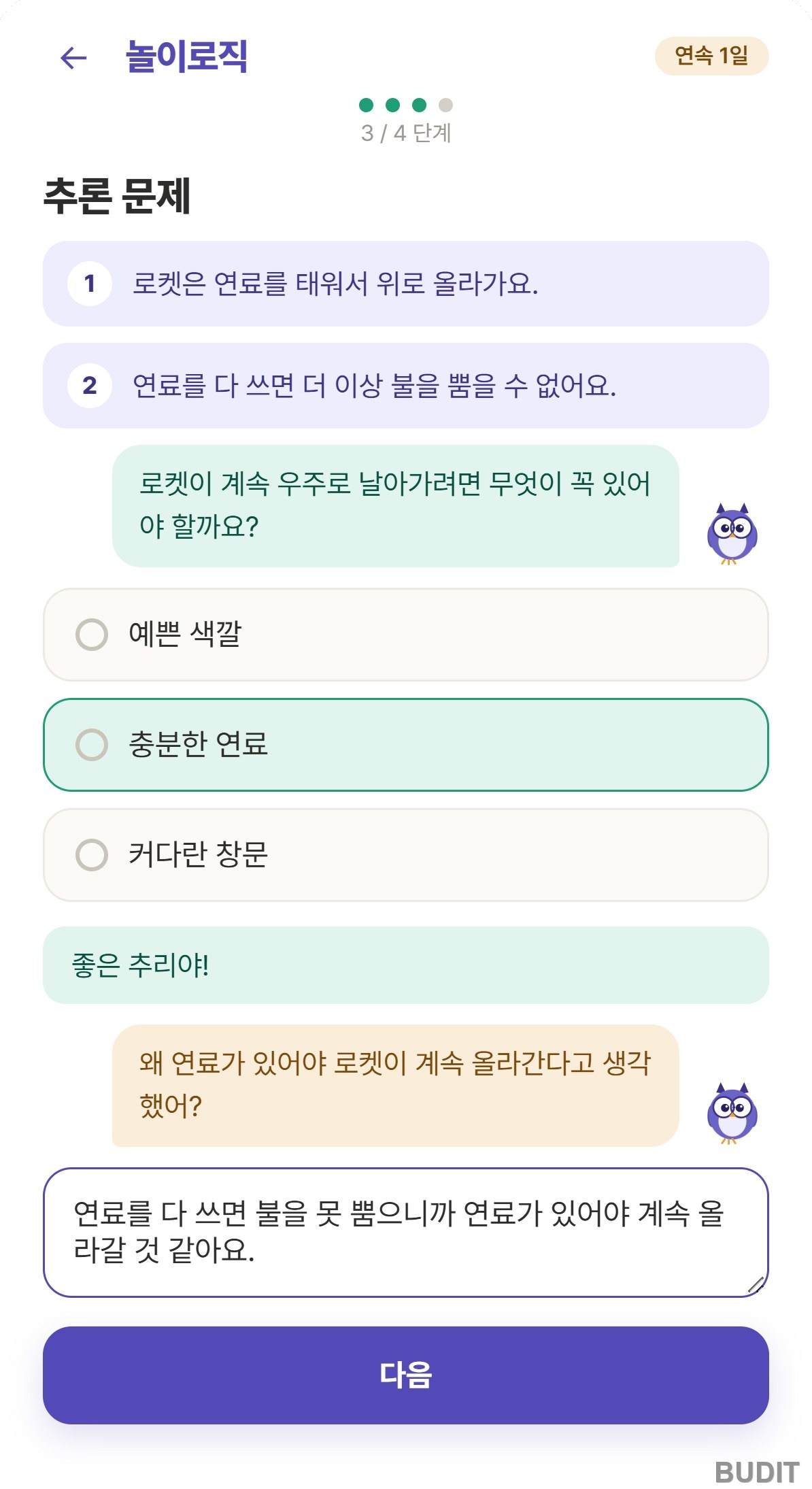
Photo: the reasoning question for the same story (as of Nov 5, 2026, with an example answer filled in). Instead of receiving the answer, the child looks at the clues, chooses, and writes the reason in words.
Try this at home
- Take questions before answers. After a book or a news story, ask 『what are you curious about?』 first and write the child's questions on paper. One question lasts longer than ten answers.
- When asking AI, check together. Ask 『how could we tell whether this answer is right?』 and show the child what it looks like to confirm with a book or another source.
- Have the child explain. One sentence, 『I am not sure, can you explain it to me?』, puts the child in the teacher's seat. While they explain in their own words, what they know and do not know comes into view.
- Short and daily. The power to see things through grows not from one big project but from finishing something small every day.
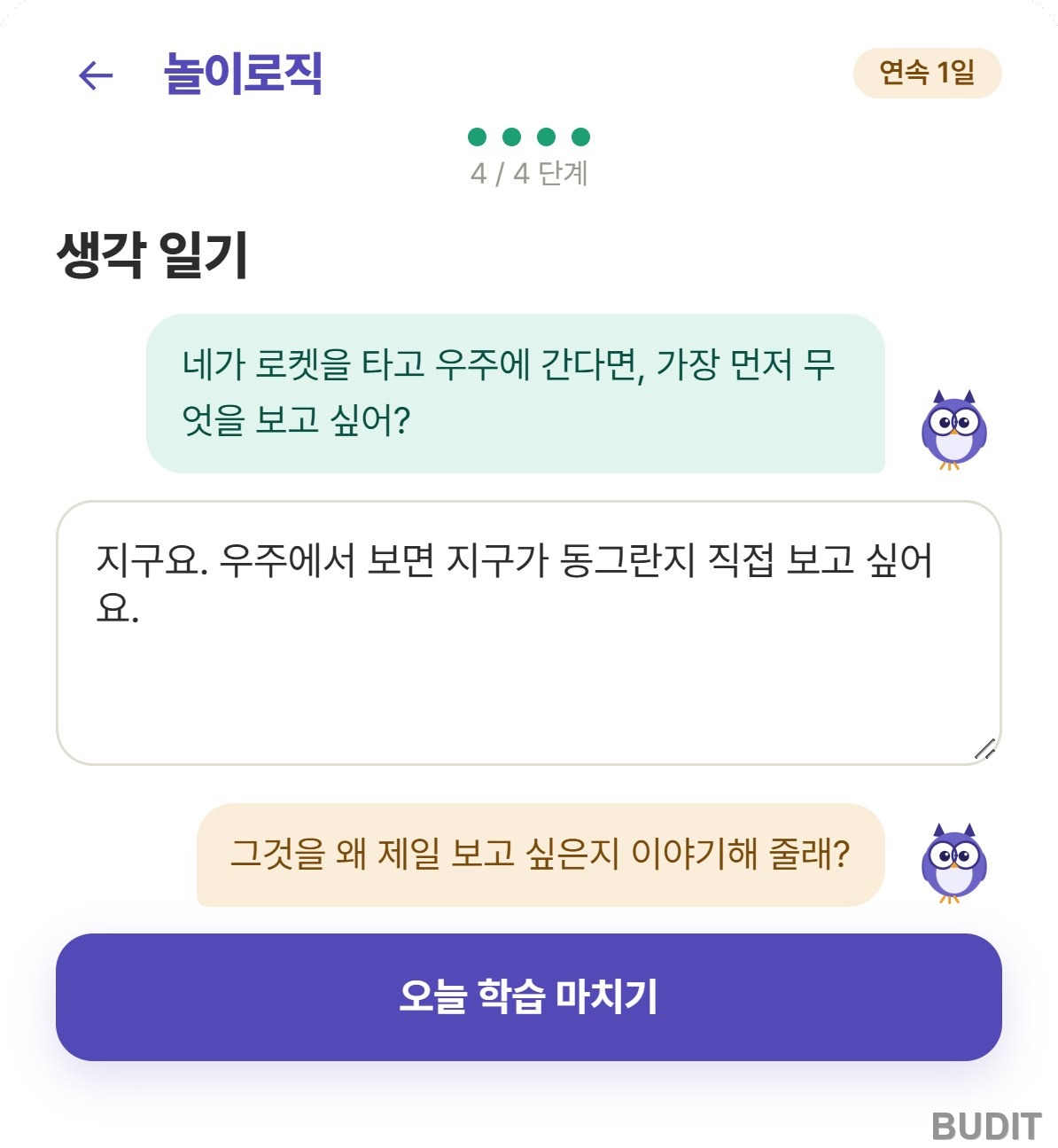
Photo: the thought journal for the same story (as of Nov 5, 2026, with an example answer filled in). The child answers a question with no right answer in their own words, and one follow up question comes after.
Frequently asked questions
Should I teach coding? Coding is good material too, but writing code itself is something AI is taking over quickly. Deciding what to build and checking whether the result holds come first, and that power can be grown outside coding.
Should I stop my child from using AI? Agreeing on how to use it works better than banning it. Promise to use it for hints or to check your own answer, not to receive answers. In the study above, the hint only version caused no harm.
From what age? Making questions and giving reasons are possible from the early elementary years. Start not with a hard topic but with something the child is already curious about.
How this continues at Budit
The three steps in the picture at the top are where a child works with questions and reasons, rather than answers, within one 『NoryLogic』 session.
- 『Read through questions』: NoryLogic rewrites news at a child's level and reads it as a conversation between Hogi and Logic. The questions come first, inside the text.
- 『Give the reason』: in the reasoning question, the child looks at the clues, chooses an answer, and answers 『why do you think so?』 in their own words.
- 『Keep it in your own words』: in the thought journal the child writes a sentence or two on a question with no right answer. Finished sessions pile up on the thinking constellations and my concept map.

Photo: 『NoryLogic』 thinking constellations (as of Nov 5, 2026, the example sky shown before login). Each finished story lights one star.
If you are new, start with Getting Started with NoryLogic to see the order of one session.
Related reading: Children Who Trust AI Answers As Is 『Automation Bias and the Habit of Thinking First』, What Is Metacognition 『A Child's Power to Know Their Own Thinking』, Growing Scientific Curiosity 『How to Answer a Child's Why』
References
- Frey, C. B. and Osborne, M. A. (2017). The future of employment: How susceptible are jobs to computerisation? Technological Forecasting and Social Change. Read the paper
- Deming, D. J. (2017). The growing importance of social skills in the labor market. The Quarterly Journal of Economics. Read the paper
- Graesser, A. C. and Person, N. K. (1994). Question asking during tutoring. American Educational Research Journal. Read the paper
- Bastani, H., Bastani, O., Sungu, A., Ge, H., Kabakcı, Ö. and Mariman, R. (2025). Generative AI without guardrails can harm learning: Evidence from high school mathematics. Proceedings of the National Academy of Sciences. Read the paper
This post covers general developmental and educational information, and every child develops at their own pace. For specific concerns, please consult a pediatrician or a developmental specialist.