
Why Alphabet Tracing Sheets Come in This Order
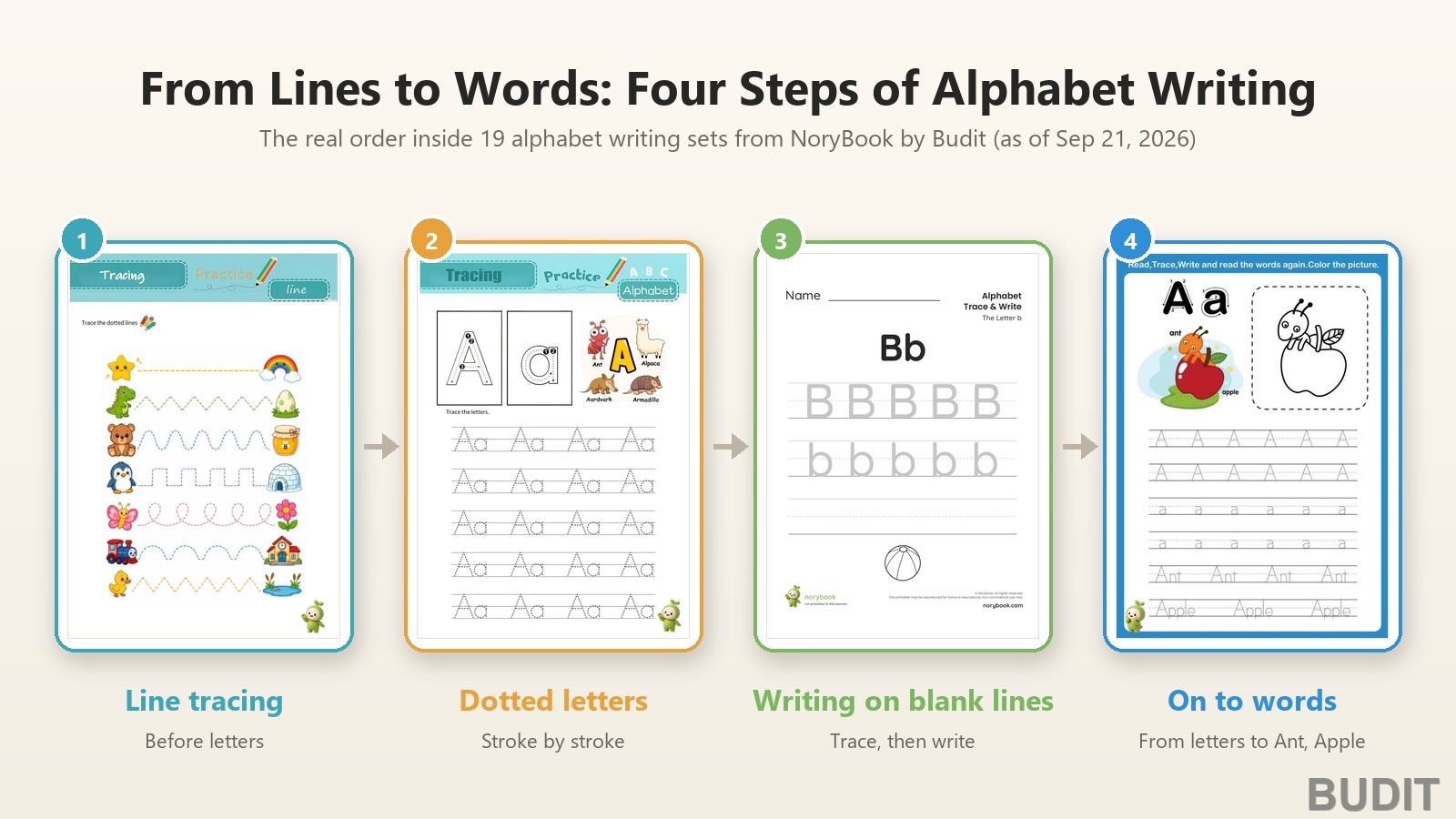
『NoryBook』 has 19 sets of alphabet writing sheets. They are not a loose pile of pages: they run in four steps, from line tracing to dotted letters, then writing on blank lines, then writing words. The image at the top shows the real sheets for those four steps.
Children learn English at very different speeds. So instead of one fixed schedule, NoryBook splits the material into steps and lets you start wherever your child is today.
The four steps, in real sheets
- Line tracing: the step before letters. Your child follows straight lines, waves, zigzags and loops, building the hand control a pencil needs. Line tracing, 44 pages.
- Dotted letters: a large letter shows the stroke order by number, and row after row of dotted letters follow it. Alphabet tracing, 27 pages.
- Writing on blank lines: trace the grey letters first, then write on the empty line below with no guide. Alphabet writing A to Z, 26 pages, and the upper and lower case worksheet, 27 pages.
- On to words: single letters give way to words like Ant and Apple. Trace, color and write, 26 pages.
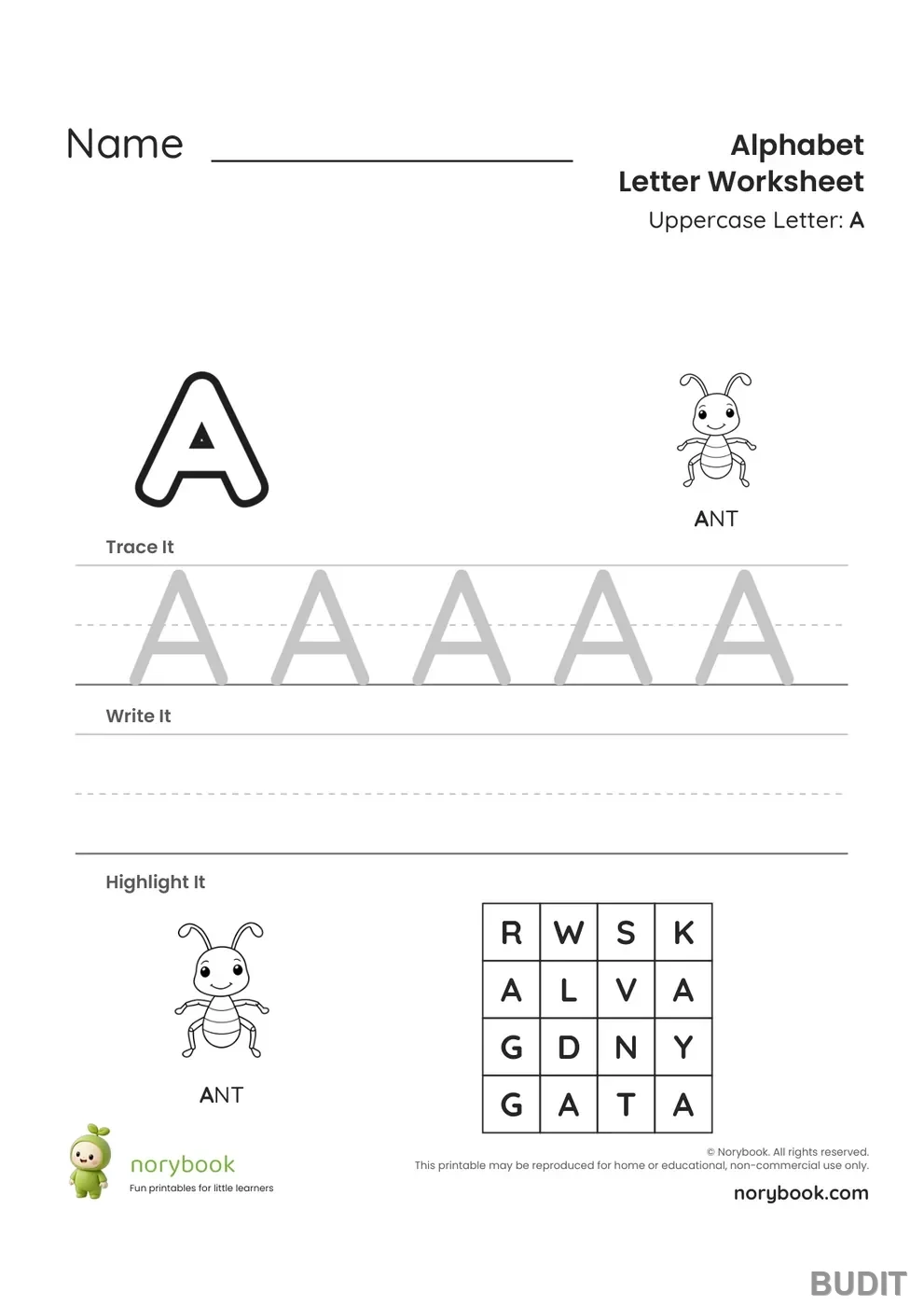
Photo: one page from the upper and lower case worksheet. Even a single page runs 『trace it, write it, find it』.
One page has an order too
Open any sheet and the help fades as you go down the page. The rows of grey letters to trace come first, then an empty line with nothing to follow, and at the bottom a task that asks your child to find that letter or pick pictures that start with its sound.
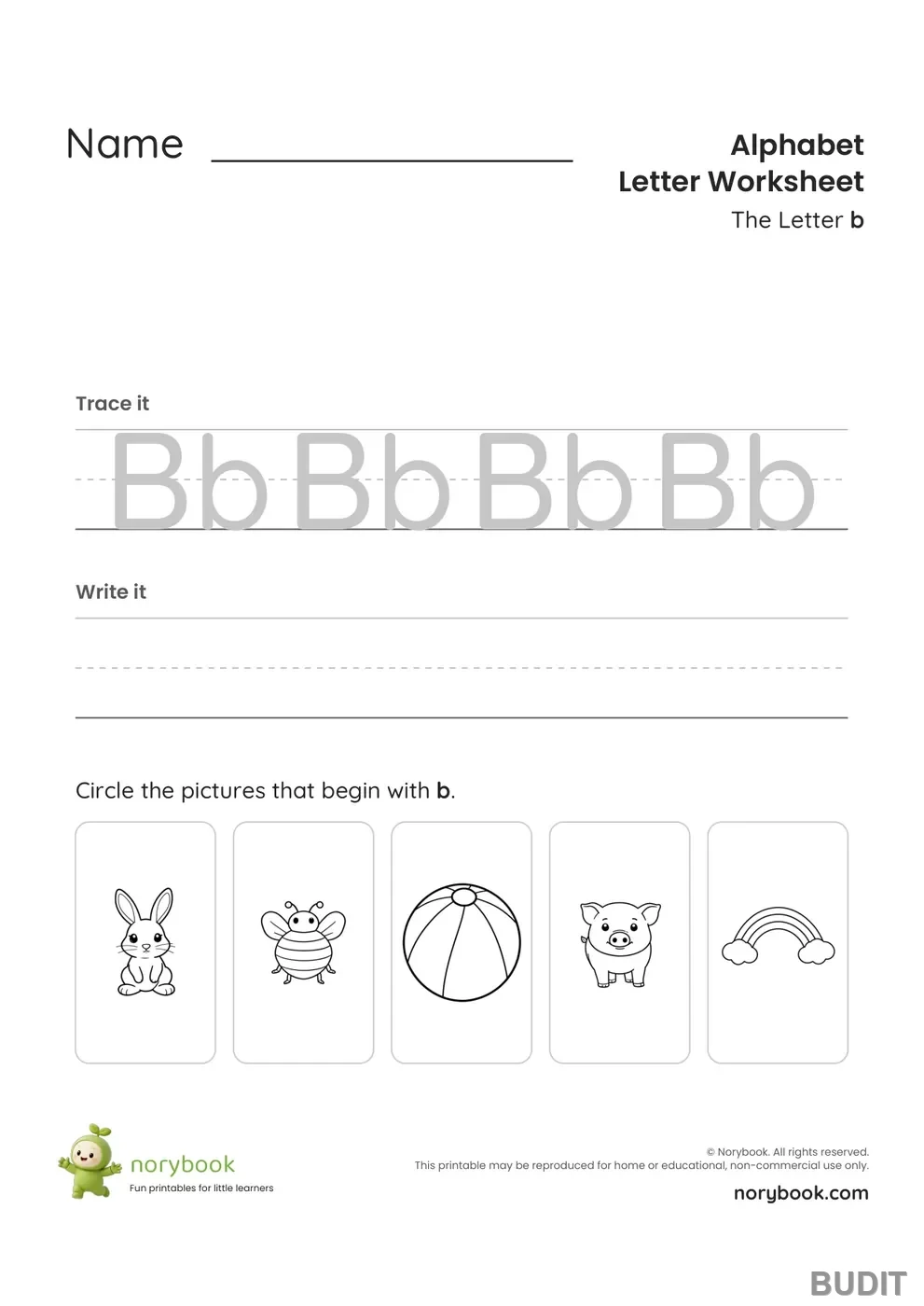
Photo: one page from the trace and write combo. After the writing comes a task that ties the letter to its sound.
What the research says
In one study, five year old children who could not yet read learned letters in three ways: writing them by hand, typing them, or tracing their outlines. Brain scans taken afterward showed that areas linked to reading became active only when the children looked at letters they had written by hand (James and Engelhardt, 2012). And people remember information better when they produce it themselves than when they only read it, a finding known as the 『generation effect』 (Slamecka and Graf, 1978).
Our article Why Paper Worksheets in a Digital Age covers both studies in more detail, and From Line Tracing to the Alphabet covers the order in which hand skills develop.
How to use them
- Start where your child is. If holding a pencil is still hard, start at step 1. If the letter shapes are familiar, start at step 2 or 3. Match the child, not the age on the sheet.
- One or two pages a day is plenty. Spreading the pages over several days beats working through a stack in one sitting.
- Leave the wobbly letters alone. On the blank line, a shaky letter your child wrote is worth more than a neat one you corrected.
- Meet the same letter again elsewhere. Bring a letter back with the alphabet flashcards or the trace and write combo.
Some of the 19 alphabet writing sets
| Step | Set | Pages |
|---|---|---|
| 1. Lines | Line tracing | 44 |
| 1. Lines | Dotted picture tracing | 71 |
| 2. Dotted letters | Alphabet tracing | 27 |
| 2. Dotted letters | Alphabet tracing 2 | 27 |
| 2. Dotted letters | Alphabet tracing 4 | 27 |
| 3. Blank lines | Alphabet writing A to Z | 26 |
| 3. Blank lines | Upper and lower case | 27 |
| 3. Blank lines | Tracing board | 14 |
| 4. Words | Trace, color and write | 26 |
| 4. Words | Trace and match | 53 |
| 4. Words | Animal names to trace | 14 |
| Writing and sound | Trace and pick the picture | 26 |
| Writing and color | Color and trace | 14 |
For everything else in the collection, see What's Inside NoryBook.
See the alphabet writing sheets
Counts and page numbers are as of Sep 21, 2026, and new materials keep coming.