

Why Paper Worksheets in a Digital Age
Children can learn a lot on a tablet these days, so why does Budit still make worksheets you print on paper? Research in cognitive psychology helps explain it.
We remember what we produce ourselves
The 『generation effect』 is the finding that people remember information better when they produce it themselves than when they simply read it (Slamecka and Graf, 1978). Writing a letter with your own hand, even clumsily, is closer to this idea than just looking at a finished one.
Handwriting research points the same way. In one study, children aged five who could not yet read learned letters in three ways: writing them by hand, typing them, or tracing their outlines. Brain scans taken afterward showed that areas linked to reading became active only when the children looked at letters they had written by hand (James and Engelhardt, 2012).
Screen and paper, each in its place
| Situation | Better tool |
|---|---|
| Meeting a word's sound and meaning for the first time | Screen (cards, audio, games) |
| Practicing by hand what was learned | Paper (tracing, coloring, matching) |
| Reviewing and enjoying what was learned | Screen games and paper activities in turn |
You don't have to choose one or the other. 『Meet new words on screen, then practice them by hand』 is a simple way to divide the work.
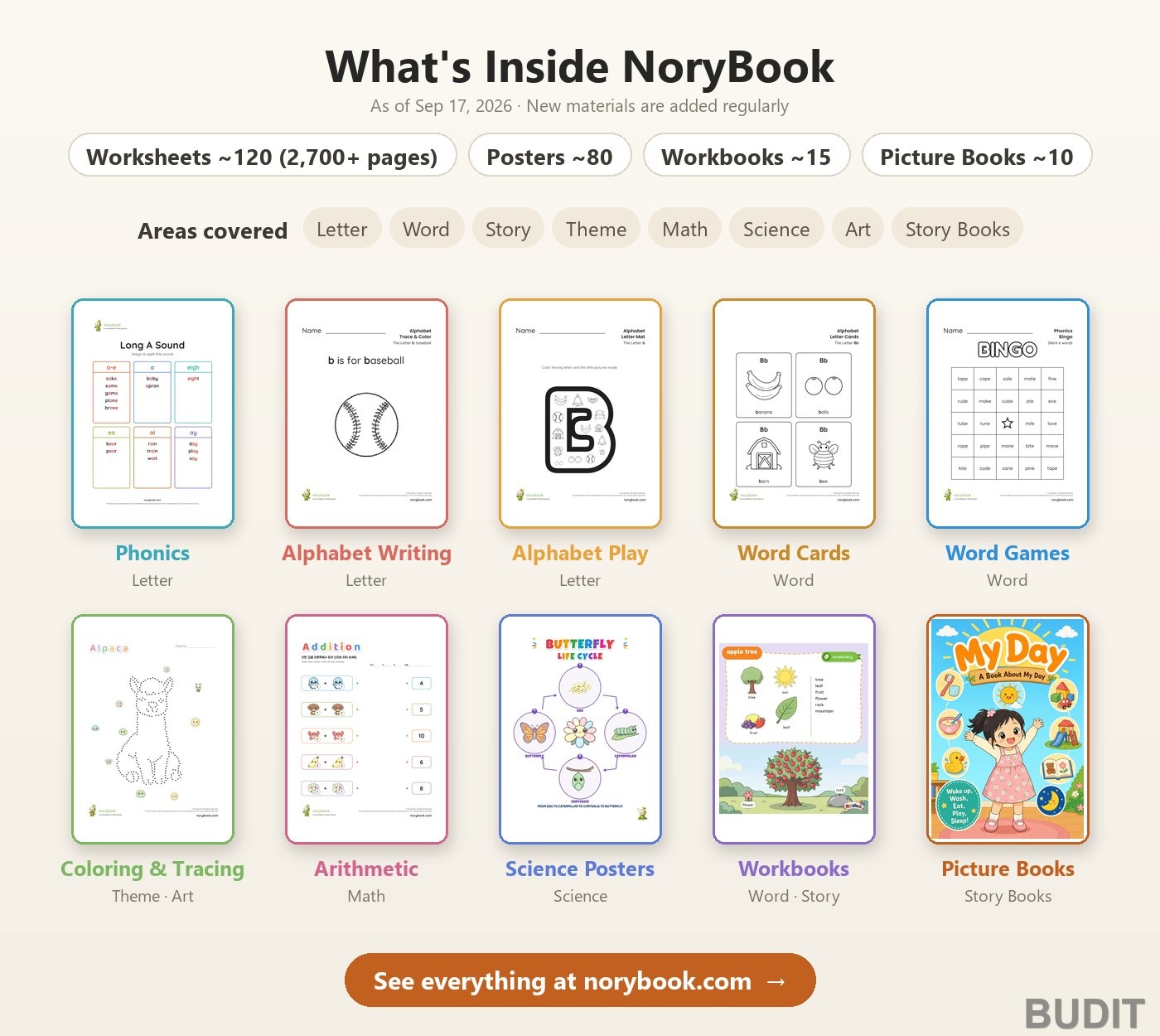
Photo: the 『NoryBook』 collection by Budit (as of Sep 17, 2026). Around 120 worksheets plus posters, workbooks and picture books cover letters, words, stories, themes, math, science and art, and new materials keep coming. See everything at norybook.com
Worth watching
Video: EBS Docuprime 『Slow Reading, the Power to Grow Thinking』 Part 1 (official YouTube channel, Korean). A fifth grade class sets its textbook aside and reads a single novel slowly and closely.
How this continues in Budit
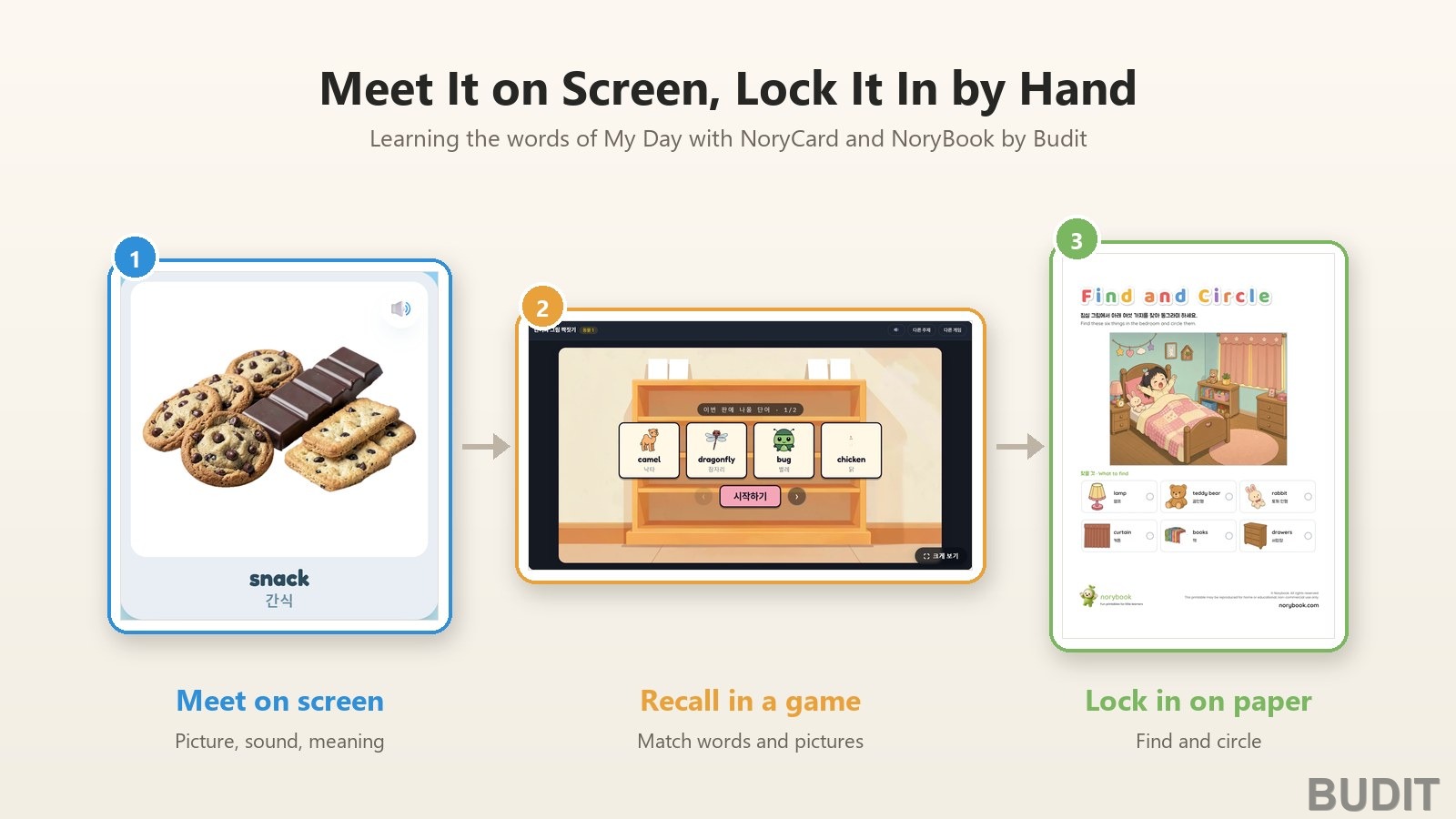
The image at the top follows words from the Budit picture book 『My Day』: meet them on screen, recall them in a game, then lock them in on paper. All three steps are real screens and materials.
- 『Meet on screen』: tap the 『단어카드』 (word cards) button on the My Day page to see each picture with its English audio and Korean meaning.
- 『Recall in a game』: use the 『게임하기』 (play games) button on the same page to bring back words from the book. Games like 『단어와 그림 짝짓기』 (word and picture matching) in the NoryCard games offer practice with more words.
- 『Lock in on paper』: open the 24 page activity workbook with the 『활동지 보기』 (view activity sheets) button on the same page. It has pages like 『Find and Circle』, where your child finds six things in the bedroom picture. To work on paper, download any worksheet from NoryBook with its 『다운로드』 (download) button.
References
- Slamecka, N. J. and Graf, P. (1978). The generation effect: Delineation of a phenomenon. View on Google Scholar
- James, K. H. and Engelhardt, L. (2012). The effects of handwriting experience on functional brain development in pre-literate children. View on Google Scholar
This article shares general information about child development and education. Every child grows at their own pace. For specific concerns, please talk with a pediatrician or a child development specialist.