


Why Deep Reading Matters in the Age of Short Form
Children learn to speak without being taught. Reading is different. The brain has to build a circuit that was never there, which is why reading is so easily shaped by the environment around it.
The brain has no reading room of its own
There is no region of the human brain set aside for reading from the start. Writing is only a few thousand years old, far too recent for evolution to have prepared a circuit for it. So the brain borrows. It links the visual areas that recognise shapes, the language areas that handle speech sounds and the areas that hold attention, and out of them it assembles a 『reading brain』. Researchers call this neuronal recycling (Dehaene and Cohen, 2007).
Borrowing carries an implication. A reading circuit does not appear on its own. It is built while reading happens, and it grows differently depending on how we read.
Skimming grows too
The reading researcher Maryanne Wolf points out that the more hours we spend reading on screens, the more fluent the brain becomes at skimming. On a screen, the eye tends to take the opening and the end and skip the middle, in an F shaped pattern, while notifications break attention every few minutes. Short form video pushes this further. A run of brief, strong stimuli leaves less patience for a long text.
The risk is not that the ability disappears but that the unused side weakens. Wolf argues for a 『biliterate brain』 that keeps both modes: fast skimming when that is what a text needs, and slow, deep reading when it is not.
Paper and screen are not the same
A 2018 meta analysis pooling 54 studies and more than 170,000 participants found that the same text was understood better on paper than on screen. The gap did not shrink over the years covered; it widened (Delgado et al., 2018). It was clearest when reading was done under time pressure, and with informational rather than narrative texts.
This is not an argument against screens. Screens are good at a first encounter, with sound and pictures. Paper is good at holding a reader still long enough to chew. We covered the same ground in our earlier article Why Paper Worksheets in a Digital Age.
It matters more for children
An adult reads with a circuit that is already built. A child is building one. If almost all of their reading is skimming, the circuit they will need later for long and difficult text stays thin.
What helps at home is not elaborate.
- Protect one unbroken stretch a day. Ten minutes is enough, with notifications off.
- Stop in the middle of a page and ask, 『What do you think happens next?』 One pause is worth more than ten extra pages.
- Meet a word on screen, then meet it again on paper. Writing by hand switches on the reading circuit alongside it (James and Engelhardt, 2012).
- Read the same book again. Repetition is not boredom; it is practice at depth.
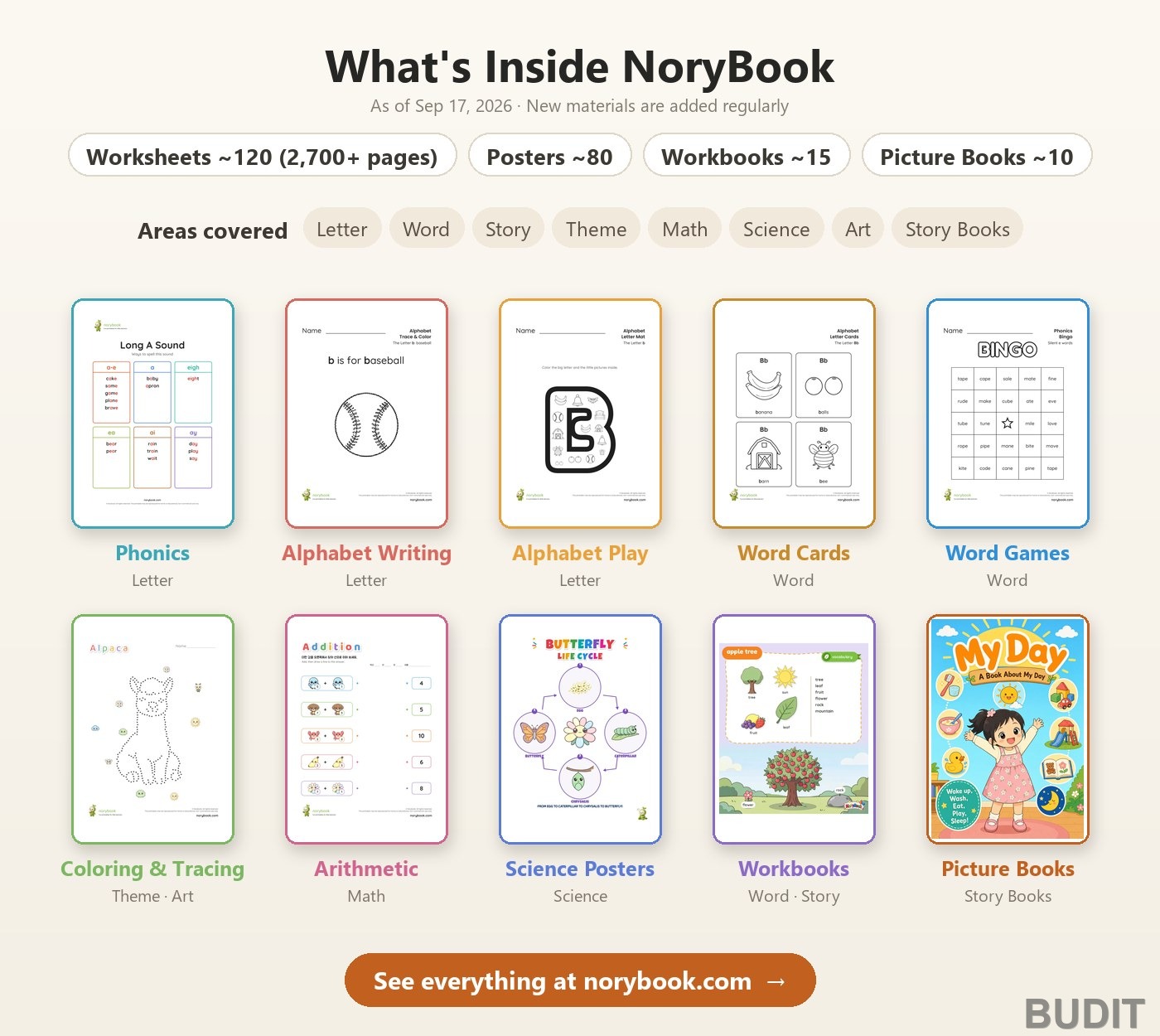
Photo: the 『NoryBook』 collection by Budit (as of Sep 17, 2026). Around 120 worksheets plus posters, workbooks and picture books cover letters, words, stories, themes, math, science and art, and new materials keep coming. See everything at norybook.com
Worth watching
Video: BBC News Korea, 『Why you must still read in the age of short form』 (official YouTube channel, Sep 25, 2026, in Korean). It explains that reading is not an inborn ability but a circuit assembled from existing ones, and how digital environments change the way we read.
How this continues in Budit
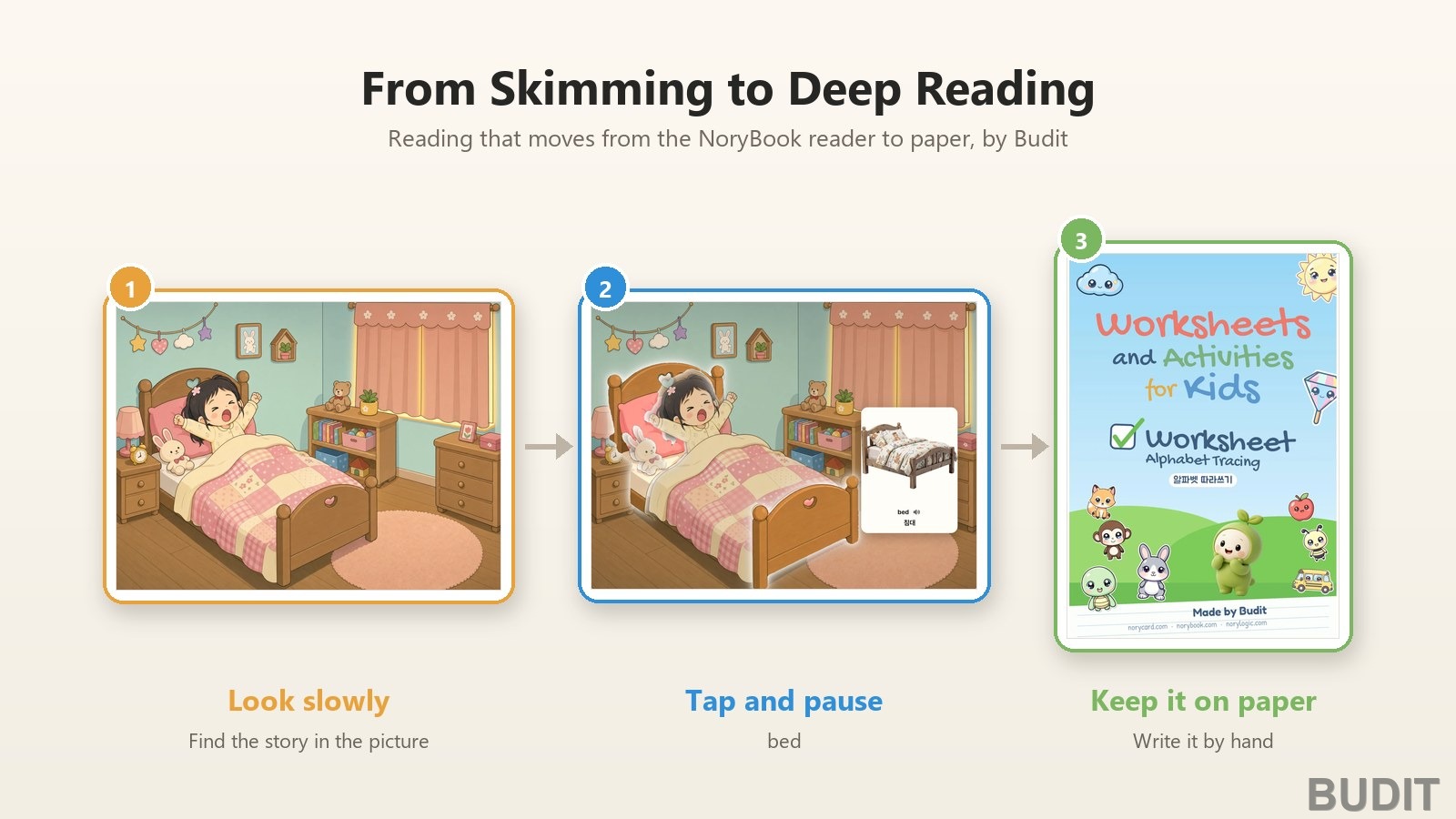
The three steps in the image at the top move from screen to paper.
- 『Look slowly』: turn the pages of My Day one at a time and find together what is happening in the picture. Not rushing is the whole point.
- 『Tap and pause』: tap an object in the illustration and it lights up with a word card, which creates a moment to stop and say the name.
- 『Keep it on paper』: write that word by hand with a paper resource such as Alphabet Tracing.
How to have the book read in a parent's own voice is covered in our earlier article A Gift of Voice for Busy Parents.
References
- Dehaene, S. and Cohen, L. (2007). Cultural recycling of cortical maps. View on Google Scholar
- Wolf, M. (2018). Reader, Come Home: The Reading Brain in a Digital World. View on Google Scholar
- Delgado, P. et al. (2018). Don't throw away your printed books: A meta-analysis on the effects of reading media on reading comprehension. View on Google Scholar
- James, K. H. and Engelhardt, L. (2012). The effects of handwriting experience on functional brain development in pre-literate children. View on Google Scholar
This article shares general information about development and education. Every child grows at their own pace. For specific concerns, please consult a pediatrician or a development specialist.