
From Lines to Letters, Fine Motor Skills Grow in Order
"The child next door is already writing, and mine still holds the crayon in a fist." There is no need to rush. Fine motor skills usually develop in a set 『order』, so you can simply choose activities that match where your child is.
Four stages of pencil grip
The way a child holds a pencil or crayon changes as they grow. Occupational therapists often describe four stages. The ages in the table are rough guides.
| Stage | Around age | What it looks like |
|---|---|---|
| 『Palmar grasp』 | 1 to 2 | Holds the crayon in a fist and draws by moving the whole arm |
| 『Digital pronate grasp』 | 2 to 3 | Holds with the fingers, palm facing down, and moves from the elbow |
| 『Static tripod』 | 3 to 4 | Holds with the thumb, index and middle fingers, but the wrist and arm still do the moving |
| 『Dynamic tripod』 | 4 to 6 | Moves the pencil with the fingertips and can write small letters |
Children vary a lot. In a study of 320 children between the ages of three and six, 48% of the youngest group (just past their third birthday) already used a mature grip, compared with 90% of the oldest group (close to age seven) (Schneck and Henderson, 1990).
Shapes follow an order too
The shapes a child can copy usually come in this order: 『vertical line, horizontal line, circle, cross, square, triangle』. The Beery test of visual motor integration, a common developmental assessment, also asks children to copy shapes from easy to hard in this order. Many children can copy a circle around age three, a square at four or five, and a triangle around five. Letters are made of straight, slanted and curved lines, so plenty of shape drawing is a natural lead into writing letters.
Activities in stage order
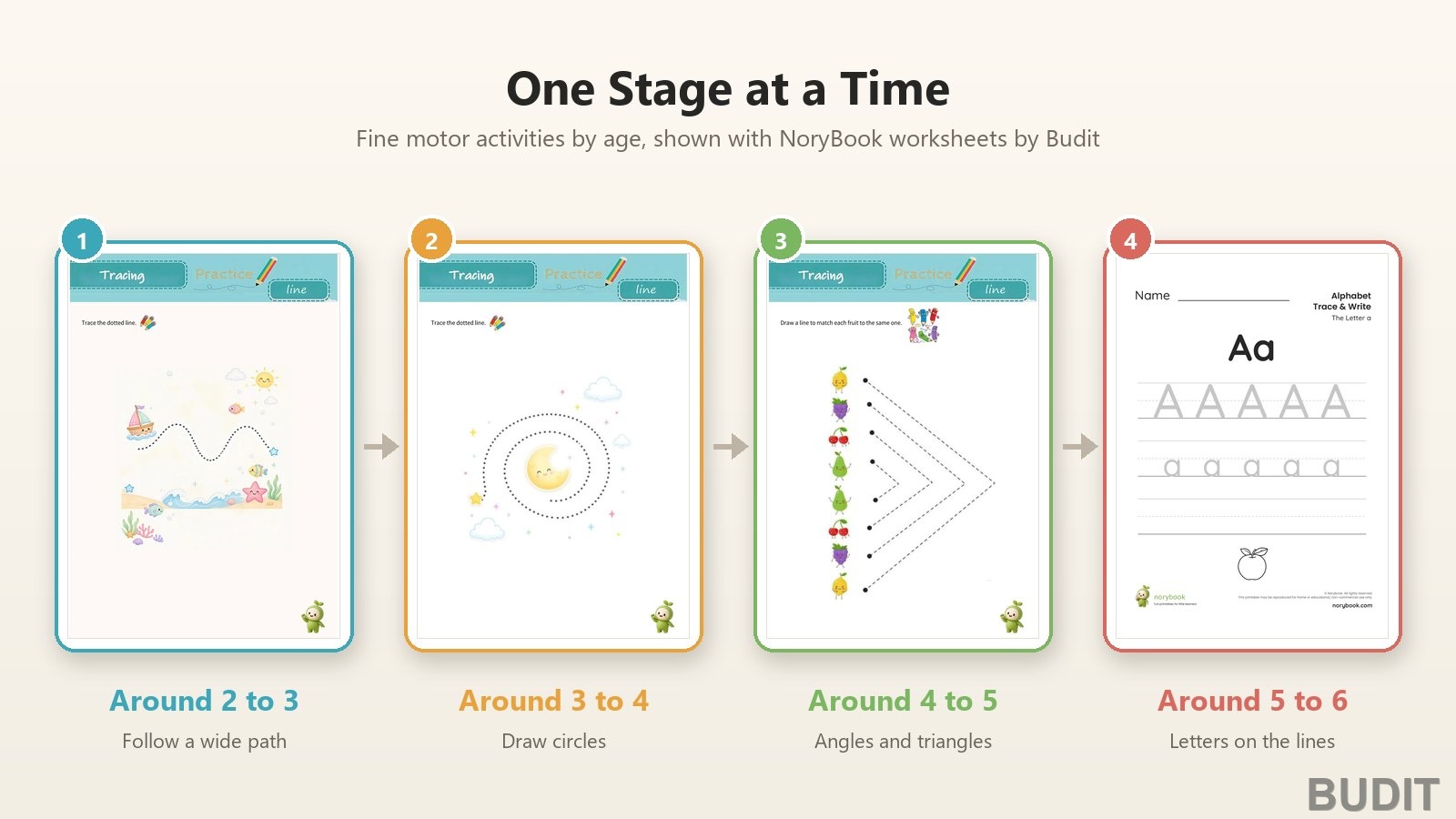
- 『Line tracing』: trace straight, wavy and zigzag lines along thick guides.
- 『Dotted picture tracing』: connect dotted lines to complete a picture.
- 『Shape drawing』: trace circles, squares and triangles, then color them.
- 『Alphabet tracing』: start with large letters, then write on ruled lines.
Go by 『the stage your child handles comfortably now』 rather than by age. Once a stage feels easy and fun, move on to the next.
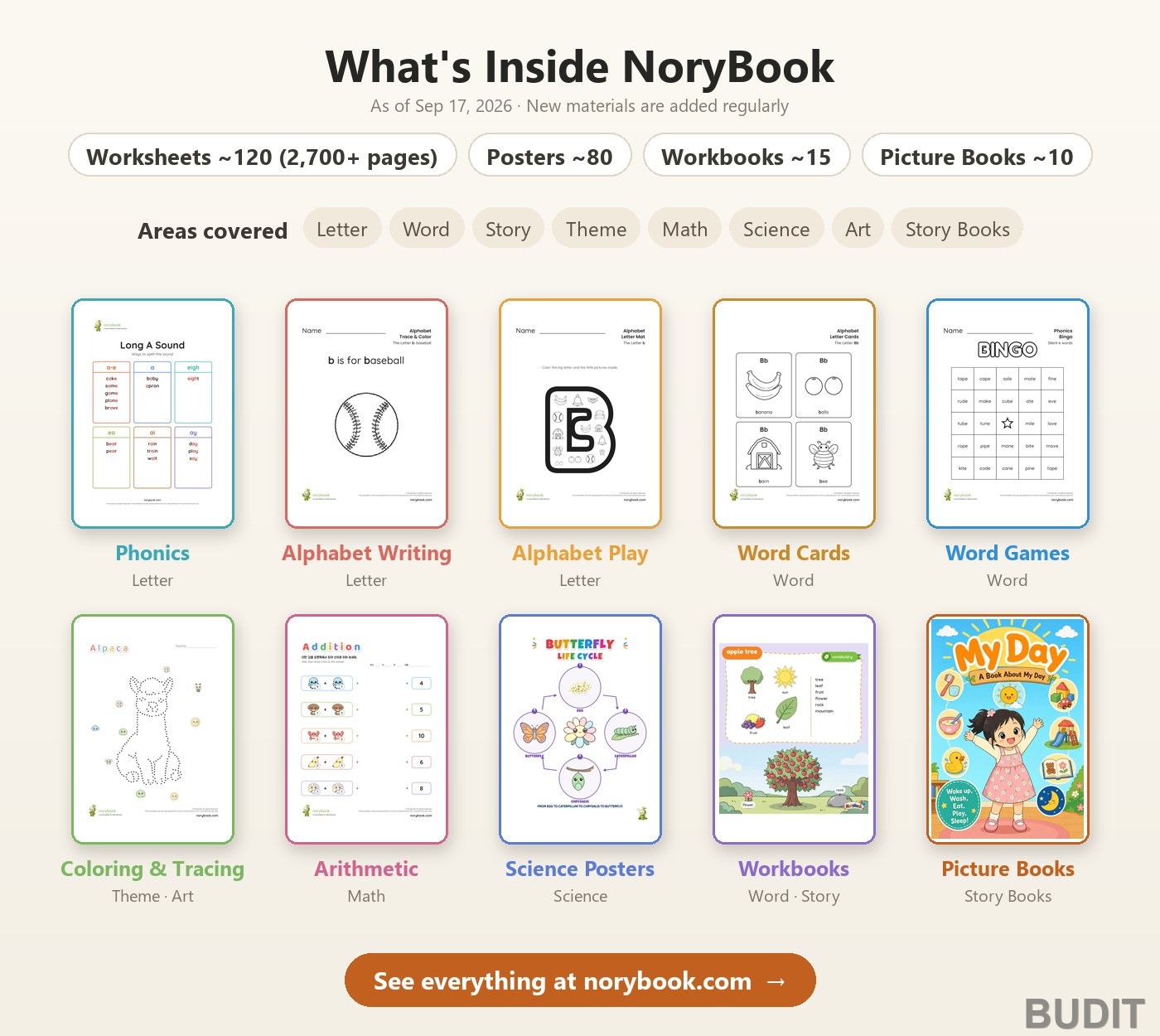
Photo: the 『NoryBook』 collection by Budit (as of Sep 17, 2026). Around 120 worksheets plus posters, workbooks and picture books cover letters, words, stories, themes, math, science and art, and new materials keep coming. See everything at norybook.com
Worth watching
Video: EBS 『Literacy Kindergarten』, the episode on toys that make writing easier (official YouTube channel, Korean). For children who struggle to hold a pencil, it shows how everyday toys can build fine motor skills.
How this continues in Budit
The four stages in the image at the top are all real 『NoryBook』 worksheets. The ages are rough guides, so start wherever your child feels comfortable.
- 『Around 2 to 3, follow a wide path』: trace the winding paths on the first pages of Line Tracing.
- 『Around 3 to 4, circles』: the circle and spiral pages in the same set get the wrist moving in round strokes.
- 『Around 4 to 5, angles and triangles』: the pages with angled lines near the end of the set practice changing direction.
- 『Around 5 to 6, letters』: write uppercase and lowercase letters on ruled lines with Alphabet Writing.
The 『Alphabet Writing』 collection has around 20 worksheets, from line tracing to letter writing (as of Sep 17, 2026).
Browse Alphabet Writing · See all NoryBook materials
References
- Schneck, C. M. and Henderson, A. (1990). Descriptive analysis of the developmental progression of grip position for pencil and crayon control in nondysfunctional children. View on Google Scholar
- Beery, K. E. and Beery, N. A. The Beery-Buktenica Developmental Test of Visual-Motor Integration (Beery VMI). View on Google Scholar
This article shares general information about child development and education. Every child grows at their own pace. For specific concerns, please talk with a pediatrician or a child development specialist.