

Why Dotted Tracing Is the First Step to Writing
Once you learn to ride a bike, you rarely forget how. The hand movements of writing letters also become natural with practice. While tracing dotted lines, a child learns a letter's shape not only with the 『eyes』 but also with the 『hand』.
Letters the body remembers
Movements practiced again and again are stored as 『motor memory』, also called procedural memory. You can use motor memory smoothly without having to think about each step. Dotted tracing is an easy way to have a child draw a letter's shape many times, and if you show the stroke order and direction as well, your child repeats the right movements.
Writing by hand helps with recognizing letters
Writing letters by hand may also make them easier to 『recognize』. In one study, children aged three to five were split into two groups for three weeks: one group copied letters by hand, and the other typed them. Among the older children, those who wrote by hand recognized the letters better (Longcamp et al., 2005). In another study of 104 preschoolers with an average age of about five, children trained in handwriting did better at writing words than children trained on a keyboard, and showed a similar trend in reading words (Kiefer et al., 2015). The researchers suggest that the movement memories formed while writing by hand support both reading and writing.
Getting the most from tracing
- Start with 『large letters』. Tracing over the letter with a finger first also helps.
- Show 『stroke order and direction』 as you go. It helps to write each letter the same way from the start.
- Put 『a picture that starts with the letter』 beside it to connect the letter with its sound and meaning.
- Keep it 『short and frequent』, such as one sheet a day, and stop before the hand gets tired.
- Once tracing feels easy, move on to 『looking and writing on their own』.
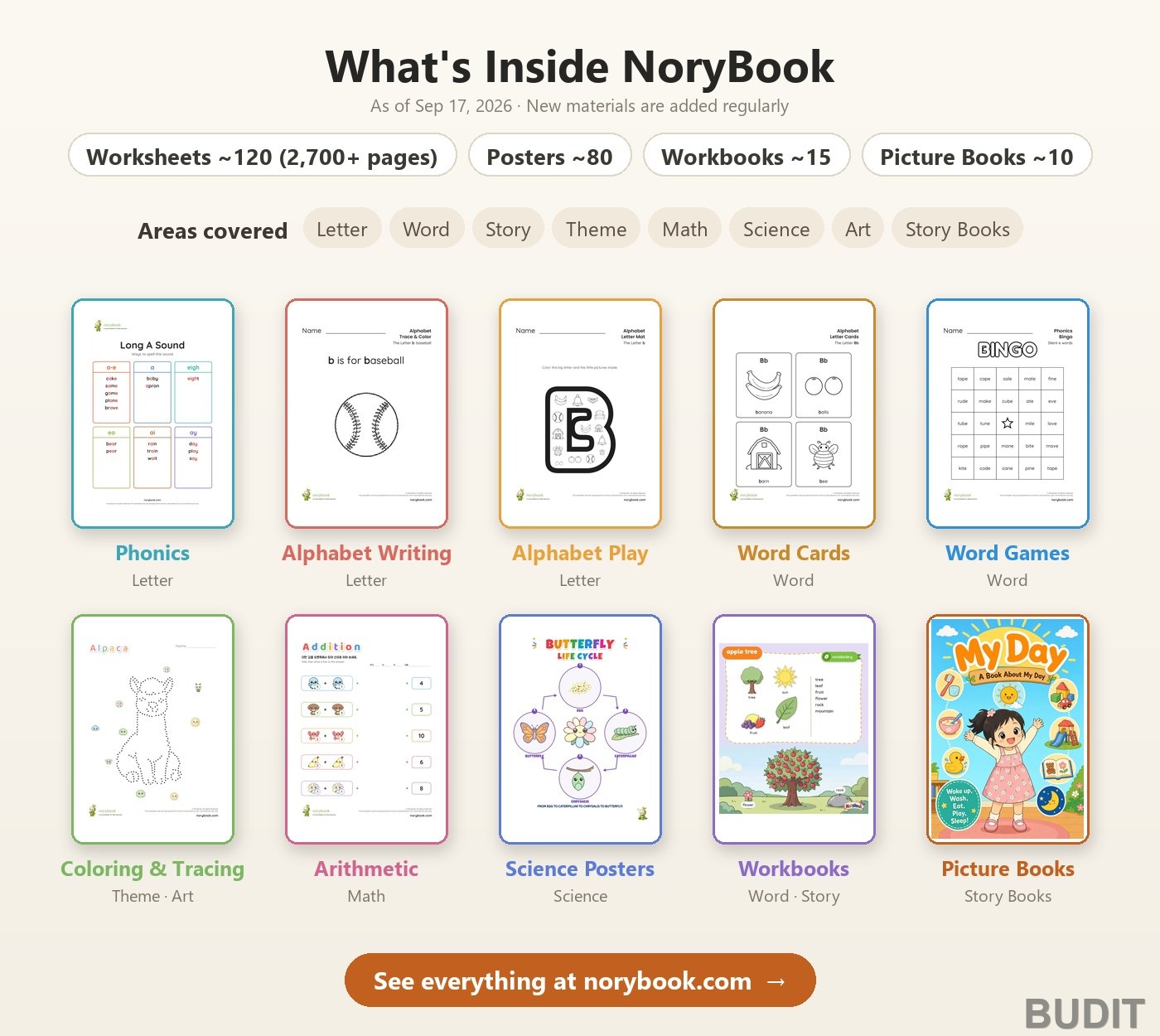
Photo: the 『NoryBook』 collection by Budit (as of Sep 17, 2026). Around 120 worksheets plus posters, workbooks and picture books cover letters, words, stories, themes, math, science and art, and new materials keep coming. See everything at norybook.com
Worth watching
Video: EBS Lifelong School 『Handwriting Basics』 (official YouTube channel, Korean). The first lesson of a handwriting course for adults, from writing large and slowly to forming Korean consonants and vowels. A useful starting point for parents who want to brush up on the basics first.
How this continues in Budit
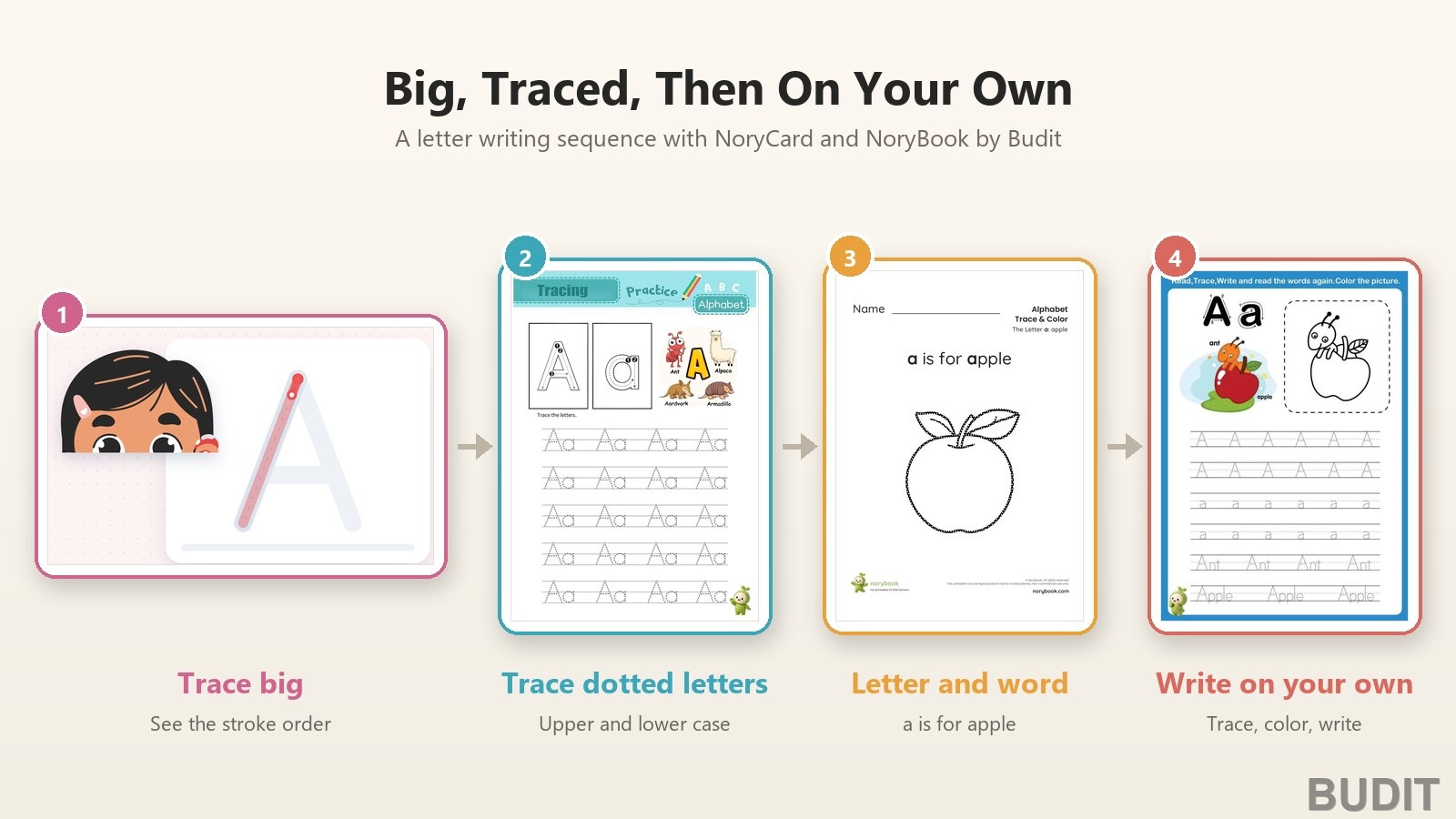
The image at the top follows a letter from tracing it big on screen, to tracing dotted lines on paper, to writing it alone. For fingertip development in general, see our earlier article A Child's Brain Grows at Their Fingertips.
- 『Trace big』: in 『알파벳 따라쓰기』 (alphabet tracing) among the NoryCard games, your child follows the stroke order of a large letter with a finger.
- 『Trace dotted letters』: write uppercase and lowercase letters over dotted lines with Alphabet Tracing.
- 『Letter and word』: Dotted Picture Tracing has more than 70 pages, each pairing a letter with a key word and picture, as in 『a is for apple』.
- 『Write on your own』: in Trace, Color and Write, your child traces letters and words, writes them without help, then colors the picture.
References
- Longcamp, M., Zerbato-Poudou, M. T. and Velay, J. L. (2005). The influence of writing practice on letter recognition in preschool children: A comparison between handwriting and typing. View on Google Scholar
- Kiefer, M. et al. (2015). Handwriting or typewriting? The influence of pen- or keyboard-based writing training on reading and writing performance in preschool children. View on Google Scholar
This article shares general information about child development and education. Every child grows at their own pace. For specific concerns, please talk with a pediatrician or a child development specialist.