


Can my child do homework with ChatGPT
『Mom, can I just ask ChatGPT?』 If you have an elementary schooler, you have probably heard it. Banning it feels like falling behind the times, and allowing it feels like the child will stop thinking. The research does not ask you to pick one. With the same AI, using it to receive answers and using it to support thinking gave different results. What matters is not whether the child uses AI but what they hand over to it.
At a glance
| Question | What the research says |
|---|---|
| Does AI homework raise grades | Students who copied answers scored higher in practice but 17 percent lower on an exam without AI |
| So should it be banned | Students who used an AI that gave only hints lost nothing on the exam |
| Why | Receiving the answer removes the recalling and checking. The more people trusted AI, the less they checked for themselves |
| What children do not notice | It is easy to mistake what you looked up for what you know |
| So | Separate what to hand over (hints, checking, examples) from what not to (answers, first thinking, writing in your own words) |
Receiving answers meant lower exam scores
The most direct study came out in 2025. Bastani and colleagues split about a thousand high school students in Türkiye into three groups during math practice. The group that used an AI giving answers directly scored 48 percent higher on practice problems, but on an exam taken without AI they scored 17 percent lower than the group that had not used AI at all. The group that used an AI built to give only hints scored 127 percent higher in practice and lost nothing on the exam (Bastani et al., 2025). Solving well in practice and learning turned out to be different things.
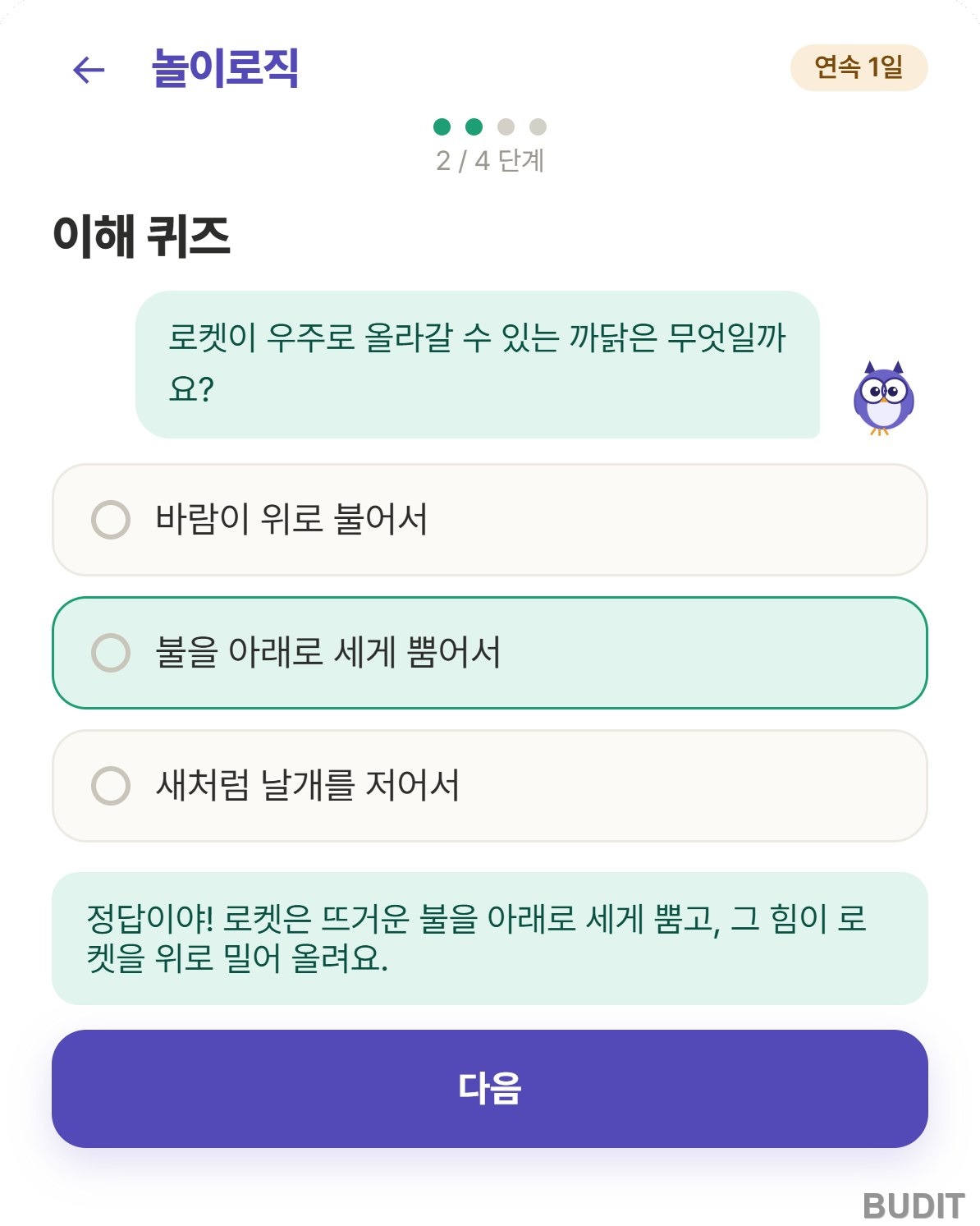
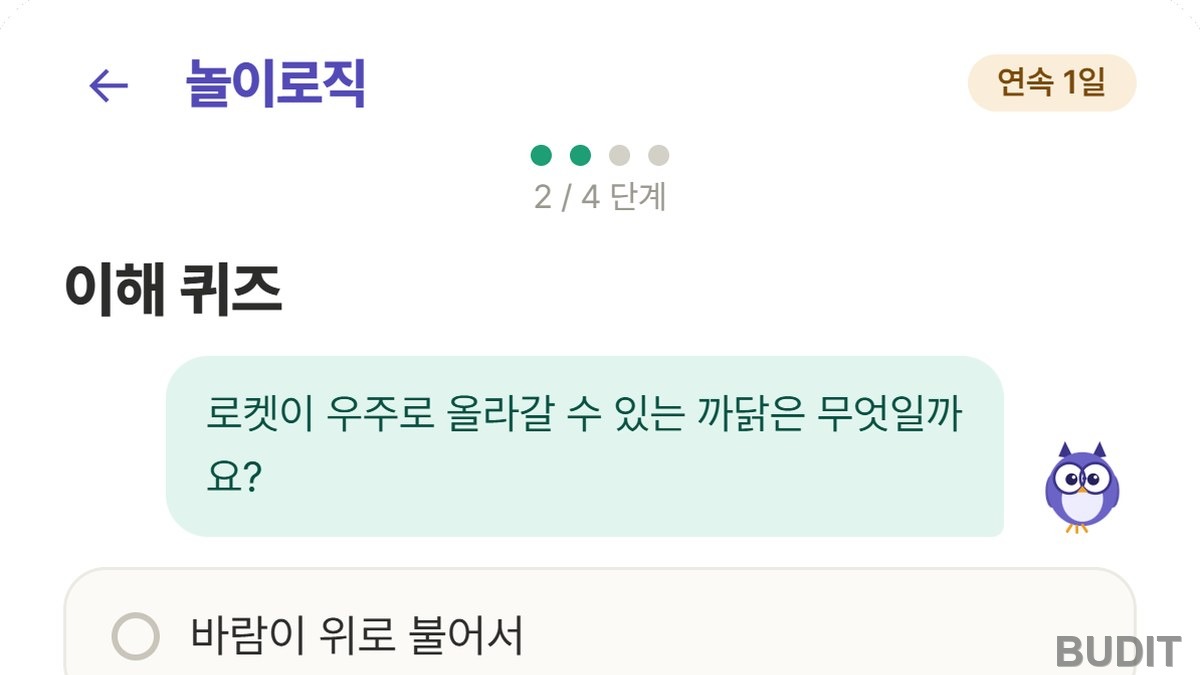
Photo: the comprehension quiz for the 『NoryLogic』 story 『How do we go up into space?』 (as of Nov 5, 2026; NoryLogic is currently in Korean). The child chooses first, and the explanation comes after. Reverse the order and the learning disappears. Visit NoryLogic
The more you trust, the less you check
Why does this happen? Lee and colleagues collected 936 real situations in which 319 knowledge workers used generative AI at work. The more people trusted the AI, the less they checked for themselves, and the more they trusted their own ability, the more they checked (Lee et al., 2025). Gerlich surveyed 666 people and reported that heavier use of AI tools went with lower critical thinking scores, that the link between them was 『offloading thinking to the tool』, and that dependence was higher among younger people (Gerlich, 2025). If adults do this, a child who has not yet built the habit of checking hands things over even more easily.
Mistaking what you looked up for what you know
There is a quieter problem. Sparrow and colleagues showed that when people believe information can be looked up later, they remember where to find it instead of the content (Sparrow et al., 2011). Fisher and colleagues showed that people who had just searched the Internet for answers felt they knew more themselves, even on questions unrelated to what they searched (Fisher et al., 2015). When a child finishes homework with AI and says 『I know it all』, that may not be a lie but an illusion. It would be a problem for that illusion to harden while metacognition is still growing.
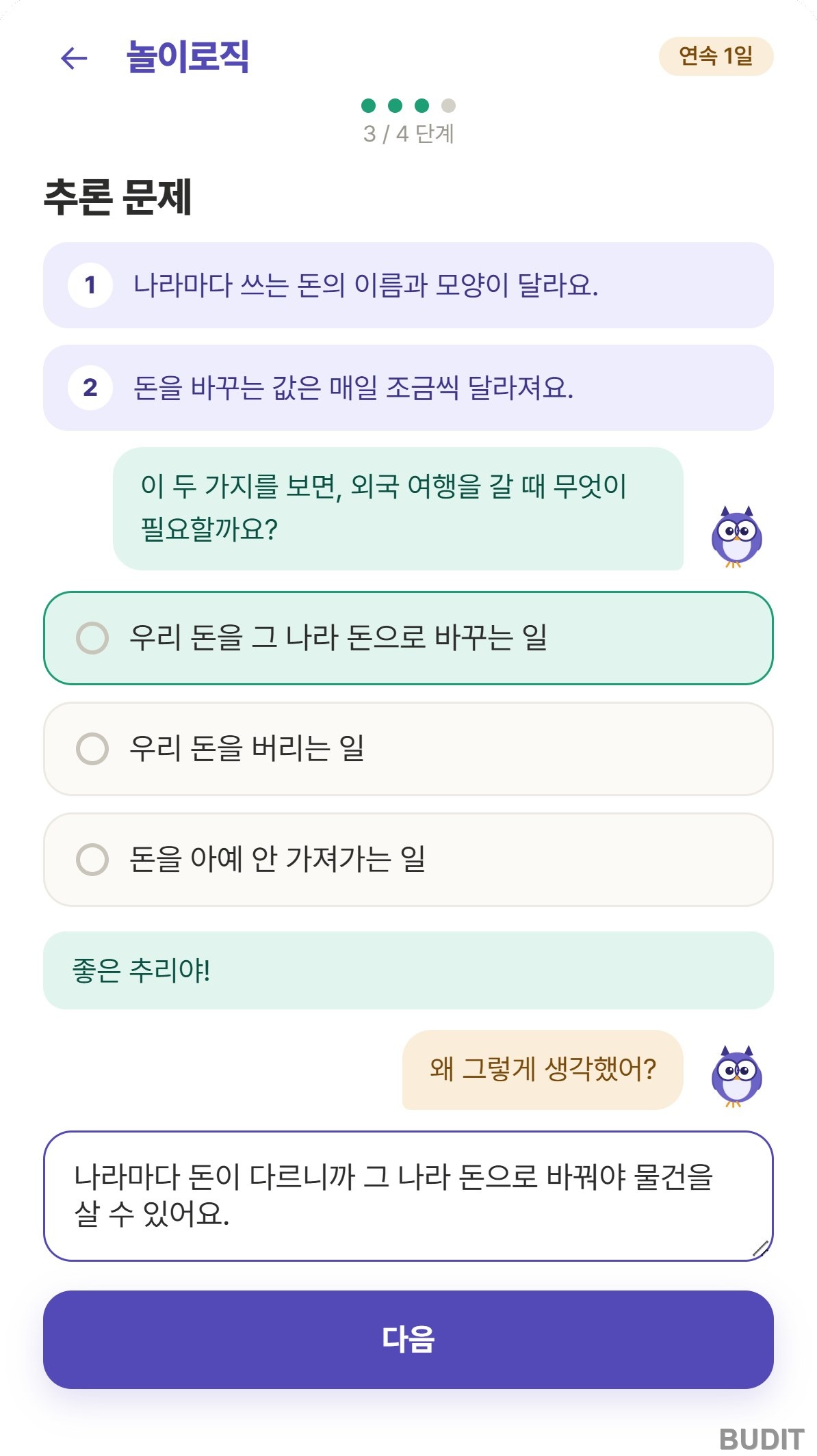
Photo: the reasoning question for the 『NoryLogic』 story 『Every country has its own money』 (as of Nov 5, 2026, with an example answer filled in). Clues are given but not the answer, and the child writes the reason in their own words.
What to hand over and what not to
| Fine to hand over | Do not hand over |
|---|---|
| One hint when stuck | Receiving the answer and copying it |
| Checking whether my answer is right | Letting AI do the first thinking |
| Asking what an unknown word means | Having a text summarized so you skip reading it |
| Seeing one more similar example | Anything written in your own words, like a journal or a response |
The rule is one line. What should happen inside the child's head (first thinking, recalling, writing in their own words) is not handed over, and what supports that work (hints, checking, examples) can be.
Agree on this at home
- Five minutes alone first: before asking AI, set a time to try alone. Writing down where they got stuck is even better.
- Hints, not answers: agree to ask 『give me one hint』 instead of 『tell me the answer』. Write that sentence out together.
- Explain any answer received: if an AI answer was used, homework is finished only when the child can answer 『why is this right?』 in their own words.
- Check together: ask 『how could we tell whether this is right?』 and show the child what it looks like to confirm with a book or another source.
- Own words homework stays yours: journals, book responses and thought writing are done without AI. Even with mistakes, that writing is the child's.
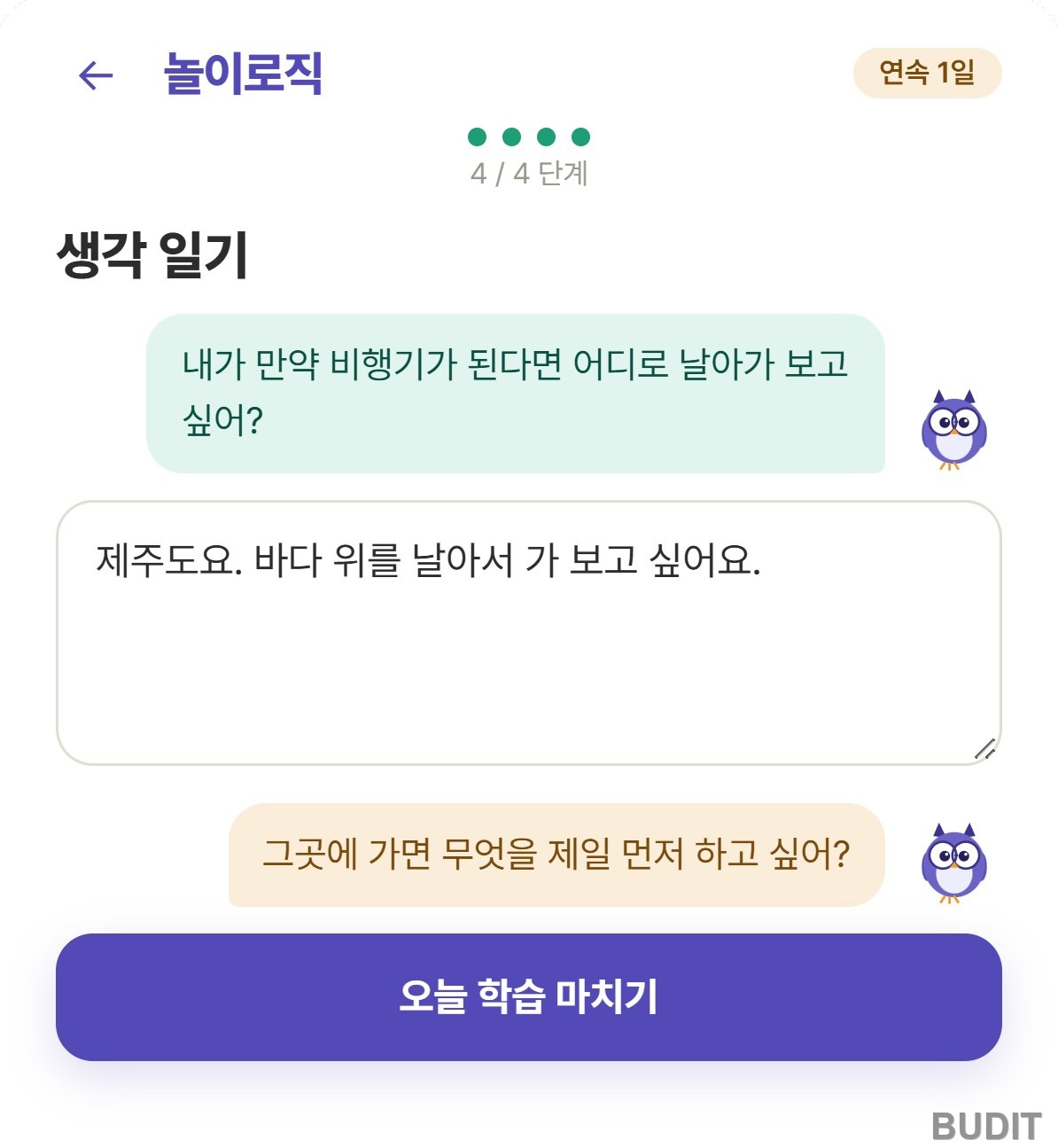
Photo: the thought journal for the 『NoryLogic』 story 『How does an airplane fly?』 (as of Nov 5, 2026, with an example answer filled in). A question with no right answer, so AI cannot write it in the child's place.
Frequently asked questions
School has banned AI. Can we use it at home? School rules come first. But agreeing on how to use it at home means that when the ban lifts, the child can go straight to the right kind of use.
From what age can a child use AI? Most AI services set a minimum age, and young children should use them together on a parent's account. For the early elementary years, asking and checking together with a parent suits better than using it alone.
Does AI give wrong answers? It does. That is why 『checking』 mattered in the studies above. Confirming an AI answer with another source is a basic study skill for the age of AI.
How this continues at Budit
The three steps in the picture at the top are how 『NoryLogic』 uses AI while leaving the thinking to the child.
- 『The child answers first』: the comprehension quiz on NoryLogic shows the explanation only after the child chooses. The explanation is a check, not an answer.
- 『Hints as clues』: the reasoning question gives two clues and no answer. After choosing, the child answers 『why do you think so?』.
- 『A place for your own words』: the thought journal is a question with no right answer. That writing belongs to the child, not to AI.
If you are new, start with Getting Started with NoryLogic to see the order of one session.
Related reading: Children Who Trust AI Answers As Is 『Automation Bias and the Habit of Thinking First』, What Children Need in the Age of AI 『Making Questions Beats Finding Answers』, What Is Metacognition 『A Child's Power to Know Their Own Thinking』
References
- Bastani, H., Bastani, O., Sungu, A., Ge, H., Kabakcı, Ö. and Mariman, R. (2025). Generative AI without guardrails can harm learning: Evidence from high school mathematics. Proceedings of the National Academy of Sciences. Read the paper
- Lee, H. P., Sarkar, A., Tankelevitch, L., Drosos, I., Rintel, S., Banks, R. and Wilson, N. (2025). The impact of generative AI on critical thinking: Self reported reductions in cognitive effort and confidence effects from a survey of knowledge workers. CHI Conference on Human Factors in Computing Systems. Read the paper
- Gerlich, M. (2025). AI tools in society: Impacts on cognitive offloading and the future of critical thinking. Societies. Read the paper
- Sparrow, B., Liu, J. and Wegner, D. M. (2011). Google effects on memory: Cognitive consequences of having information at our fingertips. Science. Read the paper
- Fisher, M., Goddu, M. K. and Keil, F. C. (2015). Searching for explanations: How the Internet inflates estimates of internal knowledge. Journal of Experimental Psychology: General. Read the paper
This post covers general developmental and educational information, and every child develops at their own pace. For specific concerns, please consult a pediatrician or a developmental specialist.