


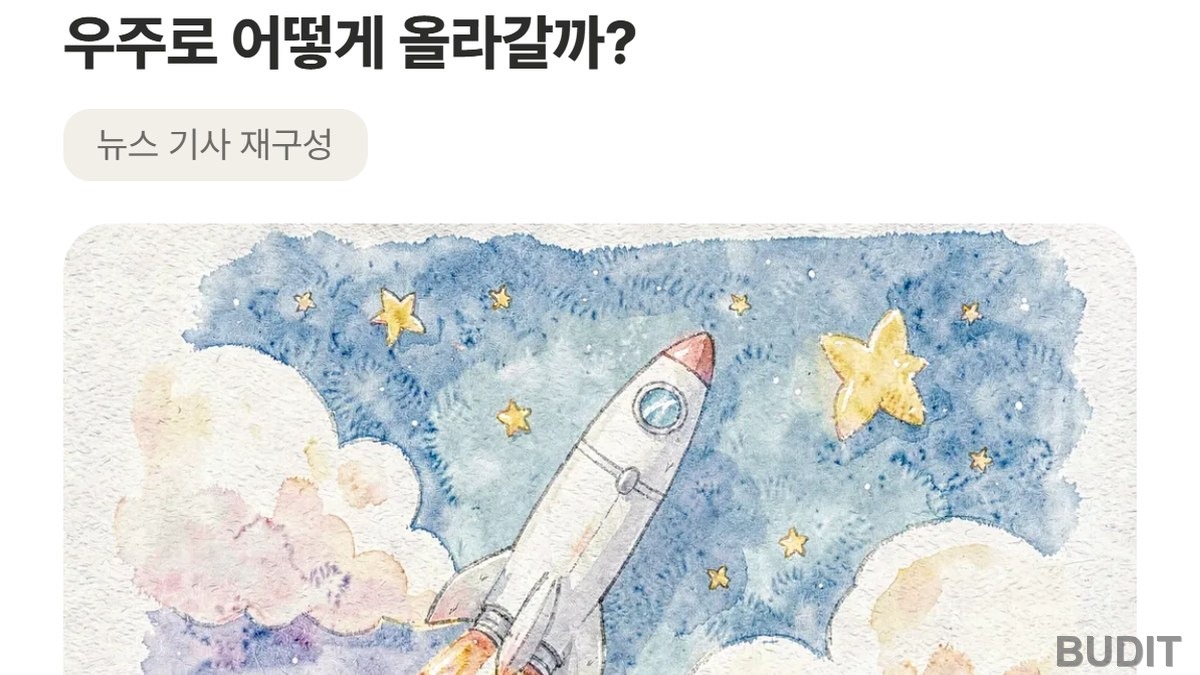
Where to Start Explaining Hard News
A child watching the news or a video asks 『how does that work?』. When you try to answer, you find more than ten concepts inside one scene. Explain them all and the child holds on to none. Pick the one basic concept at the very bottom and climb one step at a time, and even a hard scene starts to make sense to a child.
At a glance
| Question | What the research says |
|---|---|
| Why doesn't explaining everything at once stick | When there is too much to handle at once, no room is left in the mind for learning |
| Where to start | New content sticks when it starts from what the child already knows |
| What does the adult do | Shrink the task to a size the child can handle and point to what matters |
| What to do at home | Pick one basic idea, show it, ask about it, and let the child answer in their own words |
Plenty of material, but none of it connected
Children today meet what they are curious about in three main ways.
- Children's newspapers, educational comics and the news: they tell what happened today. But they have no order for learning concepts.
- Textbooks, school and after school academies: they teach in order, following curriculum standards. But they sit apart from the scene the child saw today.
- YouTube, short videos and asking AI: they show and answer anything right away. But choosing a concept, checking whether it is right and thinking for oneself easily drop out.
In Korea, primary students in grades 4 to 6 watch online video for 143.6 minutes a day on average (Korea Press Foundation, 2025 survey of teen media use), and 75.7% of primary and secondary students take private lessons (Ministry of Education, 2025 private education expenditure survey). Material is not what is missing. Each of the three ways does something well, and what is needed is a link between them.
One scene holds more than ten concepts
This October, Korean media reported a demonstration in which an electric car pushed compressed gas downward to lift its body and jumped over five cars (Kyunghyang Shinmun, YTN, October 16, 2026). If a child asks 『how does that car fly?』, this one scene tangles together more than ten concepts, such as compressed air, gas thrusters, acceleration, center of mass, air resistance, and batteries and electric motors. Read the article aloud as it is, or pass on an AI answer as it is, and the words go by but little stays with the child.
Give it all at once and it does not stay
Sweller argued that when there is too much to handle in the mind at once while solving a problem, all the effort goes into handling it and no room is left for learning. This is called 『cognitive load』 (Sweller, 1988). Explaining ten concepts at once is like piling ten books on the desk in a child's mind all at the same time.
Start from what they know
The educational psychologist Ausubel wrote that if he had to name the single most important factor influencing learning, it would be 『what the learner already knows』 (Ausubel, 1968). A new concept stays when it attaches to something already known. So the first step of an explanation should be something the child has felt with their own body, not a hard name.
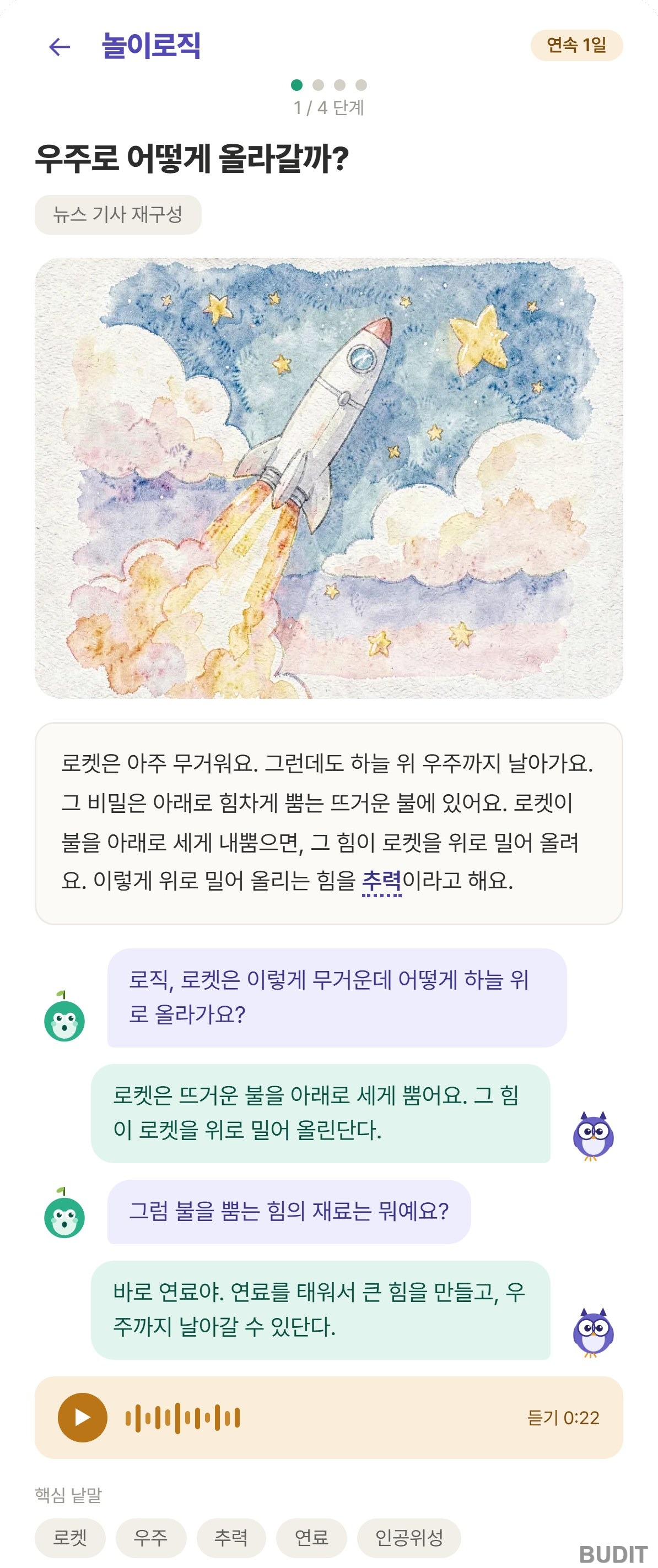
Photo: the 『NoryLogic』 story 『How do rockets get to space?』 (as of Nov 5, 2026; NoryLogic is currently in Korean). Of the many concepts around a rocket, it picks just one, 『push down and you are pushed up』, and writes it at a child's level. Visit NoryLogic
The adult supports one step at a time
Wood, Bruner and Ross observed adults helping children aged three to five build a pyramid from wooden blocks. Adults who helped well shrank the task to a size the child could handle, pointed out what mattered, and kept the child on track without letting them get frustrated. The researchers compared this to 『scaffolding』, the frame put up while a building is built (Wood et al., 1976). Explaining works the same way. The adult's job is not to say everything, but to set down one step the child can climb.
From 『push and you get pushed back』 to the scene
Let us climb the car scene from the bottom step.
- 『Push and you get pushed back』: push a wall and your body moves backward. In Korea's grade 3 and 4 science unit on force in daily life, children observe what happens when they push or pull objects. This is the first step.
- 『Gas goes down, the car goes up』: blow up a balloon and let it go, and the air goes back while the balloon goes forward. The car pushes gas down, so it is pushed up.
- 『Forces come in pairs』: as much as I push, I get pushed. Reach this step and the scene makes sense.
- 『Action and reaction』: this name does not appear in the Korean primary curriculum standards. It is a name to meet when older, and it is fine not to know it now.
Attach one question to each step and the child climbs on their own. 『Which way did the gas go?』 finds the fact, 『then why did the car go up?』 asks for the reason, and 『if you blow up a balloon and let it go, where will it go?』 asks for the child's own thinking.

Photo: the comprehension quiz for the same story (as of Nov 5, 2026). First the child finds one fact in the text.
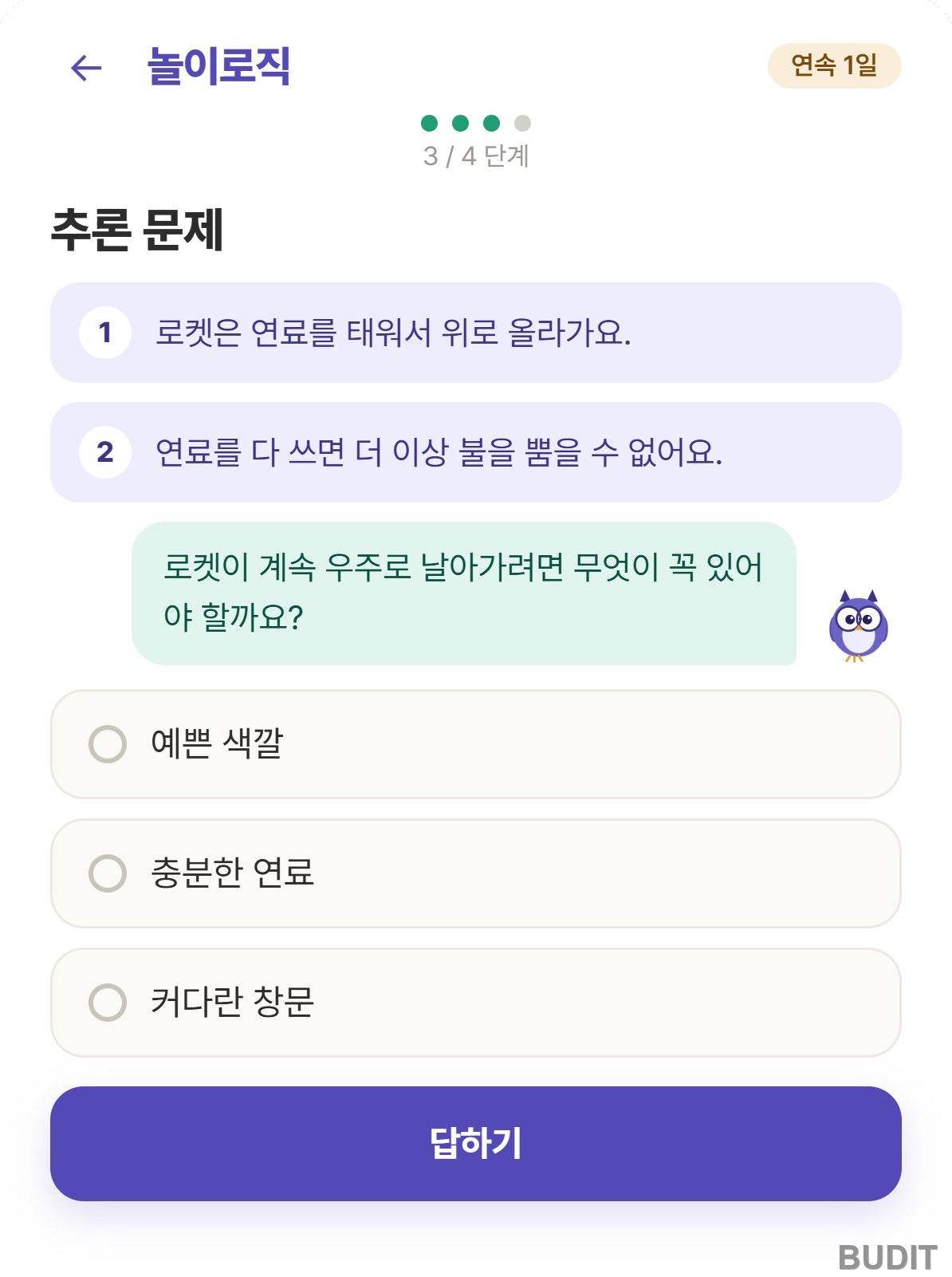
Photo: the reasoning question for the same story (as of Nov 5, 2026). The child looks at two clues and reasons one step further.
What to do at home
- Pick one basic idea. Do not explain every concept in the scene. Pick one thing the child knows with their body.
- Show it first. Start with something you can try at home right away, like letting go of a balloon or pushing a wall.
- Explain in three sentences in a child's words. 『Gas goes down, the car goes up. Push and you get pushed.』 is enough.
- Ask three times. Ask in turn what went where, why it did, and what the child thinks would happen to them.
- Add the name later. A hard term can wait until the child has said the principle in their own words.
- Leave the next step for the next day. One step is enough for today.
Questions people ask
What if my child asks about something harder? Say 『let's look that up together next time』 and write it down. Just writing down a question creates the next step.
Should I avoid hard words? You can use them. A name lasts longer when it comes after the child has linked it to something they have experienced.
Is it wrong to look things up in videos or with AI? No. After looking it up, ask 『so why do you think that is?』 and let the child answer in their own words, and what they watched turns into thinking.
How this continues in Budit
The three steps in the image at the top are the order in which 『NoryLogic』 handles a hard scene.
- 『Read one basic idea』: NoryLogic starts from the news but does not carry the incident over as it is. It writes the one concept behind it at a child's level.
- 『Ask and hear the reason』: the comprehension quiz finds the fact, and in the reasoning question the child looks at clues, answers and writes the reason.
- 『Connect on the map』: in the concept map, see where that concept sits in the primary curriculum and which concepts are its neighbors.
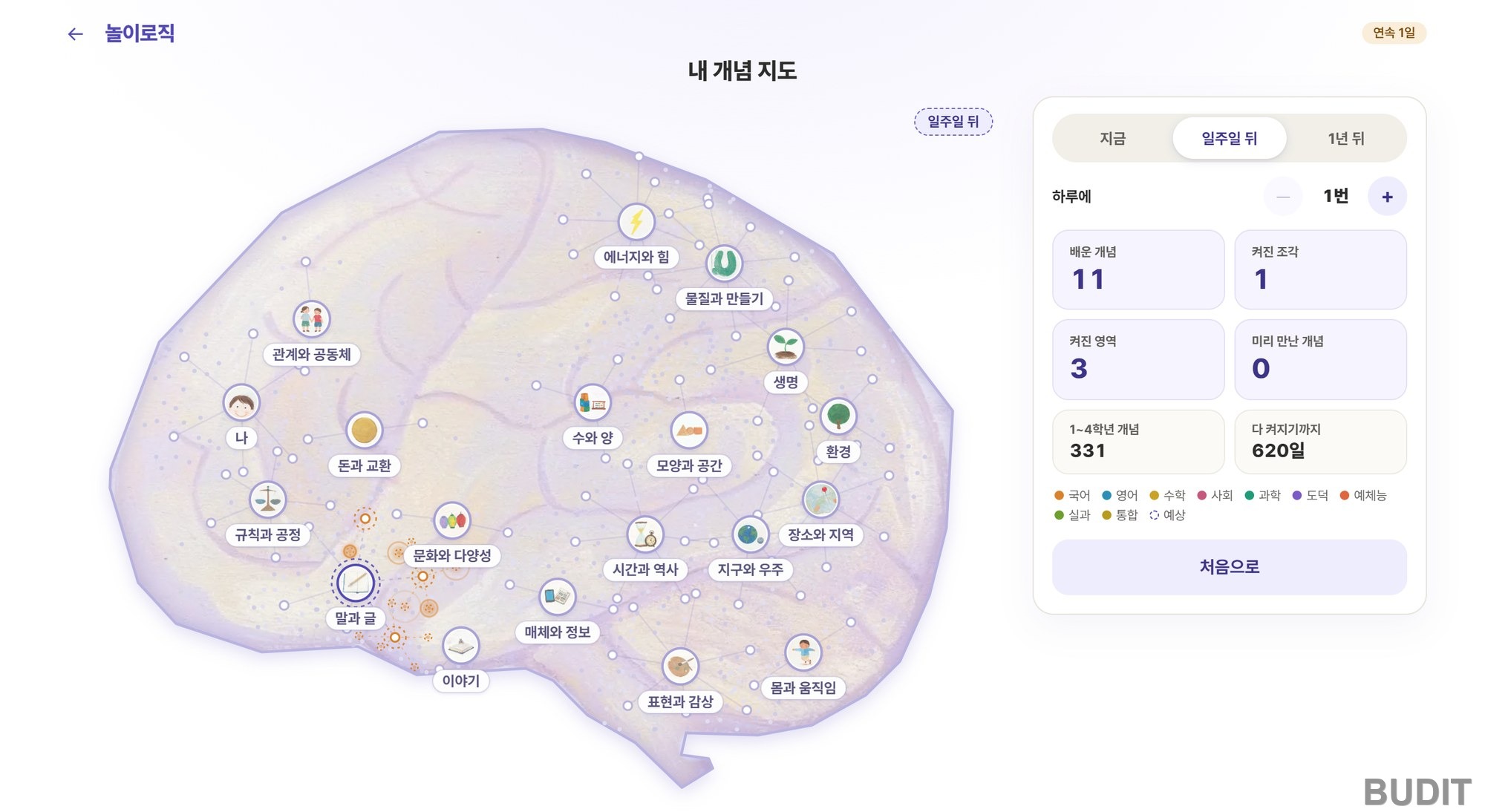
Photo: the 『NoryLogic』 concept map (as of Nov 5, 2026, previewing one week ahead). Neighboring spots such as 『energy and force』 become the next step. See the concept map
If you are new, start with Getting Started with NoryLogic to see the order of one session.
Related reading: Background Knowledge Changes Reading Comprehension 『We Read What We Already Know』, The Power of 『Why Do You Think So?』 『Explaining It Yourself Deepens Learning』, Children Who Trust AI Answers As Is 『Automation Bias and the Habit of Thinking First』
References
- Sweller, J. (1988). Cognitive load during problem solving: Effects on learning. Cognitive Science. View the paper
- Wood, D., Bruner, J. S. and Ross, G. (1976). The role of tutoring in problem solving. Journal of Child Psychology and Psychiatry. View the paper
- Ausubel, D. P. (1968). Educational psychology: A cognitive view. Holt, Rinehart and Winston.
This article shares general information about development and education. Every child grows at their own pace. For specific concerns, please consult a pediatrician or a development specialist.