



How to build elementary literacy
『My child reads fine, but says they do not know what it means.』 Most worries about elementary literacy start with this sentence. Reading letters aloud and understanding what was read are different powers. The research says what separates comprehension is not the amount read but what the child knows, the words they know, and what they do after reading.
At a glance
| Question | Answer |
|---|---|
| What is literacy | Not the power to read letters but the power to understand and write about what was read |
| What separates comprehension | Background knowledge and vocabulary had the largest share |
| Is reading more enough | Print exposure and comprehension are linked, and the link grows with grade. But reading without knowing does not add up |
| When words are taught | Comprehension of texts containing the taught words improved clearly |
| When children write after reading | Students who wrote about what they read comprehended better |
What separates comprehension is what you know
Cromley and Azevedo measured the factors that affect comprehension all at once to see which had the largest share. Among background knowledge, vocabulary, inference, word reading and reading strategies, the ones that explained comprehension most were background knowledge and vocabulary (Cromley and Azevedo, 2007). Perfetti and Stafura also wrote that how deeply a reader knows words sits at the center of a theory of comprehension (Perfetti and Stafura, 2014). Understanding a text means attaching its words and facts to what you already know. With nowhere to attach them, the letters get read but the meaning does not stay.

Photo: the reading screen for the 『NoryLogic』 story 『Every country has its own money』 (as of Nov 5, 2026; NoryLogic is currently in Korean). Five key words are shown separately below the text. Visit NoryLogic
Does reading a lot do it on its own
It is true that children who meet more books have better literacy. Mol and Bus gathered 99 studies from infancy to university and looked at the link between print exposure and vocabulary and comprehension. The link was there at every age, and it grew larger as grade went up (Mol and Bus, 2011). But the link appears when what was read piles up and what the child knows grows. Reading many texts full of unknown words does not build it. The key is reading texts the child can understand, widening what they know a little at a time.
Teaching words improves comprehension
Elleman and colleagues gathered studies that taught words and then checked whether comprehension improved. On texts containing the taught words, comprehension improved clearly (effect size 0.50), and the effect was especially large for slower readers (Elleman et al., 2009). Learning a few key words before reading is not a detour. It is the shortcut.

Photo: the comprehension quiz for the same story (as of Nov 5, 2026). Right after reading, the child recalls one fact from the text and checks it against the explanation.
Writing after reading makes reading deeper
Duke and colleagues, summarizing research on comprehension instruction, wrote that building knowledge before reading, talking while reading and writing after reading are the road to comprehension (Duke et al., 2021). The effect of writing has been measured on its own. Graham and Hebert gathered studies that had students write about what they read and reported that writing raised comprehension. Summarizing, writing answers and writing responses all helped, with an average effect size of 0.40 (Graham and Hebert, 2011). While writing a sentence or two about what they read, a child reads the text once more.

Photo: the thought journal for the same story (as of Nov 5, 2026, with an example answer filled in). The child links what they read to their own experience in one sentence.
Try this at home
- Three words before reading: say three words from the text that the child may not know. 『Today's story has the word exchange rate. It is the ratio when you change money.』
- Bring out what they know first: ask 『where did you see this before?』 so the child brings out what they already know. It makes a place to attach the new.
- One question after reading: 『Just one thing you remember most.』 Keep it short.
- Write a sentence or two: if summarizing is hard, have them connect it to their own story, like 『what would I do?』.
- Short and daily: one story a day, ten minutes is enough. Daily matters more than quantity.
Frequently asked questions
My child reads a lot, but comprehension scores are low. Often the child reads only favorite books, so the areas they know are narrow, or there is no recall step after reading. Widen the fields and add one sentence of writing after reading.
Can I teach comprehension with workbooks? Workbooks are useful for recall. But the step of covering words and background before reading is easy to skip. Talk about 『what is this text about?』 before solving.
From what age should I pay attention? From grades 1 and 2, when children start reading letters. At that stage, explaining words while reading aloud and talking afterward is enough.
How this continues at Budit
The three steps in the picture at the top are where literacy is built within one 『NoryLogic』 session.
- 『Words first』: NoryLogic shows the key words separately below the story and rewrites the text at a child's level.
- 『Recall』: right after reading, the comprehension quiz brings out one fact and the explanation confirms it.
- 『Write』: in the thought journal the child writes a sentence or two on a question linked to the story. Concepts from finished stories pile up on my concept map, so the widening of what they know is visible.
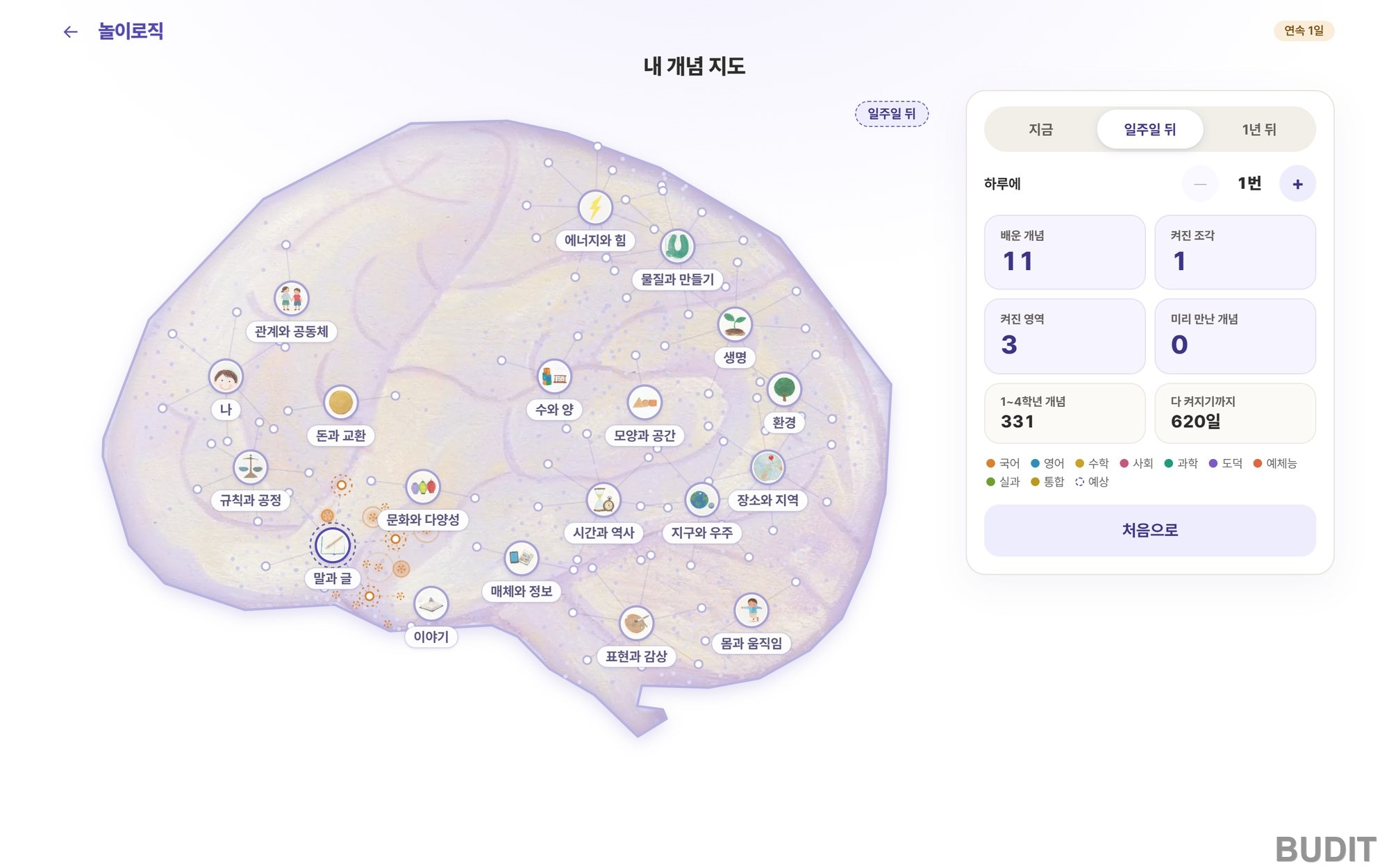
Photo: 『NoryLogic』 my concept map (as of Nov 5, 2026, the one week preview at one session a day). Concepts from the stories read light up on the curriculum map.
If you are new, start with Getting Started with NoryLogic to see the order of one session.
Related reading: Background Knowledge Changes Reading Comprehension 『We Read What We Already Know』, A Two Sentence Thought Journal 『Writing Sorts Out Thinking』, Why Deep Reading Matters in the Age of Short Form 『The Reading Brain Is Not Inborn』
References
- Cromley, J. G. and Azevedo, R. (2007). Testing and refining the direct and inferential mediation model of reading comprehension. Journal of Educational Psychology. Read the paper
- Perfetti, C. and Stafura, J. (2014). Word knowledge in a theory of reading comprehension. Scientific Studies of Reading. Read the paper
- Mol, S. E. and Bus, A. G. (2011). To read or not to read: A meta analysis of print exposure from infancy to early adulthood. Psychological Bulletin. Read the paper
- Elleman, A. M., Lindo, E. J., Morphy, P. and Compton, D. L. (2009). The impact of vocabulary instruction on passage level comprehension of school age children: A meta analysis. Journal of Research on Educational Effectiveness. Read the paper
- Duke, N. K., Ward, A. E. and Pearson, P. D. (2021). The science of reading comprehension instruction. The Reading Teacher. Read the paper
- Graham, S. and Hebert, M. (2011). Writing to read: A meta analysis of the impact of writing and writing instruction on reading. Harvard Educational Review. Read the paper
This post covers general developmental and educational information, and every child develops at their own pace. For specific concerns, please consult a pediatrician or a developmental specialist.