


My Face in the Picture Book
What if you turned the page and the hero of the story was 『you』? For a child, that is an exciting moment and a natural opening to talk about themselves.
Young children describe themselves by what they can see and do
Young children are busy forming ideas about 『who I am』, which psychologists call the 『self concept』. At this age, children tend to describe themselves through things they can see, do or own, such as 『I can run fast』 or 『I have a dog』 (Harter, 2012).
What changes when the hero is me
In one study, 35 children with an average age of three were read a book that had some sections personalized for each child and some that were not, and researchers recorded what the children said. The children spoke up more on their own during the personalized sections, and talked about themselves more often (Kucirkova et al., 2014).
Things to try while reading together
- Ask your child, now the hero, about feelings: 『How do you feel right now?』
- At a brave moment in the story, link it to real life: 『You did something like this too, remember?』
- Praise the effort, not just the result. Try something like 『You kept going all the way to the end.』
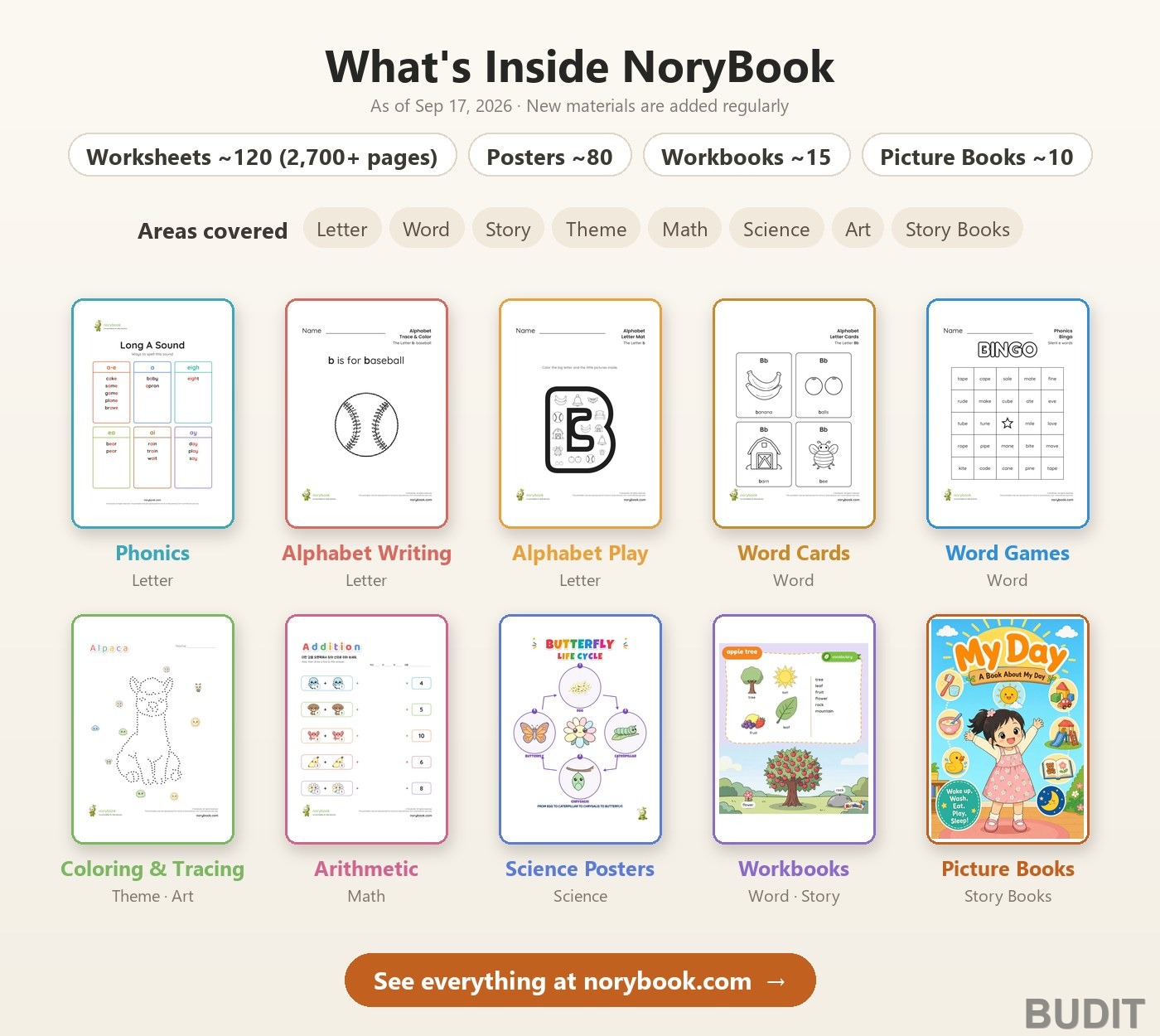
Photo: the 『NoryBook』 collection by Budit (as of Sep 17, 2026). Around 120 worksheets plus posters, workbooks and picture books cover letters, words, stories, themes, math, science and art, and new materials keep coming. See everything at norybook.com
Worth watching
Video: EBS Education Journal 『How to Be a Parent Who Builds a Child's Self Esteem』 (official YouTube channel, Korean).
How this continues in Budit
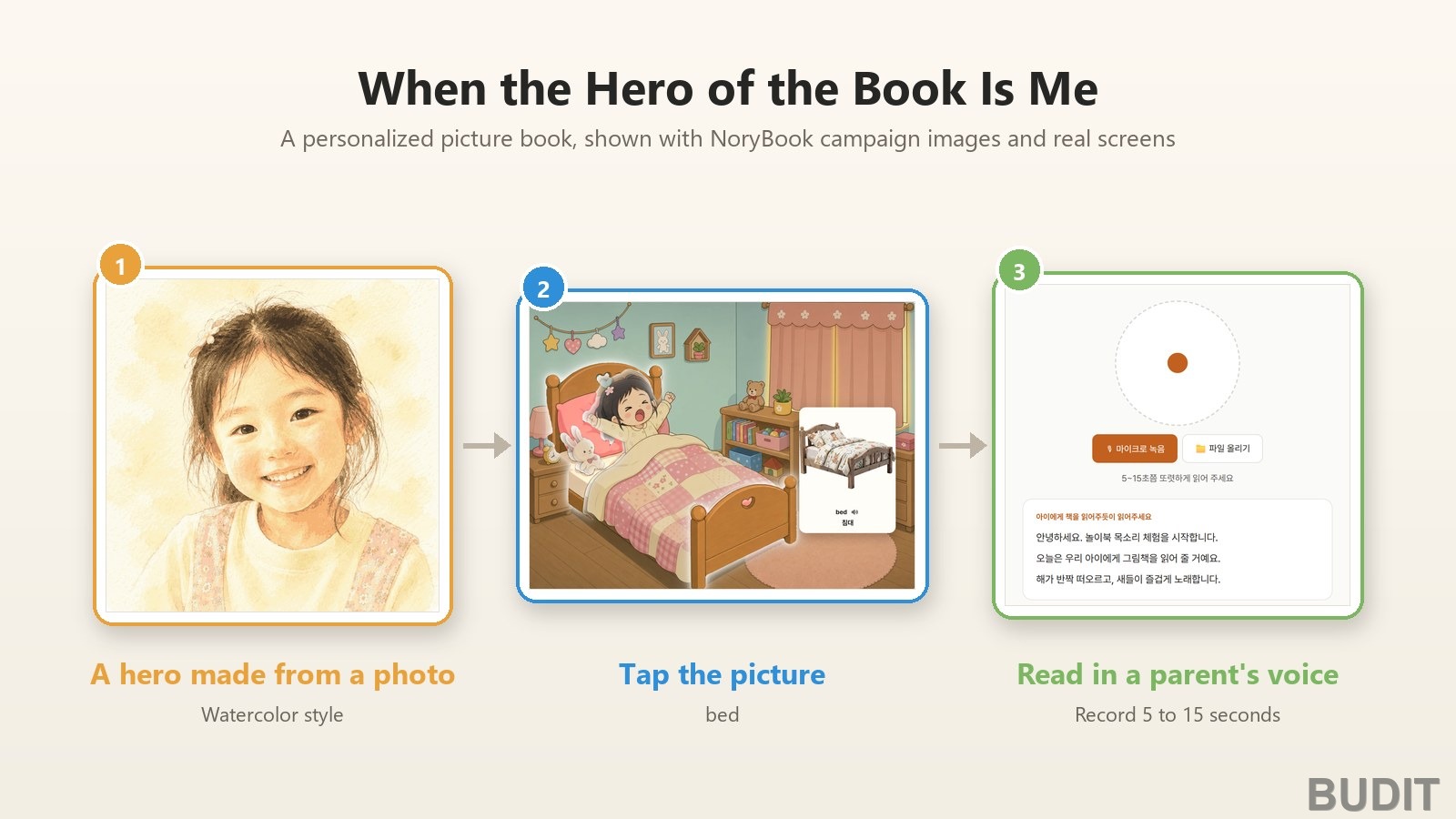
In the 『NoryBook』 demo, you can use one photo to draw your child as the hero of a picture book, and in the book reader, tapping things in the pictures brings up English word cards. The three steps in the image at the top are real screens (the first one is a card made from a sample photo).
- 『Create a hero』: in 『주인공 만들기』 (create a hero) on the NoryBook demo, turn one photo of your child into the hero of a picture book. The first image at the top comes from the NoryBook campaign images by Budit, where one photo becomes a watercolor illustration.
- 『Tap the picture』: in the My Day reader, tap things like the bed or the blanket to see the English word with its Korean meaning.
- 『Read in a parent's voice』: the voice demo lets you hear a book read in a parent's voice, using a recording of just 5 to 15 seconds.
References
- Harter, S. (2012). The Construction of the Self: Developmental and Sociocultural Foundations. View on Google Scholar
- Kucirkova, N., Messer, D. and Sheehy, K. (2014). The effects of personalisation on young children's spontaneous speech during shared book reading. View on Google Scholar
This article shares general information about child development and education. Every child grows at their own pace. For specific concerns, please talk with a pediatrician or a child development specialist.