


The Comfort of a Book Read in a Parent's Voice
At bedtime your child brings you the same book yet again. It may not only be the story they want. It may also be the time spent close to you, listening to your voice.
A secure base makes exploring possible
Attachment theory sees the emotional bond between a child and a caregiver as a foundation for development (Bowlby, 1969). Securely attached children use their caregiver as a 『secure base』: they explore new things with more confidence and come back for comfort when things get hard (Ainsworth et al., 1978). Reading together every day, in the same spot and in the same voice, can become one of the moments when a child feels that secure base.
Reading together and attachment
In a study that observed mothers and children reading together, securely attached children were less distracted during reading, and their mothers needed to correct them less often (Bus and van IJzendoorn, 1988). A meta analysis of 19 programs that help parents and children read together found small but clear benefits for the emotional wellbeing and relationships of both children and parents (Xie et al., 2018).
Comfort carried by a voice alone
After a stressful task, girls aged 7 to 12 who could only talk with their mother on the phone showed a drop in stress hormones and a rise in oxytocin, a hormone linked to bonding. The change was similar to that of girls whose mothers comforted them in person (Seltzer et al., 2010). Why a voice a child has known since infancy matters so much is covered in our earlier article A Parent's Voice Is Special.
Things to keep in mind when reading together
- Hold your child on your lap or sit close enough to touch.
- Reading the same book again and again is fine. Knowing what comes next is part of the fun for a child.
- When your child points at a picture or makes a sound, stop reading and respond.
- Keep sessions short, and read at about the same time each day.
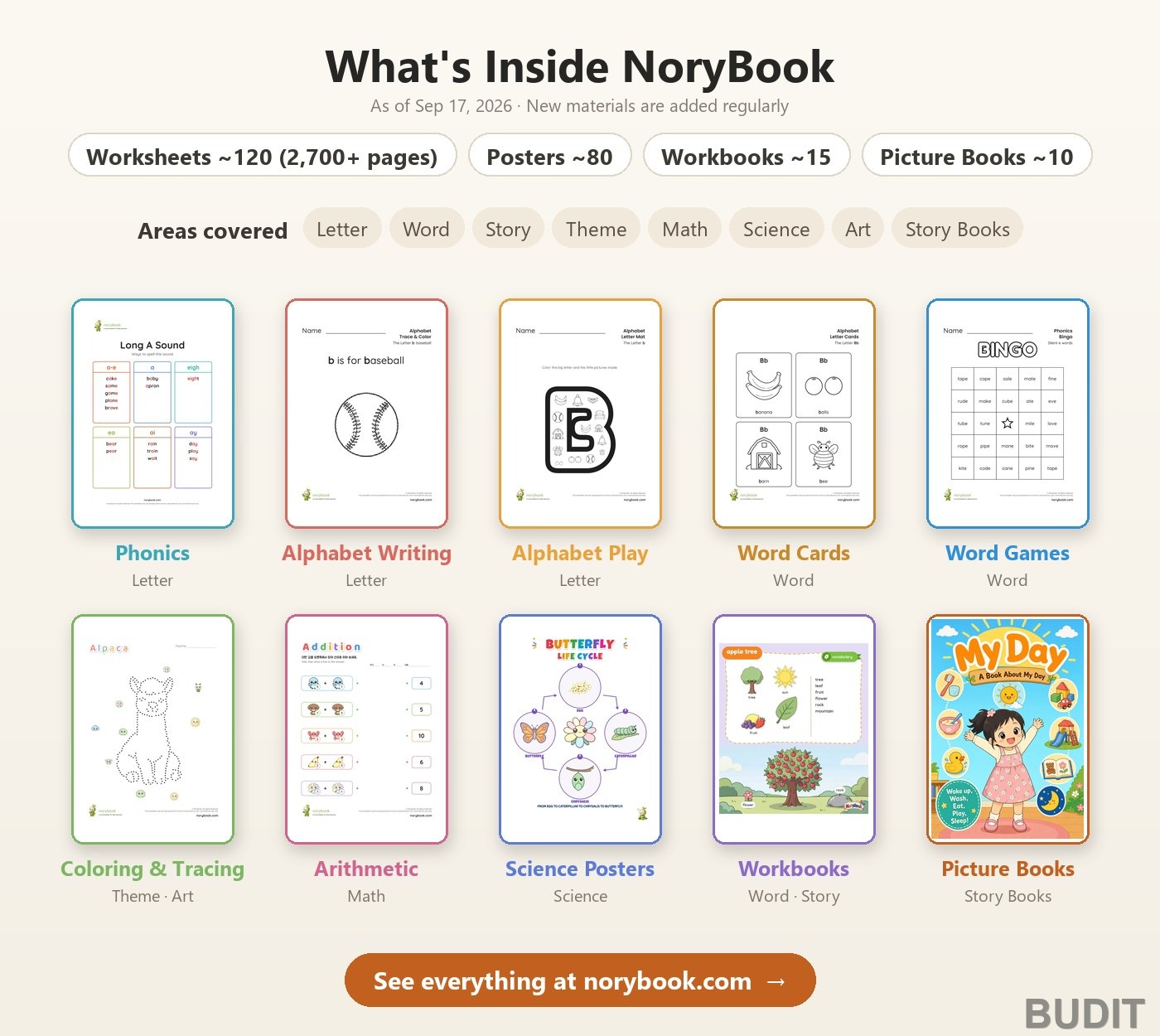
Photo: the 『NoryBook』 collection by Budit (as of Sep 17, 2026). Around 120 worksheets plus posters, workbooks and picture books cover letters, words, stories, themes, math, science and art, and new materials keep coming. See everything at norybook.com
Worth watching
Video: EBS campaign 『Please read aloud』 (official YouTube channel of the EBS literacy special, Korean). A short campaign film in which a parent who reads storybooks aloud every day encourages parents of young children to do the same.
How this continues in Budit
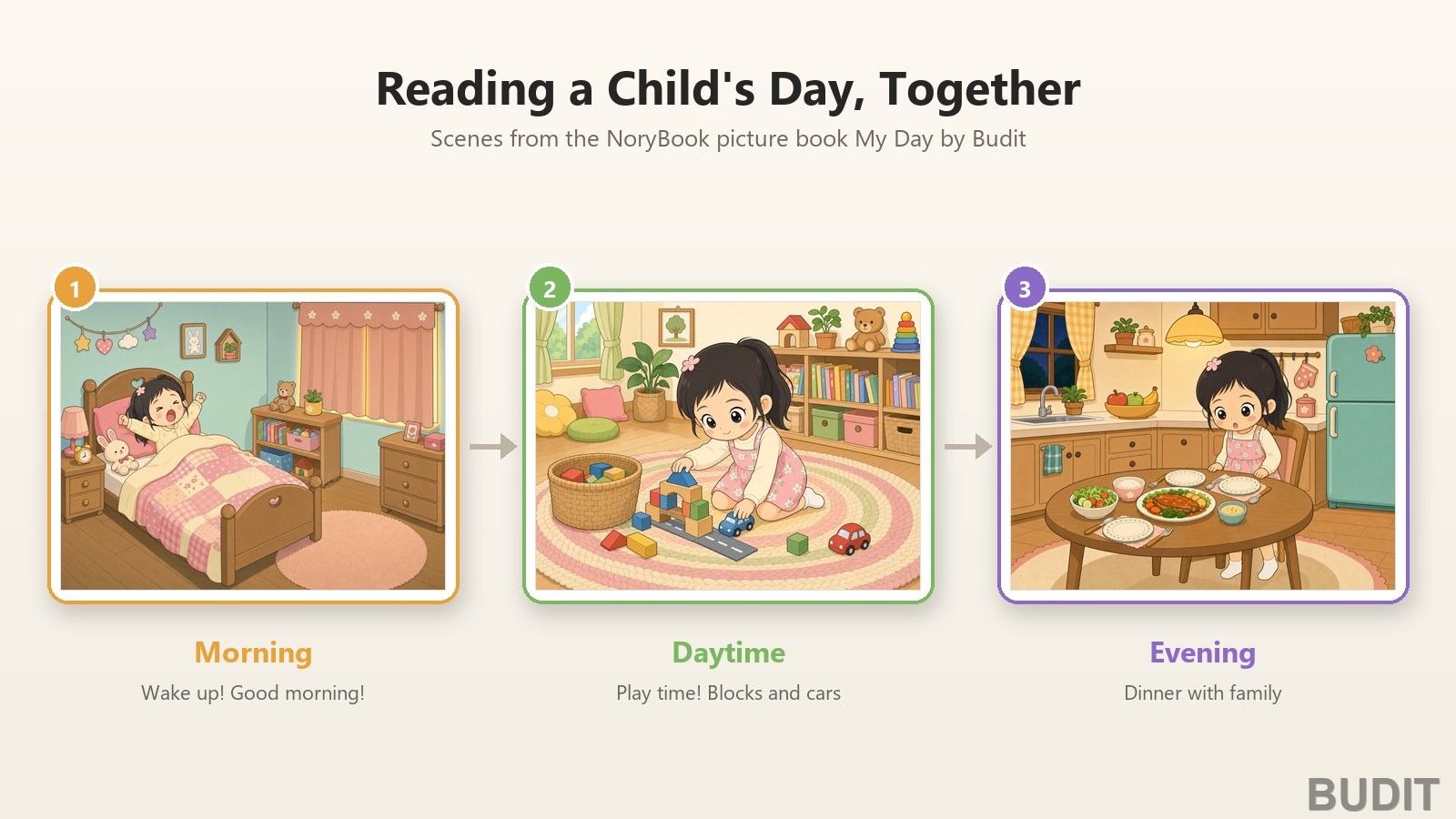
The Budit picture book 『My Day』 follows a child's day from waking up to bedtime. The image at the top shows real scenes from the book.
- 『Morning』: open the reader and start with 『Wake up! Good morning!』 Then ask, 『What did you do this morning?』
- 『Daytime』: in the play scene, tap things in the picture and listen to their English names together.
- 『Evening』: at the family dinner scene, talk about what happened today.
You can choose from several preset reading voices, and once you log in you can also listen in a voice a parent has recorded.
References
- Bowlby, J. (1969). Attachment and Loss, Vol. 1: Attachment. View on Google Scholar
- Ainsworth, M. D. S. et al. (1978). Patterns of Attachment: A Psychological Study of the Strange Situation. View on Google Scholar
- Bus, A. G. and van IJzendoorn, M. H. (1988). Mother-child interactions, attachment, and emergent literacy: A cross-sectional study. View on Google Scholar
- Xie, Q. W. et al. (2018). Psychosocial effects of parent-child book reading interventions: A meta-analysis. View on Google Scholar
- Seltzer, L. J., Ziegler, T. E. and Pollak, S. D. (2010). Social vocalizations can release oxytocin in humans. View on Google Scholar
This article shares general information about development and education. Every child grows at their own pace. For specific concerns, please consult a pediatrician or a development specialist.