

When Do Children Recognize Themselves
Show a baby a mirror, and at first they often smile or reach toward the baby in the glass. Then, at some point, they realize the child in the mirror is 『me』. When does that happen?
What the rouge test shows
In the 『rouge test』, a classic experiment in developmental psychology, a dab of red rouge is secretly put on a baby's nose, and then the baby is shown a mirror. A baby who looks in the mirror and touches 『their own nose』 is taken to know that the reflection is them. In a study that observed 88 babies between 3 and 24 months old, 65% of those aged 20 to 24 months responded this way (Amsterdam, 1972). Later research also found that many babies start to respond this way somewhere between 18 and 24 months (Lewis and Brooks-Gunn, 1979).
Recognizing yourself on video
The next step is recognizing 『a me that is not here right now』. In one study, children aged two to four had a large sticker secretly placed on their heads while they played, and three minutes later they watched a video of that moment. The children who saw the sticker on screen and reached up to their own heads were mostly four years old; most of the younger children did not (Povinelli et al., 1996). Even after children recognize themselves in a mirror, connecting the self of a few minutes ago with the self of right now comes later. Awareness of the self does not arrive all at once. It grows in stages (Rochat, 2003).
Finding yourself in pictures
While this awareness is growing, finding themselves in a drawing can be a fun game for children. Ask 『Is this me?』, compare the drawing with a photo, and copy the facial expression in the picture together.
Ideas to try at home
- Put a sticker on your child's nose in front of a mirror and play 『Where is it?』
- Put a baby photo next to a recent one and talk about 『Who is this?』
- Show your child a drawing of themselves and look together for what matches the photo.
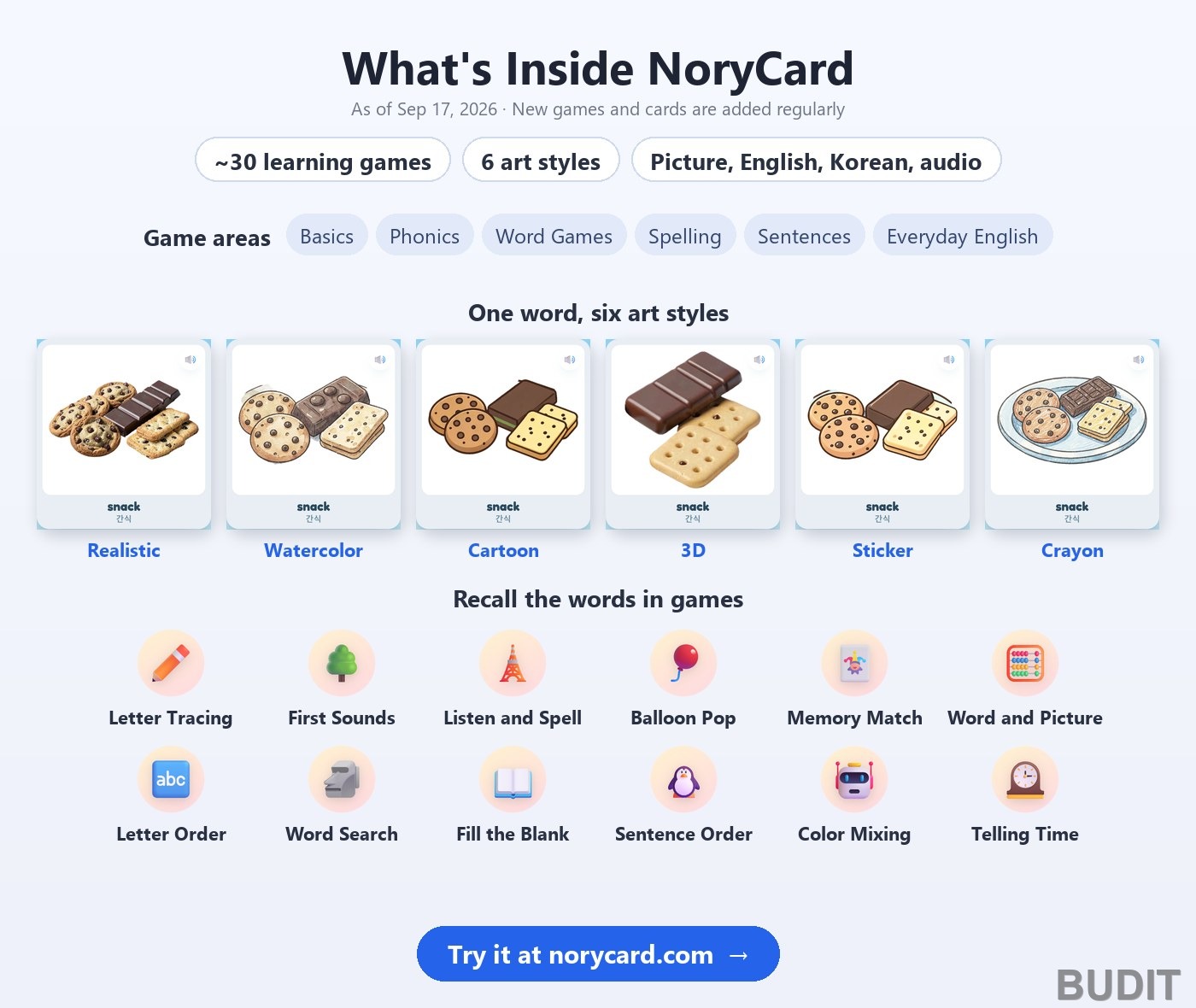
Photo: what's inside 『NoryCard』 by Budit (as of Sep 17, 2026). Around 30 learning games cover basics, phonics, words, spelling, sentences and everyday English, and every word card comes in six art styles. See all NoryCard games
Worth watching
Video: EBS special documentary 『Why Does My Child Do That?』 Episode 1, 『Can a Child Recognize Themselves in the Mirror?』 (official YouTube channel, Korean). It shows babies with lipstick on their faces being shown a mirror.
How this continues in Budit
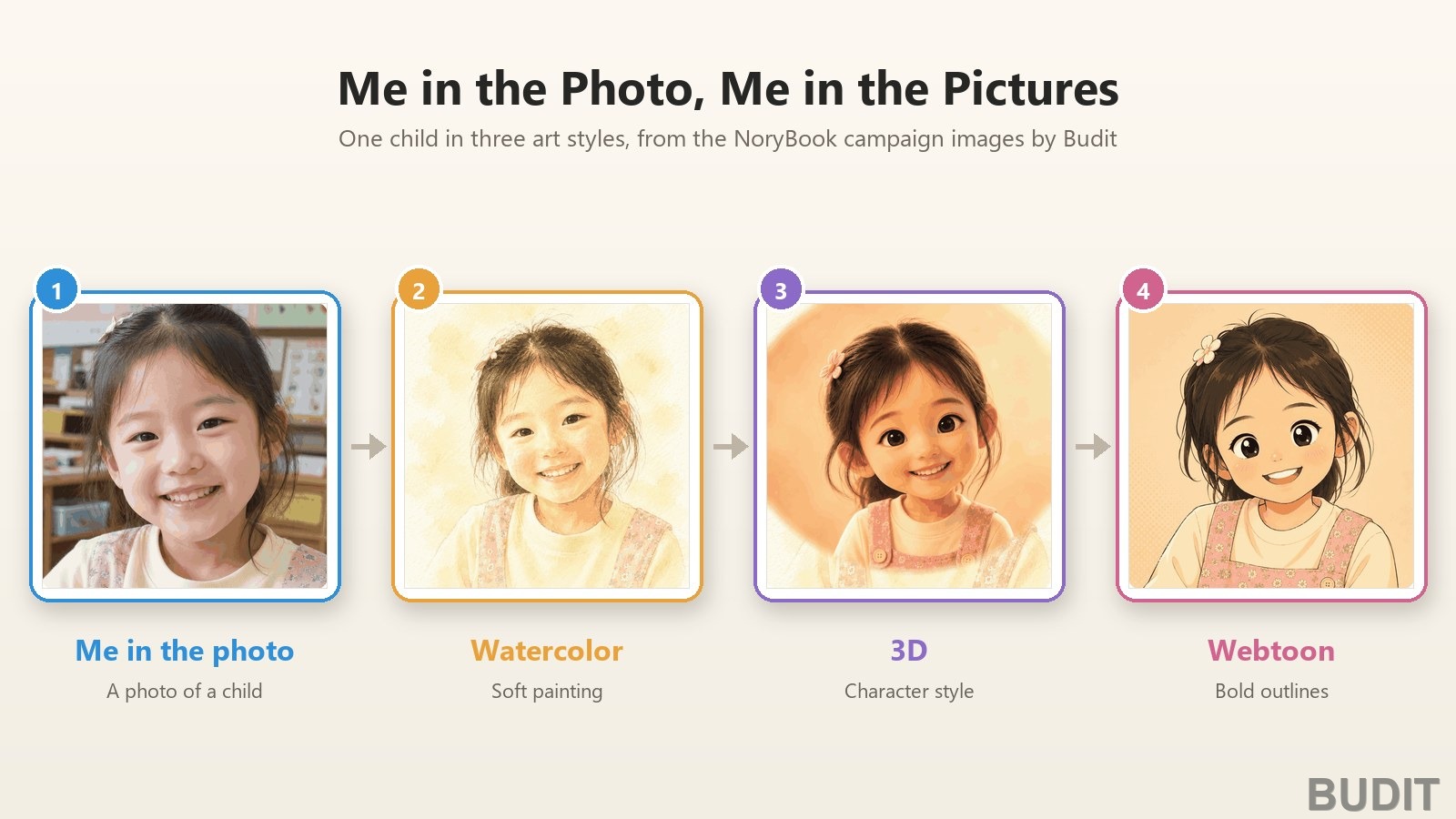
One photo is drawn in watercolor, 3D and webtoon styles. As in the image at the top, from the NoryBook campaign images by Budit, you can set the child in the photo beside the drawn versions and play 『find me』.
- 『Me in the photo』: start with one photo of your child. You can upload one on the NoryBook demo.
- 『Watercolor』: the same child appears in a soft watercolor style.
- 『3D』: choose the 3D style and the same child becomes a 3D character.
- 『Webtoon』: the webtoon style draws the same child with bold outlines. Put the three versions side by side and make the faces together with your child.
References
- Amsterdam, B. (1972). Mirror self-image reactions before age two. View on Google Scholar
- Lewis, M. and Brooks-Gunn, J. (1979). Social Cognition and the Acquisition of Self. View on Google Scholar
- Povinelli, D. J., Landau, K. R. and Perilloux, H. K. (1996). Self-recognition in young children using delayed versus live feedback: Evidence of a developmental asynchrony. View on Google Scholar
- Rochat, P. (2003). Five levels of self-awareness as they unfold early in life. View on Google Scholar
This article shares general information about child development and education. Every child grows at their own pace. For specific concerns, please talk with a pediatrician or a child development specialist.