
Why Children Learn Better as the Hero
Even in a noisy room, your name jumps out when someone says it. We are especially alert to anything about 『me』, and children are no different.
What relates to me is easier to remember
The 『self reference effect』 is the finding that people remember information better when they connect it to themselves. In a classic study with adults, words that people judged for whether they 『described me』 were remembered better than words they judged for meaning (Rogers et al., 1977).
Young children show the effect too. In one study, 64 children aged four to six worked in pairs, sorting pictures of toys into 『mine』 and 『my partner's』. In a surprise memory test later, they recognized the toys that had been assigned to them more often, and this difference was larger in the younger children (Cunningham et al., 2013).
Learning materials where your child is the hero
『Personalized learning materials』 put this idea to use. In one study, 18 children with an average age of three years and ten months heard a picture book twice, a week apart. Some sections of the book were personalized for each child and some were not, and the children learned the new words from the personalized sections better (Kucirkova et al., 2014).
Ideas to try at home
- When teaching a new word, tie it to your child's own life, as in 『the apple you love』.
- When reading a picture book, swap the hero's name for your child's name.
- Make a small word book about your child's day, using photos of your child.
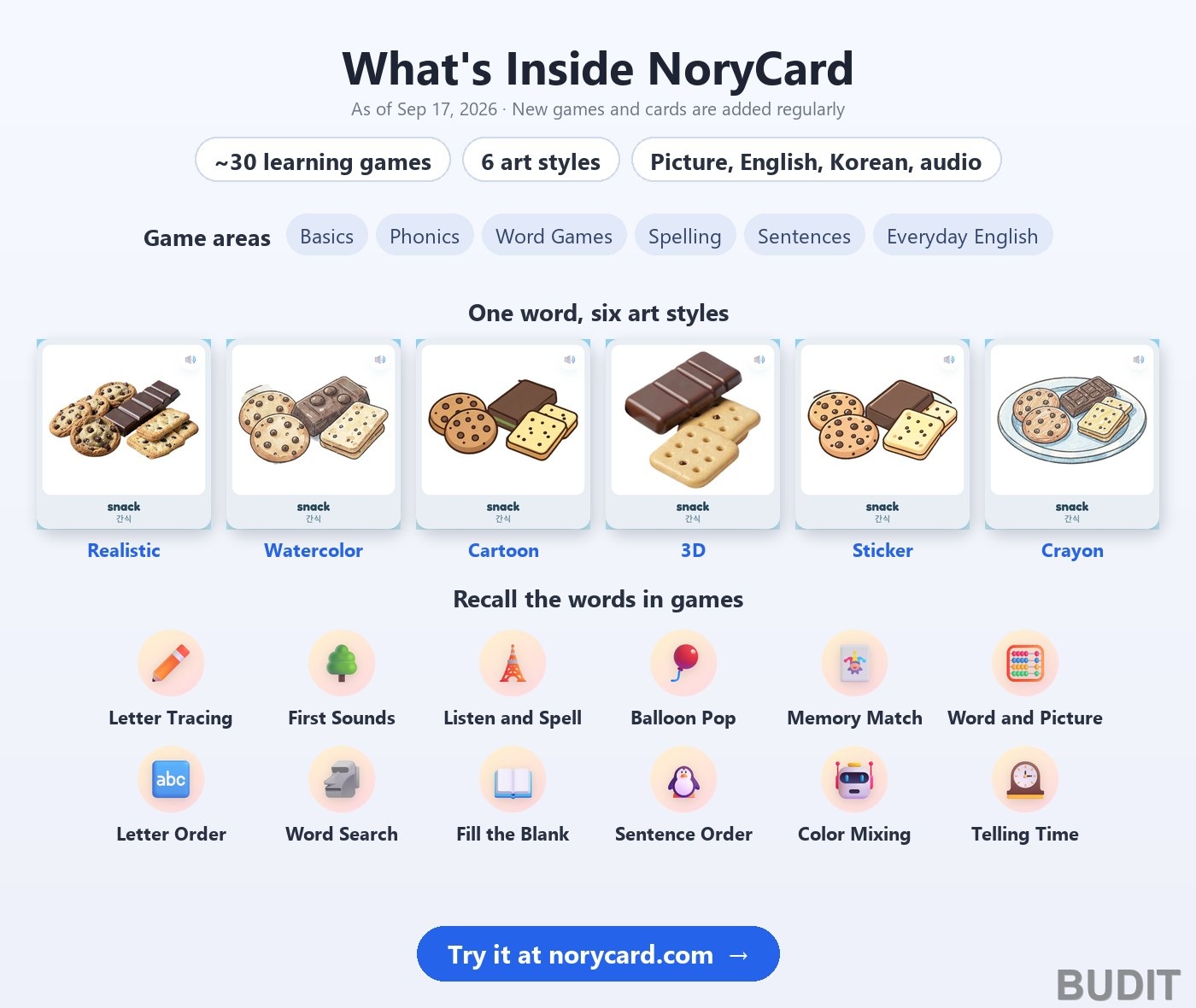
Photo: what's inside 『NoryCard』 by Budit (as of Sep 17, 2026). Around 30 learning games cover basics, phonics, words, spelling, sentences and everyday English, and every word card comes in six art styles. See all NoryCard games
Worth watching
Video: EBS Docuprime 『The Private Life of Children』 Part 3, Self Esteem (official YouTube channel, Korean). It compares children with high and low self esteem across a range of tasks.
How this continues in Budit
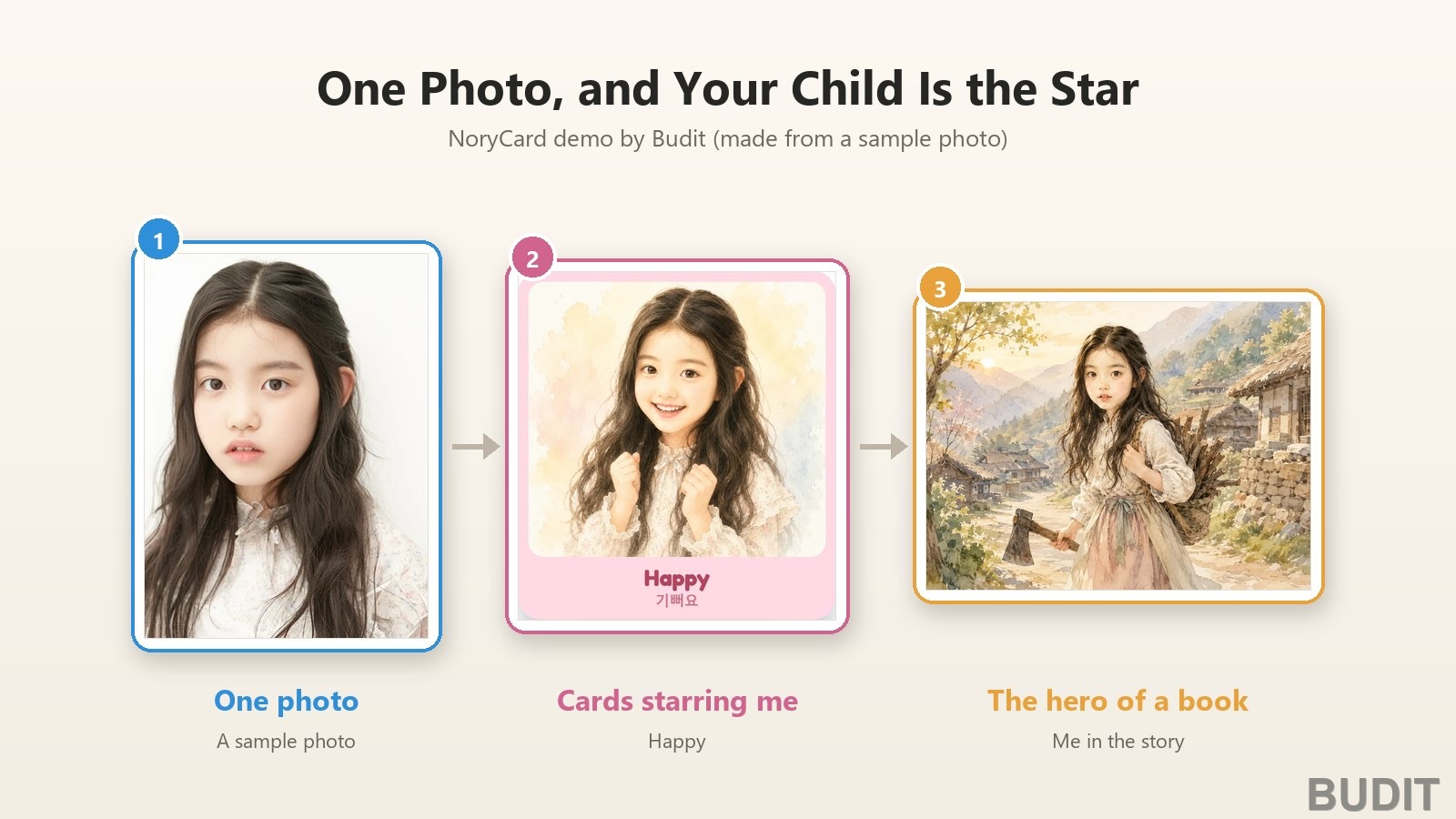
The 『NoryCard』 demo shows word cards made from a single sample photo, along with a 『NoryBook』 picture book starring the same child. The image at the top comes from this demo.
- 『One photo』: the NoryCard demo shows results made from a sample photo, with no login needed.
- 『Cards starring me』: on the same page, flip through cards like 『Happy』 in watercolor, 3D and sticker styles.
- 『The hero of a book』: in the 『NoryBook』 section of the same page, tap 『Open the book』 to read a picture book starring the same child.
References
- Rogers, T. B., Kuiper, N. A. and Kirker, W. S. (1977). Self-reference and the encoding of personal information. View on Google Scholar
- Cunningham, S. J. et al. (2013). Exploring early self-referential memory effects through ownership. View on Google Scholar
- Kucirkova, N., Messer, D. and Sheehy, K. (2014). Reading personalized books with preschool children enhances their word acquisition. View on Google Scholar
This article shares general information about child development and education. Every child grows at their own pace. For specific concerns, please talk with a pediatrician or a child development specialist.