


When a Child Refuses English
Some children ask you to turn off an English video, and ask for the Korean version the moment an English book comes out. This refusal is less about disliking English than about pulling back from something unfamiliar, and pushing makes it harder. The research points the other way: let the child choose, leave nothing to get wrong, and keep it short.
At a glance
| Question | What the research says |
|---|---|
| Is refusing English unusual | A period of weeks or months of not speaking a new language is common |
| Should I make them do it anyway | Children under pressure lost interest and forgot what they learned faster |
| What should change | Children given a choice kept going longer and learned more |
| Are more options better | Two to four options worked best, and the effect was larger for children than adults |
| So | Choose instead of push, nothing to get wrong, five minutes |
Refusal is a common signal
A researcher who followed children entering a preschool that used a new language wrote that many of them went through a period of weeks or months without speaking it (Tabors, 1997). The children were not doing nothing in that time. They listened, watched and rehearsed under their breath. Language acquisition research describes anxiety and low motivation as a wall that blocks incoming language, and calls it the 『affective filter』 (Krashen, 1982).
『I hate English』 is less a matter of ability than a sign that this wall is up. Lowering the wall comes first, and that means handing the child a handle rather than pushing from behind.
Forcing it makes it worse
In one experiment, schoolchildren were given a passage to read. One group was told 『you will be tested on it』, the other read it without that pressure. The pressured children recalled about as much right away, but understood the content less deeply, found the passage less interesting, and a week later had lost more of what they remembered (Grolnick and Ryan, 1987). The children in that study were around ten, but the finding that learning turns shallow when the sense of doing it yourself disappears repeats across self determination research (Deci and Ryan, 2000).
That is why 『just one more』 and 『finish this and then you can play』 rarely work on a child refusing English. They may get you through the moment, but they fix English in place as something the child is made to do.
Choice changes things
In an experiment where schoolchildren learned math on a computer, the group whose problems included their own name and favorite things (personalization) and who got to choose small things like their character and its name (choice) kept going longer, learned more, and chose harder problems on their own than the group that got the same content plain (Cordova and Lepper, 1996). A meta analysis of 41 experiments on choice found that being able to choose raised intrinsic motivation, effort and achievement, and that the effect was strongest with two to four options, and larger for children than for adults (Patall et al., 2008).
The choice does not have to be a big one. Which book to read, who reads it, which art style to see it in. 『Do you want to do English or not?』 is not a choice. 『This book or that one?』 is.
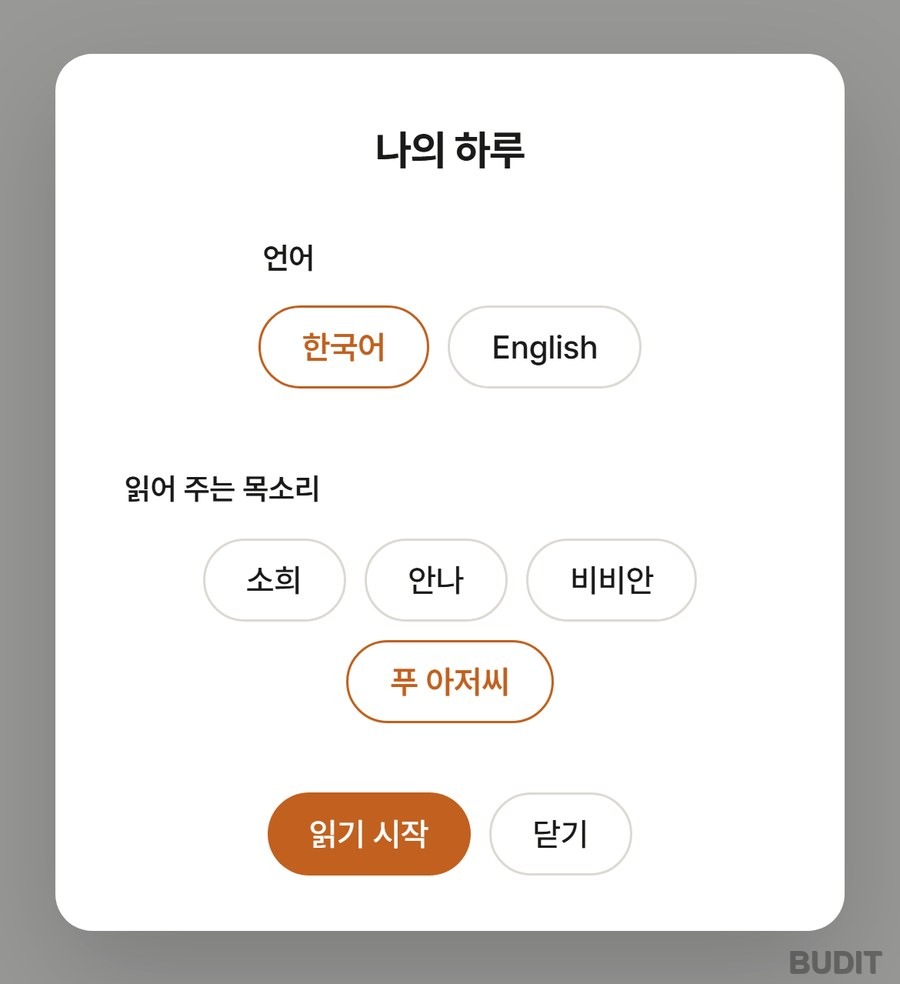
Photo: the start panel of the 『NoryBook』 picture book 『My Day』 (as of Oct 16, 2026, Korean interface shown). The child chooses the language and the reading voice. Books registered with a coupon also let the child choose the main character and the art style. Open the book
Nothing to get wrong, and short
The first English to come back to a refusing child should have no right answer. There is no way to get it wrong when you tap an object in a picture and hear its sound. The child does not have to repeat it. A child in the silent period is already working by listening. And stop while the child still wants more. Why to start with play and end with play is in our earlier article Play Is Learning.
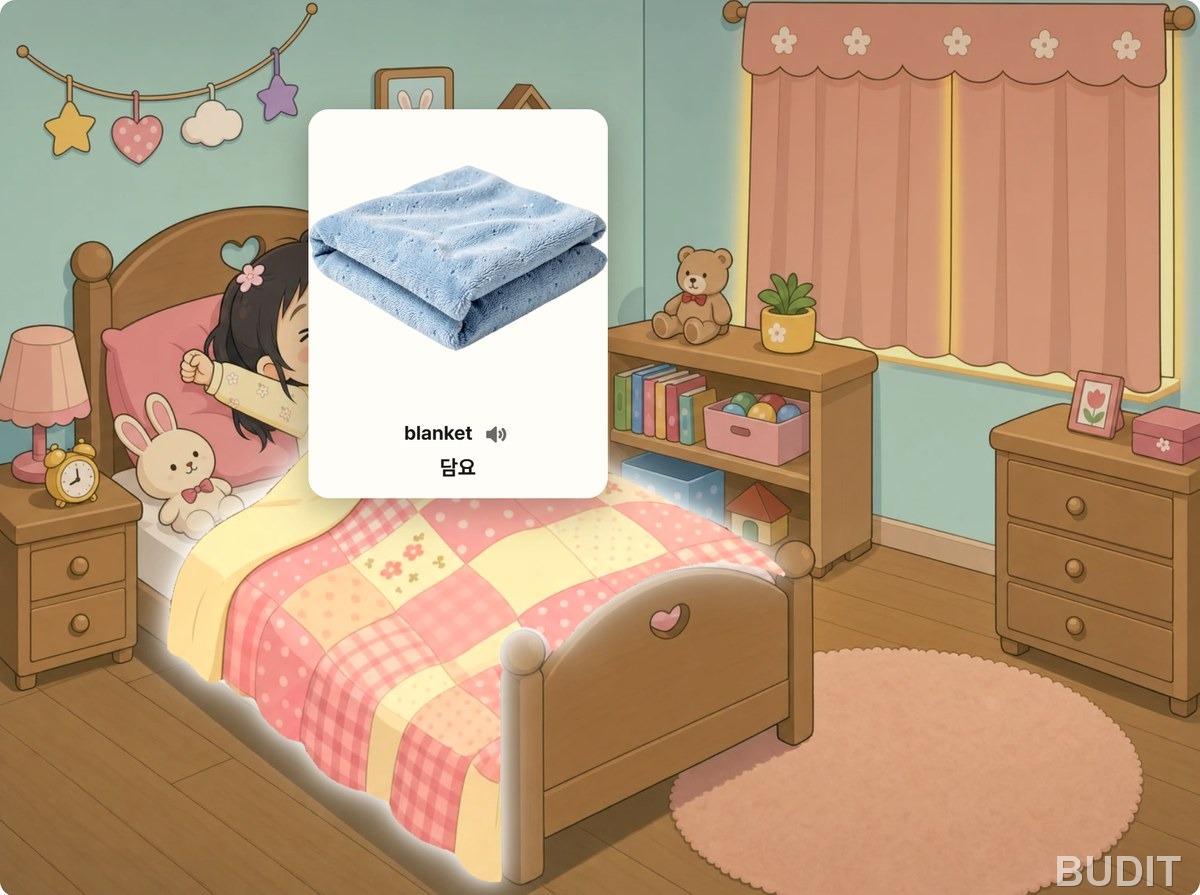
Photo: the word card that appears after tapping the blanket in 『My Day』 (as of Oct 16, 2026). No right answer, so nothing to get wrong. How it works is in Tap the Picture, Collect the Word Cards.
What to do at home
- Offer a choice of two. Instead of 『Shall we read an English book?』, ask 『『My Day』 or 『Animal Friends』?』. Let the child pick the reading voice too. Do not put 『nothing』 on the menu, and make sure both options hold a little English.
- Make the first English to come back something with no right answer. Tapping objects in a picture or one song is enough. Do not ask the child to repeat.
- Read in your own language and add one English word. 『This one is called blanket』, and move on. If the child takes it, add one more. If not, that is enough for the day.
- Five minutes is enough. Stop while the child wants more and come back tomorrow. When the adult is the one who ends it, starting the next day gets easier.
- Use a book in which the child is the hero. Even a child who refuses reaches for a book with their own name and face in it. Why is in our earlier article Why Children Learn Better as the Hero.
- If the refusal lasts for months, step back. Have days with no English, and move English over to whatever the child is into right now, dinosaurs or cars. The way back runs through what the child loves.

Photo: 『NoryBook』 Wadiz introduction material (as of Oct 16, 2026). A webtoon style main character made from one photo of a child. Even a child who refuses reaches for a book with their own face in it. Open NoryBook
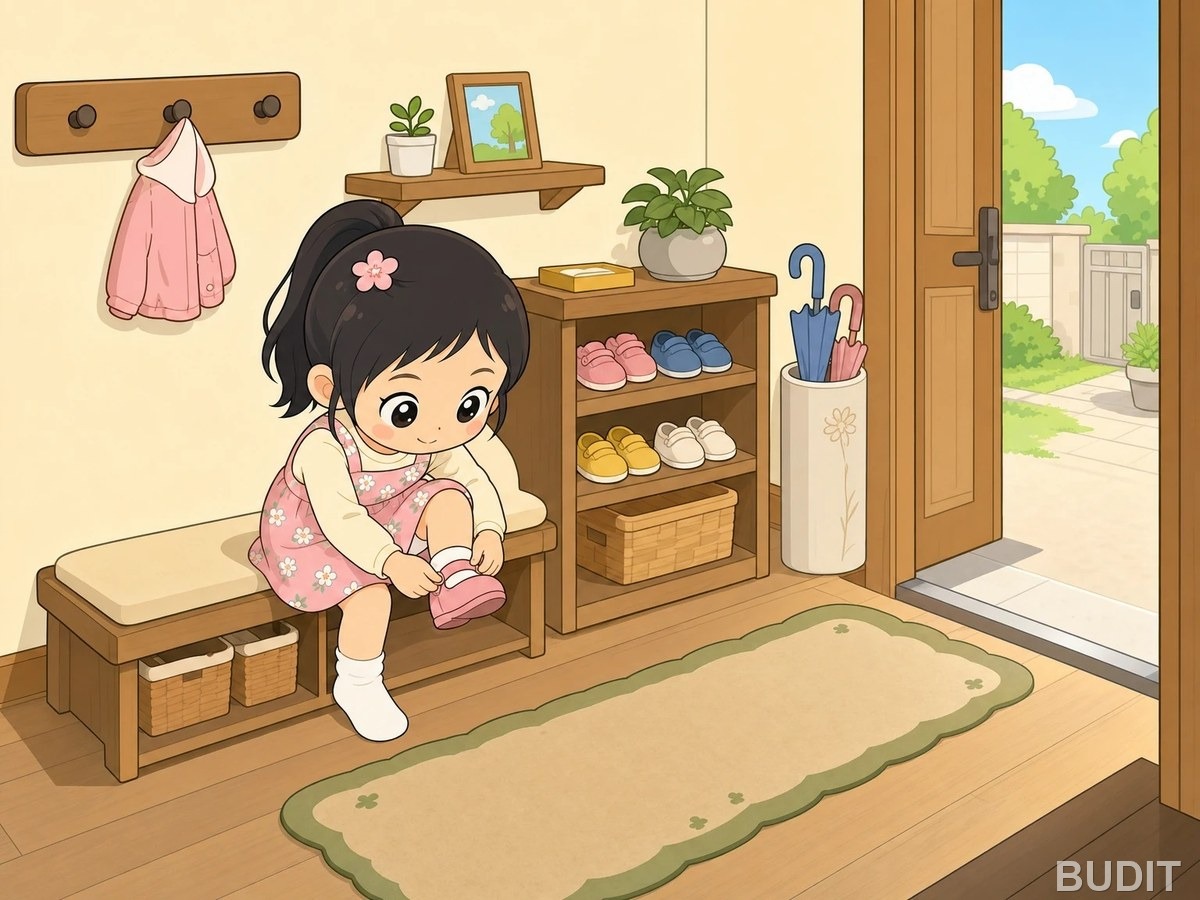
Photo: the getting ready to go out scene from 『My Day』 (as of Oct 16, 2026). Shoes are more fun when you put them on yourself, and English starts best with what the child chose. Open the book
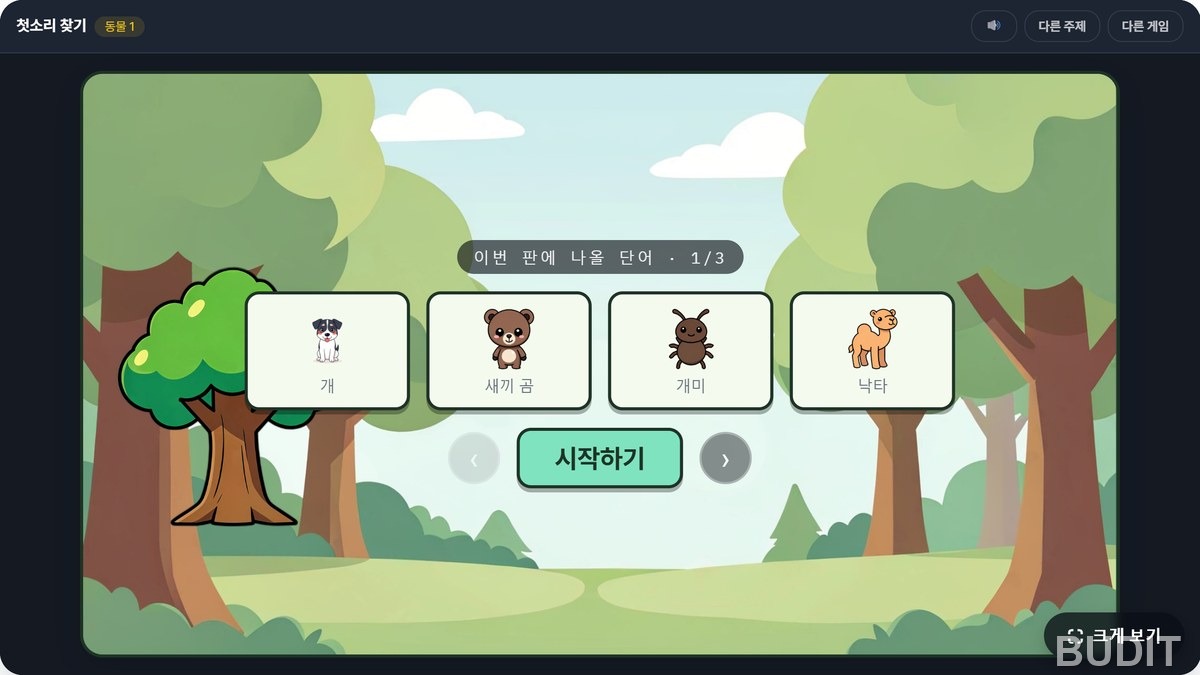
Photo: the 『NoryCard』 『Find the First Sound』 game (as of Oct 16, 2026). Before a round starts it shows the words coming up with their pictures, then you press 『Start』. One round is five minutes. Open the game
Questions people ask
My child listens but will not say a word A period of holding back speech in front of a new language is common and can last months. Do not press for words. Leave only listening, tapping and choosing. Speech comes when the child is ready.
My child wants to quit the English academy or English kindergarten Listen for what exactly the child dislikes, in their own words. The teacher, getting things wrong, or sitting still for a long time each call for a different answer. Often it is not English itself but something about that place.
The older one loves it, the younger one refuses Comparisons raise the wall. Give the younger child something of their own to choose. Even with the same book as the older sibling, let the younger one pick the voice and the page.
I offered a choice and they keep choosing 『no』 Keep 『no』 off the menu. Offer two options that both hold a little English, such as 『this book or that one』, or 『Mom's voice or Dad's voice』.
How this continues in Budit
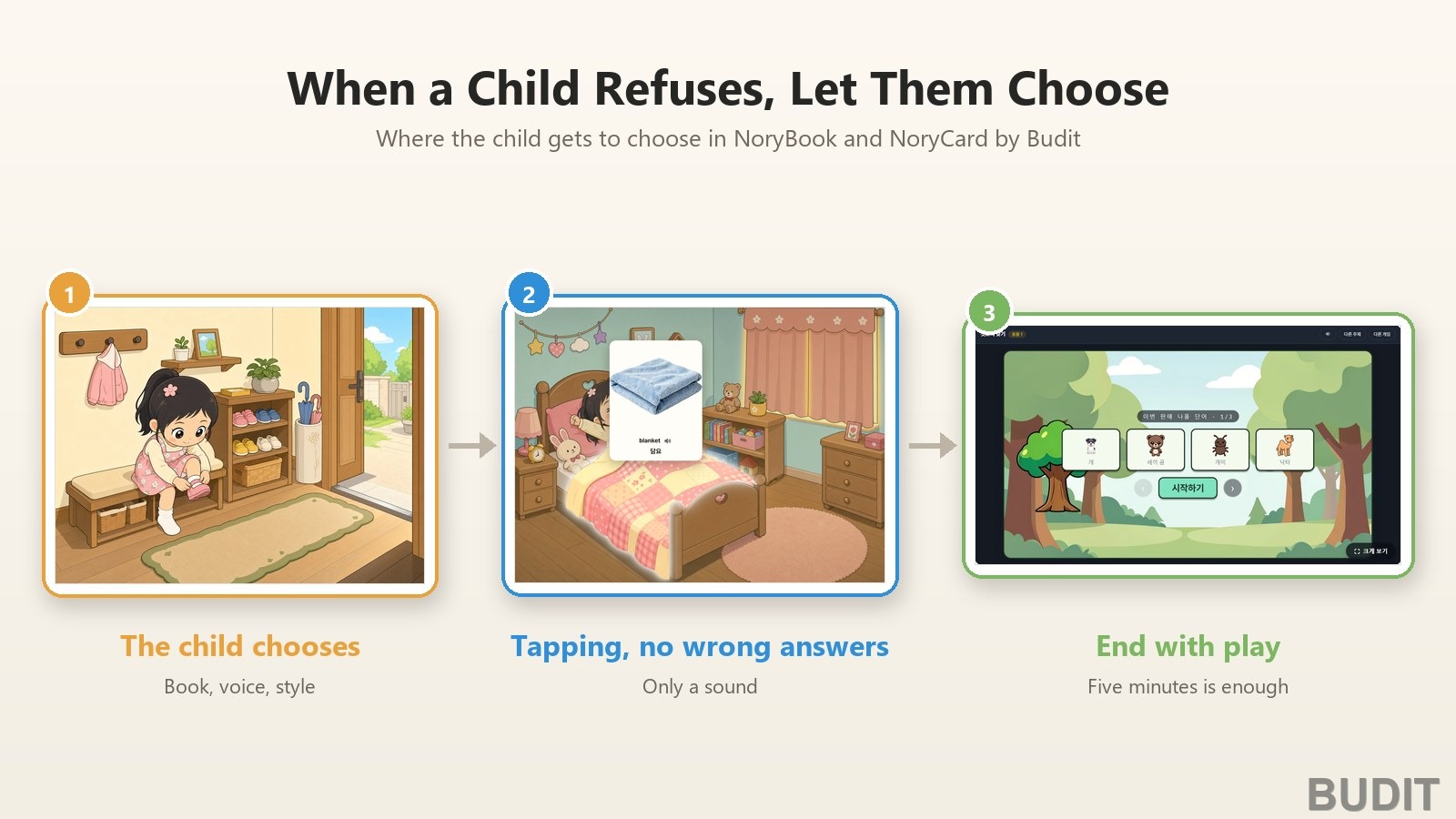
The three steps in the image at the top are the order for working through refusal.
- 『The child chooses』: on the start panel of My Day, the child picks the language and the reading voice. Books registered with a coupon also let them pick the main character and the art style.
- 『Tapping, no wrong answers』: tapping an object in the picture brings up a word card and its sound. English that cannot be gotten wrong.
- 『End with play』: finish with one round of a NoryCard game. Five minutes is enough.
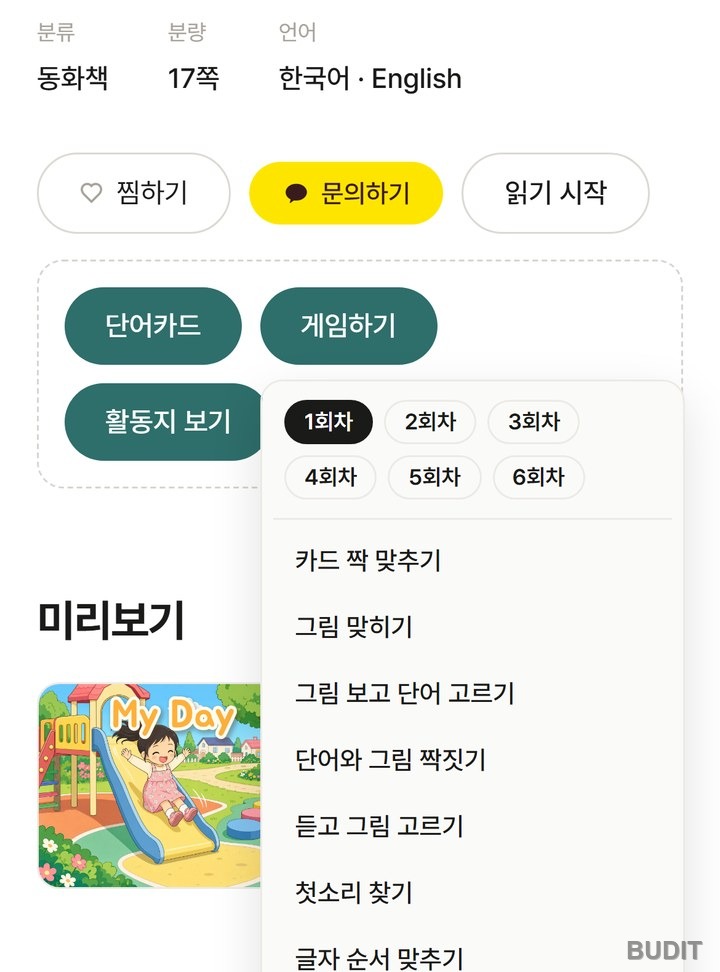
Photo: the 『Play games』 menu on the 『My Day』 book page (as of Oct 16, 2026, Korean interface shown). Letting the child pick the session and the game is a choice too. Open the book page
References
- Tabors, P. O. (1997). One child, two languages: A guide for preschool educators of children learning English as a second language. View on Google Scholar
- Krashen, S. D. (1982). Principles and practice in second language acquisition. View on Google Scholar
- Grolnick, W. S. and Ryan, R. M. (1987). Autonomy in children's learning: An experimental and individual difference investigation. View on Google Scholar
- Deci, E. L. and Ryan, R. M. (2000). The "what" and "why" of goal pursuits: Human needs and the self-determination of behavior. View on Google Scholar
- Cordova, D. I. and Lepper, M. R. (1996). Intrinsic motivation and the process of learning: Beneficial effects of contextualization, personalization, and choice. View on Google Scholar
- Patall, E. A., Cooper, H. and Robinson, J. C. (2008). The effects of choice on intrinsic motivation and related outcomes: A meta-analysis of research findings. View on Google Scholar
This article shares general information about development and education. Every child grows at their own pace. For specific concerns, please consult a pediatrician or a development specialist.