When Should a Child Start Learning English
『Start early or it will be too late』 is an easy thing to panic about. Put the research together and the answer looks different. How often and in what way a child meets the language matters more than the age they begin.
At a glance
| Question | What the research says |
|---|---|
| How long can grammar be learned | The ability holds up into the late teens |
| For native level grammar | Starting around age 10 is an advantage |
| Does an earlier start mean faster progress | In a classroom, later starters move faster |
| So is an early start useless | For sound and pronunciation, early exposure helps |
| What matters most | Not the starting age, but the amount and the regularity |
Grammar stays open longer than people expect
A study drawing on data from 669,498 English speakers found that the ability to learn grammar remains high until around age seventeen, then declines. The same study found that reaching grammar indistinguishable from a native speaker's requires starting at roughly age ten (Hartshorne et al., 2018).
Both halves matter. English can be learned at thirty. But if the goal is grammar that no one can tell apart from a native speaker's, the early primary years are a reasonable line to work back from.
In a classroom, older children move faster
One project compared children who began English at eight with children who began at eleven, after the same number of instruction hours. The result ran against what many parents expect: the later starters scored higher on most measures (Muñoz, 2006).
The reason is plain. An older child understands a rule from an explanation, borrows concepts already built in their first language, and can concentrate on purpose. Young children do absorb language remarkably well, but that is a description of being surrounded by it all day. Two or three hours of class a week does not create those conditions.
What early exposure really buys
Sound. Infants begin able to distinguish the speech sounds of every language, and around their first birthday they start losing the distinctions their native language does not use. A child who hears English sounds early and often holds those distinctions longer. That is where an early start genuinely pays, in listening and pronunciation. When listening begins is covered in our earlier article When to Start Reading Aloud.
So: build sound first, and add letters and rules when the child is ready. Reversing that order costs effort and leaves little behind.
Not at the expense of the first language
If starting English early means less time thinking and talking in Korean, that is a loss. Vocabulary grows by the same principles in both languages, and the concepts built in a first language are reused when learning a second. How vocabulary grows is covered in our earlier article Why Start Children's English with Everyday Words.
What to do at each age
- Birth to 3. The goal is familiarity. Let English songs and short picture books be part of the household soundscape. No teaching required.
- Ages 4 to 6. Link sound to picture. Point at things and name them, and read the same book many times. Start letters when the child shows interest.
- Ages 7 to 9. Link sound to letter. A good window for phonics, and for reading and writing short sentences.
- Age 10 and up. Explanations work now. Learn rules, read longer texts. Starting here is not late.
Whatever the age, one condition is shared: meeting the language often, even briefly. Ten minutes a day beats two hours crammed into a weekend.
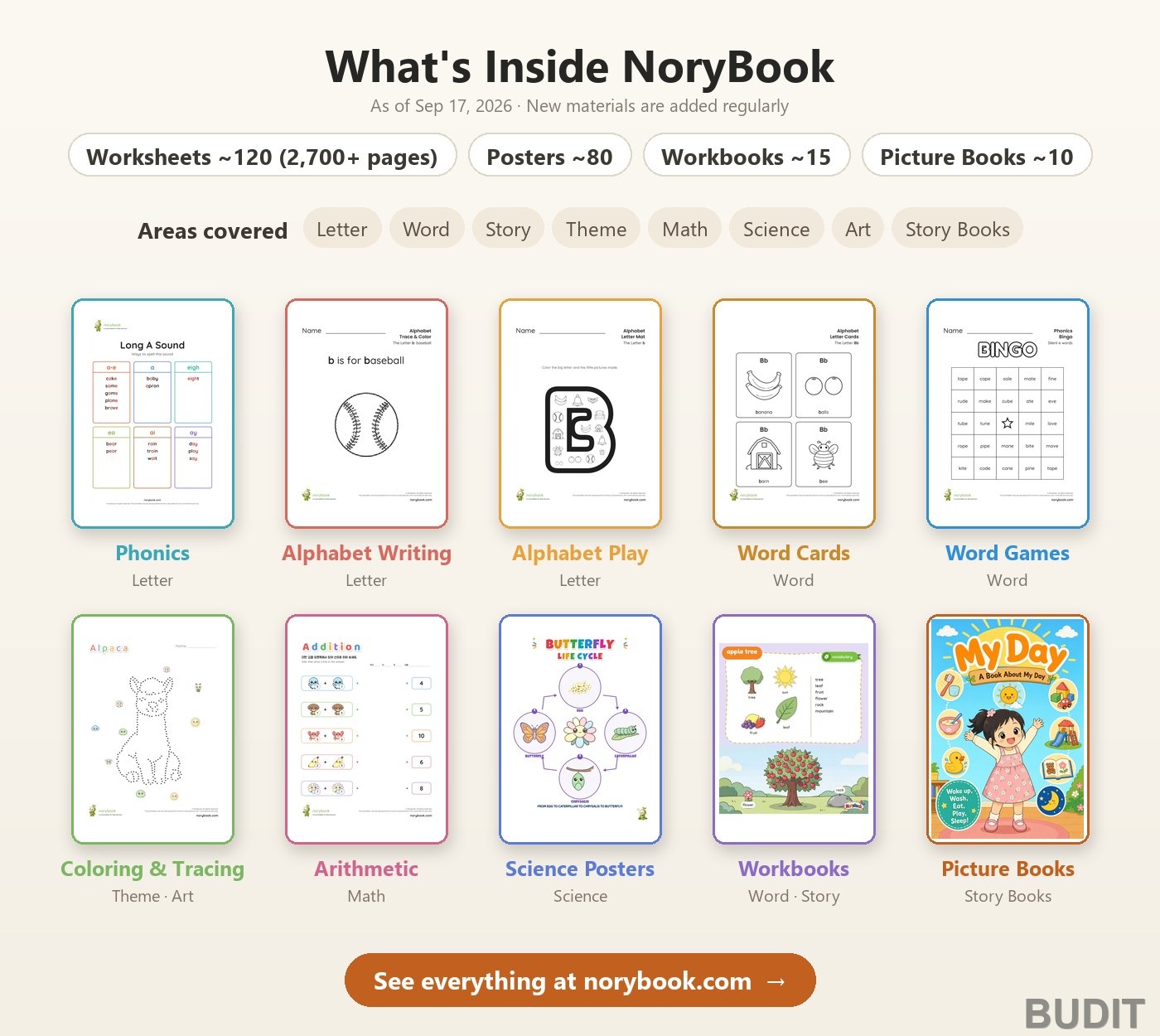
Photo: the 『NoryBook』 collection by Budit (as of Sep 17, 2026). Around 120 worksheets plus posters, workbooks and picture books cover letters, words, stories, themes, math, science and art, and new materials keep coming. See everything at norybook.com
Questions people ask
My child is five and has not started. Is it too late No. Grammar stays learnable into the late teens, and even aiming at native level, around age ten is the line. Starting now and keeping it up beats rushing.
Do we need an English immersion kindergarten A full day surrounded by English is a genuine advantage in sheer exposure. The same money and time spent in small daily doses at home is also a path. What counts is not the label on the environment but the hours actually spent with the language.
My child's Korean seems behind. Should we still do English If English is cutting into the time spent exchanging thoughts in Korean, change the order. Concepts built in a first language are reused when learning a second.
How much per day The younger the child, the more it should be short and frequent. Ten to fifteen minutes a day for preschoolers, twenty to thirty for primary age, done daily, is enough.
How this continues in Budit
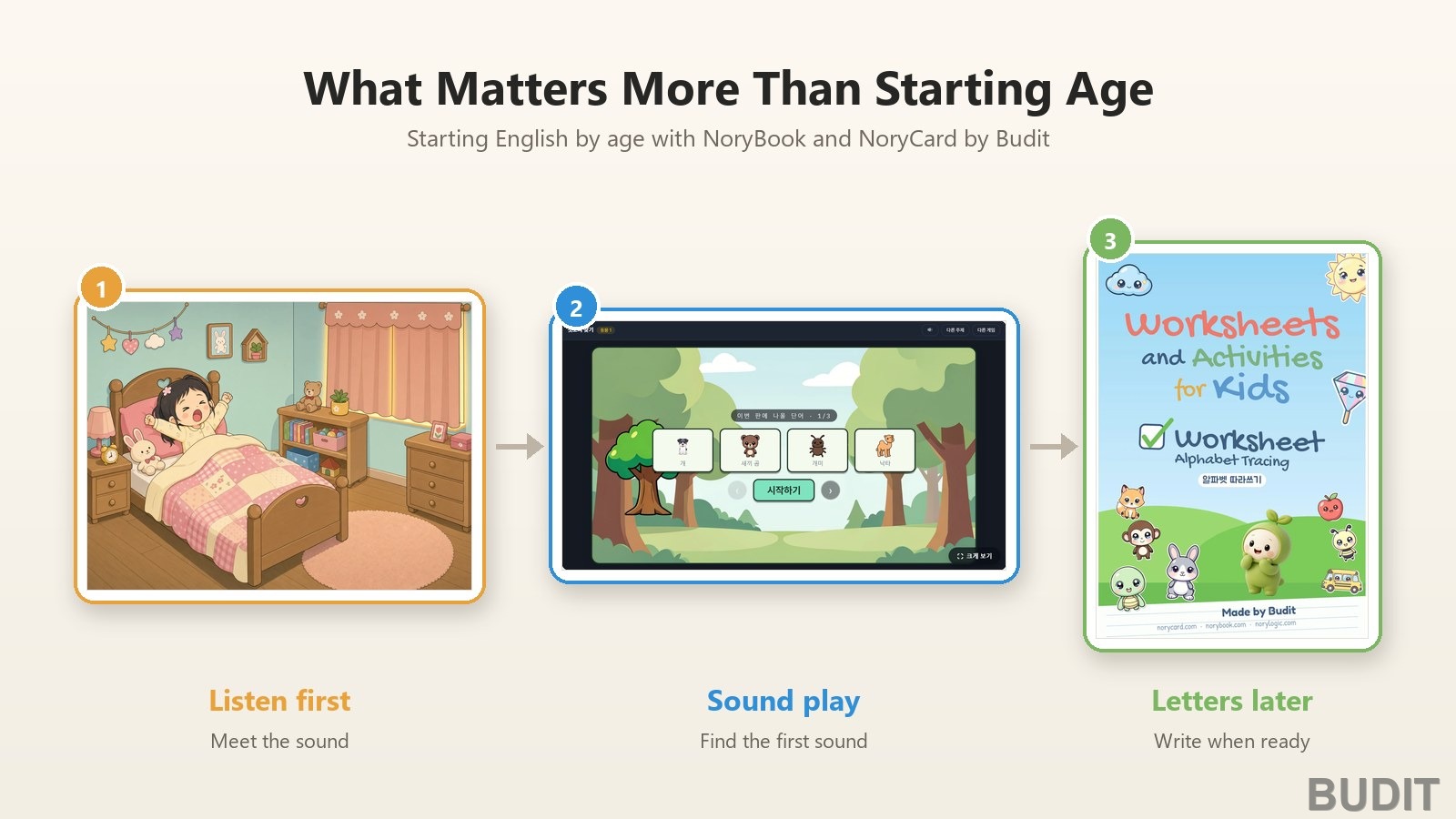
The three steps in the image at the top hold the whole argument.
- 『Listen first』: read My Day with the audio on. The scenes are a child's own day, so the words attach easily.
- 『Sound play』: play with sounds, as in 『첫소리 찾기』 (find the first sound) among the NoryCard games. No letters needed.
- 『Letters later』: when the child shows interest in letters, move to Alphabet Tracing.
Visit NoryBook · Open the NoryCard games
References
- Hartshorne, J. K., Tenenbaum, J. B. and Pinker, S. (2018). A critical period for second language acquisition: Evidence from 2/3 million English speakers. View on Google Scholar
- Muñoz, C. (2006). Age and the Rate of Foreign Language Learning. View on Google Scholar
- Johnson, J. S. and Newport, E. L. (1989). Critical period effects in second language learning. View on Google Scholar
- Werker, J. F. and Tees, R. C. (1984). Cross-language speech perception: Evidence for perceptual reorganization during the first year of life. View on Google Scholar
This article shares general information about development and education. Every child grows at their own pace. For specific concerns, please consult a pediatrician or a development specialist.