


A Child's Brain Grows at Their Fingertips
"My child is still so young. Do they really need a pencil already?" Many parents ask this. The answer is not about the pencil. It is about the 『fingertips』.
Hands and brains grow together
『Fine motor skills』 are the ability to control the small muscles of the fingers and wrists. Cutting with scissors, stacking blocks, coloring and tracing lines all belong here. The brain devotes an unusually large area to the hands, so activities that use the fingertips wake up a correspondingly large part of the brain.
Cognitive psychology has repeatedly confirmed this link. A well known large scale study found that fine motor ability in kindergarten is one of the stronger predictors of later school achievement (Cameron et al., 2012). As fingertip control improves, 『executive functions』 such as attention and working memory tend to develop alongside it.
Fingertip activities you can start at home
| Around age | Activity examples |
|---|---|
| 2 to 3 | Large stickers, stacking blocks, finger painting |
| 3 to 4 | Tracing lines, coloring, tearing and gluing paper |
| 4 to 6 | Tracing dotted letters, scissor work, writing letters and numbers |
What matters most is sequence and fun. Short activities a child enjoys, done often, beat long activities done reluctantly.
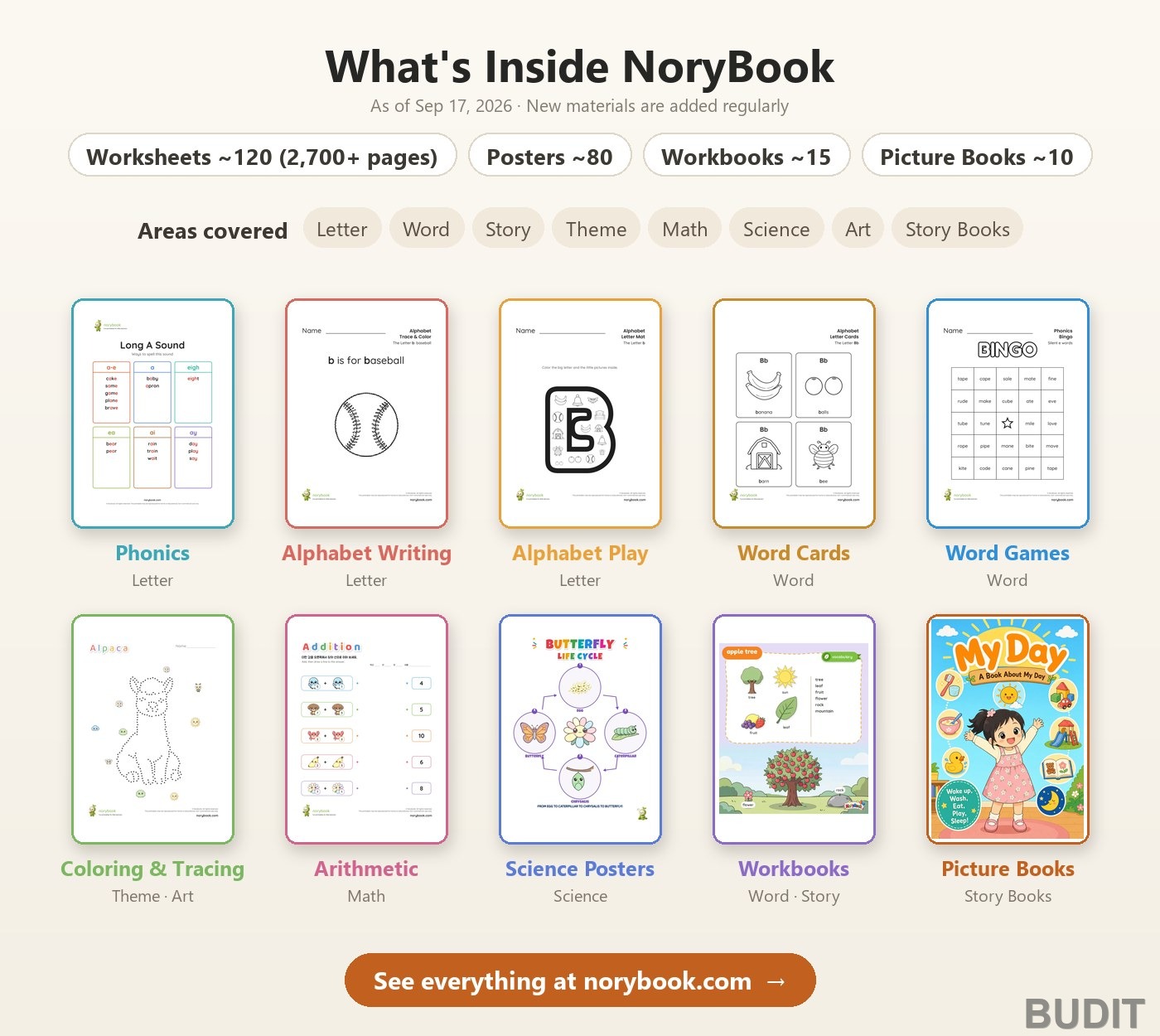
Photo: the 『NoryBook』 collection by Budit (as of Sep 17, 2026). Around 120 worksheets plus posters, workbooks and picture books cover letters, words, stories, themes, math, science and art, and new materials keep coming. See everything at norybook.com
Worth watching
Video: EBS Knowledge 『Why handwriting matters』 (official YouTube channel, Korean). Brain imaging shows how active the brain becomes while writing by hand.
More from EBS: EBS Parenting School replays · EBS Kids on YouTube
How this continues in Budit
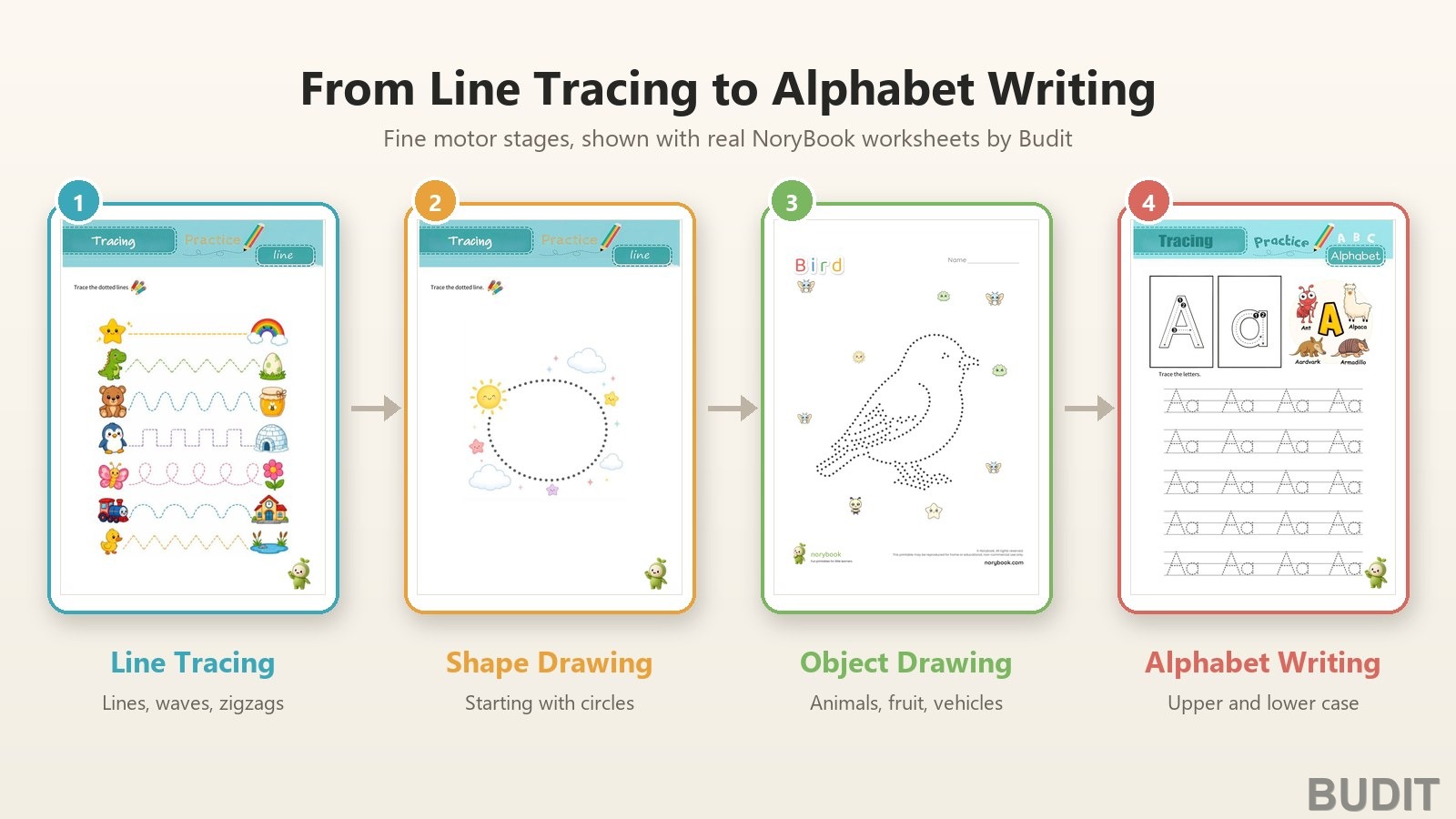
Budit's 『NoryBook』 offers printable worksheets matched to fine motor stages. The four stages in the image at the top are all real materials, ready to print at home.
- 『Line Tracing』: trace straight lines, waves and zigzags in Line Tracing.
- 『Shape Drawing』: pages in the same set trace circles and triangles.
- 『Object Drawing』: complete animals and objects along dotted lines, as in Farm Animal Tracing.
- 『Alphabet Writing』: write upper and lower case letters with Alphabet Tracing.
References
- Cameron, C. E. et al. (2012). Fine motor skills and executive function both contribute to kindergarten achievement. View on Google Scholar
- Grissmer, D. et al. (2010). Fine motor skills and early comprehension of the world. View on Google Scholar
This article shares general information about development and education. Every child grows at their own pace. For specific concerns, please consult a pediatrician or a development specialist.