


A Parent's Voice Is Special
Babies only a few days old can already tell their mother's voice from a stranger's. It is a voice they have been hearing since before they were born.
Newborns choose their mother's voice
In a classic study, babies less than three days old were given a pacifier set up so that one way of sucking played their mother's voice and another way played the voice of a woman they did not know. The babies learned to suck in the way that brought up their mother's voice, and they listened to it more often (DeCasper and Fifer, 1980). Long before they can talk, babies tell their mother's voice apart and want to hear more of it.
That familiarity starts in the womb. When fetuses close to birth heard recordings of their mother and of an unfamiliar woman reading the same poem, their heart rate went up for their mother's voice and down for the stranger's (Kisilevsky et al., 2003). In a study that recorded the brain activity of babies about a day old, their brains also responded differently to their mother's voice than to a stranger's (Beauchemin et al., 2011).
Fathers, start talking early and often
Newborns did not clearly prefer their father's voice over another man's (DeCasper and Prescott, 1984). The voice a baby hears most, and from closest, in the womb is the mother's. So fathers, talk to your baby up close and often, starting from birth.
A mother's voice still matters as children grow
In a brain imaging study of children aged 7 to 12, hearing their mother's voice activated not only areas that process sound but also areas involved in emotion, reward and recognizing faces. Children whose voice areas were more strongly connected to these areas also had stronger social communication skills (Abrams et al., 2016).
Using your voice at each stage
| Stage | What to try |
|---|---|
| Late pregnancy | Read a short story or sing aloud at about the same time each day |
| 0 to 3 months | Talk slowly with your face close to your baby's, letting your voice rise and fall |
| 3 to 6 months | Answer babbling as if you were taking turns in a conversation |
| 6 to 12 months | Read short picture books aloud and call your baby by name |
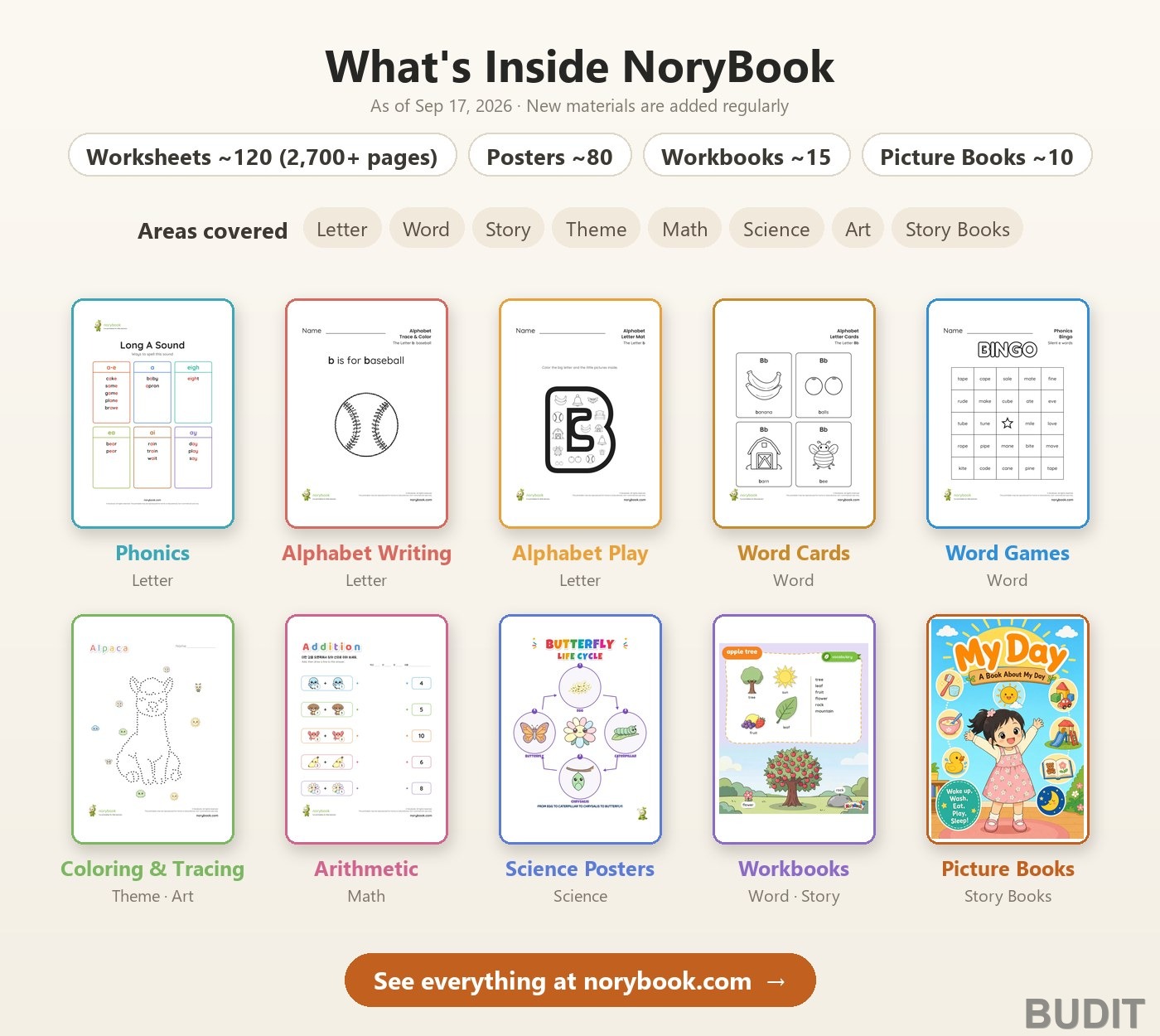
Photo: the 『NoryBook』 collection by Budit (as of Sep 17, 2026). Around 120 worksheets plus posters, workbooks and picture books cover letters, words, stories, themes, math, science and art, and new materials keep coming. See everything at norybook.com
Worth watching
Video: EBS 『News G』, 『Mom, sing me a lullaby』 (official YouTube channel, Korean). It walks through several studies on how lullabies and a mother's singing help babies.
How this continues in Budit
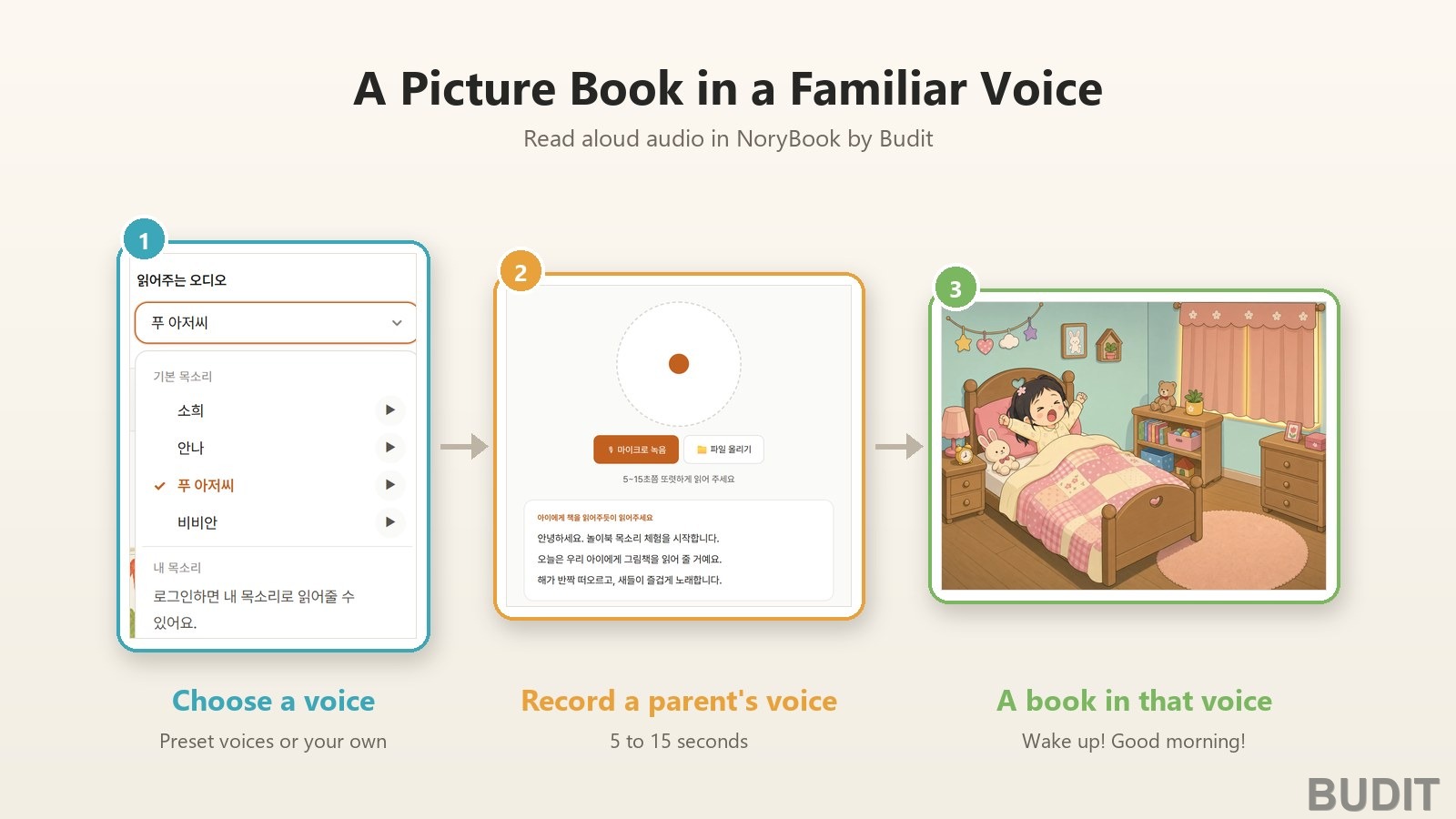
『NoryBook』 picture books let you choose the reading voice, and once you log in they can also read in a voice a parent has recorded. The three steps in the image at the top are real screens.
- 『Choose a voice』: on the My Day page, open 『읽어주는 오디오』 (reading audio) and pick one of the preset voices or 『내 목소리』 (my voice).
- 『Record a parent's voice』: in the voice demo, read the sample sentences aloud for about 5 to 15 seconds.
- 『A book in that voice』: open the reader, turn the pages and listen.
A recording cannot replace a parent talking to and holding their child. Think of it as a way to fill the times when you cannot be there.
References
- DeCasper, A. J. and Fifer, W. P. (1980). Of human bonding: Newborns prefer their mothers' voices. View on Google Scholar
- Kisilevsky, B. S. et al. (2003). Effects of experience on fetal voice recognition. View on Google Scholar
- Beauchemin, M. et al. (2011). Mother and stranger: An electrophysiological study of voice processing in newborns. View on Google Scholar
- DeCasper, A. J. and Prescott, P. A. (1984). Human newborns' perception of male voices: Preference, discrimination, and reinforcing value. View on Google Scholar
- Abrams, D. A. et al. (2016). Neural circuits underlying mother's voice perception predict social communication abilities in children. View on Google Scholar
This article shares general information about development and education. Every child grows at their own pace. For specific concerns, please consult a pediatrician or a development specialist.