

The Power of Coloring
Coloring is often seen as a way to pass the time. But while filling in a shape, a child is 『looking, planning and steering the hand』 all at the same time.
Eyes and hands working together
To stay inside the lines, a child has to watch the edge and adjust the movement of the hand to match. This ability to match what the eyes see with what the hand does is called 『visual motor integration』. Coloring, tracing and mazes all put it to work.
A study of children and teens aged 5 to 18 looked at two parts of this ability separately: 『visual motor coordination』, measured with tracing tasks, and 『visual spatial integration』, measured by copying shapes. After accounting for gender, family income, IQ and tracing ability, shape copying was still linked to achievement in math and writing (Carlson et al., 2013). So alongside coloring, it is worth having your child copy a simple picture now and then.
A calming moment
Quietly filling in a shape may also help a child settle down. In a study of 52 children with an average age of about 11, one group colored mandala patterns and another colored freely just before a test, and anxiety went down in both groups after coloring (Carsley et al., 2015). On a day when your child is wound up or upset, coloring a favorite picture together is one thing to try.
Making coloring time count
- Start with 『pictures with thick outlines』, then move on to thinner lines.
- While your child picks colors, ask questions like 『What color is an apple?』 to bring in new words.
- Write your child's name on the finished picture or hang it up, so it stays as 『something I made』.
- If the color goes past the line, praise the part that was colored instead of pointing out the mistake. Enjoyment comes first.
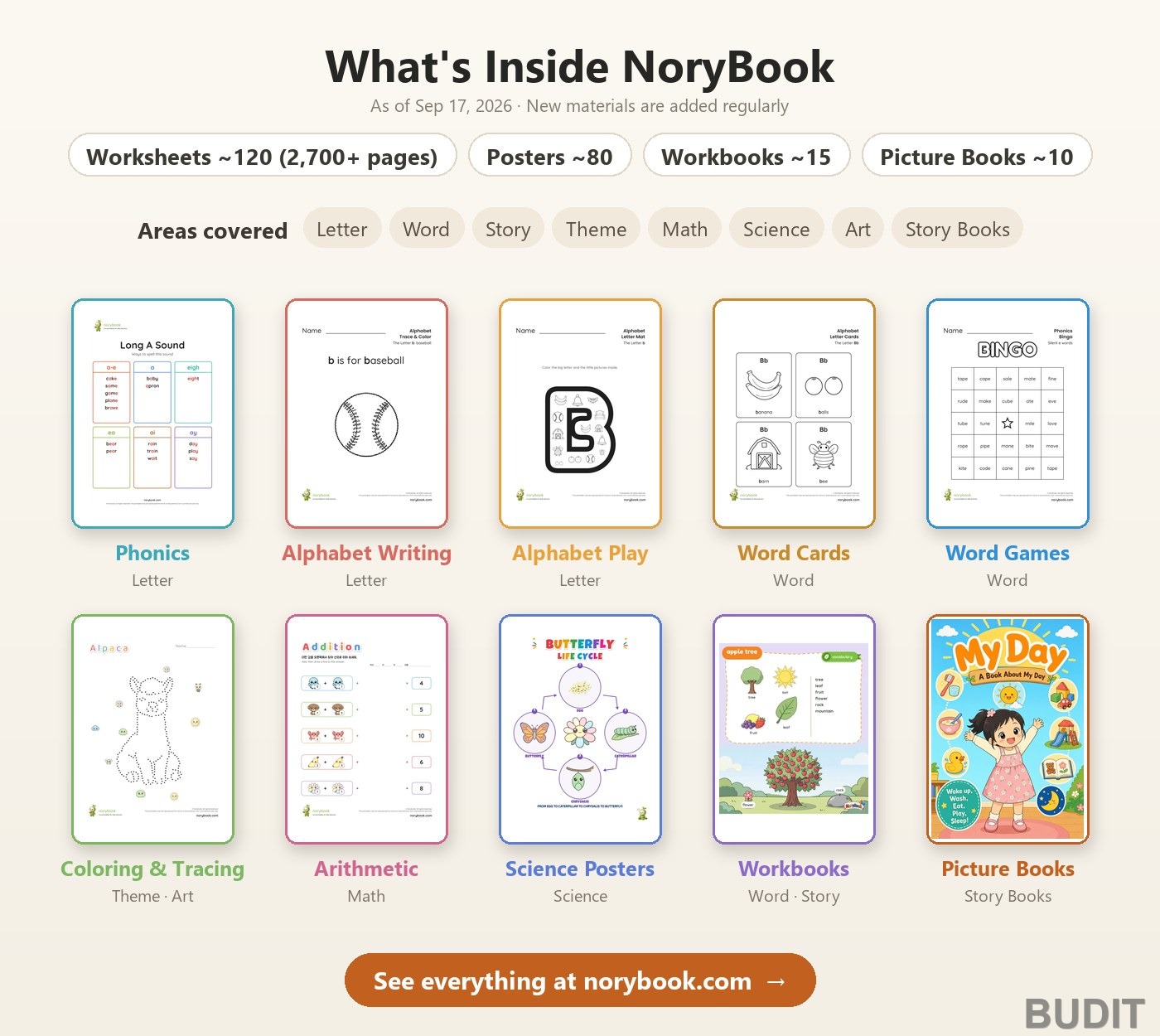
Photo: the 『NoryBook』 collection by Budit (as of Sep 17, 2026). Around 120 worksheets plus posters, workbooks and picture books cover letters, words, stories, themes, math, science and art, and new materials keep coming. See everything at norybook.com
Worth watching
Video: EBS 『Parents』, the episode on art play for a sharper mind (official YouTube channel, Korean). Part of a series on brain development and learning through the senses.
How this continues in Budit
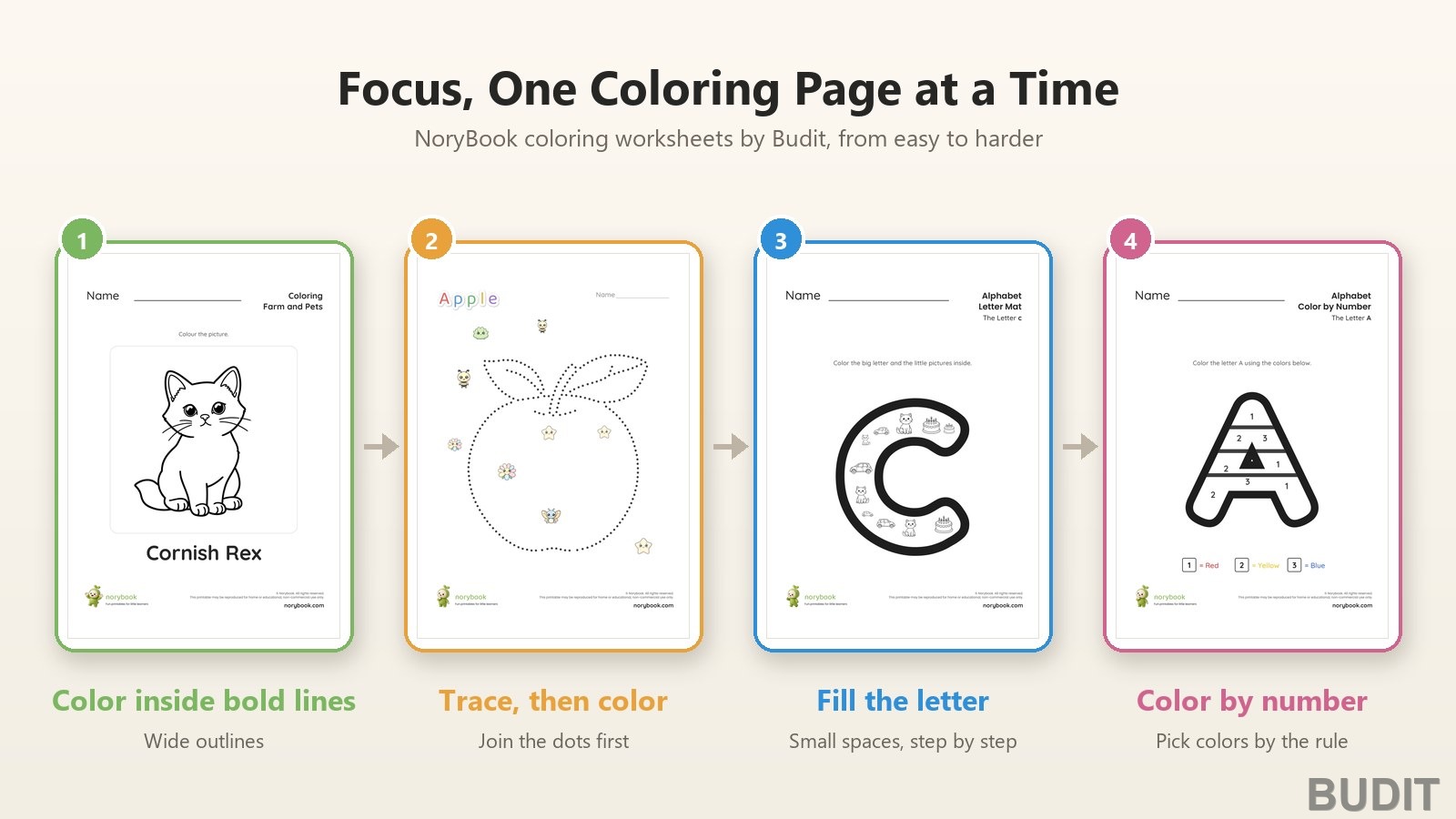
In the 『Coloring and Tracing』 worksheets on 『NoryBook』, pictures of animals, fruits and vegetables, food and vehicles are labeled with their English names, so children see new words while they color. The four stages in the image at the top are real materials, arranged from easy to harder.
- 『Color inside bold lines』: start with wide outlines, as in Farm Animal Coloring.
- 『Trace, then color』: trace the dotted lines first in Fruit and Vegetable Tracing, then add color.
- 『Fill the letter』: color the small pictures inside each big letter in Letter Fill Coloring.
- 『Color by number』: choose colors by the numbers in each space in Color by Number.
Browse Coloring and Tracing · See all NoryBook materials
References
- Carlson, A. G., Rowe, E. and Curby, T. W. (2013). Disentangling fine motor skills' relations to academic achievement: The relative contributions of visual-spatial integration and visual-motor coordination. View on Google Scholar
- Carsley, D., Heath, N. L. and Fajnerova, S. (2015). Effectiveness of a classroom mindfulness coloring activity for test anxiety in children. View on Google Scholar
This article shares general information about child development and education. Every child grows at their own pace. For specific concerns, please talk with a pediatrician or a child development specialist.